


 中文简体
2 × 15 L Commercial Slush Machine for High-Performance Foodservice Operations
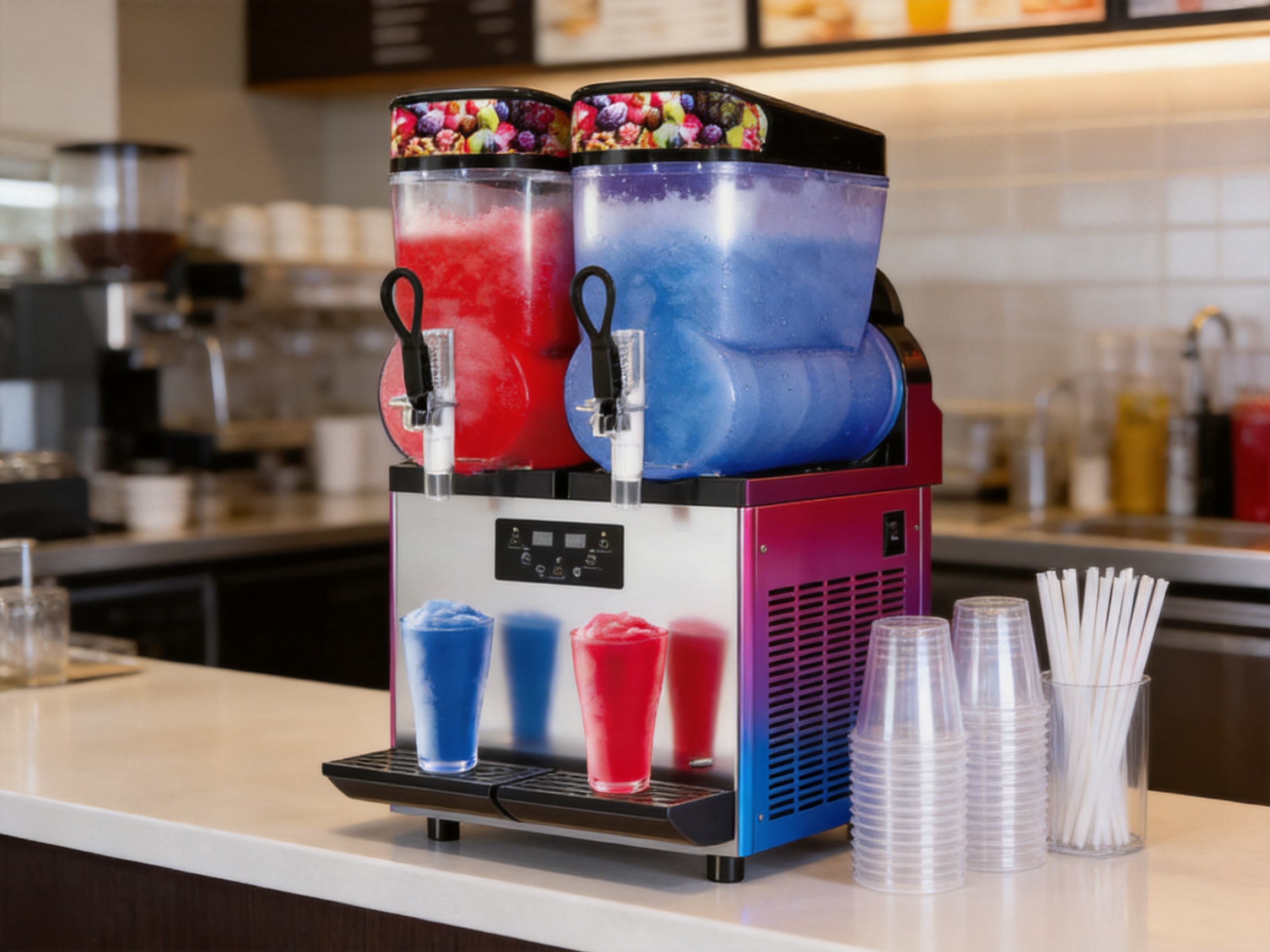
Admin 2026-09-19Commercial beverage service depends on equipment that can deliver consistent quality, efficient production, and dependable performance throughout demanding operating hours. The 2 × 15 L Commercial Slush Machine is designed for bars, cafés, restaurants, snack shops, fast-food locations, supermarkets, and other foodservice environments that need attractive frozen beverages with reliable output. With two independent 15-liter tanks, a 1000-watt rated output, R290 refrigerant, a sanitary stainless-steel and sprayed-steel body, and a sturdy commercial structure, this machine combines capacity with practical operational efficiency.
Frozen drinks are no longer limited to seasonal menus or specialized dessert stores. Slush beverages, flavored ice drinks, frozen cocktails, fruit-based refreshments, and semi-frozen specialty drinks have become important revenue opportunities for many foodservice businesses. A professional machine must therefore do more than freeze liquid. It must maintain a stable temperature, mix the product evenly, present the beverage attractively, support multiple flavors, withstand frequent use, and remain manageable for staff.
This dual-tank model is developed around those requirements. Its 2 × 15 L configuration enables operators to produce two flavors or recipes at the same time, while its compact footprint helps it fit behind a service counter or within a busy beverage station. The machine is suitable for businesses that want commercial-grade capacity without selecting a much larger multi-tank system.
The equipment is manufactured by Spelor Electrical Appliances (Zhejiang) Co., Ltd., a professional producer of commercial refrigeration, kitchen, buffet, and foodservice equipment. The company integrates product design, research and development, manufacturing, sales, and service within one organization. With more than 60,000 square meters of modern production facilities and a product portfolio covering refrigeration, beverage, cooking, and buffet applications, the manufacturer is positioned to support both standard equipment purchasing and broader foodservice projects.

2*15L Sturdy Durable Commercial Slush Machine for Bar Cafe Restaurant
Product Overview and Core Configuration
The model XN240A features two product tanks, each with a nominal capacity of 15 liters. The combined 30-liter capacity gives an operator sufficient volume for continuous service while preserving the flexibility of two separate recipes. One tank may contain a fruit slush while the other holds a soda-based flavor, frozen cocktail mix, coffee beverage, or another approved formulation. This flexibility is particularly valuable in locations where customers expect variety but counter space is limited.
| Product item | Specification |
| Model | XN240A |
| Tank configuration | 2 tanks |
| Tank capacity | 2 × 15 L |
| Rated output | 1000 W |
| Refrigerant | R290 |
| Net weight | 45 kg |
| Machine dimensions | 414 × 550 × 824 mm |
| Main body materials | Food-grade stainless steel and sprayed steel |
| Primary applications | Bars, cafés, restaurants, snack shops, beverage counters, and other commercial foodservice locations |
The equipment has a rated output of 1000 watts, providing the power required for commercial freezing and mixing operations. Its R290 refrigerant is used in the refrigeration system and is widely associated with modern commercial refrigeration design. As with all refrigeration equipment, installation, ventilation, electrical connection, and servicing should be handled according to local regulations and the instructions supplied with the machine.
With a net weight of approximately 45 kilograms, the machine offers a substantial commercial structure while remaining practical for professional placement and installation. Its dimensions of 414 millimeters in width, 550 millimeters in depth, and 824 millimeters in height create a vertical format that uses counter and floor space efficiently. Operators should still allow sufficient clearance for ventilation, cleaning, access, and routine maintenance.
Why Two 15-Liter Tanks Matter
The dual-tank design is one of the machine’s most important advantages. A single-tank unit can produce one flavor at a time, which may be adequate for a small menu but can restrict customer choice and reduce promotional flexibility. By contrast, two 15-liter tanks allow the same machine to support two product selections simultaneously.
For a café, one tank may be used for a lemon slush and the other for a berry flavor. A restaurant may offer a non-alcoholic frozen beverage alongside a frozen dessert drink. A bar can dedicate the two sides to different cocktail bases, provided that the formulations are suitable for the equipment and local operating requirements. A snack shop may use one side for a popular standard flavor and the other for rotating seasonal recipes.
This arrangement can also improve menu management. Operators can test a new flavor in one tank while continuing to sell an established product in the other. During a promotion, the two tanks can be used for complementary colors or flavors. In locations serving children and adults, separate beverage selections can be offered without purchasing two individual machines.
The 15-liter capacity of each tank represents a useful balance between storage volume and product freshness. Large enough for busy service periods, each tank can support ongoing sales without forcing the business to commit to an oversized machine. The two-tank format also gives staff greater control over inventory. Recipes can be prepared according to expected demand, and the operator can monitor which flavor requires replenishment.
Compared with some single-flavor systems, the XN240A can create a more engaging point-of-sale presentation. Customers can see two frozen products ready for service, making the machine both a production tool and a visual merchandising asset. In many foodservice environments, the appearance of the equipment and the product can encourage impulse purchases.
Commercial Construction for Frequent Use
Foodservice equipment must withstand repeated operation, regular cleaning, ingredient contact, staff handling, and the general demands of a busy service environment. The XN240A is built with a food-grade stainless-steel plate body combined with colorful sprayed steel. This material combination gives the machine a practical commercial foundation while supporting a clean and attractive appearance.
Stainless steel is widely used in foodservice equipment because it is durable, easy to wipe, and suitable for hygienic working areas when properly cleaned and maintained. The food-grade stainless-steel components help support routine sanitation around surfaces that may be exposed to splashes, condensation, and beverage residue. The sprayed steel elements add visual character and allow the machine to fit more naturally into branded cafés, modern bars, casual restaurants, and colorful dessert shops.
The structure is designed for high-frequency production environments. This does not mean that maintenance can be neglected. Instead, the machine’s robust construction gives operators a dependable foundation for regular commercial use when they follow suitable cleaning, loading, operating, and service procedures.
A strong exterior also helps protect internal components from the ordinary stresses of commercial operation. Staff may need to refill tanks, remove product containers, clean the dispensing areas, and reposition accessories during the day. Equipment with a stable structure is easier to integrate into a working station and less likely to feel fragile during routine handling.
In comparison with light-duty consumer equipment, a commercial machine is intended to support a more organized workflow. Its capacity, power rating, tank arrangement, and construction are selected for professional service rather than occasional household use. This difference can reduce the need for frequent batch preparation and help businesses maintain a more consistent customer experience.
Stable Freezing and Even Mixing
For slush products, freezing performance must be balanced carefully. If a beverage is too liquid, it may not deliver the expected texture. If it freezes excessively or unevenly, dispensing can become difficult and the product may lose its visual appeal. The equipment therefore needs to support stable cooling while maintaining movement throughout the tank.
The XN240A is designed to provide efficient cooling and even mixing in both tanks. Continuous or controlled mixing helps distribute temperature throughout the product and supports a uniform semi-frozen texture. This is especially important when the tank contains a flavored beverage made from ingredients that could otherwise settle or separate over time.
Even mixing can contribute to better portion consistency. When the product texture is uniform, each serving is more likely to resemble the previous one. Customers benefit from a predictable drink, while staff can serve the product with less manual intervention. Consistency is a key part of commercial foodservice quality because it supports customer trust and simplifies staff training.
Stable freezing also helps the operator plan production. A machine that can maintain the desired state during service gives the team greater confidence when preparing for peak periods. Staff can load the tanks before a busy lunch, evening, or weekend service and use the machine as a ready-to-serve station rather than repeatedly preparing individual batches.
Performance will depend on factors such as the formulation, sugar content, ingredient temperature, ambient conditions, ventilation, operating settings, and cleaning condition. Operators should always use recipes suitable for commercial slush equipment and follow the manufacturer’s instructions. Nevertheless, the machine’s commercial power and dual refrigeration configuration are intended to support reliable day-to-day beverage production.
Operational Efficiency in Bars, Cafés, and Restaurants
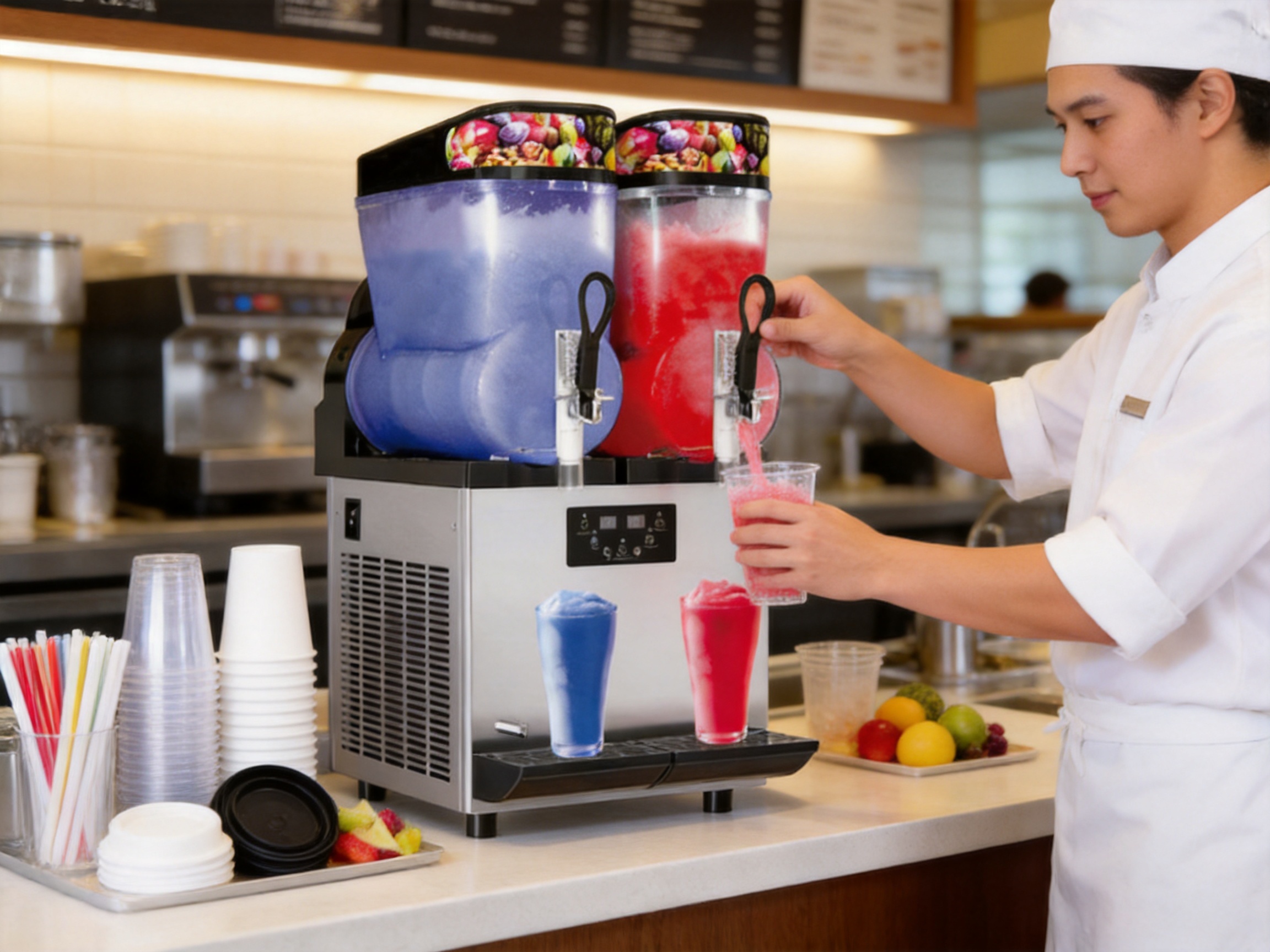
A major benefit of the 2 × 15 L format is its ability to increase menu capacity without requiring a large equipment footprint. In a café, the machine can be placed near the cold beverage station and used for premium frozen drinks, fruit slushes, or seasonal specials. In a restaurant, it can support dessert service, family dining, outdoor events, or a dedicated beverage menu.
Bars can use the system to offer frozen cocktails, mocktails, and signature drinks. The two tanks allow different recipes to be available at the same time, making it easier to serve customers with different preferences. The machine can also support themed promotions, such as two-color drinks for an event or two complementary flavors for a seasonal campaign.
Snack shops and fast-food outlets often need equipment that can deliver a product quickly while using limited counter space. A dual-tank slush machine can simplify this requirement by combining two production channels in one unit. It may also help reduce the number of separate appliances required behind the counter, creating a cleaner and more efficient workstation.
Supermarkets, institutional dining facilities, entertainment venues, and concession areas can also benefit from the machine. Its visible tanks can act as a point-of-sale attraction, while its total capacity supports service during periods of concentrated demand. The machine may be used as a permanent installation or as part of a wider beverage program for special events and promotions.
Operational efficiency is not determined only by electrical power. It also depends on how easily the equipment fits into staff routines. A machine with two tanks, a commercial structure, and a manageable footprint can reduce unnecessary movement between separate appliances. When the product is ready at the service counter, staff can focus on customer service, order accuracy, and other preparation tasks.
Hygiene, Cleaning, and Product Safety
Hygiene is central to any commercial beverage operation. Frozen drinks may contain water, syrups, fruit ingredients, dairy components, alcohol, or other recipe elements. Residue left in tanks, mixing areas, dispensing outlets, seals, or drip zones can affect product quality and create avoidable sanitation concerns. For this reason, the machine should be included in a documented cleaning and maintenance schedule.
The food-grade stainless-steel body supports a sanitary working environment when it is cleaned correctly. Operators should follow the equipment manual for disassembly, washing, sanitizing, rinsing, drying, and reassembly. Cleaning frequency should reflect the ingredients used, local food safety requirements, operating hours, and the instructions supplied by the manufacturer.
Staff should be trained to identify areas where product may collect. These can include tank edges, dispensing points, mixing components, seals, covers, and drip trays. A clear cleaning checklist can help ensure that the same steps are completed consistently across shifts. It can also make responsibility easier to assign in busy establishments.
Proper ingredient handling is equally important. Recipes should be prepared from safe, approved ingredients and stored at suitable temperatures before loading. Operators should avoid using mixtures that are incompatible with the machine or that contain particles likely to obstruct the system. Any formulation change should be evaluated carefully before being introduced into routine service.
A clean machine is not only safer; it also performs more consistently. Ingredient buildup can interfere with moving components, affect product texture, create unpleasant odors, and increase service interruptions. Regular cleaning and preventive maintenance help preserve the equipment’s appearance and support stable long-term operation.
Design Advantages Compared with Competing Equipment
Commercial slush machines vary widely in capacity, construction, tank arrangement, refrigeration performance, appearance, and service support. The XN240A offers several practical advantages when compared with basic single-tank or light-duty alternatives.
Two Flavors in One Machine
The two 15-liter tanks provide more menu flexibility than a single-flavor unit. Operators can offer a choice of products without purchasing two separate machines. This can be valuable for businesses that want variety but have limited space or a controlled equipment budget.
Commercial Capacity Without Excessive Scale
A combined 30-liter capacity is suitable for many medium-volume beverage operations. It offers meaningful production volume while remaining more compact than a large multi-tank installation. Businesses can select a capacity that reflects actual demand rather than paying for an unnecessarily oversized system.
Professional Power Rating
The 1000-watt rated output supports the machine’s intended commercial role. Compared with small domestic appliances, this rating is aligned with the need for regular freezing and mixing during service. Actual performance depends on operating conditions, but the configuration is designed for professional foodservice applications.
Durable and Presentable Materials
The combination of food-grade stainless steel and sprayed steel provides both practical durability and an attractive appearance. Some competing machines may prioritize either basic function or decorative design. This machine is intended to support both: a robust structure for daily use and a visual finish that can be placed in customer-facing environments.
Modern Refrigerant Selection
The use of R290 refrigerant reflects a contemporary approach to commercial refrigeration. Equipment buyers increasingly consider not only cooling performance but also refrigerant selection, service requirements, and long-term equipment planning. Businesses should verify local regulations and service requirements before installation.
Compact Vertical Footprint
The 414 × 550 × 824 millimeter dimensions make the unit relatively efficient in terms of floor and counter planning. The vertical form allows the tanks and product display to occupy useful height rather than requiring a very wide footprint. This can be advantageous in cafés, bars, kiosks, and other locations where every working surface matters.
Manufacturing Strengths and Production Capabilities
The performance of a commercial machine is closely connected to the manufacturing system behind it. Spelor Electrical Appliances (Zhejiang) Co., Ltd. operates as an integrated manufacturer covering design, research and development, production, sales, and service. This structure allows the company to coordinate product engineering, manufacturing decisions, customer requirements, and after-sales support within a connected business process.
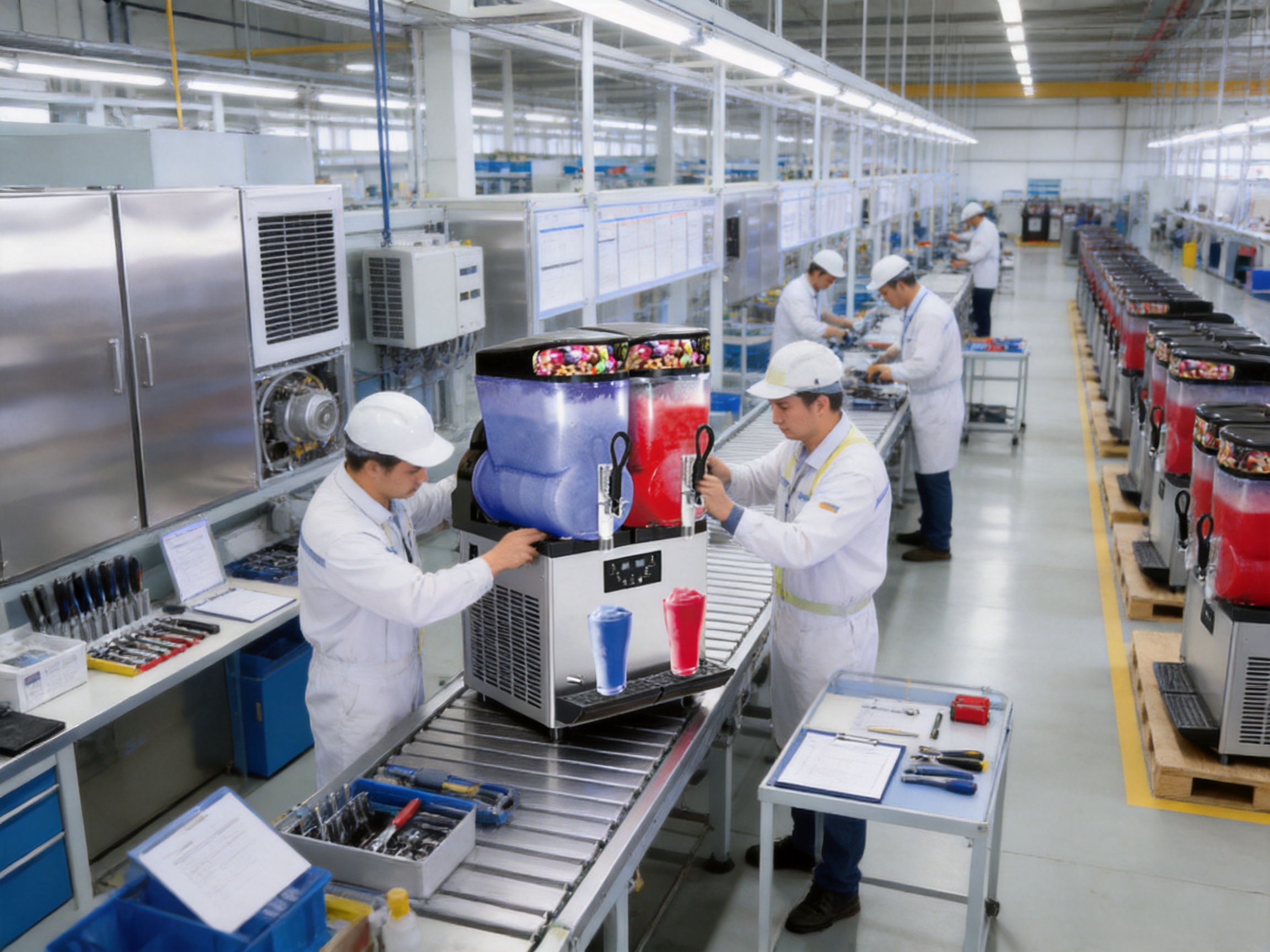
The company has more than 60,000 square meters of modern production facilities. A manufacturing base of this scale can support organized production planning, product assembly, component management, quality procedures, and multiple equipment categories. It also provides a foundation for serving customers that need more than one type of commercial appliance.
The company’s product range includes ice cream machines, juice dispensers, fried ice cream machines, refrigeration cabinets, slush machines, flake ice machines, cooking equipment, griddles, fryers, insulation products, barbecue equipment, and buffet solutions. This broad portfolio gives the manufacturer a strong understanding of different foodservice workflows. A customer may be able to coordinate beverage, dessert, refrigeration, cooking, and buffet equipment through one supplier rather than managing unrelated procurement channels.
Integrated manufacturing can also support better communication between product development and production teams. Design decisions can be assessed in relation to material availability, assembly efficiency, service access, packaging, and logistics. When customer requirements are collected by a company that also understands manufacturing, it becomes easier to discuss practical customization options and project considerations.
The company’s stated business philosophy is user-oriented and quality-driven. In practical terms, this means that equipment development should focus on the conditions in which customers actually operate: frequent service, sanitation, space limitations, menu flexibility, energy considerations, staff usability, and long-term maintenance. The XN240A reflects this approach through its dual-tank format, commercial construction, compact dimensions, and broad application range.
Research, Development, and Product Engineering
Commercial refrigeration and beverage equipment require cooperation between mechanical, electrical, thermal, and structural design disciplines. A slush machine must accommodate tanks, mixing systems, refrigeration components, controls, exterior panels, drainage or dispensing areas, and service access within a single cabinet. Product development therefore involves more than selecting a compressor or adding a decorative shell.
An effective research and development process considers how the equipment will be installed, loaded, cleaned, operated, and serviced. The tank capacity must correspond with the cooling system. The structure must support the product containers and moving parts. The external body must protect internal components while remaining accessible for inspection. Controls must be understandable to staff who may work in fast-paced environments.
Spelor’s experience across commercial refrigeration and foodservice equipment provides a broad technical base for this type of development. Knowledge gained from ice machines, beverage dispensers, refrigeration cabinets, and frozen dessert equipment can contribute to more practical product engineering. Each category has different requirements, but all depend on thermal management, material selection, reliability, and serviceability.
The manufacturer also provides OEM and ODM services based on customer drawings or requirements. This is important for distributors, restaurant groups, hospitality projects, equipment importers, and brands that need products adapted to a particular market. Customization may involve appearance, labeling, packaging, configuration, electrical requirements, documentation, or other project details, subject to technical evaluation and production feasibility.
OEM and ODM cooperation should begin with a clear specification. Buyers should communicate the intended application, preferred capacity, target market, electrical standards, product recipes, operating environment, branding requirements, packaging expectations, and certification needs. Early communication helps both parties identify technical constraints and develop a realistic production plan.
Quality-Oriented Manufacturing Process
A commercial machine reaches the customer through multiple stages, including design, material preparation, component production or sourcing, cabinet fabrication, assembly, electrical integration, refrigeration installation, inspection, packaging, and shipping. Each stage influences the final user experience.
For a machine such as the XN240A, material quality is important because the body must remain presentable in a foodservice environment. Stainless-steel and sprayed-steel panels need to be formed, finished, and assembled with attention to fit and appearance. Internal components must be positioned to support cooling, mixing, operation, and maintenance.
Assembly quality is also essential. Refrigeration systems depend on correctly installed components and properly managed connections. Electrical systems require appropriate wiring, insulation, grounding, control integration, and inspection. Moving or mixing components require accurate installation to support smooth operation. A structured manufacturing process helps reduce variation between units.
Inspection should address both appearance and function. Exterior surfaces can be checked for finish quality, alignment, and damage. Functional checks can include power-up behavior, cooling operation, mixing action, tank configuration, controls, and general machine response. Packaging inspection is also important because commercial equipment may travel long distances before reaching the final customer.
While individual testing procedures depend on the manufacturer’s internal standards and the destination market, buyers should request appropriate technical documentation and compliance information during the purchasing process. This is particularly important for imported equipment, project installations, and markets with specific electrical, refrigeration, or food-contact requirements.
Service, Customization, and Global Supply Support
Purchasing commercial equipment involves more than selecting a product. Buyers also need support before the order, during production, through shipment, and after installation. Spelor provides one-stop service that includes pre-sales consultation, product customization, flexible logistics and payment solutions, and after-sales maintenance support.
Pre-sales consultation can help customers determine whether the 2 × 15 L format matches their expected demand. A distributor may need technical data for a product catalog. A restaurant group may require advice on equipment placement and menu usage. An importer may need information about electrical specifications, packaging, documentation, and shipping arrangements.
Customization can help align the machine with a customer’s commercial identity or market requirements. Depending on the project, discussions may include exterior color, branding, labels, packaging, product configuration, or other practical details. All changes should be reviewed for their effect on production, cost, lead time, service, and regulatory compliance.
Logistics support is especially important for commercial equipment because machines are larger and heavier than ordinary consumer appliances. A reliable export process should consider protective packaging, loading plans, shipping terms, documentation, destination handling, and installation responsibilities. Clear communication reduces the risk of delays or misunderstandings.
After-sales service helps protect the value of the equipment over its working life. Operators may need assistance with installation questions, replacement parts, maintenance procedures, troubleshooting, or warranty matters. A manufacturer that offers responsive support can help customers reduce downtime and keep their equipment in service.
For distributors and foodservice equipment dealers, supplier support can also strengthen customer relationships. Accurate specifications, product images, manuals, spare-part information, and technical responses make it easier for dealers to sell and support the machine in their own markets.
Installation and Workflow Planning
Before installing the machine, the operator should evaluate the available space, power supply, ventilation, access, drainage, cleaning area, and product workflow. The unit should be positioned on a stable surface capable of supporting its weight and operating vibration. Staff should have enough room to load ingredients, serve products, clean the tanks, and access the surrounding work area.
Ventilation is important for refrigeration equipment. The machine should not be placed so close to walls, other appliances, or stored materials that airflow is restricted. Excessive ambient heat or inadequate ventilation can affect cooling performance and place additional stress on the refrigeration system.
The electrical supply should match the machine’s requirements and local regulations. Installation should be completed by qualified personnel when required. The operator should confirm grounding, protection, voltage, frequency, and connection conditions before putting the unit into service.
Workflow planning should place the slush machine near the ingredients, cups, lids, straws, garnishes, and point-of-sale area. A well-organized station reduces staff movement and helps maintain service speed. At the same time, cleaning tools and approved sanitation materials should be stored conveniently without creating contamination risks.
Businesses should also plan how the machine will be used during opening, peak service, closing, and cleaning. A simple operating procedure can define when tanks are loaded, how product levels are monitored, when the machine is cleaned, who is responsible for inspection, and how unusual noises or performance changes are reported.
Recipe and Menu Flexibility
The machine can support a wide range of frozen beverage concepts, provided that the recipes are suitable for the equipment. Fruit slushes, flavored ice beverages, frozen lemonades, non-alcoholic specialty drinks, and selected frozen cocktails are common possibilities. The dual-tank configuration makes it easier to build a menu around contrast and choice.
Menu planning should consider product texture, serving temperature, ingredient stability, and customer demand. Recipes with different sugar or solids content may freeze differently, so operators should test each formulation before commercial launch. If dairy, alcohol, pulp, or other special ingredients are used, the business should confirm that the product is appropriate for the machine and compatible with local food safety procedures.
Two tanks can also support daypart planning. A café may serve fruit flavors in the morning and introduce a dessert beverage later in the day. A bar may use one tank for a standard frozen drink and the other for a rotating signature recipe. A restaurant may coordinate flavors with meals, holidays, sports events, or local promotions.
The visual effect of two colorful frozen products can be valuable. Product presentation influences customer perception, especially when the machine is placed in a visible location. Attractive beverages can support premium pricing, combination offers, seasonal campaigns, and social-media-friendly service concepts.
Cost and Business Value
Equipment value should be assessed through more than the initial purchase price. A commercial slush machine can contribute to revenue by adding a product category, increasing average order value, supporting impulse purchases, and reducing dependence on labor-intensive batch preparation.
The dual-tank system may offer better value than purchasing two separate single-tank machines. One cabinet, one service location, and one coordinated equipment purchase can simplify space planning. It may also reduce the number of machines that staff must operate and clean, although the two tanks still require appropriate attention to hygiene and product management.
Capacity planning is essential. A machine that is too small may require repeated refilling and may struggle to meet peak demand. A machine that is too large may occupy unnecessary space and represent an inefficient investment. The 2 × 15 L configuration is suitable for businesses seeking a middle-scale commercial solution with two product options.
Durability also affects total ownership value. Equipment that remains stable, serviceable, and presentable over time can support a better return on investment than a low-cost machine that requires frequent replacement or causes repeated service interruptions. The XN240A is designed for regular commercial use, with a sturdy structure and components selected for a professional foodservice setting.
Operating cost depends on many factors, including local electricity prices, ambient temperature, operating hours, product formulation, maintenance, and ventilation. Buyers should evaluate the complete operating environment and follow recommended procedures to help preserve efficiency and reliability.
Recommended Applications
Bars and Cocktail Lounges
Bars can use the machine to serve frozen cocktails, mocktails, flavored slushes, and event-specific beverages. Two tanks allow separate recipes to be available at once and can support different alcohol-free or alcoholic options, subject to local regulations and recipe suitability.
Cafés and Dessert Shops
Cafés can add frozen fruit drinks, lemonades, iced specialty beverages, and dessert-style products to their menus. The colorful body and visible tanks can complement a customer-facing counter while providing an efficient production station.
Restaurants
Restaurants can use the machine as part of a beverage program, dessert menu, outdoor service area, or family dining concept. The two flavors may be selected to complement different meal categories or seasonal promotions.
Snack Shops and Fast-Food Locations
Fast-service businesses benefit from products that are easy to present, quick to dispense, and attractive to customers. The dual-tank format supports variety while using a single commercial unit.
Supermarkets and Institutional Foodservice
Supermarkets, schools, institutions, entertainment venues, and concession operations may use the machine to provide frozen drinks during concentrated service periods. Careful menu and hygiene management can help these locations maintain consistent quality.
Purchasing Considerations for Importers and Distributors
Importers and distributors should evaluate the machine from both a technical and commercial perspective. Product specifications should be confirmed before ordering, including capacity, rated power, refrigerant, dimensions, net weight, electrical requirements, packaging, and included components.
Market-specific compliance should also be reviewed. Requirements may differ according to country, region, voltage, plug type, refrigerant rules, food-contact expectations, labeling, and documentation. Buyers should communicate these needs to the manufacturer at the quotation stage rather than waiting until production or shipment.
Distributors should consider how the machine will be presented to end users. Sales materials can emphasize the two-flavor configuration, 30-liter total capacity, compact dimensions, commercial construction, and suitability for bars, cafés, restaurants, and other foodservice operations. Technical information should remain accurate and should distinguish confirmed specifications from application recommendations.
Spare-part planning is another important issue. Distributors may wish to discuss commonly required replacement components, service procedures, warranty terms, and technical training. A clear support plan can improve customer confidence and reduce downtime after installation.
For larger projects, buyers can discuss OEM or ODM possibilities with the manufacturer. A project may require coordinated equipment across multiple locations, customized exterior finishes, private labeling, specialized packaging, or integration into a broader foodservice equipment program. The manufacturer’s experience across several product categories can be useful in these situations.
Maintenance Practices for Long-Term Performance
Preventive maintenance helps preserve machine performance and reduce unexpected interruptions. Operators should inspect the equipment regularly for product residue, unusual sounds, vibration, loose fittings, damaged panels, abnormal temperature behavior, and signs of leakage or wear.
Cleaning should be performed according to the recommended schedule. Components that contact the beverage should be cleaned and sanitized with suitable products. Staff should avoid harsh chemicals or cleaning methods that could damage surfaces, seals, finishes, or food-contact components. Parts should be fully reassembled before the machine returns to service.
Airflow areas should be kept free of dust, packaging materials, and other obstructions. Restricted airflow can reduce cooling effectiveness. The machine should also be protected from unnecessary heat sources and direct environmental conditions that could affect the refrigeration system.
Operators should avoid overloading the tanks beyond their intended capacity and should use recipes that match the machine’s operating requirements. Sudden changes in formulation, extreme ingredient temperatures, or unsuitable solids content can influence freezing performance. Staff should record and report recurring problems rather than attempting unauthorized repairs.
Technical service should be performed by qualified personnel when refrigeration, electrical, or internal mechanical work is required. Using appropriate replacement parts and following the manufacturer’s service guidance can help protect safety, reliability, and warranty coverage.
Frequently Asked Questions
What is the capacity of the commercial slush machine?
The machine has two tanks, each with a capacity of 15 liters, for a total nominal capacity of 30 liters.
Can the two tanks hold different flavors?
Yes. The dual-tank design is intended to allow two flavors or formulations to be prepared and served simultaneously, provided that each recipe is suitable for the equipment.
What is the rated output?
The rated output is 1000 watts.
Which refrigerant does the machine use?
The product information identifies R290 as the refrigerant. Buyers should confirm market-specific requirements and service procedures before installation.
What are the machine dimensions?
The stated dimensions are 414 × 550 × 824 millimeters.
How much does the machine weigh?
The listed net weight is approximately 45 kilograms.
Is the machine suitable for a café or restaurant?
Yes. It is designed for commercial foodservice applications and is suitable for cafés, restaurants, bars, snack shops, beverage counters, and similar operating environments.
What materials are used for the body?
The plate body is made from food-grade stainless steel and colorful sprayed steel, combining a sanitary commercial appearance with a durable structure.
Can the machine be used for frozen cocktails?
It may be used for suitable frozen cocktail formulations, subject to local regulations, recipe compatibility, and the manufacturer’s operating guidance. Operators should test recipes before placing them into regular service.
Does the machine require regular cleaning?
Yes. Regular cleaning and sanitation are essential for product quality, hygiene, and reliable operation. The exact procedure and frequency should follow the product manual and applicable food safety requirements.
What makes a dual-tank machine useful for business?
It allows two products to be served from one machine, increasing menu variety while using less space than two separate single-tank machines. It can also support promotions, seasonal flavors, and different customer preferences.
Does the manufacturer provide OEM and ODM services?
The manufacturer offers OEM and ODM services based on customer drawings or requirements. Specific customization options should be reviewed with the sales and engineering teams.
What kind of support is available?
The company provides pre-sales consultation, customization assistance, logistics and payment support, and after-sales maintenance service. Buyers should confirm the exact support terms for their market and order.
What should be checked before installation?
Operators should check the available space, stable support surface, ventilation, electrical supply, local compliance requirements, access for cleaning, and the planned workflow around the machine.
Conclusion
The 2 × 15 L Commercial Slush Machine is a practical solution for foodservice businesses that need reliable frozen beverage production, two-flavor flexibility, and a professional commercial presentation. Its dual 15-liter tanks support menu variety, while the 1000-watt rated output is designed for regular service in bars, cafés, restaurants, snack shops, and similar environments.
The machine’s food-grade stainless-steel and sprayed-steel body provides a durable and attractive structure. Its compact 414 × 550 × 824 millimeter format helps businesses use available space efficiently, and its 45-kilogram net weight reflects a substantial commercial build. Efficient cooling, even mixing, and R290 refrigerant further support its role as a modern frozen beverage appliance.
Beyond the product itself, the manufacturing capabilities behind the equipment add value for buyers. Spelor Electrical Appliances (Zhejiang) Co., Ltd. combines design, research and development, manufacturing, sales, and service, supported by more than 60,000 square meters of modern production facilities. Its broad portfolio across commercial refrigeration, beverage, cooking, dessert, and buffet equipment allows it to serve a wide range of foodservice projects.
For businesses seeking a reliable way to add frozen beverages to their menu, this machine offers a balanced combination of capacity, flexibility, appearance, and commercial practicality. With correct installation, suitable recipes, regular cleaning, preventive maintenance, and appropriate operator training, it can support stable daily production and long-term foodservice value.
References
1. Product specification sheet for Commercial Slush Machine Model XN240A, including tank capacity, rated output, refrigerant, weight, and dimensions.
2. Manufacturer-provided product information for the 2 × 15 L commercial slush machine.
3. Manufacturer company profile for Spelor Electrical Appliances (Zhejiang) Co., Ltd., including production scope, facilities, product categories, and service capabilities.
4. General commercial foodservice equipment principles concerning sanitation, preventive maintenance, workflow planning, and equipment installation.
5. General refrigeration equipment guidance concerning ventilation, refrigerant handling, electrical safety, and qualified technical service.
Product: 2*15L Sturdy Durable Commercial Slush Machine for Bar Cafe Restaurant

For exclusive deals and latest offers, sign up by entering your email address below.


-
spelor@spelor.com
-
+86-576-85229688
-
No.528, Changxi Road, Linhai City, Zhejiang Province, China
Commercial Refrigeration Equipment Manufacturer China
Copyright © 2025 by Spelor Electrical Appliances (Zhejiang) Co., Ltd. Rights Reserved.
