


 中文简体
中文简体Food-Grade Stainless Steel Commercial Desktop Soft Serve Ice Cream Machine: A Practical Guide to Performance, Hygiene, and Small-Batch Foodservice Production
Admin 2026-08-08Soft serve ice cream remains one of the most attractive products for cafés, bakeries, dessert shops, snack bars, restaurants, and compact foodservice businesses. It is visually appealing, easy to customize, suitable for impulse purchases, and capable of generating strong value from a relatively small serving area. However, the quality and profitability of a soft serve operation depend heavily on the equipment selected. A machine must provide stable freezing, hygienic product contact surfaces, convenient controls, dependable refrigeration, and a compact footprint that does not interfere with daily service.
The Food-Grade Stainless Steel Commercial Desktop Soft Serve Ice Cream Machine, model BQL-9200ST, is designed to address these requirements in a compact commercial format. With a stated production capacity of 10 liters per hour, a 1 × 3.6-liter hopper, a 1 × 1.6-liter freezing tank, a 1,000-watt input rating, and a net weight of approximately 45 kilograms, it is intended for small and medium-volume applications. The desktop structure makes it suitable for counters where floor space is limited but professional soft serve production is still required.
The machine combines food-grade stainless steel construction, a colorful sprayed steel exterior, an LCD touch screen, self-cleaning functionality, pre-cooling, and R290 refrigerant. These features create a practical balance between appearance, sanitation, operating convenience, energy-conscious refrigeration design, and manageable capacity. It is especially suitable for businesses that need regular daily production without investing in a large floor-standing system.
Product Overview and Intended Applications
A commercial desktop soft serve machine is different from a household appliance or a high-capacity industrial freezer. It is designed to operate in a foodservice environment where the machine may be used repeatedly throughout the day, where operators need a simple workflow, and where the equipment must fit into a visible customer-facing area.
The BQL-9200ST is a single-flavor desktop soft serve machine. Its hopper receives prepared liquid mix, while the freezing tank cools and partially freezes the mix before dispensing. The stated production capacity of 10 liters per hour is appropriate for controlled small-batch production, regular café service, dessert counters, bakery sales, and other applications where demand is steady but not extremely high.
Typical applications include cafés serving soft serve in cups or cones, bakeries adding frozen desserts to their menu, snack shops offering quick impulse products, small restaurants creating dessert combinations, and catering or event businesses requiring a relatively mobile countertop solution. It can also support seasonal promotions, children’s menus, self-contained dessert stations, and specialty products such as soft serve with toppings, fruit, sauces, biscuits, or beverages.
| Product Item | Specification |
| Model | BQL-9200ST |
| Machine Type | Desktop soft serve ice cream machine |
| Production Capacity | 10 liters per hour |
| Input Power | 1,000 watts |
| Hopper Capacity | 1 × 3.6 liters |
| Freezing Tank | 1 × 1.6 liters |
| Net Weight | Approximately 45 kilograms |
| Refrigerant | R290 |
| Compressor | Chinese compressor |
| Stated Dimensions | Approximately 210 × 580 × 700 millimeters or 213 × 555 × 720 millimeters, subject to final confirmation |
| Control Interface | LCD touch screen |
| Cleaning Function | Self-cleaning function |
| Pre-Cooling | Pre-cooling function for product freshness management |
The supplied product materials show two slightly different dimension records: 213 × 555 × 720 millimeters and 210 × 580 × 700 millimeters. Buyers should confirm the final production specification, packaging dimensions, clearance requirements, and installation drawing before placing an order. This is particularly important for countertop installation, door access, transport planning, and placement beneath shelving or ventilation systems.
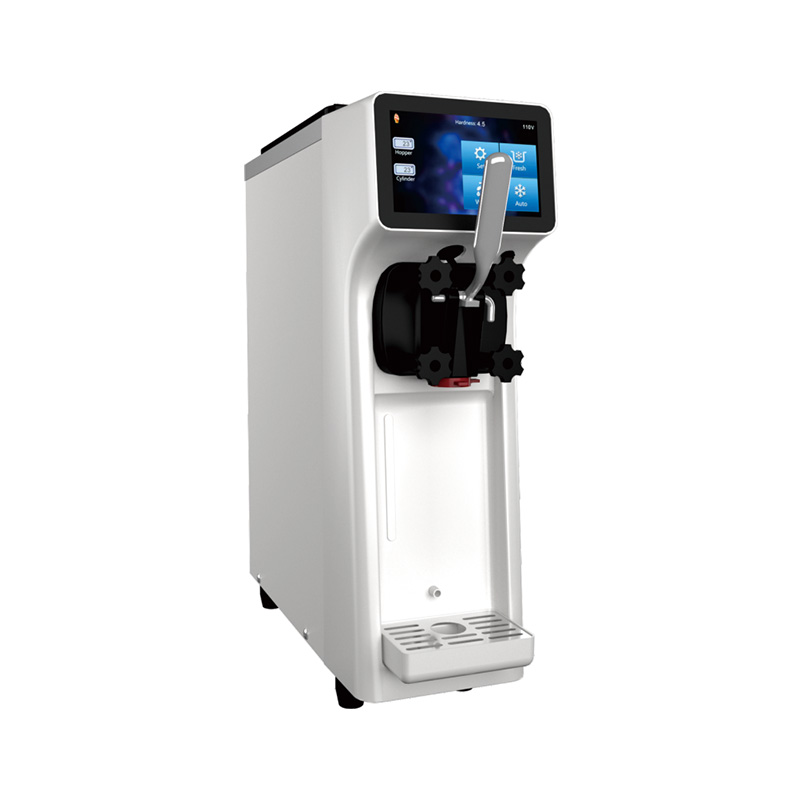
Food-Grade Stainless Steel Commercial Desktop Soft Serve Ice Cream Machine
Food-Grade Stainless Steel Construction
One of the machine’s most important advantages is its food-grade stainless steel plate body. Stainless steel is widely used in professional food equipment because it offers a combination of durability, corrosion resistance, cleanability, and visual quality. In a soft serve environment, the exterior is exposed to moisture, splashes, condensation, cleaning chemicals, fingerprints, and repeated handling. A suitable stainless steel structure helps the equipment maintain a professional appearance during continuous commercial use.
The smooth surface of stainless steel is easier to wipe than porous or heavily textured materials. This supports daily sanitation routines and reduces areas where dirt, mix residue, or moisture can accumulate. When operators follow the appropriate cleaning instructions, the machine can be maintained to a high standard of cleanliness without complicated exterior care.
The product also uses colorful sprayed steel as part of its exterior design. This allows the machine to appear more attractive in customer-facing environments than a plain industrial appliance. A café or dessert counter may use the machine as a visible part of its presentation, and an appealing appearance can help communicate freshness, professionalism, and product quality to customers.
Compared with basic plastic-bodied equipment, a stainless steel commercial structure generally provides a stronger impression of durability and professional use. It is also better aligned with the requirements of busy foodservice environments where equipment must withstand regular wiping, movement, and repeated operation. The combination of stainless steel and sprayed steel gives operators both a hygienic working surface and a more distinctive visual identity.
Benefits for Foodservice Operators
For operators, food-grade stainless steel can reduce the time spent on exterior maintenance. It supports a simple cleaning sequence: remove visible residue, apply an approved cleaning solution, wipe the surface, rinse or wipe according to the chemical instructions, and dry the exterior. Because the machine is intended for commercial use, this routine should be incorporated into opening, service, and closing procedures.
The stainless steel structure also supports long-term procurement value. A machine that continues to look clean and professional is more suitable for customer-facing locations than one that quickly shows discoloration, peeling, or surface wear. In addition, a durable exterior can help reduce the need for frequent cosmetic replacement when the refrigeration system and operating components remain serviceable.
LCD Touch Screen and Intelligent Operation
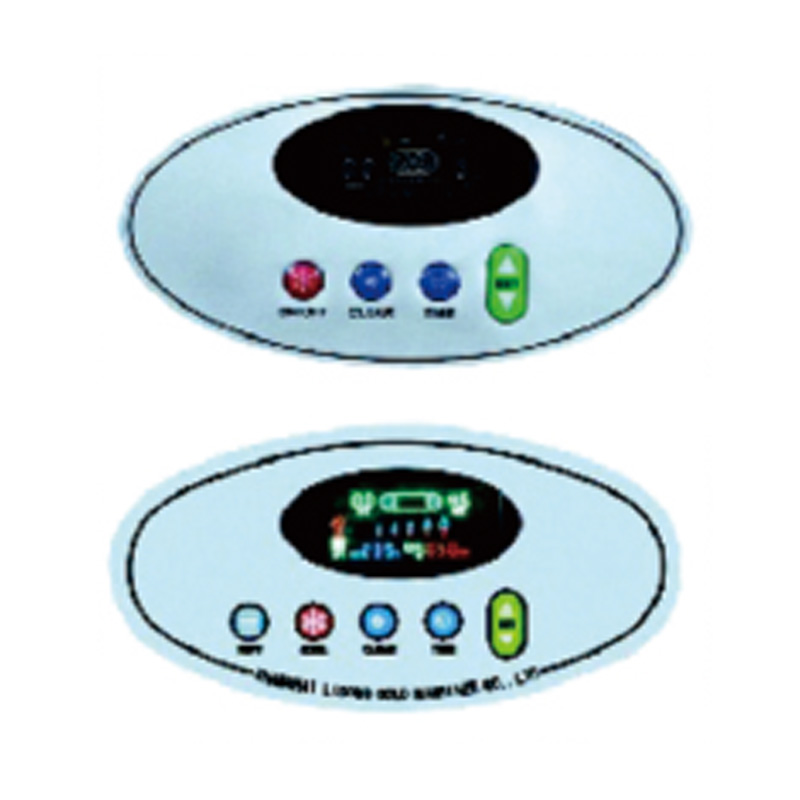
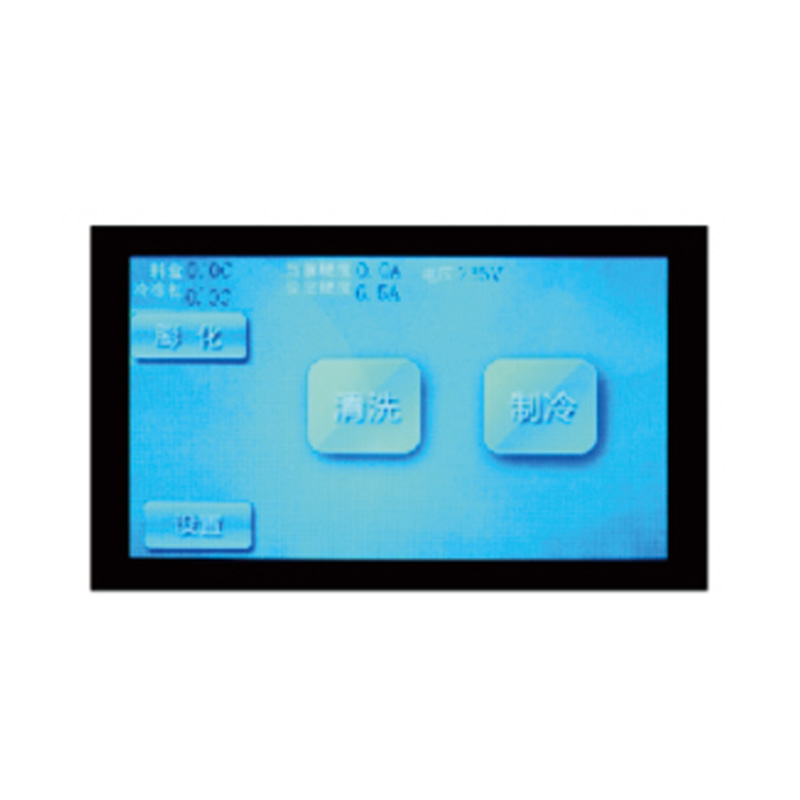
The LCD touch screen provides a more modern operating interface than simple mechanical switches or basic indicator lights. A visual control panel can make machine status easier to understand, especially for staff members who are learning the equipment for the first time. The supplied product description identifies the screen as supporting intelligent operation and real-time visualization.
Real-time visualization is valuable in a commercial environment because operators need to know whether the machine is ready, cooling, cleaning, or waiting for the next operating step. A clear interface can reduce uncertainty during busy service periods and help staff follow a repeatable workflow.
A touch screen may also make the equipment easier to integrate into standard operating procedures. Staff training can be organized around visible functions such as starting the machine, selecting a mode, monitoring operating status, activating cleaning, and using pre-cooling. This is particularly useful for businesses with part-time employees or changing shifts.
Operational Advantages Compared with Basic Controls
Entry-level soft serve equipment often relies on simple switches and limited feedback. While such controls can be functional, they may require operators to remember sequences or interpret sounds and indicator lights. A visual interface can improve usability by presenting information in a more direct format.
The LCD touch screen also supports a more professional customer-facing impression. In a café or bakery, equipment appearance matters because customers may observe the preparation area. A modern control panel combined with a stainless steel body can help the machine fit naturally into a contemporary interior.
Operators should still ensure that staff follow the official user manual and do not treat the screen as a substitute for cleaning, inspection, or maintenance. Digital controls improve convenience, but good results also depend on correct mix preparation, proper loading, appropriate operating temperatures, and timely sanitation.
Refrigeration Performance and R290 Refrigerant
The BQL-9200ST uses a Chinese compressor and R290 refrigerant. R290 is propane refrigerant, a natural refrigerant commonly used in modern refrigeration equipment. It has a low global warming potential compared with many traditional high-global-warming-potential refrigerants. Its use reflects a broader movement toward refrigeration systems that balance cooling performance with environmental considerations.
R290 systems require correct engineering, installation, ventilation, electrical protection, and service procedures. Because propane is flammable, only qualified technicians should work on the refrigeration circuit. Operators should not modify the refrigeration system, replace components with unapproved alternatives, or attempt refrigerant service without the proper technical capability.
The compressor and refrigeration circuit are central to soft serve performance. The system must remove heat from the mix consistently, maintain a suitable freezing condition, and recover efficiently after repeated dispensing. For small commercial businesses, stable cooling is often more important than maximum theoretical output because inconsistent freezing can affect texture, serving speed, product appearance, and customer satisfaction.
The stated 1,000-watt input power represents a compact electrical requirement for a commercial countertop machine. Before installation, the buyer should confirm the machine’s voltage, frequency, plug configuration, circuit requirements, ambient temperature limits, and ventilation clearance with the supplier. Actual electrical specifications may vary by market or customization request.
Cooling Stability in Daily Service
Soft serve mix can be sensitive to temperature changes. If the freezing system is not stable, the product may become too soft, too hard, uneven in texture, or slow to dispense. A properly sized commercial refrigeration system helps the operator maintain a more consistent product during normal service conditions.
The 1 × 1.6-liter freezing tank provides a relatively compact freezing chamber for small-batch production. This configuration is practical for businesses that want to limit product waste and refresh the mix more frequently. It is not intended to replace a high-capacity multi-flavor system in a large amusement venue or high-volume chain, but it can be a more efficient fit for a smaller store where demand changes throughout the day.
The machine’s 10-liter-per-hour production rating should be understood as a reference capacity rather than a universal guarantee under every operating condition. Production can be influenced by mix formulation, inlet temperature, ambient temperature, cleaning intervals, voltage stability, dispensing frequency, and operator technique. Buyers should request test conditions and verify the capacity required for their actual business model.
Pre-Cooling and Product Freshness Management
The pre-cooling function is designed to keep the mix cool before the freezing or dispensing stage. The supplied product information states that pre-cooling can help keep the product fresh for up to one week. This should be treated as a feature claim that must be used together with safe food handling procedures, approved mix instructions, local regulations, and the recommendations of the ingredient supplier.
Pre-cooling can be especially helpful during periods of intermittent demand. A small café may not sell soft serve continuously throughout the day, yet it may want the machine prepared for sudden customer demand. Keeping mix cool can reduce the time required to reach an operating condition and may support a smoother transition between preparation and service.
It can also help reduce unnecessary product waste. Rather than freezing excessive quantities at once, operators can use a measured workflow that matches the expected sales volume. This is important for small businesses where demand may vary according to weather, holidays, school schedules, local events, and daily foot traffic.
Safe Use of the Pre-Cooling Function
Pre-cooling does not eliminate the need for proper refrigeration hygiene. Operators should use fresh ingredients, clean containers, approved mix, correct storage temperatures, and clearly defined discard times. The phrase “keep fresh for one week” should not override food safety regulations or the instructions provided by the mix manufacturer.
Businesses should document when a batch is prepared, what ingredients were used, and when the batch must be discarded. If the product develops an unusual smell, appearance, texture, or taste, it should not be served. Staff should also avoid repeatedly adding new mix to an old batch unless the operating procedure explicitly allows it.
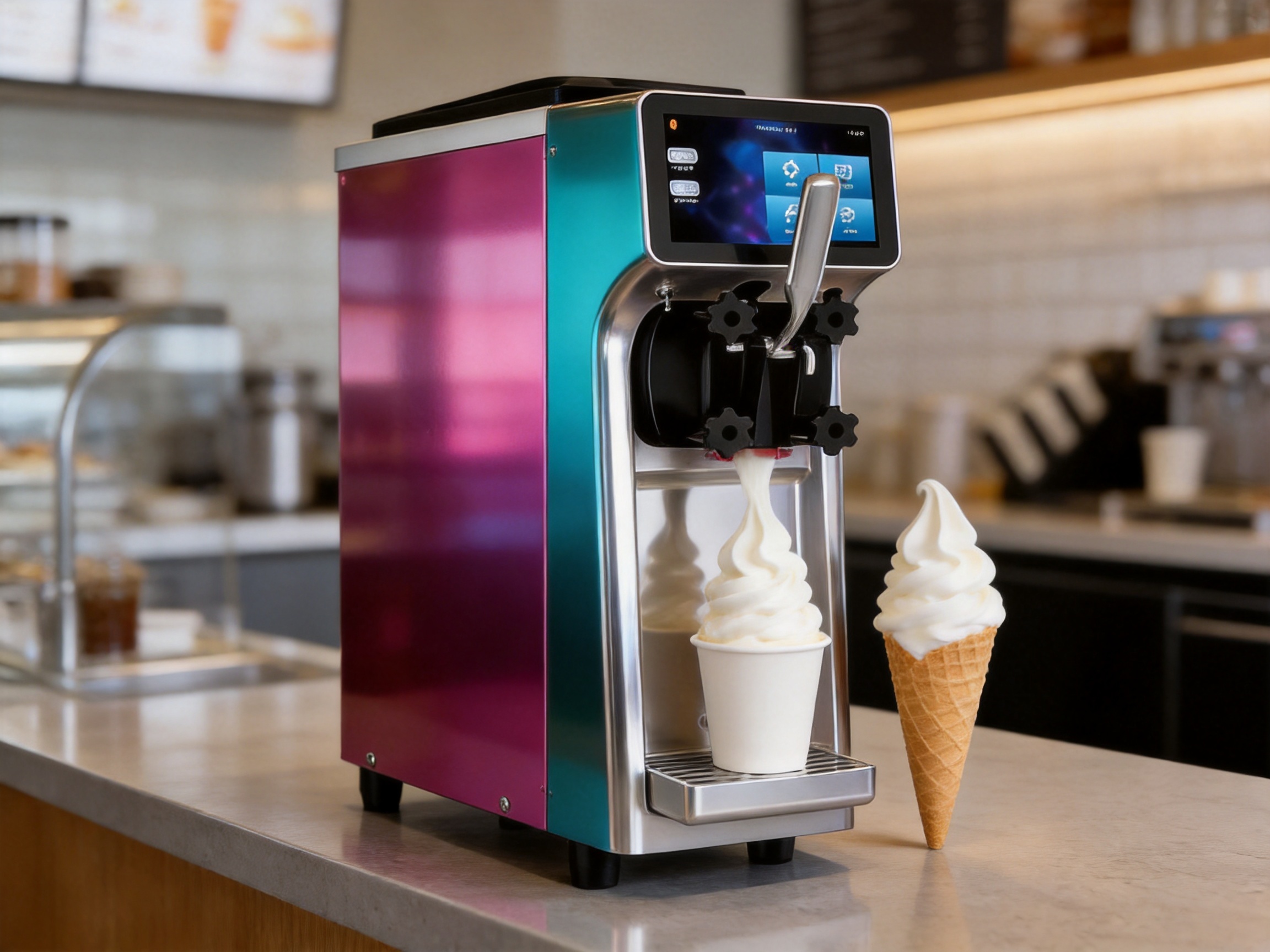
Self-Cleaning Function and Sanitation Efficiency
Sanitation is one of the most important considerations in any soft serve operation. Mix residue can remain in hoppers, freezing chambers, dispensing passages, seals, and other product-contact components. If cleaning is delayed or incomplete, residue may affect taste, texture, odor, hygiene, and equipment performance.
The BQL-9200ST includes a self-cleaning function intended to simplify the cleaning process. A self-cleaning cycle can help circulate water or an approved cleaning solution through relevant internal paths, reducing manual effort. It may also create a more consistent routine for staff members who need to perform cleaning at the end of each operating period.
Self-cleaning should be viewed as a support function rather than a complete replacement for manual disassembly and inspection. Product-contact parts, seals, dispensing components, and removable sections may still require cleaning according to the manufacturer’s instructions. Operators should verify which parts must be removed, brushed, rinsed, sanitized, lubricated, or replaced.
Recommended Cleaning Workflow
At the end of service, operators should first stop dispensing and follow the machine’s shutdown procedure. Remaining mix should be handled according to the approved food safety procedure. The machine can then be placed into the appropriate cleaning mode, and the recommended cleaning solution should be used at the correct concentration.
After the internal cycle, removable components should be inspected for residue. Seals and gaskets deserve particular attention because small amounts of product can remain around joints. Components should be rinsed thoroughly when required, sanitized using an approved product, and dried or reassembled according to the manual.
Cleaning records can improve accountability in multi-shift businesses. A simple checklist may include the date, operator name, cleaning cycle completion, component inspection, sanitizer use, and any observed issues. This supports consistent hygiene and can help management identify maintenance needs before they become service interruptions.
Compact Desktop Design and Space Efficiency
The desktop format is one of the machine’s strongest commercial advantages. Many small businesses have limited floor area, especially in urban cafés, bakeries, kiosks, convenience stores, and compact dessert counters. A countertop machine can use existing service space without requiring a dedicated floor-standing installation.
The stated dimensions place the machine within a compact commercial footprint, although the final dimensions should be confirmed because the supplied specifications include two different measurements. The approximate net weight of 45 kilograms gives the unit a substantial commercial structure while still allowing planned relocation by trained personnel when necessary.
Compared with a larger floor-standing soft serve machine, a desktop model can reduce the amount of space committed to one product category. This can leave room for refrigerators, topping stations, displays, payment equipment, or preparation areas. It is a practical choice when the goal is to add soft serve to an existing menu rather than build a dedicated frozen dessert production line.
Installation Planning
The countertop must be strong, level, dry, and capable of supporting the machine’s weight. Operators should allow sufficient clearance around ventilation openings and service panels. The machine should not be placed directly beside heat-producing cooking equipment unless the installation requirements specifically permit it.
There should also be enough space for staff to load mix, operate the dispensing area, remove components for cleaning, and access the power connection. A countertop that technically fits the machine but leaves no room for cleaning or ventilation may create operational problems.
Before shipment, commercial buyers should request an installation drawing, carton dimensions, gross shipping weight, voltage details, and recommended clearance. These details are especially important for international projects, where door sizes, elevators, electrical standards, and countertop construction may vary considerably.
Production Capacity and Small-Batch Economics
A stated capacity of 10 liters per hour makes the machine suitable for regular but controlled production. The actual number of servings depends on serving size. For example, if a business offers a 100-milliliter serving, one liter of mix may theoretically produce approximately ten servings before accounting for product loss, overrun, cleaning requirements, and portion variation. A 10-liter-per-hour reference capacity therefore represents meaningful output for a small shop.
Small-batch production can improve purchasing control. A business does not need to prepare or freeze more mix than it expects to sell. This can be helpful when demand is uncertain or when the menu includes multiple dessert options. Operators can adjust daily preparation according to weather, promotions, weekday traffic, and seasonal demand.
The production capacity should be matched to the business’s sales pattern. A café with a moderate number of dessert orders may benefit from the machine’s compact size and manageable capacity. A high-volume venue with long queues may require multiple machines, dual-flavor equipment, or a larger floor-standing model. Selecting a machine based only on maximum output can lead to unnecessary investment, while selecting one that is too small can create delays during peak periods.
| Business Type | Potential Suitability | Reason |
| Small café | High | Compact footprint and manageable daily production |
| Bakery or dessert counter | High | Supports an additional frozen dessert category |
| Small restaurant | High | Suitable for dessert service and combination dishes |
| Snack shop | High | Customer-facing design supports impulse sales |
| Seasonal kiosk | Moderate to high | Useful where demand is regular but space is limited |
| Large amusement venue | Moderate to low | May require greater capacity or multiple units |
| High-volume chain location | Case-dependent | Capacity and flavor configuration should be evaluated carefully |
Advantages Over Typical Entry-Level Alternatives
The BQL-9200ST offers several advantages over basic entry-level machines that may be designed primarily for occasional or light use. Its food-grade stainless steel body is more appropriate for professional foodservice than a purely domestic construction. Its LCD touch screen gives operators more visible control information than a simple switch panel. Its self-cleaning and pre-cooling functions address two daily operational challenges: sanitation and preparation time.
The desktop design is another important point of differentiation. Some commercial machines are powerful but difficult to place in small stores. A compact unit can provide a better return when the available service area is limited. Rather than paying for unused capacity, a buyer can choose equipment aligned with actual daily demand.
R290 refrigerant adds another modern feature. While refrigerant selection must always be evaluated alongside safety and service requirements, R290 is recognized as a lower-global-warming-potential option in many refrigeration applications. Its inclusion may appeal to businesses and project developers seeking more environmentally considerate refrigeration technology.
The machine also combines a visible commercial appearance with practical production functions. In a customer-facing environment, the equipment is not merely a hidden utility appliance. The stainless steel and colorful sprayed steel exterior can contribute to the visual presentation of the dessert station, helping the soft serve process become part of the customer experience.
Balanced Performance Rather Than Oversized Capacity
A common mistake in equipment purchasing is to compare machines only by their largest output number. An oversized machine may consume more space, require a greater investment, and be inefficient when daily demand is modest. The BQL-9200ST is positioned as a balanced solution for businesses that value manageable production, compact installation, convenient operation, and professional appearance.
Its 3.6-liter hopper and 1.6-liter freezing tank support a workflow suited to smaller batches. This can help reduce the operational risks associated with holding excessive product. For a small business testing a new dessert category, this balance may be more useful than the maximum capacity of a much larger system.
Manufacturing Strengths and Factory Capabilities
Spelor Electrical Appliances (Zhejiang) Co., Ltd. is described as a manufacturer integrating design, research and development, manufacturing, sales, and service. The company operates more than 60,000 square meters of modern production facilities and specializes in commercial refrigeration, kitchen equipment, and buffet equipment.
This broad manufacturing scope is relevant to buyers because commercial refrigeration equipment involves more than assembling an attractive cabinet. A reliable machine requires coordinated work across product design, sheet metal fabrication, refrigeration integration, electrical controls, assembly, inspection, packaging, and after-sales support.
An integrated factory structure can make communication more efficient. Engineering teams can evaluate product requirements, production teams can assess manufacturability, and sales or service teams can bring field feedback into future improvements. For OEM and ODM buyers, this structure can be valuable when a project requires changes to dimensions, exterior colors, labels, controls, packaging, electrical standards, or product configuration.
Design and Research and Development
Product development for commercial food equipment must consider the entire operating life of the machine. Designers need to evaluate operator access, cleaning paths, ventilation, component placement, control usability, transport stability, and service access. A desktop soft serve machine must also balance internal refrigeration space with external dimensions and countertop ergonomics.
The company’s stated design and research capabilities support the development of equipment for different foodservice environments. Buyers with specific requirements can provide drawings, technical specifications, target capacity, regional voltage information, branding requirements, and installation limitations for evaluation.
OEM and ODM cooperation may be particularly relevant to distributors, regional equipment suppliers, restaurant groups, and foodservice projects. A customized product may include a different exterior color, private label, control language, packaging design, electrical configuration, or mounting arrangement. All customization should be confirmed through technical documentation and an approved sample or production specification.
Manufacturing and Assembly Coordination
The production of a stainless steel refrigeration appliance generally involves several coordinated stages. These may include material preparation, sheet metal cutting, forming, surface treatment, cabinet assembly, refrigeration component installation, electrical wiring, control panel integration, insulation work, testing, cleaning, and packaging.
Consistent assembly is important because small variations can affect door or panel alignment, ventilation, wiring protection, seal performance, and serviceability. A factory with dedicated production infrastructure can establish repeatable work instructions and inspection points for each stage.
For international buyers, manufacturing strength also includes the ability to prepare export packaging and documentation. Commercial machines may need protection against vibration, moisture, handling impact, and long-distance transport. Packaging design should take account of the machine’s weight, dimensions, vulnerable control areas, and refrigeration components.
Quality and Process Management
Although specific certifications and inspection records should be confirmed for each order, a professional manufacturing process should include systematic quality checks. These may include visual inspection of stainless steel surfaces, verification of dimensions, electrical safety checks, refrigeration performance tests, control panel testing, cleaning-cycle verification, noise evaluation, and final packaging inspection.
Buyers should ask for the applicable quality documents, test procedures, warranty terms, spare parts policy, and service response process before purchase. For larger projects, pre-shipment inspection or third-party inspection may also be considered.
The company’s product range includes ice cream machines, juice dispensers, fried ice cream machines, refrigeration cabinets, slush machines, flake ice machines, cooking equipment, griddles, fryers, insulation products, barbecue equipment, and buffet solutions. This range indicates experience across multiple foodservice equipment categories and can simplify procurement for customers developing a complete commercial kitchen or dessert business.
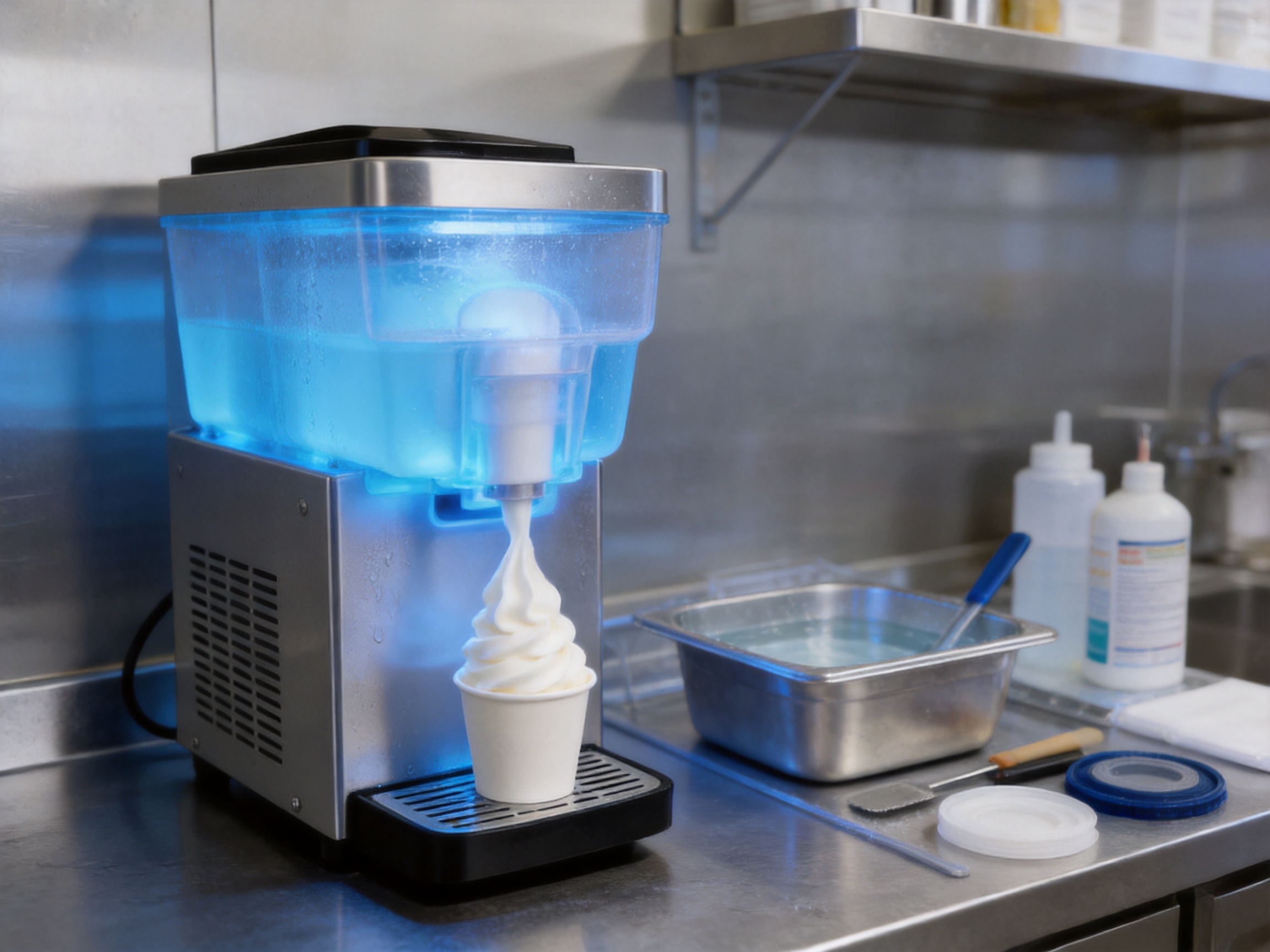
OEM and ODM Cooperation
OEM and ODM services can help customers obtain equipment that fits a particular market or business model. A distributor may require a private label and specific packaging. A restaurant group may need a consistent color scheme across several stores. A project contractor may require a precise countertop dimension. A regional buyer may need a different electrical standard or documentation package.
The supplier’s stated OEM and ODM capability is based on drawings or customer requirements. A successful customization project should begin with a clear technical brief. This brief may include the desired capacity, hopper arrangement, freezing tank size, exterior materials, color, control interface, voltage, frequency, plug type, refrigerant requirements, dimensions, logo placement, packaging, and delivery schedule.
Customers should distinguish between cosmetic customization and technical customization. Changing a logo or color is usually different from changing the refrigeration capacity, control logic, tank volume, or machine dimensions. Technical changes may affect testing, certification, lead time, minimum order quantity, spare parts, and warranty conditions.
One-Stop Service for International Buyers
The company describes its support as including pre-sales consultation, product customization, flexible logistics and payment solutions, and after-sales maintenance. This one-stop approach can reduce the number of suppliers involved in a project and make communication more direct.
International buyers should provide accurate destination information, expected annual quantity, import requirements, and intended installation environment. They should also confirm whether the machine is being purchased for direct operation, resale, rental, catering, or a multi-location project. The correct configuration may differ according to the final use.
After-sales planning should include replacement seals, cleaning tools, electrical components, control parts, refrigeration service procedures, and technical documentation. A buyer that plans spare parts in advance can reduce downtime and improve long-term operating reliability.
Recommended Operating Practices
Before first use, the machine should be positioned on a stable countertop, checked for transport damage, and allowed to settle according to the supplier’s transport instructions. The electrical supply should be verified, and the ventilation area should remain unobstructed.
Operators should prepare the soft serve mix according to the ingredient supplier’s instructions. The mix should be thoroughly blended, stored under the required conditions, and loaded into the hopper without introducing unnecessary contamination. Ingredients with unsuitable viscosity, excessive particulates, or incorrect formulation may affect freezing and dispensing performance.
The machine should be allowed to reach the appropriate operating condition before service begins. Operators should monitor product consistency during the first servings and make adjustments only through approved controls or mix procedures. Staff should avoid forcing the dispensing handle, blocking ventilation openings, or operating the machine with insufficient mix if the manual prohibits that condition.
During service, the dispensing area should be kept clean. Drips should be removed promptly, and serving utensils should be handled hygienically. Staff should monitor the product level, listen for abnormal sounds, observe error indicators, and report unusual temperature or performance changes.
At closing, the machine should be cleaned according to the approved procedure. The self-cleaning function should be used correctly, and manual cleaning should be completed where required. The machine should not be left with unapproved residue or standing water in areas that require drying.
Maintenance and Long-Term Reliability
Regular maintenance helps preserve cooling performance, hygiene, and service life. Operators should inspect seals, dispensing components, hopper areas, electrical cables, ventilation openings, and exterior surfaces. Any component showing cracking, excessive wear, leakage, or deformation should be evaluated by qualified service personnel.
The condenser and ventilation areas should be kept free of dust and grease. Restricted airflow can increase refrigeration load and reduce cooling efficiency. The cleaning frequency should reflect the operating environment. A machine installed near fryers or grills may require more frequent attention than one installed in a clean café counter.
R290 refrigeration systems require qualified service. Technicians should follow appropriate procedures for flammable refrigerants and use compatible tools and replacement components. Operators should not open the refrigeration circuit or attempt to recharge the system without professional authorization.
A maintenance record can help identify patterns. The record may include cleaning dates, observed temperatures, error messages, replacement parts, service visits, and unusual operating conditions. Such records are useful for both internal management and warranty communication.
How to Evaluate the Machine for a Business
Businesses should begin with demand forecasting. Estimate the number of servings sold during normal periods and peak periods, then compare the expected mix requirement with the 10-liter-per-hour reference capacity. Consider serving size, menu pricing, operating hours, and whether soft serve will be the main product or an additional menu item.
Next, evaluate the installation location. Measure the available counter space, access route, doorways, elevator, storage area, and service clearance. Confirm the final machine dimensions because the supplied product records contain two different dimension references.
Electrical compatibility should be confirmed before shipment. The buyer should obtain the rated voltage, frequency, current, plug, circuit protection, and grounding requirements for the intended market. If the equipment is part of an international project, these details should be reviewed by a qualified local electrician.
Finally, evaluate the total cost of ownership. Purchase price is only one part of the decision. Consider shipping, installation, mix ingredients, cleaning chemicals, labor, electricity, preventive maintenance, replacement parts, downtime risk, and warranty support. A machine with convenient cleaning and a compact design may provide value by reducing labor and space costs, even if a simpler model has a lower initial price.
Why This Model Fits Compact Commercial Operations
The BQL-9200ST is best understood as a practical entry point into professional soft serve production. It is not positioned as a high-output industrial system, but as a compact commercial appliance that brings professional construction and operating features to smaller businesses.
Its principal strengths are clear: food-grade stainless steel construction, an attractive sprayed steel exterior, LCD touch control, self-cleaning, pre-cooling, R290 refrigerant, a 1,000-watt input rating, and a 10-liter-per-hour reference capacity. These features address the most common concerns of small foodservice operators: hygiene, appearance, ease of use, refrigeration stability, and limited space.
The machine can also support business experimentation. A café may add soft serve during summer, a bakery may test frozen desserts, or a snack shop may develop a new product line. Because the equipment is compact and designed for small-batch production, it can help businesses introduce the category without immediately committing to a large production system.
For larger buyers, the model may serve as part of a broader equipment program. Multiple units can potentially support separate locations or service zones, subject to project requirements and supplier confirmation. The manufacturer’s wider product range may also allow buyers to coordinate soft serve equipment with juice dispensers, slush machines, ice makers, refrigeration cabinets, and other foodservice products.
Q&A
What type of business is the BQL-9200ST designed for?
It is designed for small commercial foodservice environments such as cafés, bakeries, dessert shops, snack shops, small restaurants, and compact customer-facing counters. Its desktop format and 10-liter-per-hour reference capacity make it suitable for controlled daily production rather than extremely high-volume service.
How much soft serve can the machine produce?
The stated production capacity is 10 liters per hour. Actual output depends on mix formulation, ambient conditions, inlet temperature, serving size, operating cycle, voltage stability, and dispensing frequency. Buyers should confirm test conditions with the supplier when capacity is critical to a project.
Is the machine suitable for a countertop installation?
Yes. It is designed as a desktop unit. The countertop must be stable, level, strong enough to support approximately 45 kilograms, and large enough to provide operating and ventilation clearance. Final dimensions should be confirmed because two dimension records are provided in the product information.
What material is used for the machine body?
The plate body is made of food-grade stainless steel and colorful sprayed steel. This combination provides a professional appearance, corrosion resistance, and a surface that can be cleaned as part of a regular foodservice sanitation routine.
Does the machine have automatic cleaning?
The machine includes a self-cleaning function. However, operators should follow the complete cleaning procedure in the user manual. Self-cleaning may need to be supplemented by manual removal, brushing, inspection, sanitizing, drying, and lubrication of designated components.
What is the function of pre-cooling?
Pre-cooling keeps the mix cool before or between production stages. It can help support product freshness management and reduce preparation time during intermittent service. The supplied material states that it can keep product fresh for up to one week, but businesses must follow applicable food safety rules and ingredient supplier instructions.
What refrigerant does the machine use?
The machine uses R290 refrigerant. R290 is a natural refrigerant with a low global warming potential, but it is flammable. Refrigeration service and repairs must be performed by qualified technicians using suitable procedures and components.
What compressor is installed?
The supplied specification identifies a Chinese compressor. Buyers requiring a specific compressor brand, performance standard, or regional service arrangement should confirm the available configuration with the manufacturer before ordering.
Is the machine suitable for several flavors?
The listed configuration has one 3.6-liter hopper and one 1.6-liter freezing tank, indicating a single-flavor configuration. Buyers needing two or more flavors should request information about alternative models or customized configurations.
Can the machine be customized?
The manufacturer offers OEM and ODM cooperation based on drawings or requirements. Potential customization may include branding, exterior color, packaging, dimensions, electrical configuration, control requirements, or other approved technical details. Each change should be confirmed in a formal specification because it may affect cost, lead time, testing, and minimum order quantity.
What should be confirmed before purchase?
Buyers should confirm final dimensions, voltage, frequency, plug type, production conditions, warranty, spare parts, cleaning procedures, shipping details, packaging, installation clearance, and after-sales service. They should also confirm whether the machine satisfies the regulations and electrical requirements of the destination market.
Why is stainless steel important in a soft serve machine?
Stainless steel is durable, corrosion-resistant, visually professional, and relatively easy to clean. These characteristics are useful in foodservice environments where the machine may be exposed to moisture, mix residue, repeated wiping, and customer observation.
Can the machine be used in a high-volume chain?
It may be suitable for selected locations, seasonal service, or supplementary dessert stations, but a high-volume chain should compare peak demand with the machine’s 10-liter-per-hour reference capacity. Multiple machines or a larger model may be needed for locations with sustained heavy traffic.
Conclusion
The Food-Grade Stainless Steel Commercial Desktop Soft Serve Ice Cream Machine is a compact commercial solution for businesses that want professional soft serve capability without dedicating a large floor area to heavy equipment. Its food-grade stainless steel construction supports hygiene and durability, while the colorful sprayed steel exterior gives it a more attractive customer-facing appearance.
The LCD touch screen, intelligent operation, self-cleaning function, and pre-cooling feature are designed to simplify daily work. The 10-liter-per-hour reference capacity, 3.6-liter hopper, and 1.6-liter freezing tank create a sensible configuration for small-batch production and controlled service. The 1,000-watt input rating and R290 refrigerant further support a modern compact refrigeration design, subject to correct installation and qualified maintenance.
Behind the product is a manufacturer with integrated design, research and development, production, sales, and service capabilities, more than 60,000 square meters of modern production facilities, and a broad foodservice equipment portfolio. This combination is valuable for individual operators, distributors, restaurant groups, and international buyers seeking OEM or ODM cooperation.
For the best purchasing decision, customers should match the machine’s capacity to actual demand, confirm the final dimensions and electrical specifications, plan ventilation and cleaning access, and establish after-sales support before ordering. When these factors are properly managed, the BQL-9200ST can provide a practical foundation for reliable soft serve production in cafés, bakeries, dessert counters, snack shops, and other compact commercial foodservice environments.
References
1. Product specification sheet for the BQL-9200ST commercial desktop soft serve ice cream machine.
2. Manufacturer-provided information regarding food-grade stainless steel construction, LCD touch control, self-cleaning, and pre-cooling functions.
3. Manufacturer-provided company profile describing commercial refrigeration, kitchen equipment, buffet equipment, OEM, ODM, and after-sales capabilities.
4. General commercial refrigeration equipment operating and maintenance principles.
5. General foodservice sanitation and soft serve equipment cleaning practices.
6. General technical guidance concerning the use, handling, and service requirements of R290 refrigerant.
7. General food safety principles for the storage, handling, and service of prepared frozen dessert mixes.
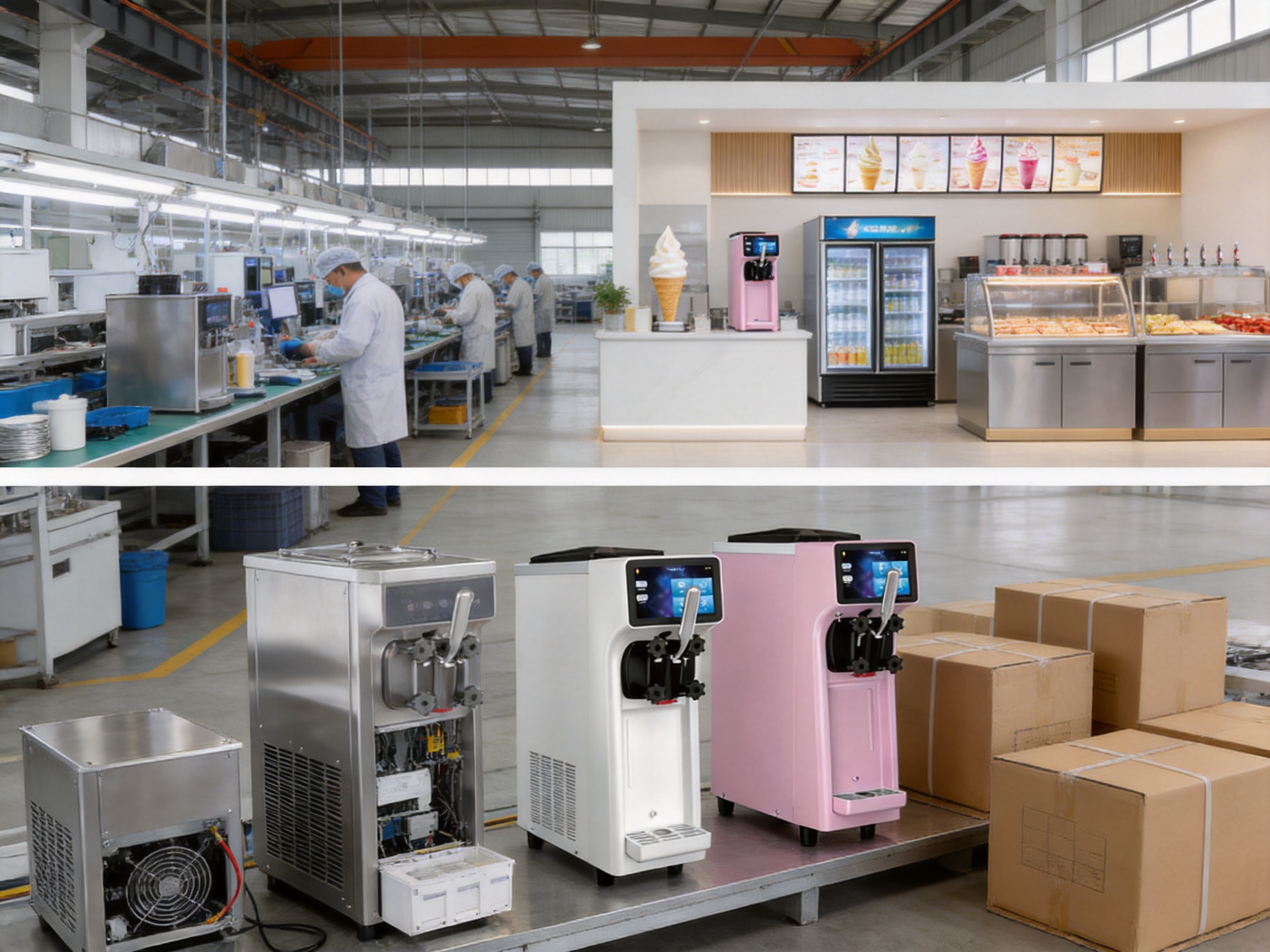
Product: Food-Grade Stainless Steel Commercial Desktop Soft Serve Ice Cream Machine
For exclusive deals and latest offers, sign up by entering your email address below.


-
spelor@spelor.com
-
+86-576-85229688
-
No.528, Changxi Road, Linhai City, Zhejiang Province, China
Commercial Refrigeration Equipment Manufacturer China
Copyright © 2025 by Spelor Electrical Appliances (Zhejiang) Co., Ltd. Rights Reserved.
