


 中文简体
2×15L Commercial Slush Machine for High-Volume Beverage Service
Admin 2026-08-21Commercial beverage operations need equipment that can deliver consistent results throughout long service periods. Bars, cafés, restaurants, dessert shops, convenience stores, hotels, and catering businesses often serve frozen drinks in high quantities, especially during warm seasons and peak business hours. A commercial slush machine must therefore do more than freeze a beverage. It must support continuous operation, maintain a stable texture, allow efficient flavor management, and remain practical to clean, operate, and maintain.
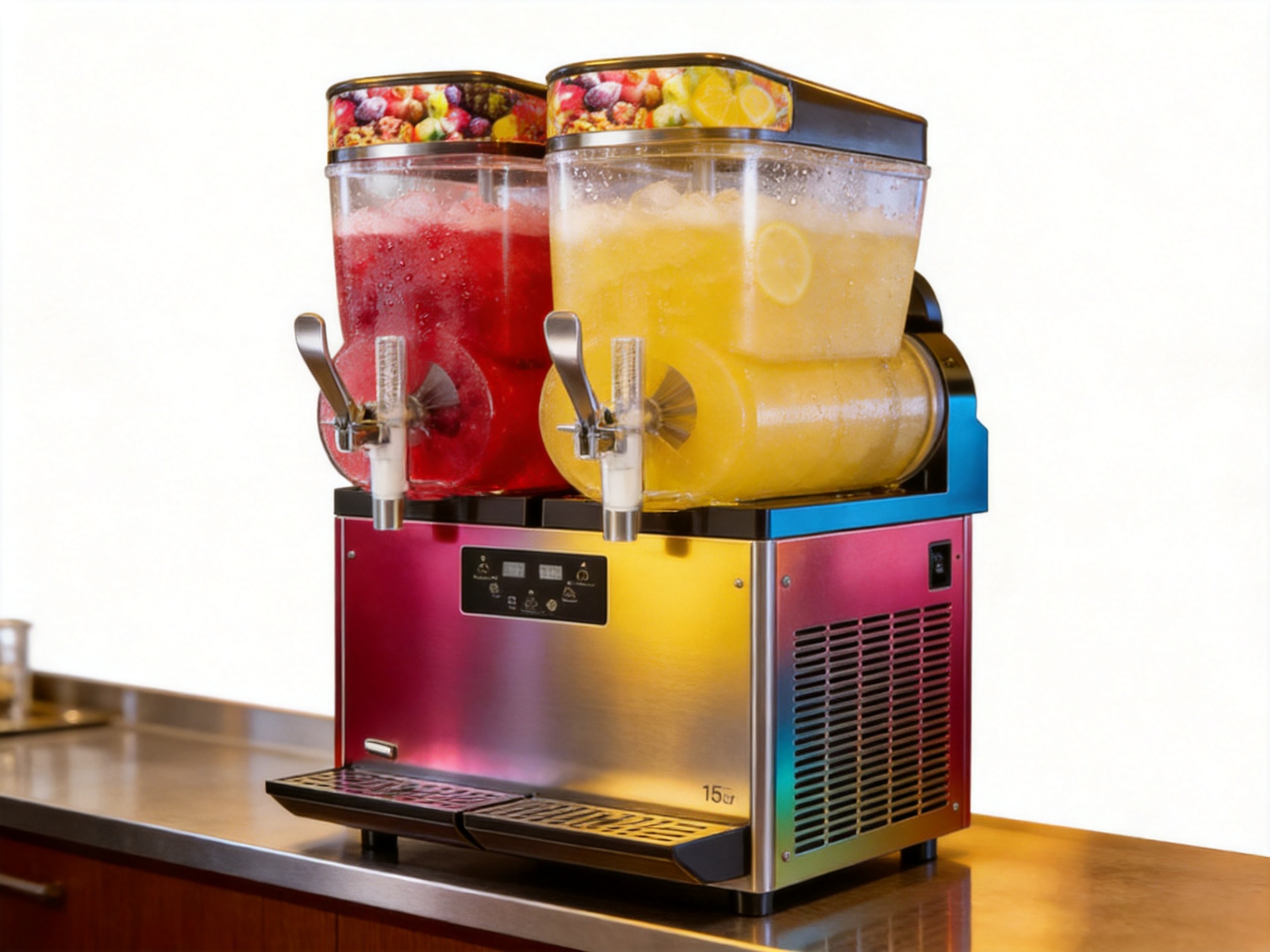
The XN240A 2×15L commercial slush machine is designed for these demanding foodservice environments. With two independent 15-liter tanks, the machine provides a total capacity of 30 liters and enables operators to prepare two flavors or recipes at the same time. Its 1,000-watt rated output, food-grade stainless-steel plate body, colorful sprayed steel construction, R290 refrigerant, and sturdy commercial structure provide a balanced combination of capacity, durability, operating efficiency, and presentation appeal.
Manufactured by Spelor Electrical Appliances (Zhejiang) Co., Ltd., this unit reflects the company’s broader experience in commercial refrigeration, kitchen equipment, buffet equipment, and foodservice machinery. The manufacturer operates modern production facilities covering more than 60,000 square meters and integrates product design, research and development, manufacturing, sales, and service. This integrated structure supports consistent production, product customization, export supply, and after-sales assistance for foodservice customers worldwide.
For businesses comparing commercial slush machines, the XN240A offers a practical solution for applications that require multiple flavors, reliable cooling, easy service access, and a professional counter presentation. Its design is especially suitable for operators who want more flexibility than a single-tank machine while maintaining a compact footprint for a commercial-grade appliance.

2*15L Sturdy Durable Commercial Slush Machine for Bar Cafe Restaurant
Product Overview
The XN240A is a dual-tank commercial slush machine with two 15-liter containers. Each tank can be used for a different beverage flavor, recipe, or product variation. This makes it possible to serve two popular options simultaneously without purchasing or installing two separate machines.
The total tank capacity is 2×15 liters, or 30 liters. This capacity is appropriate for establishments that experience steady customer traffic and need a larger frozen beverage reserve than countertop or small-volume units can provide. The dual-tank format also helps businesses expand their menu without requiring additional floor space for another complete machine.
| Product Specification | Details |
| Model | XN240A |
| Tank configuration | 2 tanks |
| Tank capacity | 2×15 liters |
| Total nominal capacity | 30 liters |
| Rated output | 1,000 watts |
| Refrigerant | R290/R290a |
| Net weight | 45 kg |
| Machine dimensions | 414×550×824 mm |
| Recommended applications | Bars, cafés, restaurants, dessert shops, snack shops, catering venues, and other foodservice locations |
The machine body combines food-grade stainless steel with colorful sprayed steel. Stainless steel is widely used in commercial food equipment because it offers a sanitary, durable, and easy-to-maintain surface. The sprayed steel components contribute to the machine’s visual appeal and allow the unit to fit into different commercial interiors, from modern cafés to colorful dessert counters.
With a net weight of approximately 45 kilograms and dimensions of 414×550×824 millimeters, the XN240A is designed as a substantial commercial appliance without occupying the space associated with multiple separate units. Its vertical structure makes effective use of counter and floor area, while the two visible tanks can help customers identify available flavors quickly.
Why Dual-Tank Capacity Matters in Commercial Service
A single-tank slush machine can be suitable for a narrow menu, but it limits the number of frozen beverage choices available at one time. A dual-tank unit provides a more flexible service model. One tank can hold a fruit-based slush while the other contains a cola-style drink, lemonade, specialty cocktail base, or seasonal recipe. Operators can also use one tank for a standard best-selling flavor and the second tank for rotating promotions.
The 2×15-liter configuration is particularly useful for businesses that want to balance capacity with menu variety. A larger single tank may provide volume, but it does not necessarily provide choice. Two independent tanks enable operators to respond to different customer preferences and create a more attractive product display.
Dual-tank capacity can also improve workflow. Staff members do not need to empty, sanitize, and refill one container every time the business changes flavors. Instead, two products can remain available during the same service period. This is helpful during lunch, dinner, weekend, event, and seasonal rushes when interruptions can reduce sales and create queues.
For businesses with multiple service periods, the two-tank structure can support differentiated preparation. For example, a café may offer a non-carbonated fruit slush in one tank and a traditional frozen soft drink in the other. A restaurant may offer a family-friendly beverage in one tank and an adult-oriented frozen cocktail base in the second, subject to local regulations and recipe requirements. A dessert shop may use the two sides for contrasting colors and flavors to create a stronger visual presentation.
Compared with purchasing two independent single-tank machines, one dual-tank unit can simplify installation, staff training, cleaning routines, and equipment management. It also reduces the need to allocate separate counter positions and electrical arrangements for two complete machines. The precise operational benefit depends on the business layout and recipe program, but the dual-tank format provides a strong foundation for efficient service.
Stable Cooling for Consistent Frozen Beverage Texture
Frozen beverage quality depends on more than temperature alone. A commercially successful slush product should have a smooth, attractive, and consistent texture rather than becoming excessively liquid or freezing into a hard block. Stable cooling and continuous mixing work together to support an even product condition within each tank.
The XN240A is designed for efficient cooling and even mixing. As the beverage is cooled, the mixing action helps distribute temperature throughout the product and supports a more uniform texture. This is important because areas near a cooling surface can become colder than areas farther away. Consistent circulation helps reduce uneven freezing and allows the product to remain more suitable for dispensing.
The 1,000-watt rated output provides the power platform required for commercial cooling and mixing performance. Actual operating results depend on ambient temperature, initial beverage temperature, recipe composition, sugar content, serving frequency, ventilation, and maintenance condition. Nevertheless, the rated output is appropriate for a machine intended to serve commercial beverage operations rather than occasional household use.
Stable operation is especially important during peak periods. When customers are served continuously, the machine must recover effectively after repeated dispensing. A reliable cooling system helps maintain the desired product condition while the tanks are being replenished with warm or room-temperature liquid. Operators should always follow appropriate preparation procedures, avoid overfilling, and use recipes compatible with the machine’s intended application.
Consistent product texture can also reduce waste. If a drink becomes too thin, too hard, or unevenly frozen, staff may need to adjust it, discard it, or interrupt service. A machine that supports stable freezing and mixing can help reduce these operational disruptions and improve the repeatability of each serving.
Food-Grade Materials and Sanitary Construction
Commercial beverage equipment comes into direct or indirect contact with food and drink ingredients, so material selection is an important part of safe and efficient operation. The XN240A uses a food-grade stainless-steel plate body together with sprayed steel construction. This combination is intended to provide a sanitary exterior and a durable commercial structure.
Stainless steel is valued in foodservice environments for its resistance to corrosion, smooth surface, and relatively simple cleaning requirements. It can be wiped down efficiently during routine service and is compatible with standard cleaning procedures when the appropriate products are used. Its professional appearance also helps the equipment maintain a clean and organized visual impression in front-of-house areas.
The colorful sprayed steel components give the machine a more distinctive appearance than plain industrial equipment. A commercial appliance often forms part of the customer-facing environment, especially when it is positioned on a beverage counter. A visually attractive machine can reinforce the product display and help draw attention to the frozen beverage offering.
Sanitary construction must be supported by correct operating procedures. Staff should clean tanks, dispensing components, seals, and mixing areas according to a documented schedule. Beverage residues should not be allowed to build up. Cleaning frequency should be adjusted according to the type of recipe, sugar content, dairy content, usage level, and local food safety requirements.
The materials used in the machine provide a suitable foundation for hygiene, but they do not replace proper sanitation. Operators should use approved cleaning agents, rinse components thoroughly, inspect seals regularly, and follow the manufacturer’s instructions for disassembly and reassembly. A clean machine protects beverage quality, reduces odor, supports equipment performance, and helps extend service life.
Commercial Construction for High-Frequency Environments
Commercial foodservice equipment must withstand repeated operation, frequent handling, and demanding working conditions. The XN240A is described as having a sturdy structure suitable for high-frequency production environments. Its design is intended for businesses that need dependable equipment during extended operating hours rather than occasional domestic use.
The machine’s 45-kilogram net weight reflects a substantial commercial build. A stable appliance is less likely to move during normal dispensing and cleaning activities, provided it is installed on a suitable, level surface. Its vertical format also creates a clear and organized arrangement for two tanks while maintaining a manageable footprint.
Durability is influenced by the complete equipment system, including the body materials, cooling components, mixing mechanism, electrical design, assembly quality, and maintenance program. Spelor’s integrated manufacturing model allows these areas to be coordinated under one organization. The company’s design, research and development, manufacturing, sales, and service functions work together to support product development and customer requirements.
For distributors and foodservice equipment buyers, manufacturing integration is an important consideration. It can simplify communication during product selection, customization, quality coordination, packaging, shipment, and after-sales support. Instead of relying on disconnected suppliers for different stages, customers can work with a manufacturer that understands the product from design through service.
Long-term durability does not mean that maintenance can be ignored. Commercial refrigeration equipment performs best when ventilation openings remain unobstructed, electrical connections are properly installed, tanks are cleaned, and service inspections are performed when required. Correct use helps protect the equipment from avoidable stress and contributes to a longer operating life.
R290 Refrigerant and Refrigeration Considerations
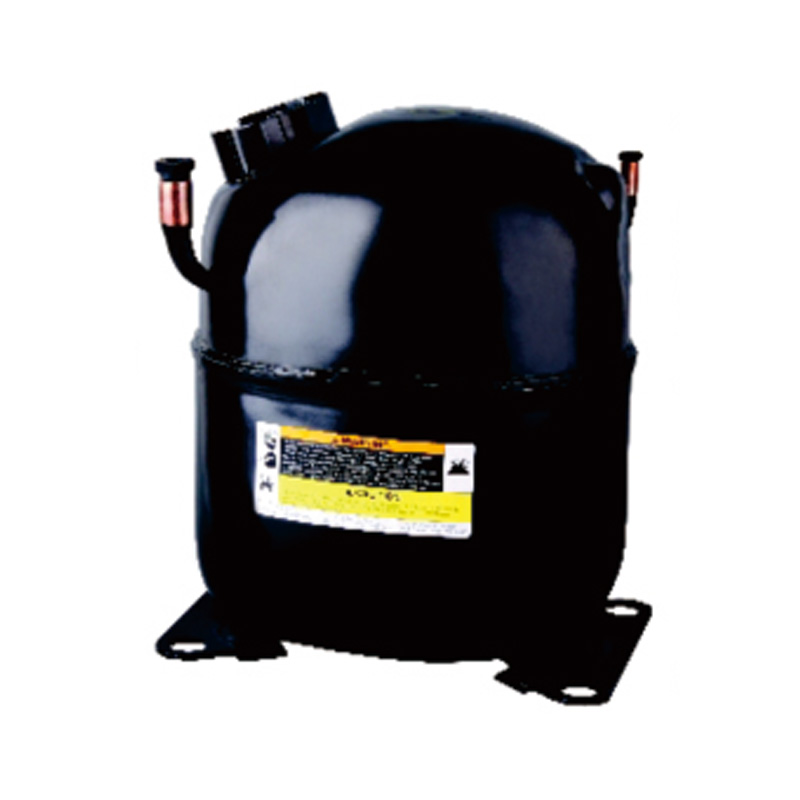
The XN240A uses R290 refrigerant, also identified in the supplied product information as R290a. R290 is propane refrigerant, a refrigerant type used in various modern commercial refrigeration applications. It is recognized for its low global warming potential compared with many older refrigerant options, although it is classified as flammable and must be handled according to applicable safety standards.
The use of R290 reflects the continuing development of refrigeration systems toward refrigerants with lower environmental impact. For commercial buyers, refrigerant selection can be relevant to sustainability goals, regulatory compliance, service planning, and long-term equipment strategy.
Because R290 is flammable, installation, repair, refrigerant recovery, and charging should be performed by qualified technicians who understand the relevant requirements. Operators should not attempt to open the refrigeration circuit or perform unauthorized modifications. The machine should be positioned and used in accordance with the manufacturer’s instructions and local electrical and safety regulations.
R290 performance depends on the refrigeration system as a whole. Adequate airflow around the machine, suitable ambient conditions, correct electrical supply, and regular condenser maintenance are all important. If the condenser becomes blocked by dust or grease, heat rejection can become less effective and the machine may require more time to achieve the desired product condition.
Space Efficiency and Counter Presentation
Commercial premises often have limited space. Every appliance must contribute to the business without creating unnecessary congestion behind the counter or in the customer service area. The XN240A measures 414×550×824 millimeters, giving operators a clear basis for planning installation and counter placement.
The machine’s compact width and depth relative to its 30-liter total capacity make it suitable for many beverage counters. Its upright design allows the two tanks to be arranged vertically within one appliance footprint. This can be more space-efficient than installing two separate single-tank units side by side.
Before installation, operators should measure doorways, counters, service corridors, storage areas, and the final operating position. Sufficient clearance should be provided for ventilation, cleaning, maintenance, and safe staff movement. The machine should be placed on a stable and level surface that can support its operating weight and any associated counter loads.
The colorful sprayed steel exterior can support product merchandising. Frozen beverages are highly visual products, and a well-presented machine can make flavors easier for customers to notice. In a café, snack shop, or bar, the equipment can become part of the service display rather than remaining hidden in a back-of-house area.
Visual presentation should be combined with clear labeling. Operators can identify each tank with flavor names, ingredients, allergen information where applicable, pricing, and serving suggestions. This reduces customer uncertainty and helps staff explain the available choices quickly.
Applications Across Foodservice Businesses
Bars and Beverage Lounges
Bars can use the dual-tank configuration to offer two frozen beverage options during busy service periods. One tank may be dedicated to a popular standard recipe while the other supports a seasonal or promotional option. When alcoholic recipes are used, operators must ensure that the formula is compatible with the machine and complies with local licensing and food safety requirements.
The machine can support faster service by keeping the product prepared and ready for dispensing. This is valuable during events, themed nights, warm-weather promotions, and high-traffic evening periods. The two visible tanks also make it easier for customers to compare flavors before ordering.
Cafés and Dessert Shops
Cafés and dessert shops can use the XN240A to expand beyond hot beverages, chilled drinks, and standard soft drinks. Fruit slushes, lemon-based beverages, colorful dessert drinks, and seasonal flavors can create additional sales opportunities. The two-tank structure allows a business to offer contrasting products, such as a sweet berry flavor and a refreshing citrus flavor.
Because dessert businesses often emphasize appearance, the colorful exterior and transparent product tanks can support a lively counter presentation. Staff can coordinate the frozen beverage menu with ice cream, fried ice cream rolls, waffles, crepes, and other dessert products.
Restaurants and Fast-Food Locations
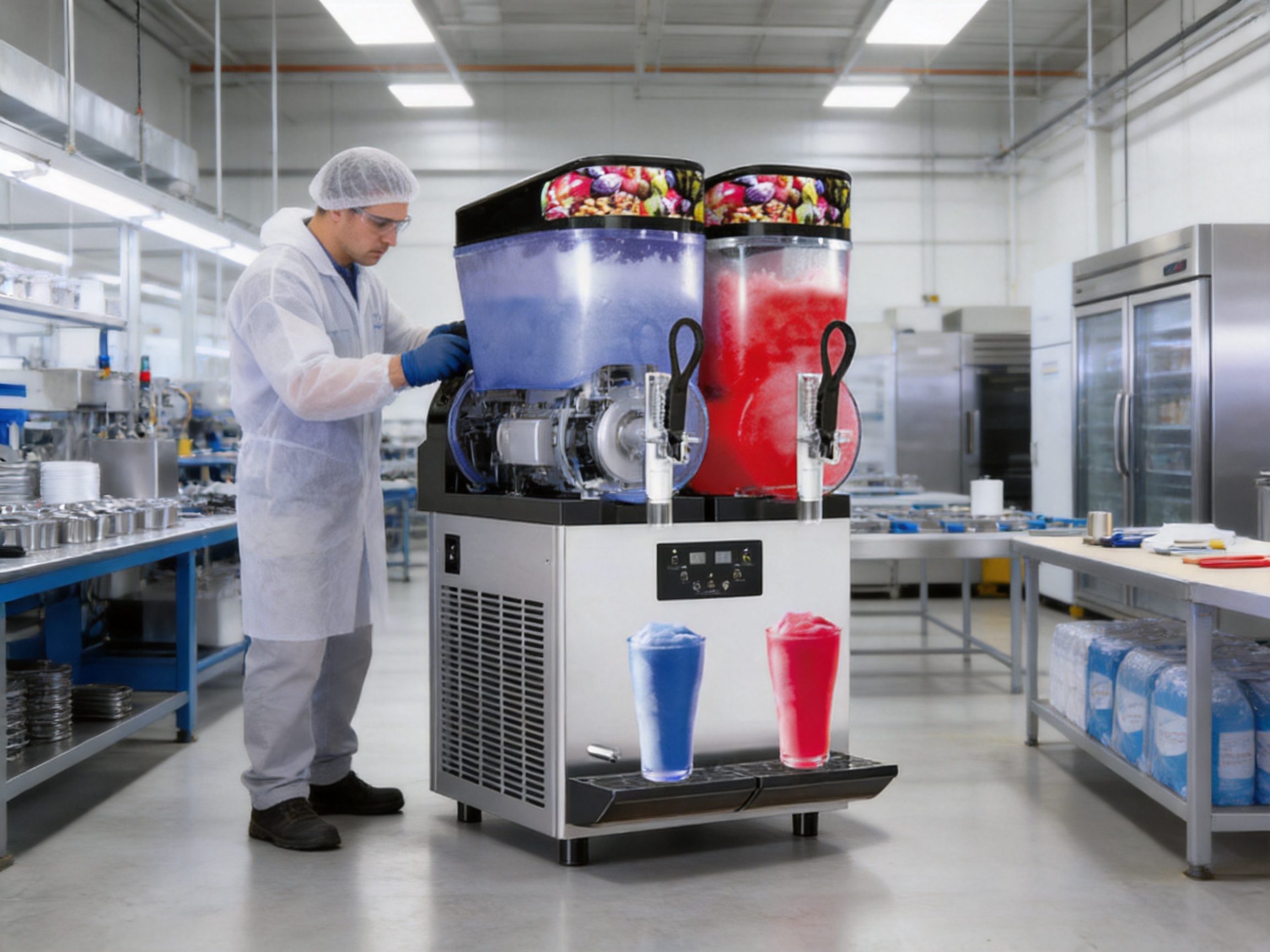
Restaurants can use the machine to provide frozen beverages alongside meals. A dual-tank unit may be used for two drink choices, a regular and a sugar-reduced option where recipes allow, or a standard flavor and a limited-time promotion. Its 30-liter capacity can support steady service while reducing the need for frequent small-batch preparation.
Fast-food locations often value speed, repeatability, and straightforward staff procedures. A machine that provides a consistent product condition and two flavor choices can help standardize service across shifts. Staff training should include safe filling, dispensing, cleaning, product rotation, and response procedures for unusual operating conditions.
Snack Shops and Convenience Stores
Snack shops and convenience stores frequently depend on impulse purchases. A visible slush machine can attract attention, especially during warm weather and high-footfall periods. The two-tank layout gives customers a choice and can encourage combination purchases when paired with snacks, sandwiches, fried foods, or desserts.
Convenience-focused operations can benefit from the machine’s straightforward commercial format. Staff can prepare the tanks according to anticipated demand, monitor product levels during service, and clean the equipment according to a shift-based schedule.
Catering and Event Service
For catering operators and event venues, two-flavor production can simplify beverage planning. The machine may be suitable for fixed event counters, banquet areas, recreational venues, and seasonal outdoor operations when the installation environment meets the required electrical, ventilation, and safety conditions.
Event operators should plan transportation carefully because the machine weighs approximately 45 kilograms. It should be moved securely, protected from impact, and installed on a level surface. The refrigeration system should be allowed to settle for the period recommended by the manufacturer after transportation before operation begins.
Advantages Compared with Common Alternatives
When comparing the XN240A with other commercial slush machine formats, buyers should evaluate capacity, tank configuration, materials, refrigerant, dimensions, service requirements, and supplier support rather than focusing only on purchase price.
| Comparison Factor | XN240A Dual-Tank Machine | Typical Single-Tank Unit | Operational Consideration |
| Flavor availability | Two flavors at the same time | One flavor at a time | Dual tanks provide greater menu flexibility |
| Total stated capacity | 30 liters | Often lower, depending on model | Larger reserve can support higher demand |
| Space use | One appliance footprint | One appliance per flavor | One dual-tank machine may reduce equipment duplication |
| Body construction | Food-grade stainless steel and sprayed steel | Varies by supplier and model | Material quality affects hygiene, durability, and appearance |
| Refrigerant | R290/R290a | Varies by model | Refrigerant choice affects service and environmental considerations |
| Commercial use | Designed for high-frequency production | May be intended for light or commercial use | Application rating should match expected workload |
| Menu presentation | Two visible product options | Usually one visible option | More choices can improve customer engagement |
Compared with a single-tank machine, the clearest advantage is simultaneous variety. Compared with two separate single-tank machines, the dual-tank design may offer a more unified appearance and simpler equipment arrangement. Compared with lightweight consumer equipment, the XN240A is built around a larger capacity and a commercial operating concept.
These advantages should be considered together with the needs of the specific business. A small location with limited demand may not require 30 liters of capacity, while a busy venue may need even greater production or multiple machines. The correct choice depends on sales volume, menu design, available space, power supply, staff capacity, and service schedule.
Manufacturing Strengths Behind the Product
Spelor Electrical Appliances (Zhejiang) Co., Ltd. is a professional manufacturer integrating design, research and development, manufacturing, sales, and service. This business structure is significant because commercial equipment performance depends on coordination between engineering decisions, component selection, production control, testing, packaging, installation guidance, and after-sales support.
The company’s modern production facilities cover more than 60,000 square meters. Such a manufacturing base supports organized production lines, dedicated assembly areas, inventory management, product inspection, and the development of multiple equipment categories. Its product range includes commercial ice cream machines, juice dispensers, fried ice cream machines, refrigeration cabinets, slush machines, flake ice machines, cooking equipment, griddles, fryers, insulation products, barbecue equipment, and buffet solutions.
This broad product range gives the manufacturer an understanding of different foodservice environments. A customer may require a slush machine together with ice-making equipment, beverage dispensers, refrigeration cabinets, cooking appliances, or buffet products. A supplier with experience across these categories can better understand the equipment relationships within a complete foodservice project.
Research and development capability is also important for product improvement. Commercial users may request changes to tank capacity, exterior color, electrical specifications, branding, packaging, control systems, or other product details. Spelor provides OEM and ODM services based on drawings or customer requirements, allowing distributors, importers, and project buyers to explore customized solutions for their target markets.
Customization should always be confirmed technically before production. Changes may affect cooling load, electrical performance, safety certification, packaging dimensions, minimum order quantity, lead time, and service procedures. A professional manufacturer can evaluate these factors before finalizing a customized order.
The company’s user-oriented and quality-driven philosophy supports its approach to product development and customer service. Its stated one-stop service includes pre-sales consultation, product customization, flexible logistics and payment solutions, and after-sales maintenance. For international buyers, this combination can reduce communication gaps and help coordinate the process from initial inquiry to product delivery.
Production Process and Quality Considerations
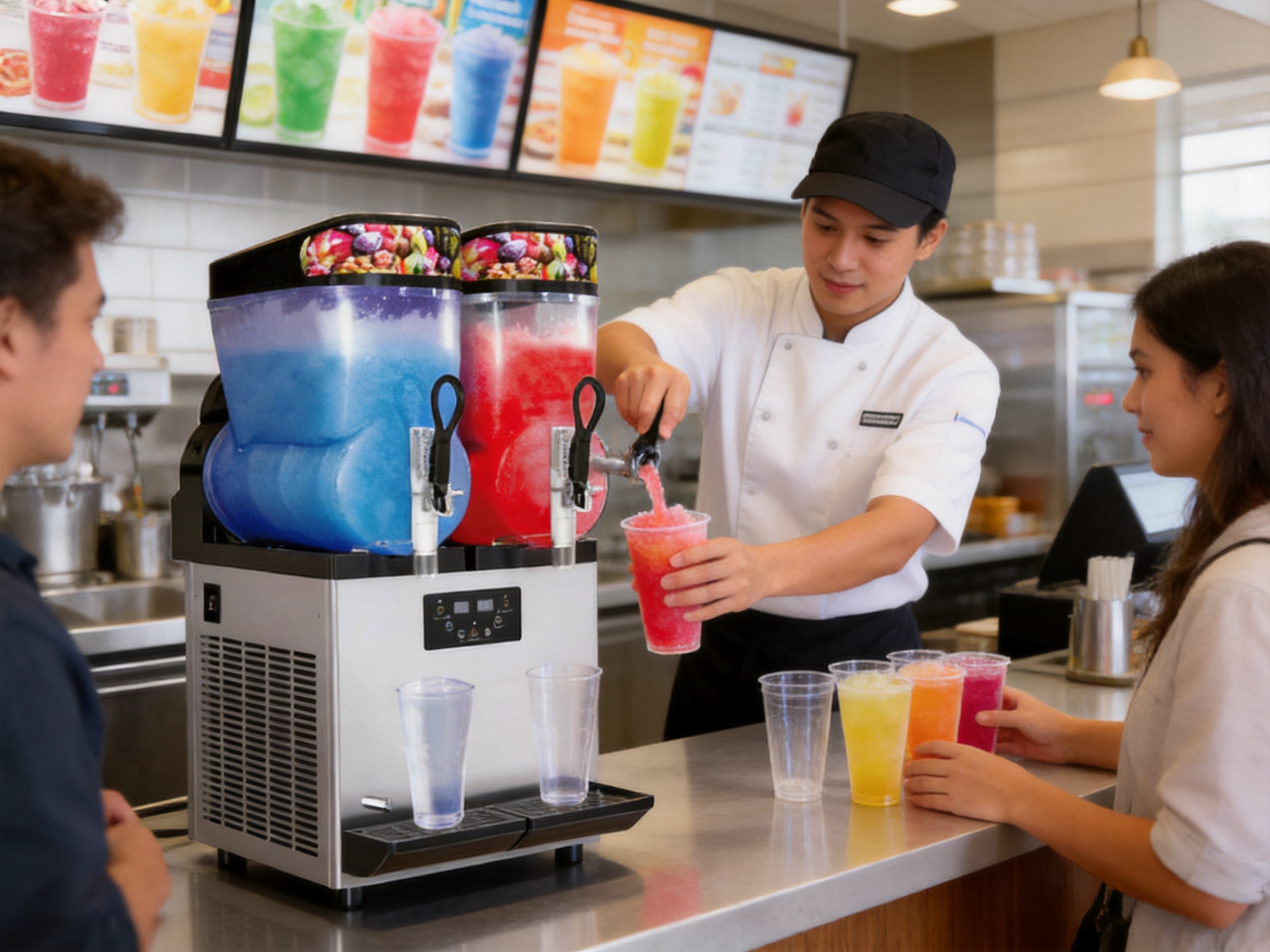
A commercial slush machine typically passes through several manufacturing stages before shipment. These stages may include material preparation, body fabrication, surface treatment, tank and component assembly, refrigeration system installation, electrical wiring, mixing system installation, inspection, performance testing, cleaning, packaging, and final dispatch.
Material Preparation
The process begins with the selection and preparation of materials for the machine body, internal components, tanks, brackets, panels, and support structures. Food-contact and external materials should be selected according to their intended function. Stainless steel is used where a sanitary and durable surface is required, while sprayed steel can provide structural support and aesthetic variety.
Body Fabrication
Metal panels are cut, formed, joined, and finished to create the machine enclosure. Accurate fabrication helps ensure that panels align correctly and that the finished appliance has a stable structure. Proper edge treatment and surface finishing are important for both safety and appearance.
Surface Treatment
Sprayed steel components undergo surface preparation and coating processes designed to provide color, protection, and a consistent appearance. A durable finish helps the machine remain presentable in customer-facing environments. The final coating should be inspected for uniformity, adhesion, and visible defects.
System Assembly
The refrigeration circuit, cooling surfaces, mixing mechanism, electrical components, controls, tanks, dispensing parts, and structural supports are assembled into the completed machine. Careful routing of wires and refrigeration lines helps reduce the possibility of interference, damage, or difficult servicing.
Testing and Inspection
Completed units should be inspected for structural integrity, electrical safety, refrigeration performance, mixing function, tank operation, dispensing behavior, noise, appearance, and packaging readiness. Testing helps identify assembly problems before equipment reaches the customer. The precise testing program depends on the product configuration, market requirements, and applicable standards.
Manufacturing quality is not limited to the final inspection. It also depends on process consistency, component traceability, employee training, equipment calibration, supplier management, and continuous improvement. An integrated manufacturer can coordinate these activities across departments and respond more efficiently when improvements are identified.
Installation and Operating Guidance
Correct installation is essential for safe and reliable performance. The machine should be positioned on a level, stable surface with sufficient load-bearing capacity. Operators should confirm that the electrical supply matches the product requirements and that the outlet, plug, and protective devices are suitable for commercial use.
Ventilation space should be maintained around the machine. Airflow must not be blocked by walls, boxes, curtains, other appliances, or accumulated grease and dust. Restricted airflow can reduce cooling efficiency and increase stress on the refrigeration system.
Before filling the tanks, staff should inspect the machine, confirm that removable components are clean and correctly installed, and verify that the dispensing and mixing mechanisms are in the proper position. Beverage recipes should be prepared according to the machine’s operating requirements. Ingredients with unusual viscosity, excessive solids, incompatible acidity, or unsuitable alcohol content may affect performance and should be reviewed in advance.
Do not operate the machine empty unless the manufacturer specifically permits it. Do not exceed the stated tank capacity. Overfilling can create spills, affect mixing, and complicate cleaning. Ingredients should be added carefully to prevent contamination of external surfaces and electrical areas.
During operation, staff should monitor product levels, texture, temperature condition, and dispensing behavior. Unusual noise, leakage, excessive frost, electrical odor, or abnormal cooling should be treated as a reason to stop operation and request qualified service. Operators should not remove covers or attempt refrigeration repairs without appropriate training.
Cleaning and Preventive Maintenance
Cleaning is one of the most important responsibilities associated with a commercial slush machine. Frozen beverages often contain sugar, fruit acids, colorants, flavor compounds, and other ingredients that can leave residues. If residues remain in tanks, seals, valves, or dispensing outlets, they can affect hygiene, taste, appearance, and mechanical operation.
A suitable cleaning routine should include product removal, power isolation where required, component disassembly according to instructions, washing with an approved solution, thorough rinsing, sanitizing where applicable, drying, inspection, and correct reassembly. Staff should be trained to identify small parts and reinstall them properly so that seals and dispensing mechanisms function correctly.
Cleaning schedules should be based on local regulations, product type, operating hours, and manufacturer recommendations. High-frequency use generally requires more frequent attention than occasional operation. Dairy-based or protein-containing recipes may require especially careful cleaning because residues can spoil more quickly.
Preventive maintenance should also include inspection of seals, dispensing handles, tank components, electrical cables, ventilation openings, and the condenser area. Dust and grease should be removed from accessible areas using safe procedures. The refrigeration circuit should only be serviced by qualified technicians, particularly because the machine uses R290 refrigerant.
Good maintenance can help protect product consistency and reduce avoidable downtime. It may also help businesses plan service costs more effectively. Instead of waiting for a failure during a busy period, operators can identify worn components, blocked airflow, or unusual performance early.
Purchasing Considerations for Importers and Distributors
Importers and distributors should evaluate more than the basic product specification before placing a commercial equipment order. They should confirm voltage, frequency, plug type, certification requirements, packaging method, shipping dimensions, loading quantity, warranty policy, spare parts availability, and technical documentation.
For international markets, electrical configurations can vary significantly. The rated output of 1,000 watts should be considered together with the intended voltage and frequency. Buyers should provide destination-market requirements during the quotation stage so that the correct configuration can be confirmed before production.
Packaging should be designed to protect the machine body, tanks, controls, and refrigeration components during transport. Buyers may request information about carton dimensions, palletization, gross weight, loading capacity, moisture protection, and handling marks. These details influence freight planning and warehouse receiving procedures.
Spelor’s product categories and manufacturing capability may be useful for distributors that want to develop a broader commercial foodservice equipment portfolio. A distributor can potentially coordinate slush machines with juice dispensers, commercial ice machines, ice cream equipment, refrigeration cabinets, cooking equipment, and buffet products through one manufacturing partner.
OEM and ODM discussions should include detailed drawings, logo requirements, colors, labels, manuals, packaging artwork, control language, certification marks, and inspection procedures. The more complete the technical brief, the easier it is for the manufacturer to evaluate feasibility and prepare an accurate quotation.
Business Benefits and Return on Equipment Investment
A commercial slush machine can contribute to revenue in several ways. It can add a new beverage category, increase average order value, support seasonal promotions, and encourage impulse purchases. Frozen drinks may also complement meals, desserts, snacks, and event packages.
The dual-tank design supports menu testing. An operator can introduce one established flavor and one experimental flavor, then compare demand. This approach allows the business to collect practical sales information before committing to a larger beverage program.
Capacity also influences labor efficiency. Preparing and serving a ready-to-dispense frozen beverage may require fewer steps than producing individual drinks to order. The exact labor savings depend on the recipe, serving format, and staff workflow, but equipment that supports batch preparation can simplify busy periods.
Businesses should calculate expected consumption, ingredient cost, selling price, cleaning labor, electricity, maintenance, and depreciation when evaluating investment. A machine is most valuable when its capacity and operating characteristics match actual demand. Overloading a small machine can reduce service quality, while buying equipment far beyond demand may delay the return on investment.
Food Safety and Responsible Operation
Operators are responsible for establishing procedures that comply with local food safety laws and workplace regulations. Beverage ingredients should be stored at appropriate temperatures, handled hygienically, and used within suitable time limits. Cross-contamination should be prevented through proper staff hygiene, clean utensils, and organized ingredient handling.
Recipes should be documented so that staff can reproduce the intended flavor and texture. Changes in sugar concentration, acidity, alcohol content, or solids can affect freezing behavior. Each new formula should be evaluated before being introduced into regular service.
The two tanks should be managed independently when the recipes differ. Staff should use clear labels and dedicated preparation tools where necessary. If one product contains allergens or specific ingredients, customer information should be handled according to local requirements.
Safety also applies to equipment handling. The machine should be disconnected from the power supply before cleaning procedures that require electrical isolation. Water should not be directed into electrical components. Covers, panels, and protective parts should remain in place during normal operation.
Service Support and Long-Term Partnership
Commercial equipment buyers need support before and after purchase. Pre-sales consultation helps customers select the appropriate capacity, configuration, and application. Technical communication is especially important when the equipment will be integrated into a new store, hotel, restaurant group, or catering project.
After-sales support can include operating guidance, maintenance recommendations, spare parts coordination, troubleshooting assistance, and service communication. Spelor’s stated service structure includes after-sales maintenance and one-stop support for customers worldwide.
A long-term manufacturing partnership can offer advantages beyond a single purchase. Customers may receive assistance with product selection, future model updates, customized designs, shipment planning, and portfolio expansion. Reliable communication is particularly valuable for distributors that must support their own customers in different regions.
Spelor Electrical Appliances (Zhejiang) Co., Ltd. is located at No. 528, Changxi Road, Linhai City, Zhejiang Province, China. Its sales and service team can be contacted through the company’s business channels for product specifications, OEM and ODM discussions, commercial quotations, and technical requirements.
Frequently Asked Questions
What is the total capacity of the XN240A?
The machine has two tanks, each with a nominal capacity of 15 liters. Its total stated capacity is therefore 30 liters, configured as 2×15 liters.
Can the two tanks hold different flavors?
Yes. The dual-tank design is intended to allow two flavors or recipes to be prepared and served at the same time. Operators should follow suitable recipe, cleaning, and cross-contamination procedures.
What is the rated output?
The rated output is 1,000 watts. Actual cooling and production performance can vary according to ambient temperature, recipe composition, initial product temperature, ventilation, serving frequency, and maintenance condition.
Which refrigerant does the machine use?
The supplied specifications identify R290, also written as R290a in the product information. Because R290 is flammable, refrigeration service must be performed by qualified technicians in accordance with applicable regulations.
What materials are used for the machine body?
The plate body is made from food-grade stainless steel and colorful sprayed steel. The stainless-steel construction supports a sanitary and durable commercial surface, while the sprayed steel contributes to the machine’s appearance and structural design.
Where can this slush machine be used?
It is suitable for bars, cafés, restaurants, dessert shops, snack shops, convenience stores, catering operations, hotels, and other foodservice environments that need frozen beverages and multiple flavor choices.
How much space does the machine require?
The stated dimensions are 414×550×824 millimeters. Buyers should also allow additional clearance for ventilation, cleaning, staff movement, and service access.
Is the machine suitable for high-frequency operation?
The machine is described as having a sturdy structure suitable for high-frequency production environments. Its suitability for a particular business depends on demand, operating hours, recipe type, maintenance, and correct installation.
What should be considered before using a new recipe?
Operators should consider sugar content, acidity, viscosity, solids, alcohol content, and other ingredients because they can influence freezing and mixing behavior. New recipes should be tested before being introduced during busy service.
How should the machine be cleaned?
The tanks, dispensing components, seals, and mixing areas should be cleaned according to the manufacturer’s instructions and applicable food safety requirements. A typical procedure includes emptying the product, isolating power when required, disassembling removable parts, washing, rinsing, sanitizing where applicable, drying, inspecting, and reassembling.
Does the manufacturer offer OEM and ODM services?
Spelor offers OEM and ODM commercial refrigeration and foodservice equipment solutions based on customer drawings or requirements. Specific customization options, minimum order quantities, certifications, lead times, and costs should be confirmed for each project.
What other equipment does the manufacturer produce?
The company’s product range includes commercial ice cream machines, juice dispensers, fried ice cream machines, refrigeration cabinets, slush machines, flake ice machines, cooking equipment, griddles, fryers, insulation products, barbecue equipment, and buffet solutions.
How can buyers request technical information?
Buyers can contact Spelor Electrical Appliances (Zhejiang) Co., Ltd. through its business email or sales channels to request quotations, specifications, customization discussions, shipping information, and after-sales support details.
Conclusion
The XN240A 2×15L commercial slush machine is designed for foodservice businesses that need dependable frozen beverage production, two flavor choices, and a durable commercial structure. Its 30-liter total capacity provides a practical balance between volume and menu flexibility. The 1,000-watt rated output supports commercial cooling and mixing, while the use of R290 refrigerant reflects a contemporary refrigeration approach with relevant safety requirements.
Its food-grade stainless-steel plate body and colorful sprayed steel construction combine sanitation, durability, and visual appeal. The machine’s vertical dimensions help businesses plan an efficient counter arrangement, and its dual-tank configuration can be more flexible than a single-tank appliance or two separate small units.
The product is supported by Spelor’s integrated manufacturing capabilities, modern production facilities, broad foodservice equipment experience, OEM and ODM services, and international customer support. For bars, cafés, restaurants, dessert shops, snack stores, and catering businesses, the XN240A can serve as a practical foundation for expanding frozen beverage sales and improving service variety.
Successful operation depends on suitable recipes, correct installation, adequate ventilation, regular cleaning, preventive maintenance, and compliance with local safety regulations. When these requirements are managed properly, the machine can support stable service, attractive product presentation, and long-term commercial value.
References
1. Product specification sheet for commercial slush machine model XN240A, including capacity, rated output, refrigerant, dimensions, and net weight.
2. Spelor Electrical Appliances (Zhejiang) Co., Ltd. company profile and foodservice equipment manufacturing information.
3. General commercial refrigeration equipment maintenance and sanitation practices for foodservice applications.
4. General technical guidance concerning hydrocarbon refrigerants and safe handling requirements for R290 systems.
5. General foodservice equipment planning principles covering capacity selection, ventilation, cleaning, installation, and preventive maintenance.
Product: 2*15L Sturdy Durable Commercial Slush Machine for Bar Cafe Restaurant

For exclusive deals and latest offers, sign up by entering your email address below.


-
spelor@spelor.com
-
+86-576-85229688
-
No.528, Changxi Road, Linhai City, Zhejiang Province, China
Commercial Refrigeration Equipment Manufacturer China
Copyright © 2025 by Spelor Electrical Appliances (Zhejiang) Co., Ltd. Rights Reserved.
