


 中文简体
How a Floor-Standing Commercial Soft Serve Machine Supports High-Volume Dessert Operations
Admin 2026-10-29Soft serve ice cream remains one of the most adaptable and profitable dessert products in the foodservice industry. It can be served in cones, cups, sundaes, milkshakes, dessert bowls, waffles, and combination menu items. Because the product is familiar, visually appealing, and easy to customize, it is used by snack shops, cafés, fast-food restaurants, hotels, catering businesses, amusement venues, supermarkets, and institutional foodservice operators.
However, commercial soft serve production requires more than a basic freezing unit. A professional machine must provide stable cooling, sufficient hourly output, hygienic construction, simple controls, convenient cleaning, and dependable performance during repeated service cycles. The Spelor BQL-818 floor commercial soft serve ice cream machine is designed around these requirements. Its floor-standing structure, dual-flavor configuration, 18-liter-per-hour production capacity, stainless steel food-contact construction, LCD control panel, and self-cleaning function make it suitable for businesses that need consistent dessert production throughout the working day.
The machine is positioned as a practical solution for medium-sized and large venues that require more capacity than a compact countertop unit can provide. At the same time, it is designed to remain straightforward enough for daily operation by ordinary foodservice staff. This balance between production capability, usability, sanitation, and commercial durability is one of its most important advantages.

Spelor Floor Commercial Soft Serve Ice Cream Machine Versatile for Dessert Catering
Product Overview
The BQL-818 is a floor-standing soft serve ice cream machine intended for commercial dessert and catering applications. It has a production capacity of 18 liters per hour and a rated input power of 1,800 watts. The machine uses two 5.5-liter hoppers and two 1.6-liter freezing tanks, allowing operators to prepare and dispense multiple flavors. Its listed dimensions are 540 by 575 by 1,370 millimeters, giving it a relatively compact footprint for a full-height commercial machine.
The unit combines a food-grade stainless steel plate body with colorful sprayed steel surfaces. This construction gives the machine a professional appearance while supporting routine sanitation and the demanding conditions of commercial food preparation. The upright layout also makes efficient use of floor space. Instead of requiring a broad countertop area, the machine uses vertical space and can be positioned in a dedicated service area, dessert station, café counter zone, or catering production area.
The supplied product information identifies the model as BQL-818 and lists R404 as the refrigerant and a Chinese compressor. The available specifications also identify a net weight of 119 kilograms in one product table and 106 kilograms in another information table. Because packaging configuration, production revisions, and specification records can affect the stated shipping or net weight, buyers should confirm the final approved specification before placing an order or arranging installation.
| Item | Specification |
| Model | BQL-818 |
| Product type | Floor-standing commercial soft serve ice cream machine |
| Production capacity | 18 liters per hour |
| Input power | 1,800 watts |
| Hopper capacity | 2 x 5.5 liters |
| Freezing tank capacity | 2 x 1.6 liters |
| Machine dimensions | 540 x 575 x 1,370 millimeters |
| Refrigerant | R404 |
| Compressor | Chinese compressor |
| Control interface | LCD panel |
| Cleaning feature | Self-cleaning function |
| Net weight stated in supplied information | 106 kilograms or 119 kilograms, depending on specification record |
Why Production Capacity Matters in Commercial Dessert Service
In a commercial environment, production capacity directly affects service speed, labor efficiency, and customer satisfaction. A small machine may be suitable for occasional use, but it can become a bottleneck when several customers order desserts at the same time. Staff may need to wait for the product to recover its texture, refill the machine repeatedly, or limit the menu during busy periods.
With an indicated capacity of 18 liters per hour, the BQL-818 is designed for steady output rather than occasional preparation. The actual number of portions depends on serving size, mix formulation, overrun, temperature settings, and operating conditions. Even so, the rated output gives operators a useful reference when planning service volume and menu demand.
For example, a business offering 100-milliliter portions can theoretically obtain approximately 180 portions per hour under ideal production conditions. Real service results will vary because of product waste, portion variation, refill timing, and recovery requirements. The important point is that the machine is designed for continuous commercial operation and can support a meaningful number of servings during peak periods.
High capacity is especially valuable for locations with concentrated demand. Ice cream counters near tourist attractions, cinemas, school canteens, shopping centers, restaurants, and event venues may experience sharp demand increases at particular times of the day. A floor-standing unit with a larger hopper and commercial cooling system allows staff to prepare for those peaks more effectively than a small domestic-style appliance.
Dual-Flavor Operation for Broader Menu Flexibility
The two 5.5-liter hoppers and two 1.6-liter freezing tanks support multiple-flavor service. This configuration gives foodservice operators more menu flexibility than a single-flavor machine. One side can be used for vanilla while the other is used for chocolate, fruit, coffee, yogurt, or another approved mix. The exact flavor combination depends on the recipe and the operator’s production plan.
Multiple flavors create several commercial advantages. First, customers have more choice, which can improve the appeal of the dessert station. Second, the operator can offer a combination serving strategy, such as a dual-flavor cone or cup. Third, the business can adapt the flavor plan to seasonal demand, promotional campaigns, or local preferences. For catering operations, the same machine can support different event themes without requiring separate equipment for every flavor.
The dual-hopper arrangement also supports menu differentiation. A business might reserve one side for a standard high-volume flavor and use the other side for a premium or limited-time flavor. This allows operators to maintain a dependable core product while testing new recipes. In a competitive foodservice market, this type of flexibility can help a small business create a more distinctive customer experience.
Operators should still follow appropriate food safety procedures when changing mixes or switching flavors. Ingredients must be compatible with the machine, and the product should be prepared according to the manufacturer’s operating instructions. Cleaning and sanitation procedures remain essential whenever the product changes or the machine is taken out of service.
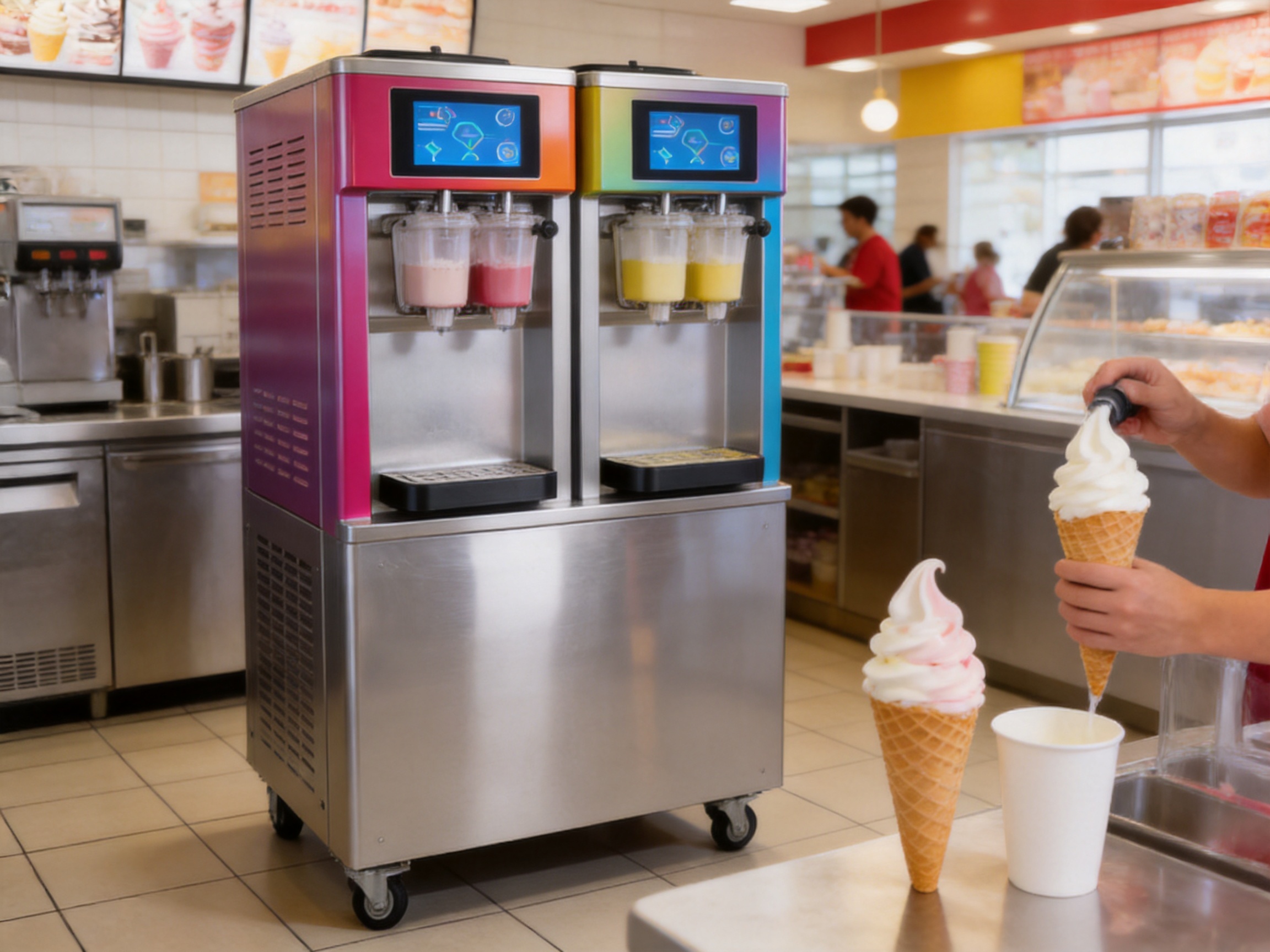
Rapid and Stable Cooling for Consistent Texture
Soft serve quality depends heavily on temperature control. If the product is too warm, it may become loose, melt rapidly, and lose its shape after dispensing. If the product is too cold, it may become excessively firm, difficult to dispense, or unpleasant in texture. A commercial machine must therefore provide a controlled freezing environment that supports a consistent balance between firmness and smoothness.
The BQL-818 is described as providing rapid and stable cooling. Its freezing tanks are designed to cool the prepared mix into a ready-to-serve soft serve product, while the machine’s cooling system supports repeated production during service. Stable cooling is particularly important during busy periods when the machine is dispensing product continuously and receiving regular replenishment from the hoppers.
Reliable thermal performance offers several operational benefits. It helps staff serve products with a more consistent appearance and texture. It reduces the likelihood that the dessert will be too soft during a rush. It also supports more predictable portioning, which can help the operator manage ingredient costs. When each serving has a similar texture and shape, customers are more likely to view the product as professional and dependable.
Cooling performance is influenced by several external factors, including ambient temperature, ventilation, mix temperature, product formulation, voltage stability, and cleaning condition. For this reason, the machine should be installed in a well-ventilated area and operated according to the recommended procedures. Adequate space around the refrigeration system helps the unit release heat and maintain efficient operation.
Food-Grade Construction and Commercial Hygiene
Food-contact equipment must be designed with sanitation in mind. The BQL-818 uses a food-grade stainless steel plate body together with sprayed steel components. Stainless steel is widely used in commercial kitchens because it is durable, resistant to corrosion under normal operating conditions, and relatively easy to wipe down and sanitize.
The smooth appearance of the stainless steel body also contributes to a cleaner visual impression. Customers can see the equipment in an open dessert area, and a well-maintained stainless steel machine can reinforce the perception of professionalism. For cafés, restaurants, hotels, and retail stores, the appearance of front-of-house equipment can influence customer confidence in the overall operation.
Hygiene depends on more than the exterior material. The internal product path, dispensing components, seals, freezing tanks, hoppers, and removable parts must also be cleaned according to the operating instructions. Regular sanitation helps reduce residue buildup and supports consistent product quality. The machine’s self-cleaning function can simplify the cleaning routine, although it should be used as part of a complete sanitation program rather than as a replacement for inspection and manual cleaning where required.
Foodservice operators should establish a written cleaning schedule that identifies daily, weekly, and periodic maintenance tasks. Staff should be trained to recognize product residue, unusual odors, leaking seals, blocked air passages, and changes in dispensing performance. A disciplined cleaning process protects both customer health and equipment life.
Self-Cleaning Function and Labor Efficiency
Cleaning is one of the most important recurring tasks in soft serve production. Traditional cleaning processes can require significant time, particularly when staff must drain the product, flush internal passages, disassemble parts, wash components, sanitize surfaces, and reassemble the machine. If the process is difficult, operators may postpone it, which can negatively affect hygiene and machine performance.
The BQL-818 includes a self-cleaning function intended to make routine maintenance more convenient. A self-cleaning program can help circulate cleaning solution or water through selected internal areas, loosen residual mix, and reduce the manual effort required for basic cleaning. This is valuable in busy venues where staff must balance sanitation with customer service and other food preparation duties.
Labor efficiency is an important advantage over machines that require entirely manual cleaning. When the cleaning process is easier to understand and perform, staff are more likely to complete it correctly and consistently. The business may also reduce downtime between production cycles. These improvements can be particularly helpful for businesses operating extended hours or serving large customer volumes.
Even with a self-cleaning function, the operator should follow the complete cleaning and sanitation instructions supplied with the machine. Some components may need to be removed, inspected, washed, lubricated, sanitized, or replaced at specified intervals. The self-cleaning feature should be viewed as a practical aid that supports proper maintenance, not as an automatic guarantee of complete sanitation.
LCD Control Panel for Clear Operation
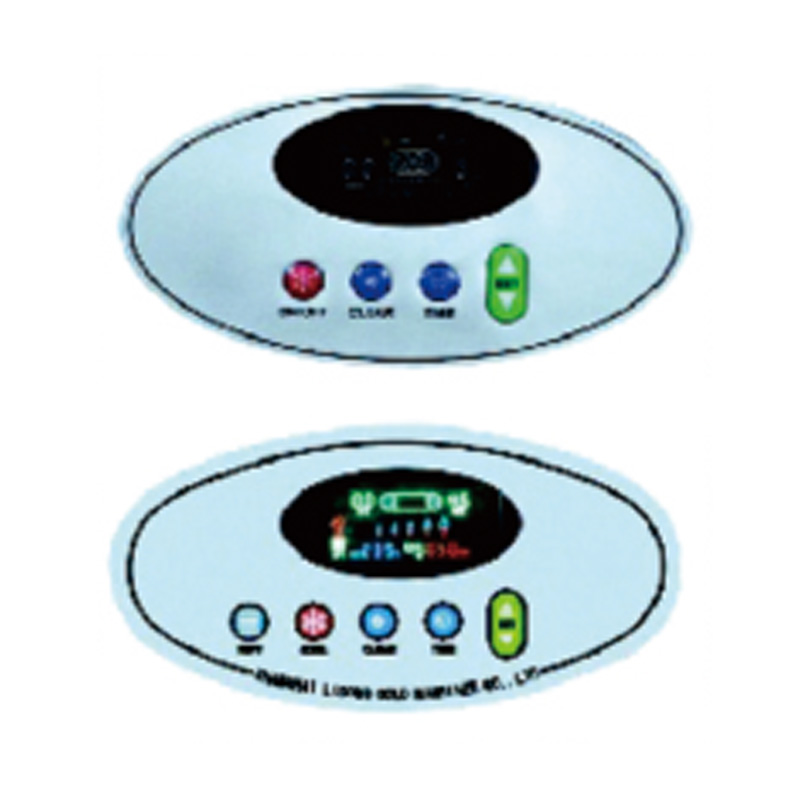
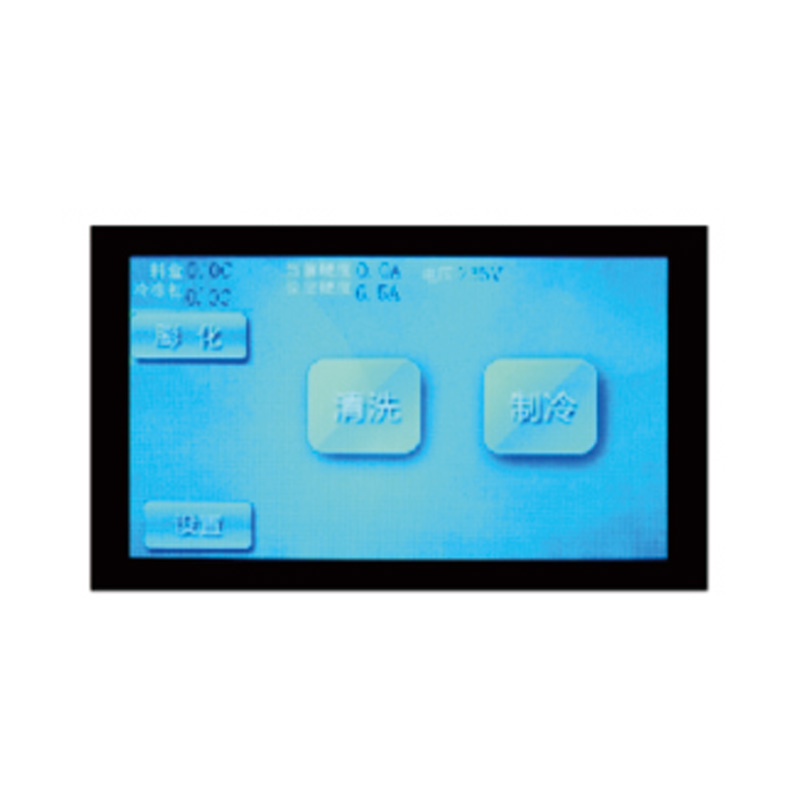
The LCD panel gives operators a clear interface for monitoring and controlling the machine. Compared with basic switches or unclear analog controls, a digital panel can make operating information easier to read. This is useful when different staff members share responsibility for the dessert station or when the machine is used in a fast-paced service environment.
A straightforward control interface can reduce training time. New employees can learn the primary functions more easily when operating information is presented in a structured format. Staff can also identify selected modes, cleaning functions, and operating conditions without relying entirely on memory or handwritten instructions.
Clear controls contribute to process consistency. The same operating steps can be followed each day, reducing the chance of incorrect settings or accidental misuse. For multi-location businesses, an easy-to-understand panel can support more standardized procedures across different stores or catering teams.
The LCD display should be kept clean and dry, particularly in a dessert preparation area where mix, water, or syrup may be present. Operators should avoid using abrasive materials on the display or control surface. Routine inspection of buttons, indicators, and control response can help identify problems before they interfere with service.
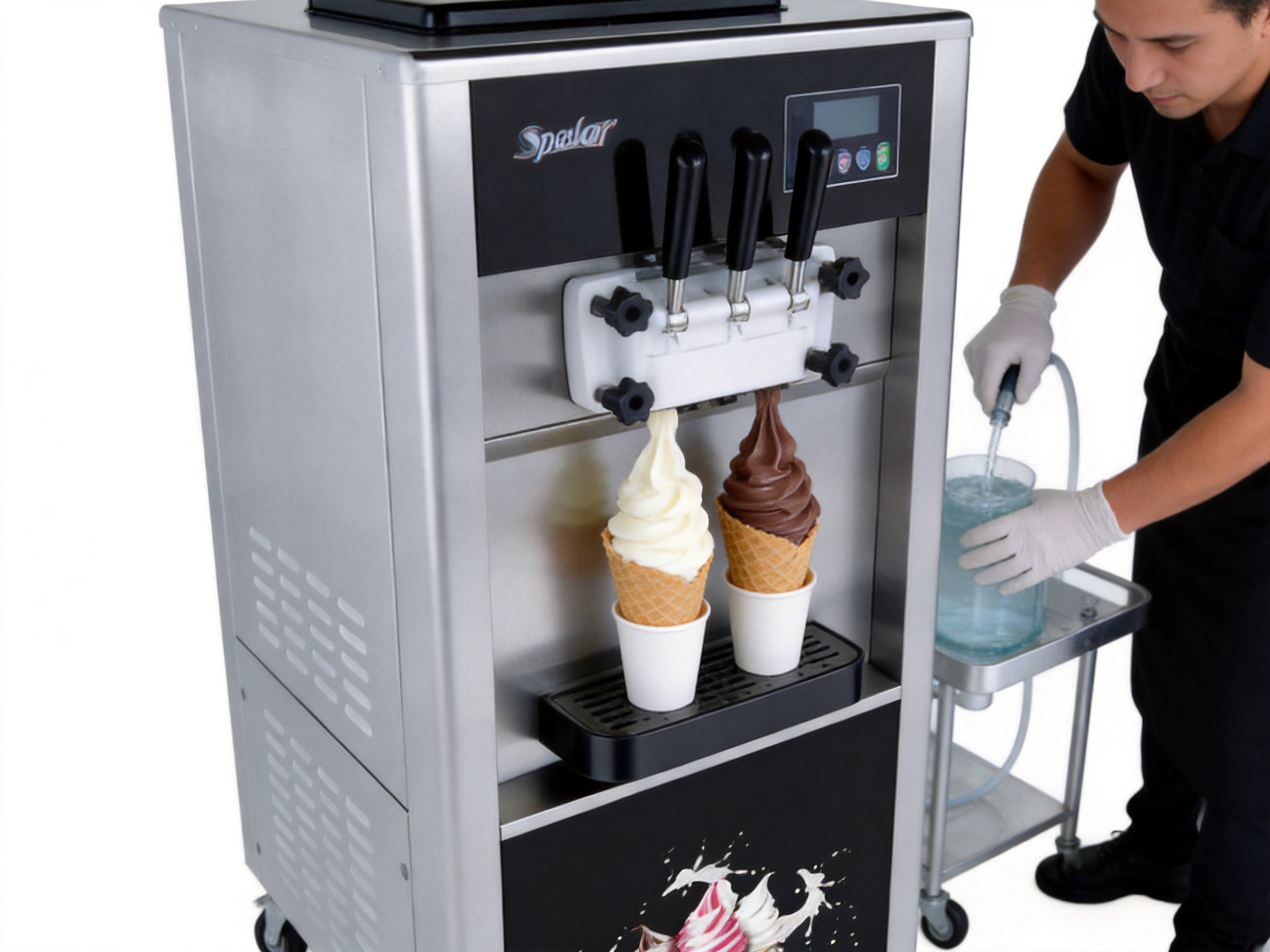
Space-Efficient Floor-Standing Design
The floor-standing design is a practical choice for commercial locations that require substantial production capacity but have limited counter space. With dimensions of 540 by 575 by 1,370 millimeters, the BQL-818 uses a relatively narrow footprint while providing a full-height operating structure. This allows the machine to be placed in a dedicated equipment line, dessert corner, service counter area, or catering preparation zone.
Countertop machines can be useful for small operations, but they may occupy valuable work surfaces needed for ingredients, packaging, payment equipment, or other appliances. A floor unit keeps the working counter more available and can make the overall workspace easier to organize. Its height also places the dispensing area at a convenient level for many standing operators.
Before installation, the operator should measure doorways, elevators, corridors, and the final placement area. The machine should be positioned on a stable, level surface with sufficient clearance for ventilation, cleaning, service access, and electrical connection. The area should be protected from excessive heat, direct water spray, and conditions that could interfere with refrigeration performance.
The upright format is suitable for a range of business models. A fast-food restaurant may place it near the beverage and dessert pickup area. A hotel may use it in a buffet or banquet preparation station. A snack shop may install it behind or beside the service counter. A catering company may position it in a production kitchen where it can support events and seasonal demand.
Advantages for Medium and Large Venues
The BQL-818 is especially appropriate for medium-sized and larger venues because its design combines capacity, dual-flavor production, and continuous commercial operation. These venues often need more output than a compact machine can provide, but they also require equipment that is practical for daily staff use.
In a restaurant, soft serve can become an additional revenue stream rather than merely a side item. The business may sell cones, cups, sundaes, dessert combinations, or meal upgrades. Because the machine can support multiple flavors, the restaurant can build a more attractive dessert menu without installing several separate machines.
In a café or snack shop, the machine can serve as a visual point of interest. Customers can see the equipment and associate it with freshly prepared desserts. An appealing machine appearance, clean stainless steel surfaces, and visible dispensing activity may encourage impulse purchases, especially in locations with strong pedestrian traffic.
In catering, the machine can support weddings, company events, school celebrations, festivals, and promotional activities. The floor-standing configuration and high output make it more appropriate for repeated event service than a household appliance. The operator can plan flavors in advance and use the machine as part of a wider dessert station.
In supermarkets and institutional facilities, stable production and clear operating procedures are important. Staff may need to prepare product during set periods, maintain consistent service standards, and clean the equipment according to documented schedules. A commercial machine with a digital panel and self-cleaning function can support these requirements.
Comparison with Smaller or Less Specialized Equipment
When comparing a commercial soft serve machine with smaller or less specialized equipment, buyers should consider total operating value rather than purchase price alone. A compact unit may have a lower initial cost, but it may also provide lower output, limited flavor flexibility, smaller ingredient capacity, and greater pressure during peak service.
The BQL-818 offers several advantages in this comparison. Its 18-liter-per-hour capacity is intended for regular commercial use. The two hoppers allow multiple-flavor service. Its floor-standing structure preserves counter space. Its 1,800-watt input rating supports a refrigeration system designed for commercial production. The LCD panel helps simplify operation, while the self-cleaning function addresses a major daily maintenance requirement.
Compared with single-flavor equipment, the dual-flavor layout can create a more varied customer offering. Compared with small countertop machines, the larger hopper capacity reduces the frequency of refilling during service. Compared with machines without cleaning assistance, the self-cleaning function can make routine sanitation more manageable. Compared with units made primarily for occasional use, the BQL-818 is designed around the needs of continuous foodservice production.
Every operation has different requirements, so the machine should be compared with competing models using measurable criteria. Buyers should review hourly capacity, hopper volume, freezing tank size, power consumption, dimensions, flavor configuration, cleaning process, service support, warranty terms, and spare-part availability. The best machine is the one that matches the intended volume and operating environment.
| Evaluation factor | Value offered by the BQL-818 | Commercial benefit |
| Production capacity | 18 liters per hour | Supports regular service and peak-period demand |
| Flavor configuration | Two hoppers and two freezing tanks | Enables multiple flavors and combination servings |
| Hopper volume | 2 x 5.5 liters | Reduces frequent refilling during service |
| Construction | Food-grade stainless steel plate body and sprayed steel | Supports hygiene, durability, and professional appearance |
| Controls | LCD panel | Improves visibility and operating consistency |
| Maintenance | Self-cleaning function | Helps reduce cleaning effort and routine downtime |
| Installation format | Floor-standing design | Preserves countertop workspace and supports high-volume placement |
| Footprint | 540 x 575 millimeters base dimensions | Fits many commercial service and production areas |
Manufacturing Strengths Behind the Product
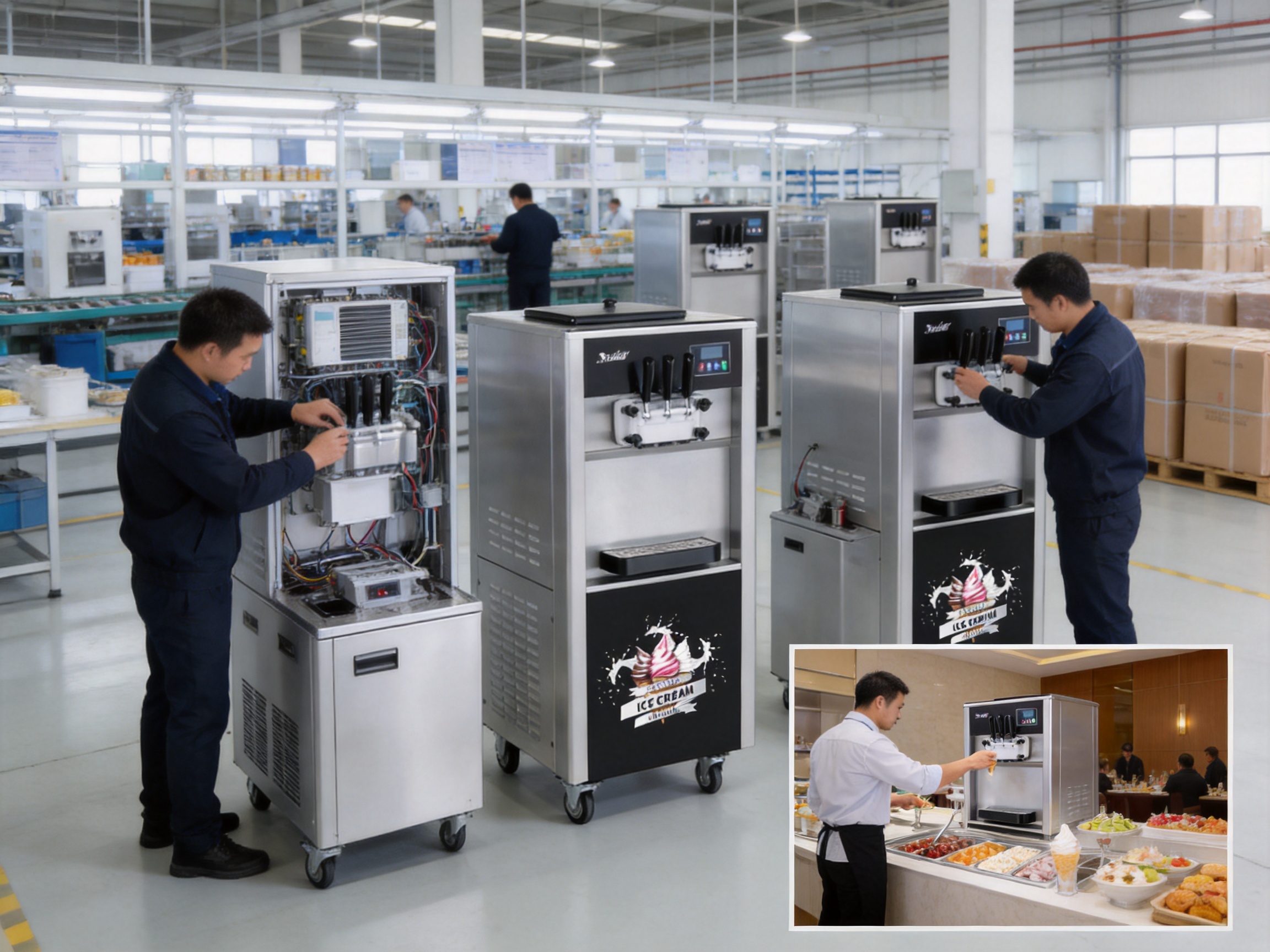
The BQL-818 is produced by Spelor Electrical Appliances (Zhejiang) Co., Ltd., a manufacturer that integrates design, research and development, manufacturing, sales, and service. The company operates more than 60,000 square meters of modern production facilities and specializes in commercial refrigeration, kitchen equipment, and buffet equipment.
This broad manufacturing scope is important because commercial refrigeration equipment requires coordination between mechanical design, refrigeration technology, electrical control, sheet-metal fabrication, assembly, quality inspection, packaging, and after-sales support. A manufacturer that handles multiple stages of the product life cycle can develop a more complete understanding of how equipment performs in real foodservice environments.
Manufacturing integration can also improve communication between engineering and production teams. Product designs can be reviewed for assembly efficiency, service access, structural stability, and practical cleaning requirements before they are released for regular production. In a commercial equipment factory, these considerations are essential because a machine must work reliably not only in testing but also during long operating cycles in restaurants and catering facilities.
The company’s product range includes ice cream machines, juice dispensers, fried ice cream machines, refrigeration cabinets, slush machines, flake ice machines, cooking equipment, griddles, fryers, insulation products, barbecue equipment, and buffet solutions. This range demonstrates experience across several categories of foodservice equipment. Such cross-category experience can support the development of practical solutions for businesses that need coordinated equipment purchases from one supplier.
Production Process and Quality-Oriented Assembly
A commercial soft serve machine begins with the selection and preparation of materials. Stainless steel and coated steel components must be formed accurately so that panels align correctly and the finished machine has a stable structure. Surface treatment must be controlled to provide a durable appearance suitable for commercial use. The body must also allow access to internal components during installation, inspection, and service.
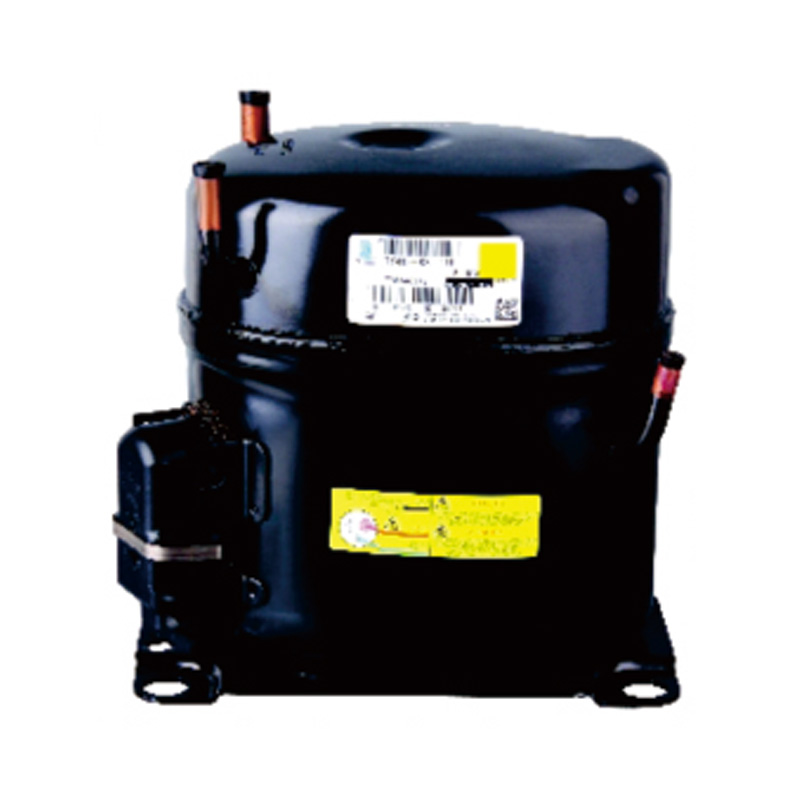
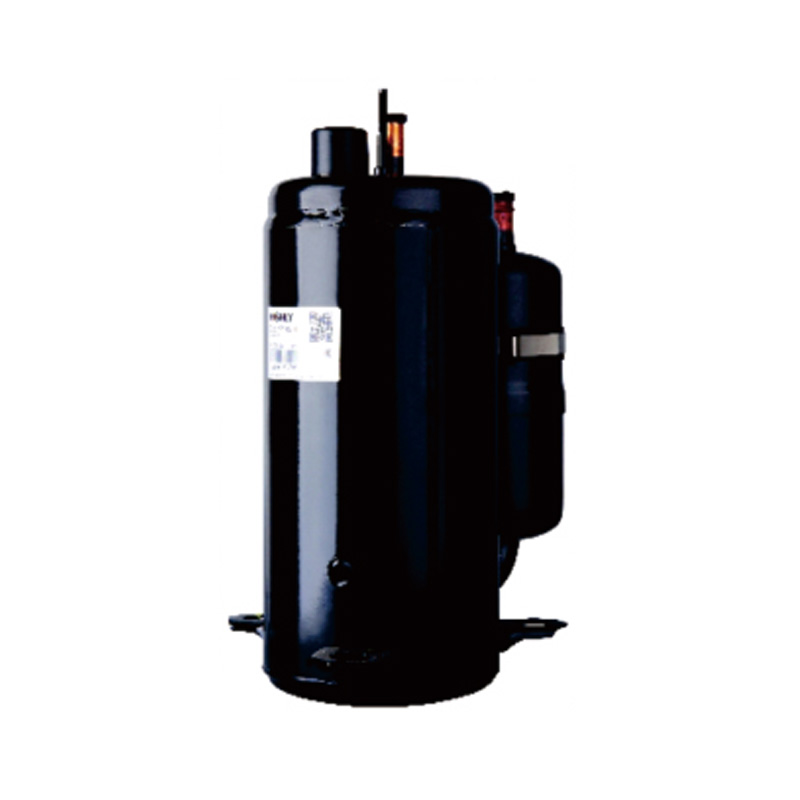
Refrigeration assembly is another central manufacturing stage. The compressor, refrigerant circuit, condenser, evaporator, controls, and insulation must work together as one system. The refrigerant used for the supplied model is identified as R404, and the compressor is listed as Chinese. During production, refrigeration components must be installed and connected carefully to support reliable cooling and reduce the risk of leakage or performance loss.
Electrical assembly includes the power system, control components, LCD panel, sensors, switches, and wiring. Proper routing and securing of wires help protect them from vibration, moisture, heat, and accidental damage. Control testing is important because the operator depends on the panel to select functions, monitor the unit, and operate the cleaning cycle.
Product-contact and dispensing components require particular attention. The freezing tanks, hoppers, outlet assemblies, seals, and internal passages must be assembled accurately so that the machine can hold and dispense the mix correctly. A well-organized assembly process reduces the possibility of loose fittings, uneven seals, or difficult-to-clean joints.
Final inspection should include appearance checks, electrical testing, refrigeration testing, control-panel verification, dispensing checks, and examination of the machine’s overall stability. Packaging and documentation are also important because the equipment may travel long distances before reaching the customer. A manufacturing process that considers the complete supply chain can help reduce damage and installation problems.
Research and Development for Foodservice Applications
Commercial equipment research and development must address practical operating conditions. A machine used in a restaurant or catering business may be switched on and off frequently, exposed to warm kitchen environments, operated by different employees, and cleaned repeatedly. Research and development therefore needs to consider more than appearance or basic cooling ability.
For the BQL-818, relevant design considerations include the balance between production capacity and machine size, the relationship between hopper capacity and service demand, the convenience of the LCD control interface, and the integration of the self-cleaning function. These features reflect a focus on daily use rather than occasional operation.
A product development team can also use customer feedback to identify common operational challenges. Operators may request easier access to cleaning areas, clearer controls, stronger panels, improved dispensing behavior, or more flexible flavor configurations. A manufacturer with sales and service experience can gather this information and incorporate it into future designs or customized versions.
The company’s ability to provide OEM and ODM services further supports this development approach. Customers may have specific requirements relating to color, dimensions, electrical standards, branding, packaging, controls, or installation conditions. Manufacturing based on drawings or technical requirements allows the equipment to be adapted for different markets and business models, subject to technical feasibility and final approval.
OEM and ODM Support for Global Foodservice Markets
Foodservice markets vary by region. Electrical voltage, frequency, plug type, labeling rules, refrigerant requirements, operating habits, and preferred product formats may differ between countries. A manufacturer that provides OEM and ODM support can work with importers, distributors, chain restaurants, and equipment brands to develop products suited to particular market conditions.
OEM service may be useful when a buyer wants a machine manufactured under its own brand or according to an established product specification. ODM service may be appropriate when the buyer needs assistance developing a product based on a concept, drawing, performance target, or market requirement. In both cases, technical communication is essential. Buyers should provide clear information about capacity, dimensions, electrical conditions, intended ingredients, appearance, packaging, and certification expectations.
Customization can also support business expansion. A distributor may require a particular exterior color to match its product portfolio. A restaurant chain may need consistent dimensions across several store formats. A catering company may seek a configuration suited to mobile or event-based service. A hotel group may request equipment that complements its buffet presentation. The ability to discuss these needs directly with a factory can improve procurement efficiency.
Customization should not remove the need for testing. Any change to the refrigeration system, electrical system, body structure, control program, or product-contact components should be evaluated before mass production. Sample approval, performance testing, documentation review, and packaging confirmation help reduce risk when ordering customized equipment.
Service, Logistics, and Long-Term Procurement Value
Commercial equipment value continues after the machine leaves the factory. Installation support, operating instructions, spare parts, troubleshooting, and maintenance assistance all influence the total ownership experience. Spelor presents itself as a supplier offering pre-sales consultation, product customization, flexible logistics and payment solutions, and after-sales maintenance.
Pre-sales consultation can help buyers select an appropriate model and avoid purchasing equipment that is too small or too large for the intended application. The buyer can discuss expected daily volume, peak demand, available space, power supply, preferred flavors, cleaning routines, and local service capabilities before confirming the order.
Logistics planning is particularly important for a floor-standing machine because of its size and weight. The buyer should confirm packaging dimensions, loading requirements, delivery access, unloading equipment, and final placement procedures. A clear logistics plan can reduce delays and help protect the equipment during transportation.
After-sales maintenance helps preserve cooling performance, sanitation, and operating reliability. Operators should maintain a record of cleaning, inspections, repairs, and replacement parts. Common maintenance attention may include seals, dispensing components, electrical connections, condenser cleanliness, refrigerant circuit performance, and control-panel operation. Specific maintenance intervals should follow the manufacturer’s instructions and the actual operating environment.
For distributors and commercial buyers, dependable supplier communication can be as important as the machine’s physical specifications. Responsive technical support helps resolve questions before they become service interruptions. A manufacturer that offers one-stop service can simplify procurement for businesses purchasing several categories of foodservice equipment.
Installation Planning and Daily Operating Practices
Proper installation is necessary for the machine to deliver its intended performance. The floor should be level and strong enough to support the equipment. There should be adequate clearance around ventilation areas and service panels. The electrical supply must match the approved machine specification, and the unit should be connected by qualified personnel where local regulations require it.
The machine should not be placed next to equipment that releases excessive heat or in an area where water can spray directly onto electrical components. Ambient conditions can affect refrigeration efficiency, so ventilation and room temperature should be considered during site planning. The operator should also leave enough space for staff to refill hoppers, serve customers, clean the machine, and access the controls safely.
Before production begins, staff should inspect the machine, verify that the product-contact components are clean, prepare the approved mix, and follow the startup procedure. The mix should be loaded carefully to avoid spills and contamination. Operators should monitor the first servings to confirm that the texture, temperature, and dispensing behavior are suitable.
During service, staff should avoid overfilling the hoppers, blocking ventilation openings, or using unapproved ingredients. The machine should be monitored for unusual vibration, leakage, odor, noise, or changes in product consistency. Early attention to abnormal conditions can prevent a small issue from becoming a major interruption.
Cleaning, Sanitation, and Preventive Maintenance
Cleaning should be scheduled according to product type, operating frequency, local food safety requirements, and the manufacturer’s instructions. At the end of a service period, remaining mix may need to be removed or handled according to approved procedures. Internal passages should be cleaned and sanitized, while external surfaces should be wiped down to remove splashes, dust, and residue.
The self-cleaning function can support the internal cleaning process, but staff should still verify that the machine is clean. Removable parts may require separate washing and sanitizing. Seals and dispensing components should be inspected because damaged or worn parts can cause leakage, poor product control, or hygiene concerns.
Preventive maintenance should include checking ventilation areas and keeping them free of dust and obstruction. Refrigeration performance may decline when heat exchange surfaces become dirty. Operators should also inspect power cords, connectors, panel functions, fasteners, and visible tubing. Any repair involving the refrigeration circuit or electrical system should be performed by qualified service personnel.
Good maintenance has a direct economic benefit. It can help extend equipment life, reduce unexpected downtime, maintain product quality, and prevent avoidable service costs. It also supports a safer workplace because leaks, damaged cables, unstable components, and blocked ventilation can create operational hazards.
Business Applications and Menu Opportunities
The BQL-818 can support a broad range of soft serve menu concepts. A traditional cone or cup remains the simplest offering, but businesses can also create layered desserts, fruit toppings, chocolate sauces, cookie combinations, waffle desserts, milkshakes, and promotional specialty items. Multiple flavors allow the operator to build combination servings and provide customers with more variety.
Restaurants can use soft serve as a dessert add-on to increase average order value. Fast-food operators can bundle a cone or cup with a meal. Cafés can offer soft serve alongside coffee and baked goods. Hotels can include it in buffet service or family dining areas. Catering companies can present it as an interactive dessert station at events.
Seasonal menu planning can improve equipment utilization. Fruit-based flavors may be promoted during warmer months, while chocolate, coffee, or holiday-themed options can be used for special campaigns. The machine’s dual-flavor capability supports this approach without requiring two separate machines.
Operators should calculate the cost of mix, toppings, packaging, electricity, labor, cleaning materials, maintenance, and waste before setting prices. The 18-liter-per-hour capacity provides a production reference, but actual profitability depends on sales volume and portion control. Consistent dispensing and standardized serving sizes can help improve cost management.
Purchasing Considerations for Importers and End Users
Before purchasing, buyers should confirm the final technical data, including production capacity, input power, dimensions, weight, refrigerant, compressor specification, electrical configuration, and available accessories. The supplied information lists two different net weights, so this point should be verified against the final quotation, packing list, and approved product documentation.
Buyers should also confirm whether the machine includes all required dispensing components, cleaning accessories, documentation, spare seals, and electrical fittings. If the equipment will be used in a regulated market, the importer should review applicable safety, electrical, food-contact, labeling, and refrigeration requirements.
Installation conditions should be checked before shipment. Doorway width, floor loading, elevator access, ventilation, drainage requirements, and power availability can all influence the final installation. For multiple machines or chain locations, standardizing the installation process can reduce setup time and simplify staff training.
Warranty coverage and service response should be discussed in writing. Buyers should ask how technical problems are reported, which parts are considered consumable, how replacement components are supplied, and whether remote troubleshooting or local service support is available. These details are important when the machine is a central part of daily dessert sales.
Why the BQL-818 Is a Practical Commercial Choice
The BQL-818 combines several features that address common foodservice challenges. Its floor-standing design provides a substantial production platform without requiring a wide countertop footprint. Its 18-liter-per-hour capacity supports regular commercial output. Its two hoppers and two freezing tanks allow multiple-flavor production. Its stainless steel and sprayed steel body is suited to a professional foodservice environment. Its LCD panel supports clear operation, and its self-cleaning function can reduce routine maintenance effort.
These features become more valuable when supported by an established manufacturing organization. Spelor’s integrated design, research and development, production, sales, and service structure provides a foundation for supplying commercial refrigeration and foodservice equipment to customers in different markets. Its more than 60,000-square-meter production base and broad product range demonstrate the scale to support both standard products and customized procurement programs.
The machine is not intended to replace every type of soft serve equipment. A small café with limited demand may prefer a compact unit, while a very large chain may require a highly customized automated system. Nevertheless, for medium-sized and larger venues seeking a versatile, floor-standing machine with multiple flavors and practical maintenance features, the BQL-818 offers a balanced commercial solution.
Its strongest competitive advantage is the combination of capacity, usability, sanitation-oriented design, and supplier support. These elements work together to help foodservice operators produce consistent soft serve, manage busy service periods, maintain a professional presentation, and build a dessert menu that can adapt to changing customer demand.
Q&A
What type of business is the BQL-818 designed for?
The machine is designed for commercial dessert and catering applications, including snack shops, cafés, restaurants, hotels, fast-food businesses, supermarkets, event venues, and institutional foodservice operations. Its floor-standing design and 18-liter-per-hour capacity make it particularly suitable for medium-sized and larger venues.
How much soft serve can the machine produce?
The stated production capacity is 18 liters per hour. Actual output may vary according to mix formulation, serving size, operating temperature, refill timing, and service conditions.
Can the machine serve more than one flavor?
Yes. The machine has two 5.5-liter hoppers and two 1.6-liter freezing tanks, supporting multiple-flavor production. Operators should follow approved recipes and cleaning procedures when changing flavors.
What are the dimensions of the machine?
The listed dimensions are 540 by 575 by 1,370 millimeters. Buyers should confirm the final packaged dimensions and installation clearance before shipment and site preparation.
What type of controls does it use?
The machine is equipped with an LCD panel. The digital interface is intended to make operation and function selection clearer for commercial staff.
Does the machine have a self-cleaning function?
Yes. The BQL-818 includes a self-cleaning function to help simplify routine cleaning. Staff should still follow the complete sanitation procedure, including manual inspection and cleaning of removable components when required.
What materials are used for the machine body?
The product information identifies a food-grade stainless steel plate body combined with colorful sprayed steel. These materials support a professional appearance and practical cleaning in commercial environments.
Which refrigerant and compressor are specified?
The supplied product information lists R404 as the refrigerant and a Chinese compressor. Final technical details should be confirmed in the approved quotation and product documentation.
What is the listed machine weight?
The supplied materials state 119 kilograms in one specification table and 106 kilograms in another information table. Because the records differ, buyers should confirm the final net weight and shipping weight with the manufacturer before arranging transport or installation.
Can the manufacturer provide OEM or ODM service?
The company offers OEM and ODM foodservice equipment solutions based on drawings or customer requirements. Buyers should provide detailed technical, electrical, appearance, packaging, and market requirements for evaluation.
How should the machine be installed?
The machine should be placed on a stable, level floor with suitable ventilation and sufficient space for operation, cleaning, and service. The electrical supply should match the approved specification, and qualified personnel should complete electrical installation where required by local regulations.
What maintenance does the machine require?
Maintenance may include routine cleaning and sanitation, inspection of seals and dispensing components, cleaning of ventilation areas, checking of electrical connections, and professional inspection of refrigeration components. The manufacturer’s operating and maintenance instructions should take priority.
Conclusion
The BQL-818 floor commercial soft serve ice cream machine is designed to meet the practical needs of professional dessert production. Its 18-liter-per-hour capacity, dual-flavor configuration, large hoppers, stable cooling system, LCD panel, stainless steel construction, and self-cleaning function make it suitable for businesses that need reliable output and manageable daily operation.
Its advantages extend beyond the machine itself. The product is supported by a manufacturer with integrated design, research and development, manufacturing, sales, and service capabilities, more than 60,000 square meters of modern production facilities, and experience across a wide range of commercial refrigeration and foodservice equipment categories. This combination can help buyers obtain a dependable product, customization support, logistics coordination, and long-term service assistance.
For dessert shops, restaurants, hotels, catering providers, supermarkets, and other foodservice operators, the machine offers a practical way to expand menu variety, improve peak-period service, and create a consistent soft serve program. When correctly installed, cleaned, maintained, and matched to the business’s expected demand, it can serve as a productive and versatile part of a commercial dessert operation.
References
1. Spelor Electrical Appliances (Zhejiang) Co., Ltd., BQL-818 Commercial Soft Serve Ice Cream Machine Product Specifications.
2. Spelor Electrical Appliances (Zhejiang) Co., Ltd., Commercial Refrigeration and Foodservice Equipment Manufacturing Information.
3. Spelor Electrical Appliances (Zhejiang) Co., Ltd., OEM and ODM Foodservice Equipment Supply Information.
4. General commercial foodservice equipment principles for refrigeration, sanitation, preventive maintenance, and equipment installation.
5. General food safety and hygienic design principles for commercial frozen dessert preparation.
Product: Spelor Floor Commercial Soft Serve Ice Cream Machine Versatile for Dessert Catering

For exclusive deals and latest offers, sign up by entering your email address below.


-
spelor@spelor.com
-
+86-576-85229688
-
No.528, Changxi Road, Linhai City, Zhejiang Province, China
Commercial Refrigeration Equipment Manufacturer China
Copyright © 2025 by Spelor Electrical Appliances (Zhejiang) Co., Ltd. Rights Reserved.
