


 中文简体
中文简体2×15L Double Tank Commercial Slush Machine for Efficient Frozen Beverage Service
Admin 2026-08-12Frozen beverages are no longer limited to seasonal fairs, amusement parks, and outdoor events. Slush drinks, flavored ice beverages, frozen cocktails, fruit-based refreshments, and dessert-style drinks have become important menu categories for cafés, bars, restaurants, convenience stores, snack shops, and hospitality businesses. As customer demand increases, foodservice operators need equipment that can deliver attractive products consistently while using counter space efficiently. A dependable commercial slush machine must provide stable cooling, even texture, simple operation, sanitary construction, and sufficient capacity for busy service periods.
The X-300 2×15L Double Tank Commercial Slush Machine is designed around these requirements. It combines two independent 15-liter tanks, a total working capacity of 30 liters, a 1000W rated output, a food-grade stainless-steel and sprayed-steel body, and R290 refrigerant technology. Its dual-tank configuration allows operators to prepare two flavors at the same time, making it suitable for businesses that want greater menu variety without installing multiple single-tank units.
With a compact footprint of approximately 410 millimeters wide and 510 to 535 millimeters deep, depending on the listed specification version, the machine offers a practical balance between capacity and counter efficiency. Its height of approximately 810 millimeters allows the tanks and dispensing area to remain accessible while preserving a professional appearance at the front counter.
This article examines the machine’s design, performance advantages, operating applications, maintenance considerations, manufacturing background, customization capabilities, and purchasing value. It also explains why a dual-tank commercial slush machine can be a stronger investment than relying on separate single-flavor equipment or lower-capacity consumer machines.
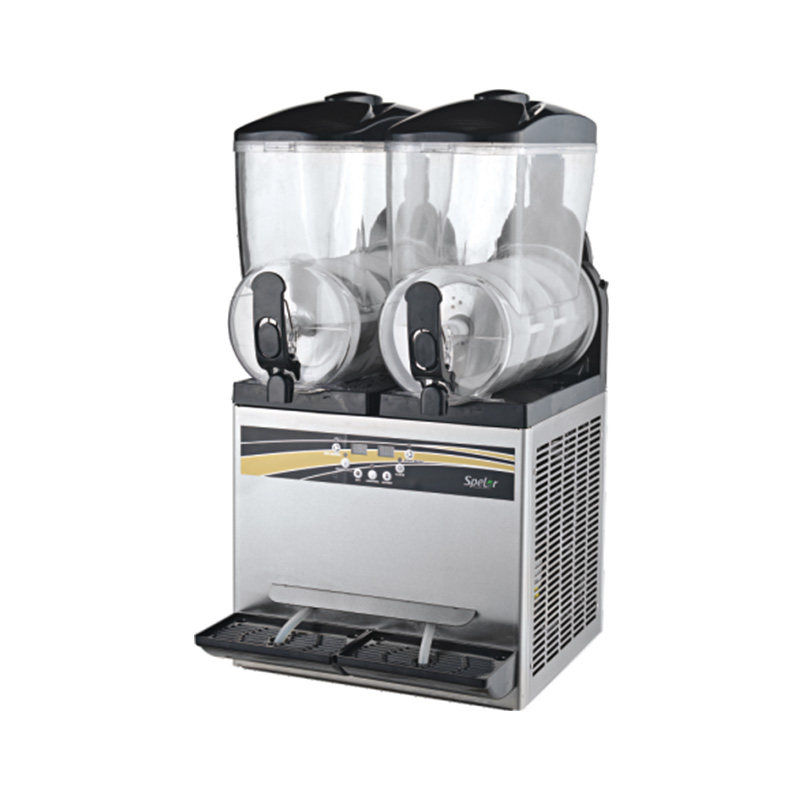
2*15L Double Tank Commercial Slush Machine for Bar Cafe Restaurant
Product Overview
The X-300 is a commercial frozen beverage machine with two 15-liter tanks. Each tank can be used for a separate flavor, recipe, or beverage category. For example, an operator may serve lemon slush in one tank and strawberry slush in the other. A bar may use one tank for a non-alcoholic frozen beverage and the second tank for a frozen cocktail base. A café may offer a fruit flavor alongside a coffee, tea, or specialty dessert flavor.
The two-tank layout creates flexibility without requiring two independent machines. It also gives staff the ability to manage each flavor separately. When demand for one flavor changes, the operator can adjust that tank without necessarily interrupting production in the other tank. This independent approach is especially valuable during peak periods, when different beverages may sell at different rates.
| Product Model | X-300 |
| Product Type | Commercial double-tank slush machine |
| Tank Configuration | 2 tanks |
| Capacity | 2×15 liters, 30 liters total |
| Rated Output | 1000W |
| Refrigerant | R290, also listed as R290a in the product specifications |
| Net Weight | Approximately 44–45 kilograms |
| Approximate Dimensions | 410×510×810 millimeters or 410×535×810 millimeters, depending on specification version |
| Body Materials | Food-grade stainless steel and colorful sprayed steel |
| Primary Applications | Cafés, bars, restaurants, dessert shops, snack shops, and other commercial foodservice locations |
The listed dimensions and weight contain minor variations between specification records. This can occur when measurements are taken with different external components, packaging allowances, rear clearances, or production versions. Buyers should confirm the final technical drawing, shipping dimensions, electrical configuration, and net weight before placing a large order.
Why a Dual-Tank Configuration Matters
A single-tank machine can produce one flavor at a time, which may be sufficient for a small operation with a highly focused menu. However, many modern foodservice businesses need to offer at least two choices. Customers may want a fruit flavor, a creamy flavor, a low-sugar option, a colorful specialty drink, or a frozen alcoholic beverage. A dual-tank machine supports this variety within one equipment footprint.
The 2×15L configuration provides 30 liters of total tank capacity. This is large enough for continuous service in many medium-sized cafés, bars, restaurants, and dessert shops, while remaining more space-efficient than installing two separate machines. The two tanks can also support menu segmentation. One side may be dedicated to a best-selling standard product, while the second side can be used for seasonal promotions or limited-time recipes.
Separate tanks can improve workflow during preparation and service. Staff can refill, inspect, and clean each side independently according to the business schedule. If one flavor requires a different production cycle or is temporarily unavailable, the other tank can continue serving customers. This operational separation helps reduce the risk that a problem with one flavor will stop the entire frozen beverage program.
Compared with a single large shared tank, two independent tanks offer greater product flexibility. A shared tank may require a compromise between recipes, flavors, or service timing. By contrast, the X-300 allows two beverage programs to operate side by side. This makes it easier to serve contrasting products and respond to changing customer preferences.
Compared with purchasing two low-capacity single-tank machines, the double-tank format can make better use of counter space and simplify equipment planning. One integrated unit typically requires one primary installation area, one equipment position, and one coordinated service workflow. The final economic result depends on local prices, electricity conditions, and usage patterns, but the compact dual-flavor design is an important advantage for businesses with limited space.
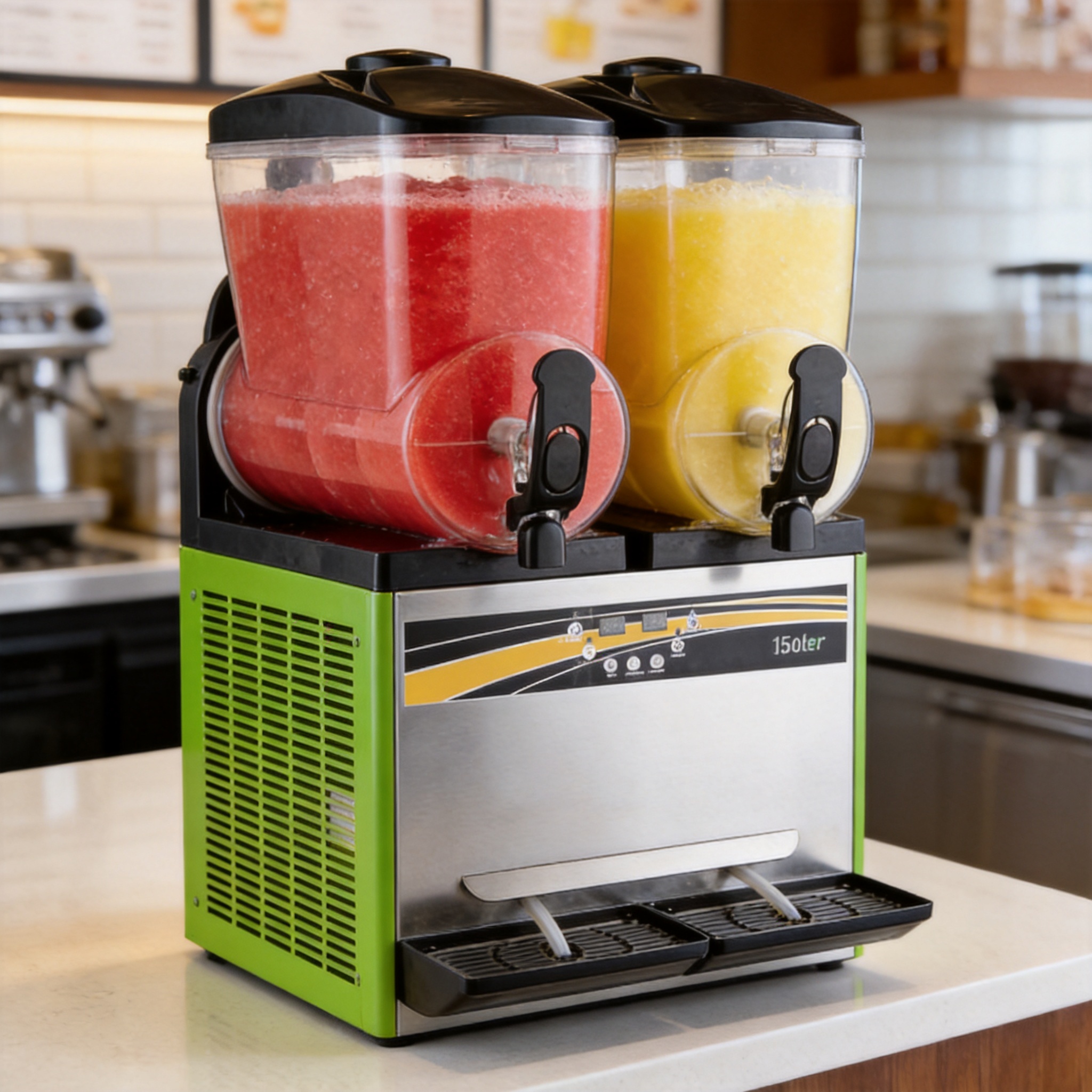
Independent Circulation for Consistent Beverage Texture
The product information identifies an independent circulation system for each flavor. This design is important because frozen beverages need more than cold temperatures. They also need continuous movement to help maintain an even texture and prevent the mixture from separating during service.
When a beverage remains stationary, heavier ingredients, fruit particles, sweeteners, or other components may settle unevenly. Continuous circulation helps distribute the mixture throughout the tank. It also supports a more uniform product from the beginning of a service period to the end. This is particularly useful for drinks containing fruit bases, flavored syrups, or ingredients that do not remain perfectly suspended without movement.
Independent circulation means that each tank can manage its own beverage condition. A strawberry formula may have a different viscosity from a lemon formula, and a frozen cocktail base may behave differently from a non-alcoholic drink. Separate systems give the operator greater control over the production of each flavor. This is a practical distinction from equipment that uses a shared operating arrangement for multiple product areas.
Consistent texture has direct commercial value. Customers often judge a frozen beverage by its appearance, spoonability, pourability, and mouthfeel. A product that is too liquid may appear under-frozen, while a product that is excessively hard may be difficult to dispense. Stable circulation and controlled cooling help operators achieve a more dependable serving condition when the recipe, ambient temperature, and operating practices are appropriate.
The circulation system also supports visual presentation. A well-maintained frozen beverage display can attract attention from people passing the counter. Colorful drinks moving within transparent tanks create an immediate indication of freshness and activity. This visual merchandising effect can encourage impulse purchases, especially in cafés, snack shops, cinemas, family entertainment venues, and quick-service locations.
Cooling Performance and R290 Refrigerant
The X-300 is specified with R290 refrigerant, with one product record identifying it as R290a. In commercial refrigeration terminology, R290 generally refers to propane refrigerant used in appropriately designed systems. It is widely recognized as a low-global-warming-potential refrigerant option, although installation, servicing, charging, ventilation, and safety procedures must follow applicable regulations and the equipment manufacturer’s instructions.
Refrigerant selection is only one part of overall machine performance. Cooling capacity also depends on compressor design, heat exchange, insulation, ambient temperature, recipe composition, starting temperature, product loading, and operating discipline. Nevertheless, the use of R290 reflects a modern approach to commercial refrigeration and can help businesses align equipment purchasing with evolving environmental expectations.
The machine’s 1000W rated output is intended to support commercial frozen beverage production across two tanks. Operators should understand that rated power is not the same as a guaranteed freezing speed under every condition. A machine’s actual performance will vary according to the temperature of the ingredients, the quantity added at one time, the sugar and alcohol content of the recipe, ventilation around the condenser, and the room temperature.
For best results, pre-chilled liquid ingredients should be used whenever possible. Large quantities of warm liquid can increase recovery time and place additional demand on the refrigeration system. Keeping the machine away from ovens, direct sunlight, hot walls, and other heat sources can also support better performance and lower unnecessary energy consumption.
Good ventilation is particularly important for commercial refrigeration equipment. The condenser area must be able to release heat effectively. Operators should avoid blocking air inlets and outlets, pushing the machine tightly against a wall, or storing packaging and cleaning materials around ventilation openings. A clear installation zone supports more stable operation and may help extend the life of the refrigeration components.
Food-Grade Construction and Professional Appearance
The body is described as being made from food-grade stainless steel and colorful sprayed steel. Stainless steel is widely used in commercial foodservice equipment because it is durable, relatively easy to clean, resistant to many common kitchen conditions, and visually compatible with other professional appliances.
For a beverage machine, sanitation is a central concern. Product contact areas, dispensing points, tank surfaces, and removable components must be cleaned according to the operating manual and local food safety requirements. A hygienic external structure supports a clean service environment, while a well-maintained interior helps protect beverage quality and customer confidence.
The colorful sprayed-steel elements add visual appeal. A machine positioned at the front counter is not only a production appliance; it can also be part of the store’s merchandising environment. A professional finish can complement a café interior, dessert shop, bar, or restaurant service line. The combination of stainless steel and colored panels allows the equipment to appear both durable and attractive.
Compared with basic consumer-grade plastic units, a commercial metal-bodied machine is generally better suited to repeated daily use in a business environment. Commercial equipment must handle frequent service, staff interaction, ingredient loading, cleaning cycles, and extended operating periods. While proper maintenance remains essential, the selected construction materials are intended to support a more demanding operating environment.
The appearance also contributes to perceived product quality. Customers can see the tanks and the frozen product, so the condition of the equipment is part of the overall dining experience. Regular cleaning, polished external surfaces, and orderly ingredient handling help transform the machine from a hidden back-of-house appliance into a positive point-of-sale feature.
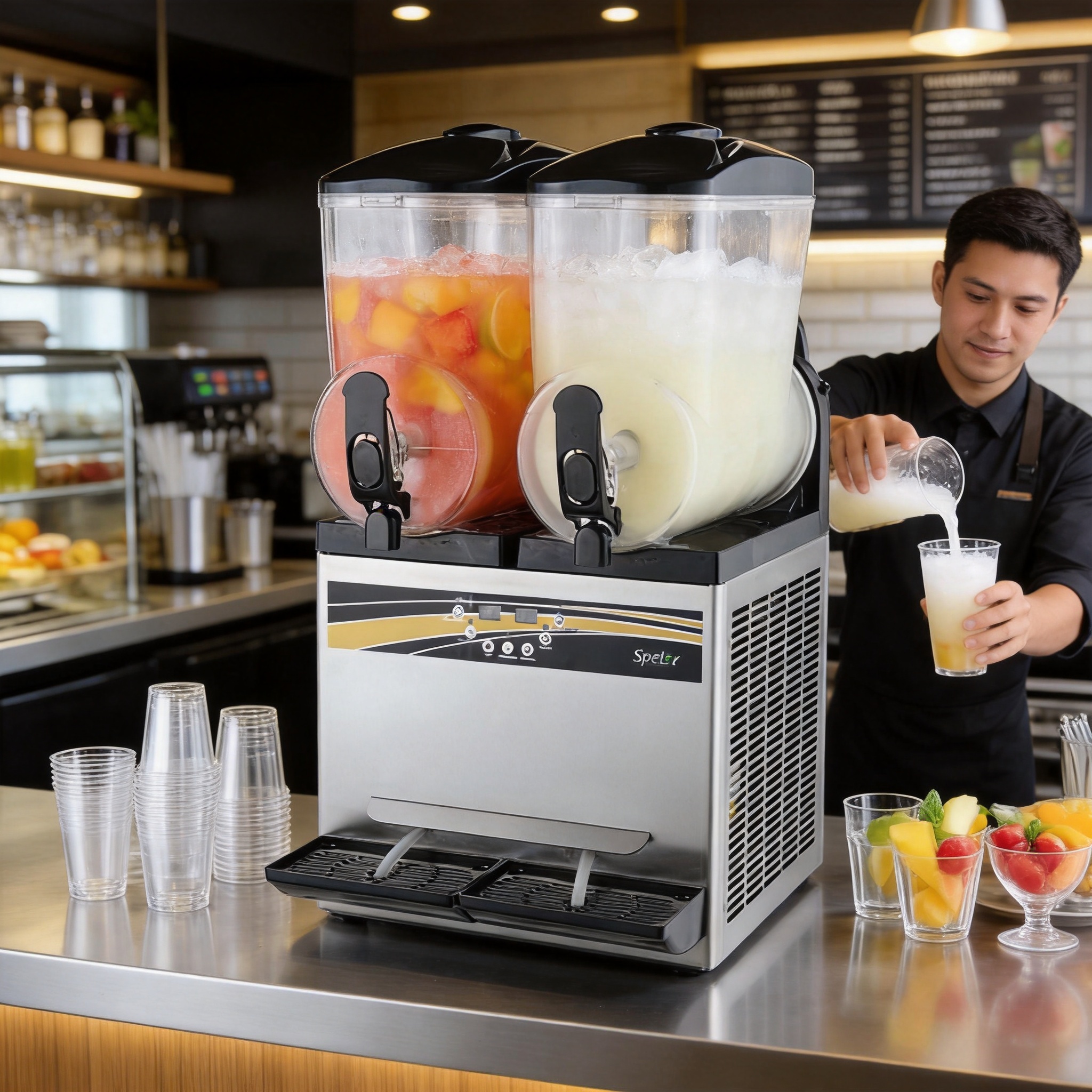
Commercial Applications
Cafés and Coffee Shops
Cafés can use the two tanks to expand beyond hot coffee and chilled beverages. One tank may serve a fruit-based slush, while the other supports a seasonal specialty. Frozen lemonade, iced tea slush, berry drinks, and dessert beverages can increase menu variety during warm weather. The machine can also help cafés use the same counter area for different promotional products throughout the year.
Bars and Beverage Lounges
Bars can produce frozen cocktails, mocktails, and non-alcoholic slush drinks. The two-tank format allows alcoholic and alcohol-free options to be separated, subject to the business’s sanitation procedures and local regulations. Operators should verify that any alcohol-containing recipe falls within the machine’s recommended formulation range, because excessive alcohol can affect freezing behavior.
Restaurants and Quick-Service Locations
Restaurants can offer frozen beverages as an accompaniment to meals or as a dessert alternative. A dual-tank unit can support two popular flavors without requiring a large beverage station. Quick-service restaurants may benefit from the machine’s ability to serve repeatable products during lunch, dinner, and peak weekend periods.
Dessert Shops and Snack Stores
Dessert shops can use the machine alongside ice cream, fried ice cream, waffles, or other sweet products. Brightly colored slush beverages can create a complementary product category and encourage customers to purchase a drink with a dessert. Because each tank can hold a different flavor, the store can present a broader selection in a compact area.
Convenience Stores and Supermarkets
High-traffic retail locations can place a slush machine near the checkout area or prepared-food section. The visible tanks can attract impulse purchases. The 30-liter total capacity provides a useful service volume, although the appropriate capacity will depend on customer traffic, refill frequency, operating hours, and local demand.
Hotels, Events, and Institutional Foodservice
Hotels, catering operations, leisure facilities, schools, and institutions may use the equipment for self-service or staffed beverage stations, provided that the installation and supervision meet applicable safety requirements. Two flavors can help serve different age groups, dietary preferences, or event themes.
Operating Advantages Over Less Specialized Equipment
Commercial slush production requires equipment designed for continuous freezing and movement. A domestic blender or ordinary refrigerator may chill a beverage, but it will not necessarily create and maintain the desired slush texture during repeated service. The X-300 is purpose-built for frozen beverage production, giving it a functional advantage over improvised methods.
Compared with small countertop consumer machines, the X-300 provides substantially greater capacity. Two 15-liter tanks allow the operator to prepare a larger volume before service and reduce the frequency of small-batch preparation. This can save staff time and help maintain faster service during busy periods.
Compared with single-tank commercial equipment, the two-flavor design offers a stronger menu proposition. The business can provide variety without dedicating a separate machine and separate counter position to each flavor. This can be especially important when the available service area is limited.
Compared with shared-tank systems, independent circulation supports better flavor separation and operational control. Each product can be managed according to its own recipe and demand. This arrangement can also simplify troubleshooting because a performance issue may be isolated to one tank rather than affecting a shared production area.
Compared with poorly ventilated or low-efficiency refrigeration equipment, a unit using R290 and a modern commercial refrigeration design may better align with current expectations for refrigerant selection and energy-conscious purchasing. Energy results still depend on usage and installation, so operators should evaluate local electrical specifications, ambient conditions, and expected operating hours before making a final decision.
Manufacturing Strengths and Production Capabilities
The manufacturer is described as a professional producer integrating design, research and development, manufacturing, sales, and service. This integrated structure is important for commercial equipment because product quality depends on more than final assembly. It involves engineering, component selection, metal fabrication, refrigeration integration, electrical control, testing, packaging, logistics, and after-sales support.
With more than 60,000 square meters of modern production facilities, the company has the scale to support a broad commercial equipment portfolio. Its product range includes ice cream machines, juice dispensers, fried ice cream machines, refrigeration cabinets, slush machines, flake ice machines, cooking equipment, griddles, fryers, insulation products, barbecue equipment, and buffet solutions.
A diversified product portfolio can strengthen technical experience across related categories. Slush machines share important knowledge areas with other refrigeration and foodservice products, including compressors, refrigerant circuits, temperature management, food-contact materials, electrical safety, thermal insulation, and commercial durability. Experience across these product groups can support a more complete approach to equipment development.
Research and development capabilities allow the manufacturer to refine machine structures, improve usability, evaluate new refrigerant requirements, and respond to foodservice trends. For buyers, this can be valuable when a standard machine needs to be adapted for a particular market, counter arrangement, electrical system, color program, or product application.
Manufacturing control is also significant for OEM and ODM customers. A factory that manages design and production within one organization can communicate more directly between engineering and manufacturing teams. This may reduce misunderstandings when a customer provides drawings, branding requirements, packaging instructions, or technical specifications.
Production quality depends on process discipline. Metal sheets must be cut and formed accurately, surfaces must be finished consistently, tanks and circulation components must be assembled correctly, and refrigeration systems must be tested for reliable operation. Electrical connections, controls, insulation, seals, and dispensing components must be checked before shipment.
Commercial machines also require attention to repeatability. A factory supplier should be capable of producing consistent dimensions, stable component placement, uniform external finishes, and repeatable operating performance across batches. This is particularly important for distributors, chain stores, and project customers that need multiple units with a consistent appearance and specification.
From Material Selection to Finished Equipment
Engineering and Product Planning
The manufacturing process begins with product planning and technical design. Engineers determine tank volume, external dimensions, refrigeration requirements, circulation arrangements, electrical configuration, access points, safety provisions, and serviceability. For a dual-tank product, the design must balance the two internal systems while maintaining a practical external footprint.
Metal Fabrication
Metal fabrication generally includes sheet cutting, bending, forming, surface preparation, and assembly. Accurate fabrication helps ensure that panels fit correctly and that the finished cabinet has a clean appearance. Stainless-steel sections must be formed and finished in a way that supports sanitation and daily cleaning.
Refrigeration Integration
The refrigeration system must be matched to the volume and intended operation of the two tanks. Component selection, refrigerant charging, tubing connections, heat exchange, insulation, and compressor operation all influence performance. Proper testing is necessary to identify leaks, abnormal pressure conditions, poor cooling, or unstable operation before the equipment reaches the customer.
Circulation and Dispensing Assembly
Each tank’s circulation and dispensing structure must be assembled to support smooth product movement and convenient service. Components should be positioned for reliable operation and reasonable access during cleaning and maintenance. Dispensing points should be checked for secure fit, correct movement, and proper sealing.
Electrical and Functional Testing
Electrical testing helps verify that the machine operates safely and that controls, motors, refrigeration components, and other powered systems perform as intended. Functional testing may include starting the machine, checking circulation, observing cooling behavior, verifying tank operation, and inspecting the unit for unusual noise or vibration.
Final Inspection and Packaging
Before shipment, the finished unit should undergo visual inspection, dimensional verification, accessory confirmation, and packaging review. Commercial refrigeration equipment must be protected against vibration, impact, moisture, and handling damage during transportation. Clear documentation helps distributors and end users install, operate, clean, and service the machine correctly.
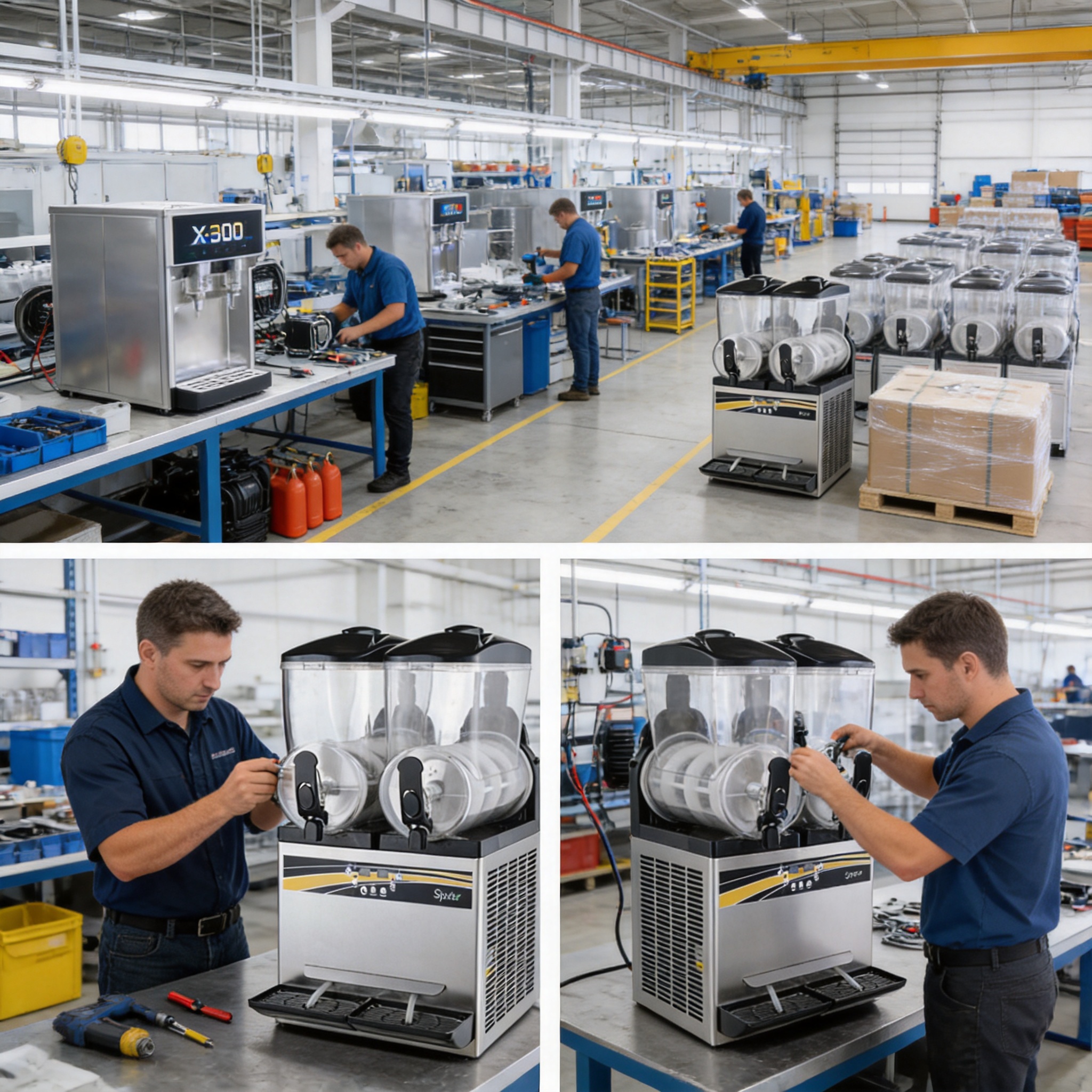
OEM and ODM Potential
The manufacturer offers OEM and ODM foodservice equipment services based on customer drawings or requirements. This creates opportunities for importers, distributors, restaurant groups, hospitality projects, and established equipment brands that need products adapted to their commercial programs.
OEM cooperation may involve customer branding, color selection, packaging design, labels, manuals, and other market-specific details. ODM cooperation can extend further into product configuration, external structure, control preferences, dimensions, tank arrangements, or application-focused improvements, subject to technical feasibility and order requirements.
Customization should begin with a clear specification. Buyers should identify the target market, expected daily volume, preferred tank capacity, electrical voltage and frequency, plug type, refrigerant requirements, exterior finish, shipping method, documentation language, and applicable certifications. Clear communication at the beginning reduces delays later in the project.
For chain businesses, customized equipment can support visual consistency across multiple locations. A particular color or panel finish may match the company’s interior design. A distributor may also request packaging or labeling suited to a specific country. These details can help the product fit more naturally into a commercial program rather than appearing as a generic appliance.
Technical customization must be evaluated carefully. Changes to dimensions, cooling systems, tank volume, electrical components, or control functions can affect performance and compliance. A responsible factory supplier should review proposed changes through engineering and production teams before confirming feasibility, pricing, lead time, and testing requirements.
Installation Planning
Although the machine has a compact commercial footprint, installation planning remains important. The operator should measure the counter or floor location, account for door and dispensing clearance, provide sufficient ventilation, and ensure that the supporting surface can safely carry a machine weighing approximately 44 to 45 kilograms before product is added.
The final installed weight will be higher than the listed net weight because the tanks may contain up to 30 liters of beverage mixture. The support surface should therefore be stable, level, and capable of handling the combined weight of the machine and its contents. A level position also helps support proper circulation, consistent product distribution, and convenient dispensing.
Electrical requirements must be confirmed before installation. The standard product information identifies a rated output of 1000W but does not specify every regional electrical configuration. Buyers should verify voltage, frequency, current, plug style, circuit requirements, and any required protective devices with the supplier and a qualified local electrician.
The machine should be positioned away from direct sunlight, ovens, cooking lines, radiators, and other heat sources. Adequate clearance around ventilation openings is necessary. In hot or humid climates, the operator should pay particular attention to ambient conditions, because extreme heat can increase refrigeration demand and influence freezing performance.
Before adding product, staff should inspect the tanks, dispensing parts, circulation components, and external surfaces. The machine should be cleaned and sanitized according to the manual. Any protective packaging, transport materials, or temporary covers must be removed before normal operation.
Recipe and Product Management
Frozen beverage quality depends on recipe formulation as well as machine design. Sugar content, acidity, fruit solids, dairy ingredients, alcohol, water content, and stabilizers can all affect freezing behavior. Operators should use recipes appropriate for commercial slush equipment and avoid assuming that every liquid beverage can be frozen in the same way.
A mixture with too little soluble solids may freeze excessively hard or place unnecessary stress on the system. A mixture with too much sugar or alcohol may remain too soft. The correct balance depends on the intended product and manufacturer guidance. Businesses introducing a new beverage should test the recipe in controlled quantities before placing it on the regular menu.
Ingredients should be mixed thoroughly before loading. If powders, syrups, fruit concentrates, or other ingredients are not fully dissolved, they may create uneven flavor, sediment, or inconsistent texture. Straining may be appropriate for recipes containing large particles, seeds, or fibers, depending on the machine’s recommendations.
Each tank should be clearly identified when different recipes are used. Labels can reduce the risk of cross-use, incorrect refilling, or accidental flavor confusion. A written preparation procedure can help different staff members produce the same result across shifts.
Operators should avoid overfilling the tanks. The appropriate fill level should follow the equipment instructions and allow room for circulation and expansion. Adding a large quantity of warm product at once may delay the formation of the desired texture, so pre-chilling and staged loading are recommended whenever practical.
Cleaning and Preventive Maintenance
Cleaning is essential for food safety, product quality, and equipment reliability. The tanks and product-contact components should be emptied, washed, rinsed, sanitized, and dried according to the manufacturer’s instructions and local regulations. Cleaning frequency should reflect the recipe, operating hours, product changes, and food safety program.
Particular attention should be given to dispensing outlets, seals, gaskets, mixing or circulation components, and areas where product may remain after service. Even a small amount of residue can affect flavor, create unpleasant odors, or support microbial growth if cleaning is delayed.
Different flavors should not be changed without an appropriate cleaning procedure. A strong fruit flavor, dairy-based mixture, or colored syrup can affect the next product if residue remains in the tank or outlet. Businesses that rotate seasonal flavors should schedule changeover cleaning as part of their daily operating plan.
The external stainless-steel and sprayed-steel surfaces should be cleaned with suitable materials that do not damage the finish. Abrasive pads, harsh chemicals, or improper tools may create scratches or discoloration. Staff should follow the manual for approved detergents and sanitation procedures.
Preventive maintenance should include inspection of seals, fasteners, electrical cables, circulation components, ventilation openings, and condenser areas. Dust accumulation around the condenser can reduce heat transfer and increase operating stress. Regular inspection helps identify problems before they interrupt service.
Only qualified technicians should work on refrigeration circuits or electrical systems. R290 refrigerant systems require appropriate tools, training, ventilation, and safety procedures. Unauthorized repair or incorrect refrigerant handling can create safety risks and may affect warranty coverage or regulatory compliance.
Service Efficiency During Peak Hours
Peak-hour performance is one of the main reasons businesses choose commercial equipment instead of small domestic appliances. During a busy period, staff need a machine that can remain ready for repeated dispensing without requiring constant manual preparation. The X-300’s two 15-liter tanks provide a reserve of product for ongoing service.
Two flavors can also reduce ordering friction. Customers can choose between two visible options instead of waiting for staff to prepare a special drink from individual ingredients. This supports faster decision-making at the counter and can simplify service during lunch breaks, weekend traffic, or event periods.
Staff workflow can be improved by assigning clear responsibilities. One employee may monitor product levels and refill preparation, while another handles dispensing and payment. In smaller operations, the same employee can manage both tasks because the machine provides ready-to-serve product in a centralized location.
Businesses should monitor sales by flavor. If one side sells much faster, preparation schedules can be adjusted. The slower side may be used for a seasonal option, a promotional flavor, or a lower-volume product. This flexibility helps the operator use the two tanks strategically rather than treating them as identical production spaces.
Total Value for Foodservice Businesses
The value of a commercial slush machine should be assessed beyond its purchase price. Capacity, menu expansion, service speed, maintenance requirements, energy use, product consistency, counter space, and after-sales support all affect the long-term result.
The X-300 supports menu expansion through its two-tank format. A business can introduce frozen beverages without installing a separate machine for every flavor. This may make it easier to test new products, run promotions, and respond to seasonal demand.
The total 30-liter capacity can reduce the need for frequent small-batch preparation. Less manual preparation may free staff to focus on customer service, food assembly, cleaning, or other operational duties. The actual labor benefit depends on the store’s volume and workflow, but the capacity is designed for more than occasional household use.
The machine’s visible presentation can also contribute to sales. Frozen drinks are highly visual products, and transparent tanks allow customers to see the colors and texture. A clean, well-lit, professionally maintained machine can work as part of the store’s merchandising strategy.
The integrated manufacturing and service structure adds another aspect of value. Customers seeking OEM, ODM, or long-term supply cooperation may benefit from a supplier able to provide product development, manufacturing, logistics coordination, and after-sales assistance through one organization.
Purchasing Considerations
Before purchasing, buyers should confirm the final model specification. The provided records list the machine as X-300 and identify two 15-liter tanks, 1000W rated output, R290 refrigerant, and approximate dimensions around 410×510×810 or 410×535×810 millimeters. Weight is listed as 44 kilograms in one specification and 45 kilograms in another. These details should be reconciled in the quotation, technical drawing, product manual, and shipping documents.
Importers should confirm regional electrical compatibility, certification requirements, customs documentation, warranty terms, spare parts availability, and packaging standards. They should also request information about recommended ambient temperature, product formulation, cleaning procedures, installation clearance, and service access.
For commercial projects, the buyer should estimate expected daily volume and peak-hour demand. A 30-liter total capacity may be appropriate for many medium-sized businesses, but high-volume locations may need several machines or a larger production plan. Capacity should be evaluated together with refill frequency and the time required to reach the desired texture.
Businesses should also consider the available counter depth and height. The listed external dimensions are compact for a two-tank machine, but operators still need room for staff movement, customer access, cleaning, ingredient storage, and ventilation. A site survey can prevent installation problems.
Finally, buyers should evaluate supplier communication. Clear technical documents, responsive pre-sales support, dependable production scheduling, suitable packaging, and practical after-sales assistance can be as important as the equipment itself. A reliable factory relationship is especially valuable for distributors and multi-location foodservice groups.
Frequently Asked Questions
What is the total capacity of the machine?
The machine has two tanks, each with a capacity of 15 liters, providing a total nominal capacity of 30 liters. The usable operating fill level should follow the manufacturer’s instructions rather than automatically filling each tank to the maximum listed volume.
Can the two tanks hold different flavors?
Yes. The dual-tank design is intended to allow two flavors or beverage recipes to be prepared at the same time. The independent circulation arrangement helps keep the operating processes of the two tanks separate.
Is this machine suitable for bars?
Yes. It is suitable for bars that serve frozen cocktails, mocktails, and other frozen beverages. Alcoholic recipes should be tested carefully because alcohol content can influence freezing behavior. Operators must also follow local requirements for food safety and responsible beverage service.
What refrigerant does the machine use?
The product information identifies R290, with another specification listing R290a. Buyers should confirm the exact refrigerant designation on the final technical documents and ensure that installation and service are performed by qualified personnel using appropriate procedures.
What is the rated power?
The listed rated output is 1000W. Actual energy consumption may vary according to ambient temperature, operating time, ingredient temperature, recipe composition, loading frequency, and ventilation conditions.
How much space is needed for installation?
The listed machine dimensions are approximately 410 millimeters wide, 510 to 535 millimeters deep, and 810 millimeters high. Additional space is needed for ventilation, cleaning, dispensing, door or component access, and staff movement. The final installation clearance should be confirmed with the supplier.
Is the body suitable for commercial foodservice use?
The body uses food-grade stainless steel and colorful sprayed steel. These materials are intended to provide a sanitary, durable, and professional external structure when the machine is operated and maintained correctly.
Can the machine be customized?
The manufacturer offers OEM and ODM services based on customer drawings or requirements. Potential customization may include exterior appearance, branding, packaging, electrical configuration, and other technically feasible details. Each project should be reviewed individually by the supplier’s engineering and production teams.
What types of businesses can use the machine?
Typical applications include cafés, bars, restaurants, dessert shops, snack stores, convenience stores, supermarkets, hotels, event venues, and institutional foodservice locations. The correct application depends on expected sales volume, menu recipes, installation conditions, and local regulations.
How can operators maintain consistent texture?
Operators should use suitable recipes, pre-chill ingredients when possible, avoid overfilling, keep circulation operating as instructed, maintain proper ventilation, and clean the machine regularly. Recipe testing is recommended when introducing products with unusual sugar, dairy, fruit, or alcohol content.
What should be checked before ordering?
Buyers should confirm capacity, dimensions, net and shipping weight, voltage, frequency, plug type, refrigerant designation, certifications, warranty, spare parts, lead time, packaging, and after-sales service. The minor differences in the published dimensions and weight should also be clarified before purchase.
Conclusion
The 2×15L Double Tank Commercial Slush Machine is designed to help foodservice businesses produce and serve two frozen beverage flavors from one professional unit. Its 30-liter total capacity, independent circulation systems, 1000W rated output, R290 refrigerant, and food-grade stainless-steel and sprayed-steel construction address the central requirements of commercial slush service.
Its main advantage is flexibility. Two independent 15-liter tanks support menu variety, flavor separation, seasonal promotions, and more efficient use of counter space. The machine is more commercially focused than a domestic blender or small consumer appliance, while offering a simpler footprint than two separate single-flavor machines in many applications.
The manufacturer’s integrated design, research and development, production, sales, and service capabilities provide additional value for distributors, foodservice projects, and OEM or ODM customers. Its large modern production base and broad portfolio across refrigeration, kitchen, beverage, dessert, and buffet equipment indicate experience in developing equipment for demanding commercial environments.
For the best result, buyers should confirm the final technical specification, electrical configuration, installation requirements, recipe limitations, cleaning procedures, and service arrangements before ordering. When correctly installed and maintained, the X-300 can support consistent frozen beverage production, faster service, attractive product presentation, and long-term operational flexibility for cafés, bars, restaurants, and other foodservice businesses.
References
1. Product specification sheet for the X-300 2×15L Double Tank Commercial Slush Machine.
2. Manufacturer-provided product description and technical information for commercial frozen beverage equipment.
3. General foodservice equipment sanitation and preventive maintenance principles.
4. General commercial refrigeration installation and ventilation practices.
5. General technical guidance concerning R290 refrigerant handling and refrigeration safety.
6. Manufacturer information concerning OEM and ODM foodservice equipment production and factory capabilities.
Product: 2*15L Double Tank Commercial Slush Machine for Bar Cafe Restaurant
For exclusive deals and latest offers, sign up by entering your email address below.


-
spelor@spelor.com
-
+86-576-85229688
-
No.528, Changxi Road, Linhai City, Zhejiang Province, China
Commercial Refrigeration Equipment Manufacturer China
Copyright © 2025 by Spelor Electrical Appliances (Zhejiang) Co., Ltd. Rights Reserved.
