


 中文简体
Why a Dual 15-Litre Commercial Juice Dispenser Is a Smart Choice for Modern Foodservice Operations
Admin 2026-08-31Commercial beverage service depends on more than simply keeping a drink cold. Operators need equipment that can maintain product quality, serve customers quickly, support more than one flavor, fit efficiently into the available workspace, and remain practical to clean and operate throughout a busy working day. The 2*15L Spraying/Stirring Commercial Juice Dispenser is designed around these requirements. With two independent 15-litre containers, refrigeration, spraying and stirring circulation options, stainless steel construction, and a compact footprint, it offers a balanced solution for cafés, restaurants, buffets, snack shops, hotels, bars, supermarkets, and other foodservice environments.
The machine is identified as model PL-230A/AJ and is designed for operators who want a reliable cold beverage dispenser without occupying the space or requiring the investment associated with larger multi-tank systems. Its dual-container layout allows two beverages or two flavors to be supplied at the same time. Depending on the selected configuration, the product can use spraying circulation or stirring circulation to help maintain an even beverage condition during service.
This article examines the machine’s design, operating functions, commercial advantages, construction quality, cleaning considerations, procurement value, and suitability for different types of foodservice businesses. It also explains how the manufacturer’s integrated design, research, development, production, sales, and service capabilities contribute to the product’s market position.

2*15L Spraying/Stirring Commercial Juice Dispenser
Product Overview
The 2*15L Commercial Juice Dispenser is a dual-tank cold drink machine with a total nominal capacity of 30 litres. Each tank holds up to 15 litres, allowing two flavors or beverage recipes to be offered independently. This arrangement is especially useful for businesses that want to provide a choice of drinks while maintaining a relatively compact service counter.
The two tanks can support beverages such as fruit drinks, flavored water, tea-based refreshments, non-carbonated cold drinks, and other suitable chilled products. Actual beverage compatibility should always be confirmed according to recipe characteristics, viscosity, ingredients, hygiene requirements, and the operating instructions supplied with the unit. For best results, operators should use beverages that can circulate effectively through the selected spraying or stirring system.
The product combines a stainless steel external panel design with modern refrigeration technology. Stainless steel gives the machine a clean and professional appearance while also helping it withstand the demands of commercial use. In a restaurant, buffet, café, or hotel environment, the equipment can coordinate with other stainless steel kitchen and service appliances and present a consistent visual standard to customers.
The product specification identifies a temperature range of approximately 7°C to 12°C. This range is suitable for serving many chilled non-frozen beverages. It is important to distinguish this product from frozen drink equipment: the dispenser is intended for refrigeration and cold beverage service rather than producing a frozen slush texture. The supplied specification also describes a refrigeration-only version, while the broader model information lists spraying and stirring power options. Buyers should confirm the exact configuration, electrical specification, and operating mode before placing an order.
| Item | Specification |
| Model | PL-230A/AJ |
| Tank configuration | 2 independent containers |
| Capacity | 2 x 15 litres |
| Total nominal capacity | 30 litres |
| Power options | Spraying: 360W; Stirring: 250W |
| Net weight | 25 kg |
| Overall dimensions | 410 x 450 x 665 mm |
| Temperature range | 7°C to 12°C |
| Configuration note | Refrigeration-only specification available |
Dual-Tank Flexibility for Beverage Service
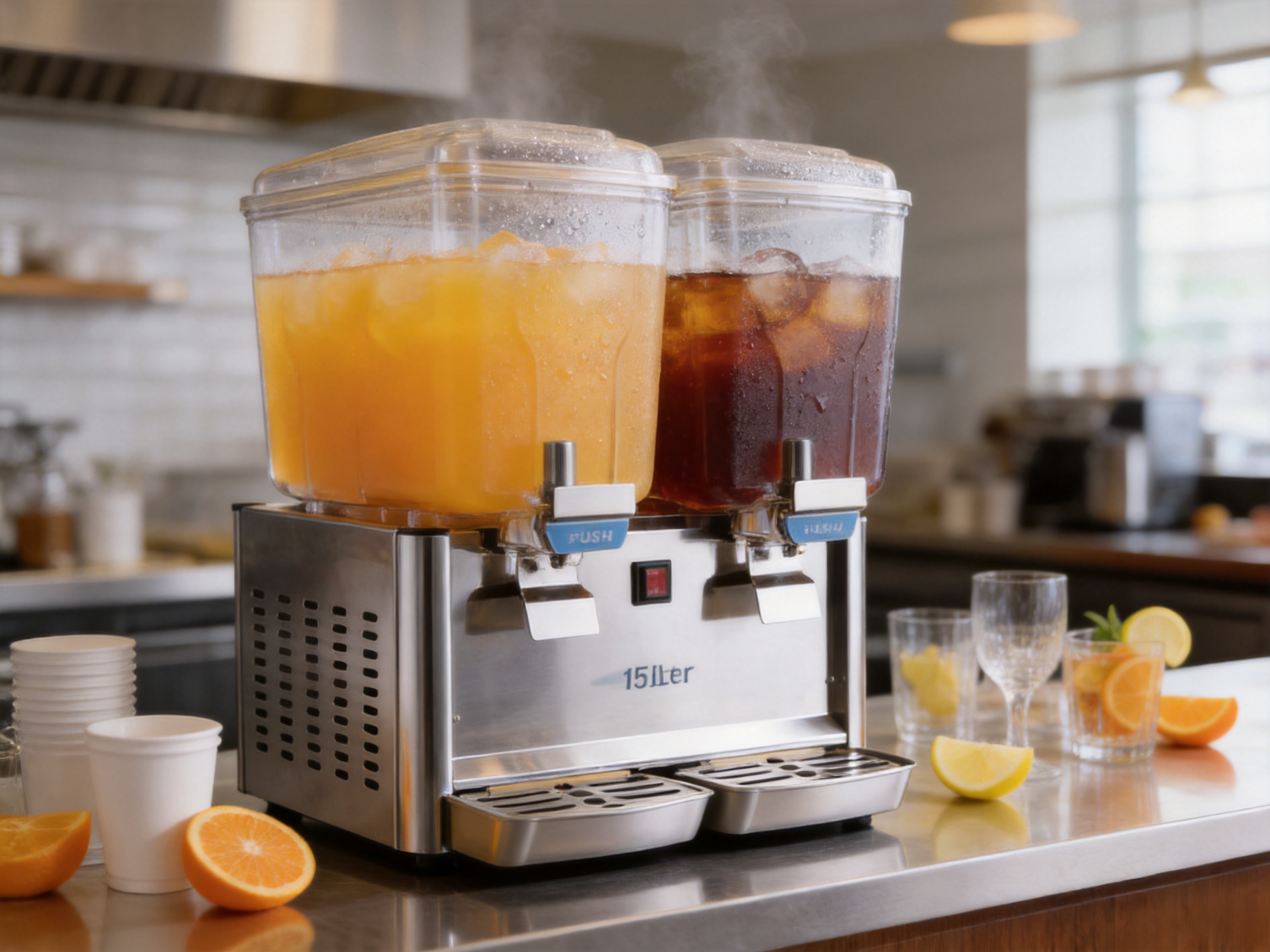
One of the most important advantages of the machine is its dual-tank design. A single-tank dispenser restricts the operator to one beverage at a time, while a two-tank unit can offer two choices from one piece of equipment. This is valuable in locations where customers expect variety but the service counter has limited room.
For example, a café may serve lemon tea in one tank and orange drink in the other. A buffet may provide two juice flavors alongside breakfast or lunch service. A hotel can use one side for a standard beverage and the second side for a seasonal or premium recipe. A fast-food outlet can offer two popular cold drinks without installing two separate single-tank machines.
Independent containers also support more organized product management. Each tank can be filled, monitored, and replenished separately. If one beverage is more popular than the other, the operator can adjust production and refill frequency without disturbing the second tank. This makes the machine suitable for businesses with changing customer demand or menus that rotate throughout the day.
The arrangement can also help reduce equipment clutter. Instead of placing two separate dispensers side by side, a business can use one dual-tank unit. This may free counter space for cups, lids, payment equipment, garnish containers, or other service tools. The compact dimensions are particularly helpful for cafés, kiosks, bars, and buffet lines where every section of the counter must be used efficiently.
Two independent tanks can also assist with flavor separation. When each beverage remains in its own container and circulation path, the operator can manage different recipes more effectively. Nevertheless, careful cleaning and sanitizing remain essential whenever flavors are changed. Separate tanks improve operational flexibility, but they do not remove the need for proper food hygiene procedures.
Spraying and Stirring Circulation Options
The PL-230A/AJ is associated with both spraying and stirring circulation. These two operating principles are useful for maintaining beverage consistency, although their exact suitability depends on the recipe and the selected machine configuration.
Spraying circulation
Spraying circulation distributes beverage through a circulation system and returns it to the tank. This movement can help keep the beverage visually active and evenly distributed during service. It is often attractive for drinks where presentation matters, because the continuous circulation can create a lively display and help draw customer attention at a counter or buffet.
The listed spraying power is 360W. The higher power specification reflects the requirements of the spraying configuration and should not be interpreted as the power consumption of every version of the machine. Operators should verify the actual nameplate rating for the unit being purchased, especially when planning electrical installation, export documentation, or large-scale equipment deployment.
Stirring circulation
Stirring circulation uses an internal stirring mechanism to keep the beverage moving. This can help reduce settling and maintain a more consistent composition for suitable non-carbonated drinks. The specified stirring power is 250W, making this option practical for operators who prefer a straightforward mixing function and a comparatively moderate power requirement.
Stirring can be useful for beverages that contain ingredients likely to settle during storage or service. It may help maintain a uniform appearance and flavor from the first serving to the last, provided that the drink recipe is appropriate for the equipment. Operators should follow the recommended filling level and avoid introducing ingredients that could block or damage the circulation components.
Choosing the correct mode
The choice between spraying and stirring should be based on the beverage recipe, desired presentation, service environment, and machine configuration. A business focused on visual display may prefer spraying, while an operation seeking practical circulation for standard cold drinks may select stirring. For OEM or wholesale projects, the correct configuration can be discussed according to the intended market and application.
Because the supplied product information includes both spraying and stirring specifications as well as a refrigeration-only remark, buyers should request a final technical confirmation before purchase. This confirmation should cover the circulation mode, power rating, voltage, frequency, plug type, control method, refrigeration arrangement, and any optional components.
Stable Refrigeration for Chilled Beverage Quality
Cold beverage quality is closely connected to temperature stability. A drink that is served too warm may appear less refreshing and may fail to meet customer expectations. A machine that produces inconsistent cooling can also create variation between the two tanks or between different service periods. The dispenser is designed with a refrigeration system intended to maintain beverages within the stated 7°C to 12°C range.
This temperature range is appropriate for many chilled juice and cold drink applications. It supports refreshment service without turning the beverage into a frozen product. For restaurants and buffets, this provides a convenient middle ground: the drink remains cold and ready to pour, while the unit avoids the texture and formulation requirements associated with slush or frozen beverage machines.
The independent tank concept can contribute to practical temperature management. Each container has its own beverage space, making it easier for the operator to monitor the condition of each flavor. The exact control arrangement may vary according to the version supplied, so purchasers should confirm whether temperature control is independent, shared, or managed through a combined system on the selected model.
Proper installation is important for refrigeration performance. The machine should be placed on a stable, level surface with sufficient ventilation around the refrigeration area. Operators should avoid positioning the unit next to high-heat appliances, in direct sunlight, or in a location where airflow is blocked. Regular cleaning of accessible ventilation areas and careful attention to room conditions can support stable operation.
Temperature performance is also affected by the starting temperature of the beverage, the frequency of dispensing, the ambient temperature, and the amount of product loaded into the tanks. Pre-chilling beverages where appropriate, avoiding overfilling, and allowing the machine to reach operating conditions before peak service can help improve consistency.
Construction and Commercial Durability
The machine uses all-stainless steel panels in its external design. This construction approach provides several practical benefits for foodservice applications. Stainless steel is widely used in commercial kitchens because it presents a clean appearance, resists many forms of everyday wear, and can be wiped down efficiently when maintained correctly.
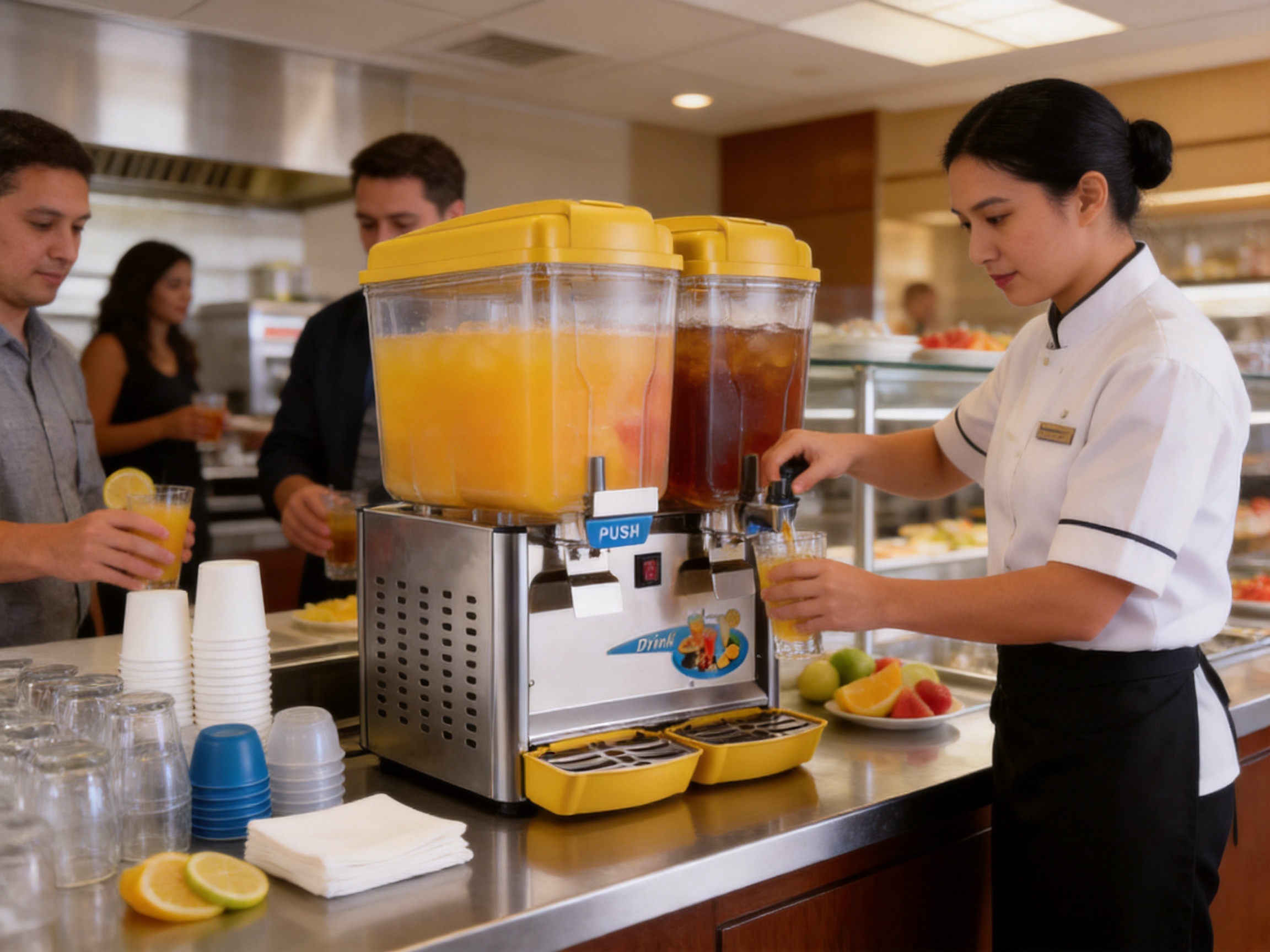
A professional exterior is important not only for durability but also for customer perception. In self-service buffets, open kitchens, hotel breakfast areas, and front-counter beverage stations, equipment is often visible to customers. A neat stainless steel machine can support a more organized and professional service environment than a lightweight appliance designed solely for household use.
The compact body is another construction advantage. Measuring approximately 410 x 450 x 665 millimetres, the unit occupies a relatively small counter footprint for a dual-tank machine. Its net weight of approximately 25 kilograms provides a practical balance between stability and manageability. It is substantial enough for commercial service while remaining easier to position or relocate than many larger beverage systems.
Durability also depends on the internal components, assembly quality, control system, refrigeration circuit, seals, circulation parts, and serviceability. A dependable commercial machine should be designed for repeated daily operation rather than occasional use. The manufacturer’s integrated production model allows these elements to be considered as part of a complete equipment solution instead of being treated as unrelated components.
Food-contact areas require especially careful attention. Tanks, dispensing points, circulation parts, seals, and other beverage-contact components should be made from appropriate food-grade materials and maintained according to hygienic operating procedures. Operators should inspect these parts regularly for wear, residue, discoloration, or damage and replace consumable components when necessary.
Advantages Compared with Basic Competitor Products
The commercial beverage dispenser market includes simple single-tank units, low-capacity countertop appliances, large multi-tank dispensers, and specialized frozen drink machines. The 2*15L model occupies a useful position between these categories. Its main advantage is the combination of capacity, flexibility, compactness, and professional construction.
More choice than a single-tank dispenser
Compared with a basic single-tank machine, the dual 15-litre format gives customers two beverage choices from one unit. This can increase menu flexibility without requiring a second complete refrigeration system. For businesses with limited counter space, the ability to serve two flavors in a single machine can improve the use of the service area.
More practical than oversized systems
Large multi-tank dispensers may provide additional capacity, but they also require more space, more product planning, and potentially greater investment. A two-tank system is often better matched to a medium-sized operation, a new outlet, a seasonal service point, or a business that wants to test new flavors before expanding.
More appropriate for chilled drinks than frozen equipment
A slush or frozen beverage machine is not necessary for every cold drink program. Frozen systems may require specialized recipes, careful control of sugar content, and more complex cleaning procedures. For operators serving refrigerated juice, tea, flavored water, and similar beverages, a chilled dispenser can be a more focused and economical choice.
More suitable for visible front-of-house service
The stainless steel appearance and dual display format make the machine appropriate for front-of-house use. Customers can see the available choices, and staff can refill or serve from a single organized station. This is a practical distinction from equipment intended only for back-of-house storage or preparation.
Better circulation flexibility
The availability of spraying and stirring configurations provides more application flexibility than a machine limited to one circulation method. Different beverages have different presentation and consistency requirements. A choice of circulation method helps distributors and end users match the machine more closely with the intended menu.
Balanced capacity and energy demand
The total 30-litre capacity offers meaningful service volume while the listed stirring power is 250W and the spraying power is 360W. Actual energy use depends on refrigeration performance, ambient conditions, operating duration, and configuration, but the specifications indicate a compact commercial platform rather than a high-capacity industrial system. This balance may be attractive to businesses that need regular service without installing oversized equipment.
Applications in Different Foodservice Environments
Cafés and coffee shops
Cafés can use the unit to extend their beverage menu beyond hot coffee and espresso. One tank may hold a fruit drink while the other serves iced tea or flavored water. The machine can be placed near the takeaway counter, allowing customers to identify cold beverage options quickly and helping staff manage service during busy periods.
Restaurants
Restaurants can use the dispenser for lunch service, casual dining, family restaurants, or self-service beverage stations. Two flavors can be offered without dedicating a large section of the dining area to beverage equipment. In a busy restaurant, the independent tank layout also allows staff to refill only the flavor that is running low.
Buffets and hotels
Buffets benefit from equipment that is visually accessible, easy to operate, and capable of serving many guests over a concentrated period. A dual-tank dispenser can present two cold beverage options during breakfast, brunch, lunch, or dinner. Hotels may also use it for conference catering, event service, or seasonal outdoor functions when a compact beverage station is required.
Bars and entertainment venues
Bars, leisure venues, and entertainment centers often need fast, consistent service and attractive equipment presentation. The spraying option may be useful when beverage movement and visibility support the display concept. The two-tank capacity enables operators to provide both a standard drink and a special flavor without adding several machines to the service area.
Snack shops and fast-food outlets
Quick-service businesses require equipment that is simple for employees to understand and fast enough for peak periods. A 2*15L dispenser can support two high-demand cold beverages while keeping the counter organized. The compact footprint may be especially useful in smaller snack shops where preparation, cooking, payment, and beverage service all compete for limited space.
Supermarkets and institutional facilities
Supermarkets may use the machine in prepared-food departments, deli areas, seasonal promotions, or customer sampling stations. Schools, hospitals, offices, and other institutions may also consider the unit where chilled beverage service is needed for staff, visitors, or events. In these applications, operators should establish clear cleaning, refill, allergen, and temperature-monitoring procedures.
Operational Efficiency During Peak Service
Equipment value is often measured by how well it performs during the busiest periods rather than during quiet hours. The dual-container layout can improve peak-service efficiency by allowing two beverages to remain ready at the same station. Staff do not need to alternate between distant equipment or repeatedly prepare individual servings for every customer.
The 15-litre capacity of each tank provides a useful reserve for moderate to high demand. Actual serving volume depends on cup size, beverage type, refill procedures, and sales patterns. Businesses should estimate demand before service and maintain a replenishment plan so that the tanks do not become empty during a rush.
Clear labeling is recommended. Each tank should display the beverage name, flavor, ingredients where appropriate, and any allergen information required by local regulations. Color-coded handles or signage may also help customers and employees distinguish between the two selections.
Efficient service is supported when the machine is positioned close to cups, lids, straws, napkins, and waste containers. However, these items should not obstruct ventilation, controls, access panels, or cleaning areas. A well-planned layout can reduce unnecessary staff movement and help maintain a smoother customer flow.
Operators should also establish a start-up routine. The machine should be inspected, cleaned, filled with the correct beverage, switched on according to the operating instructions, and allowed to reach the desired serving condition before the service period begins. At closing, the beverage should be handled according to its storage requirements, and the machine should be cleaned or prepared for the next operating cycle.
Cleaning, Hygiene, and Maintenance Considerations
Cold beverage equipment must be maintained with the same level of care as other food-contact appliances. Beverage residue can accumulate in tanks, circulation components, dispensing outlets, seals, and hidden surfaces if cleaning is delayed. This may affect taste, appearance, machine performance, and food safety.
A practical cleaning program should include daily attention to the tank interiors, lids, dispensing areas, visible circulation components, drip trays, and external surfaces. The exact disassembly sequence should follow the supplied manual. Components that come into contact with the beverage should be washed with suitable foodservice cleaning materials and rinsed thoroughly.
Sanitizing procedures should be selected according to local food safety requirements and the material compatibility of the machine. Cleaning chemicals should never be mixed improperly, and residues should not be allowed to remain in the beverage path. Staff should be trained to identify which parts can be removed, which surfaces require special care, and how to reinstall seals and circulation components correctly.
The stainless steel exterior should be wiped with a soft cloth and a suitable cleaner. Abrasive pads, aggressive chemicals, and practices that could scratch or discolor the surface should be avoided. Spills around electrical controls, ventilation openings, and refrigeration components should be addressed promptly, using safe procedures that protect the machine from moisture intrusion.
Preventive maintenance can extend operating life. Operators should inspect power cords, switches, seals, tank fittings, dispensing valves, circulation parts, and unusual noises or vibrations. If the machine does not reach the expected temperature, if circulation becomes weak, or if condensation appears abnormal, the unit should be checked by qualified service personnel.
Good maintenance is also a purchasing consideration. A commercial machine should not only work well when new; it should be supported with replacement parts, technical guidance, and after-sales service. Spelor’s product range includes optional components and spare parts, allowing distributors and operators to plan for long-term equipment support.
Manufacturing Capabilities Behind the Product
The product is manufactured by Spelor Electrical Appliances (Zhejiang) Co., Ltd., a professional equipment company based in Zhejiang, China. The business was formerly known as Zhejiang Spelor Refrigeration Equipment Co., Ltd. Its stated activities cover design, research and development, manufacturing, sales, and service.
The company operates more than 60,000 square metres of modern production facilities and focuses on commercial refrigeration, kitchen equipment, and buffet equipment. This breadth is relevant to the juice dispenser because the product combines several technical disciplines: sheet-metal construction, foodservice design, refrigeration, circulation systems, temperature management, assembly, quality control, and commercial after-sales support.
An integrated manufacturing structure can improve coordination between product design and production. Engineers can consider the practical requirements of assembly, servicing, cleaning, component access, and shipping while developing equipment. Production teams can work with standardized procedures and dedicated facilities, while service teams can provide feedback from actual operating environments.
The company’s broader product portfolio includes ice cream machines, juice dispensers, fried ice cream machines, refrigeration cabinets, slush machines, flake ice machines, cooking equipment, griddles, fryers, insulation products, barbecue equipment, and buffet solutions. This range gives the manufacturer experience across multiple foodservice categories and allows customers to source complementary equipment from one supplier.
For wholesalers and project buyers, a broad product range can simplify procurement. A distributor serving snack shops, cafés, restaurants, or hotel projects may require several types of equipment at once. Working with an integrated factory can reduce the need to coordinate multiple unrelated suppliers, while product compatibility and service communication may become easier to manage.
Design and Development Strengths
The design of the dispenser reflects a combination of appearance, functionality, and space efficiency. The European and American design influence described in the product information is expressed through a clean exterior, stainless steel panels, and a straightforward commercial format. The objective is not decorative complexity; it is a professional machine that can operate in different service environments and remain easy for staff to understand.
Research and development are particularly important for refrigeration equipment. A successful design must consider cooling performance, heat dissipation, condensation, tank geometry, circulation behavior, electrical safety, noise, cleaning access, and component durability. These factors affect the customer experience as well as the ownership cost of the machine.
Development work also needs to account for different market requirements. Voltage, frequency, plug standards, labeling, packaging, documentation, and certification expectations may vary by destination. A factory that supports OEM and ODM projects can adapt selected details according to drawings, technical requirements, or target-market needs, subject to feasibility and order conditions.
Customization may include exterior branding, color, labeling, control configuration, packaging, electrical specifications, tank arrangement, accessory selection, or other approved modifications. The level of customization depends on the project, minimum order quantity, production schedule, and technical review. Buyers should provide complete requirements at the quotation stage so that the factory can assess them accurately.
Quality-Oriented Production Process
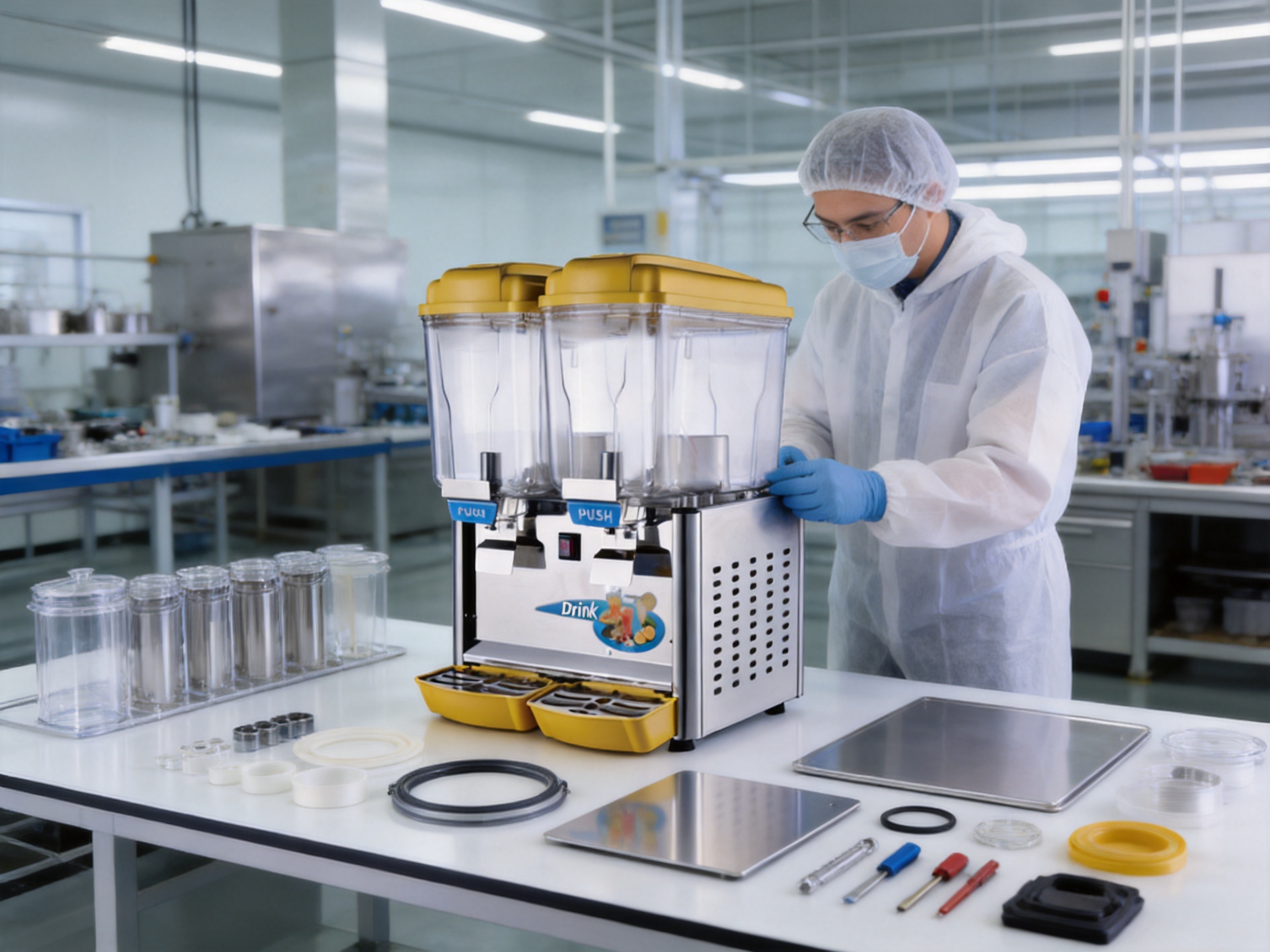
A commercial juice dispenser passes through several important production stages before it reaches a customer. Although specific internal factory procedures may differ, a responsible manufacturing process generally begins with design confirmation and material selection. The selected stainless steel, food-contact materials, refrigeration components, motors, pumps or circulation assemblies, seals, controls, and electrical parts must be matched to the intended use.
Sheet-metal processing forms the visible body of the machine. Cutting, bending, forming, welding, polishing, and surface finishing must be controlled to achieve accurate dimensions and a clean appearance. Well-fitted panels can improve the overall impression of quality and help protect internal components from the surrounding foodservice environment.
Tank and beverage-contact component production requires special care. Surfaces should be smooth enough to support effective cleaning, and joints should be designed to minimize residue retention. Assembly accuracy matters because poor alignment can affect circulation, sealing, dispensing, or the ease with which staff can remove parts for sanitation.
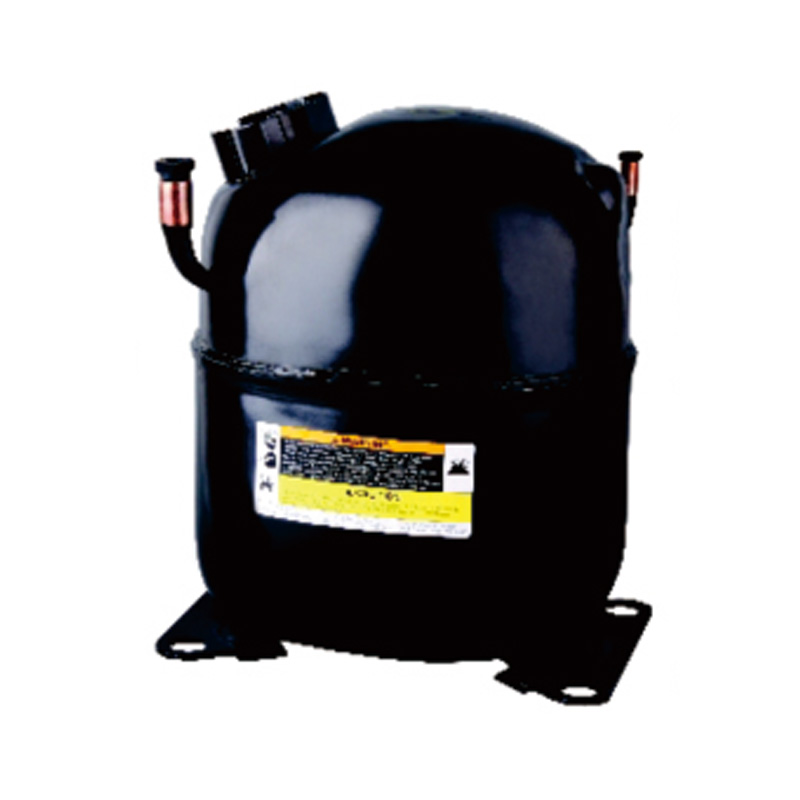
Refrigeration assembly is another critical stage. The cooling circuit, compressor-related components, condenser area, controls, insulation, and temperature-sensing elements must work together. Factory testing may include checks for cooling operation, temperature behavior, electrical safety, leakage, abnormal noise, and general functionality.
Circulation systems should be tested for consistent operation. In spraying models, the circulation path should deliver the intended movement without excessive splashing or obstruction. In stirring models, the stirring mechanism should operate smoothly and maintain suitable beverage movement. Controls should be checked to ensure that the operator can use the selected function correctly.
Final inspection should confirm the model, configuration, dimensions, power rating, appearance, accessories, packaging, and documentation. For export orders, labeling and packaging are especially important because the equipment may pass through several stages of transport and storage before installation at the final customer site.
Procurement Value for Wholesalers and Distributors
The machine is positioned as a factory-direct commercial cold drink dispenser, making it relevant to wholesalers, importers, distributors, catering-equipment suppliers, and foodservice project contractors. A direct relationship with the manufacturer can provide clearer communication about specifications, production capacity, packaging, lead times, and customization.
For distributors, the product has a broad application range and a straightforward value proposition. It provides two 15-litre tanks, a compact footprint, a professional stainless steel exterior, and chilled beverage service. These features can make it suitable for multiple customer segments rather than a narrow specialty market.
Distributors can also build packages around the machine. A café package might combine the juice dispenser with refrigeration cabinets, ice machines, or countertop equipment. A snack-shop package may include a slush machine, fried ice cream machine, cooking equipment, and display or buffet accessories. A hotel project may require several beverage dispensers together with ice-making and food-holding equipment.
OEM and ODM support can further improve market fit. A distributor may wish to sell the product under a private label, use a market-specific color scheme, or adapt the packaging for a local sales channel. Such projects require early communication, approved artwork, technical confirmation, and a realistic understanding of minimum order requirements.
After-sales service should be evaluated alongside the purchase price. A low initial price is less valuable if replacement parts are difficult to obtain or technical questions cannot be answered. Spelor describes its support as including pre-sales consultation, product customization, flexible logistics and payment solutions, and after-sales maintenance. Buyers should request detailed service terms, spare-parts availability, warranty coverage, and troubleshooting documentation before finalizing a commercial order.
Installation and Site Planning
The unit should be installed on a firm, level counter or stand capable of supporting its operating weight. The location should provide adequate clearance for ventilation, access to controls, cleaning, and routine service. A crowded installation can reduce airflow and make daily sanitation more difficult.
Before delivery, the operator should verify doorway widths, counter dimensions, elevator capacity, electrical outlet location, drainage arrangements if applicable, and the route from receiving to the final installation point. The overall dimensions are approximately 410 x 450 x 665 millimetres, but additional clearance may be required beyond the listed machine size.
The electrical supply must match the nameplate of the delivered unit. Because spraying and stirring configurations may have different power ratings, the operator should not rely on a general catalog description when preparing the site. Voltage, frequency, grounding, plug design, and local electrical requirements should be confirmed in writing.
The beverage station should be located away from direct heat, water spray, and excessive dust. It should also be positioned where staff can observe the tanks and respond quickly to low beverage levels, spills, or unusual operating conditions. If the machine is used in a self-service area, barriers or signage may be helpful to protect the unit from misuse while keeping it accessible to customers.
How to Improve Beverage Quality in Daily Use
The machine provides refrigeration and circulation, but beverage quality also depends on recipe preparation and operating discipline. Ingredients should be mixed according to a consistent formula before filling. Concentrated ingredients should be properly diluted, and any particles or materials unsuitable for the circulation path should be removed.
Operators should avoid filling above the recommended level. Overfilling can increase the risk of spills, interfere with circulation, and make cleaning more difficult. At the same time, the machine should not be run without sufficient beverage in the tank if the circulation system requires product for proper operation.
Each tank should be monitored separately. A popular flavor may require more frequent replenishment, while a slower-selling product may need smaller batch preparation to reduce waste. The two-tank layout allows the operator to match production more closely to demand.
Temperature checks should be included in the daily routine. Staff can record the temperature at opening, during peak service, and near closing, subject to the business’s food safety procedures. Unexpected temperature changes should be investigated rather than ignored.
Flavor changes should be planned around cleaning. If the operator wants to replace one beverage with another, the tank and product-contact parts should be cleaned and sanitized first. This helps avoid cross-flavor contamination and supports better hygiene control.
Environmental and Cost Considerations
Compact commercial equipment can offer cost advantages beyond the purchase price. A dual-tank machine may reduce the need to buy two separate single-tank dispensers, occupy less counter space, and simplify the beverage station. It can also help the operator serve two products from one refrigeration platform.
The machine’s moderate dimensions and approximately 25-kilogram net weight may reduce handling complexity during installation or relocation. For seasonal businesses, event caterers, and growing retailers, this flexibility can be valuable when equipment needs to be moved between service areas.
Energy performance depends on many factors, including ambient temperature, operating hours, loading practices, refrigeration condition, and the chosen spraying or stirring version. Operators can support efficient operation by keeping ventilation clear, minimizing unnecessary door or lid opening, pre-chilling beverages when appropriate, and maintaining seals and refrigeration components.
Durability and serviceability also contribute to sustainability. Equipment that remains in use for a longer period can reduce replacement frequency and avoid the costs associated with disposing of prematurely worn machines. Regular cleaning and preventive maintenance are therefore not only hygiene practices but also methods of protecting the investment.
Questions and Answers
What is the total capacity of the dispenser?
The machine has two independent 15-litre tanks, giving it a total nominal capacity of 30 litres.
Can the two tanks hold different beverages?
Yes. The independent container design allows two flavors or beverage recipes to be served at the same time. Each tank should be managed and cleaned separately according to the operator’s hygiene procedures.
Is this a frozen drink or slush machine?
No. The stated temperature range is approximately 7°C to 12°C, and the product is described as a refrigeration-only beverage dispenser. It is intended for chilled drinks rather than frozen slush textures.
What is the difference between spraying and stirring?
Spraying circulates the beverage through a spray-style system and can support an active visual presentation. Stirring uses an internal stirring mechanism to keep suitable beverages moving and help reduce settling. The best option depends on the recipe, presentation requirements, and selected model configuration.
What are the listed power ratings?
The product information lists 360W for the spraying configuration and 250W for the stirring configuration. The exact electrical rating should be confirmed from the nameplate and technical documents for the unit ordered.
What temperature can the machine maintain?
The stated temperature range is 7°C to 12°C. Actual performance can be influenced by ambient conditions, beverage starting temperature, loading volume, ventilation, and maintenance.
Is the machine suitable for a small café?
Yes. Its compact dimensions and two-tank format can suit cafés and other businesses that need multiple cold beverage choices without installing a large beverage system.
Can hotels and buffets use this equipment?
Yes. The dual-tank design is suitable for breakfast areas, buffet lines, conference catering, and other hotel or institutional beverage stations where two chilled drink choices are required.
Does the stainless steel exterior require special care?
It should be wiped regularly with a soft cloth and a suitable cleaner. Abrasive materials and harsh chemicals that could scratch or damage the surface should be avoided.
How often should the beverage-contact components be cleaned?
Cleaning frequency depends on the beverage, operating schedule, local regulations, and manufacturer instructions. Daily cleaning or cleaning after each product cycle is commonly required in commercial beverage service, but the operator should follow the approved sanitation procedure for the specific machine.
Can the product be customized?
The manufacturer offers OEM and ODM services based on drawings or requirements. Possible customization should be discussed in advance because technical feasibility, minimum quantities, production time, packaging, and certification requirements may vary.
What should a distributor confirm before ordering?
A distributor should confirm the exact model, circulation mode, power rating, voltage, frequency, plug type, temperature control arrangement, dimensions, packaging, warranty, spare-parts support, documentation, minimum order quantity, lead time, and delivery terms.
Why is factory support important for this type of equipment?
Commercial refrigeration equipment requires correct installation, cleaning, troubleshooting, and occasional replacement parts. Direct communication with an experienced manufacturer can help distributors and end users obtain technical information and long-term service support.
Conclusion
The 2*15L Spraying/Stirring Commercial Juice Dispenser is a practical cold beverage solution for businesses that need capacity and variety without installing an oversized system. Its two independent 15-litre tanks allow simultaneous service of two flavors, while spraying and stirring options provide flexibility for different beverage recipes and presentation styles.
The machine’s 7°C to 12°C refrigeration range supports chilled, ready-to-serve beverages rather than frozen products. Its stainless steel panels, compact 410 x 450 x 665 millimetre dimensions, approximately 25-kilogram net weight, and commercial configuration make it suitable for cafés, restaurants, buffets, hotels, snack shops, bars, supermarkets, and institutions.
Compared with basic single-tank dispensers, it offers greater menu flexibility. Compared with larger multi-tank systems, it can be easier to install and more efficient in limited spaces. Compared with frozen beverage equipment, it provides a focused solution for refrigerated drinks with a simpler product concept.
The manufacturer’s more than 60,000 square metres of modern production facilities, integrated design and development capabilities, broad foodservice equipment portfolio, and OEM and ODM support strengthen the product’s value for international wholesalers and distributors. For the best purchasing result, buyers should confirm the exact configuration and electrical specifications, evaluate spare-parts and after-sales support, and prepare a clear cleaning and maintenance program for the end user.
When selected for the right beverage recipes and operated according to sound foodservice procedures, this dual-tank dispenser can help businesses create a more organized beverage station, serve customers efficiently, and expand their cold drink offering with a dependable commercial platform.
References
1. Product specification sheet for the PL-230A/AJ 2*15L Spraying/Stirring Commercial Juice Dispenser.
2. Manufacturer-provided technical information covering capacity, power, dimensions, net weight, temperature range, and refrigeration configuration.
3. Manufacturer company profile describing commercial refrigeration, kitchen, buffet equipment, production facilities, OEM and ODM services, and after-sales support.
4. General commercial foodservice equipment hygiene and preventive maintenance principles.
5. General guidance for chilled beverage service, refrigeration equipment installation, food-contact component cleaning, and temperature monitoring.
Product: 2*15L Spraying/Stirring Commercial Juice Dispenser

For exclusive deals and latest offers, sign up by entering your email address below.


-
spelor@spelor.com
-
+86-576-85229688
-
No.528, Changxi Road, Linhai City, Zhejiang Province, China
Commercial Refrigeration Equipment Manufacturer China
Copyright © 2025 by Spelor Electrical Appliances (Zhejiang) Co., Ltd. Rights Reserved.
