


 中文简体
30L Single Tank Stirring Commercial Juice Dispenser: Efficient Cooling and Reliable Beverage Service
Admin 2026-09-09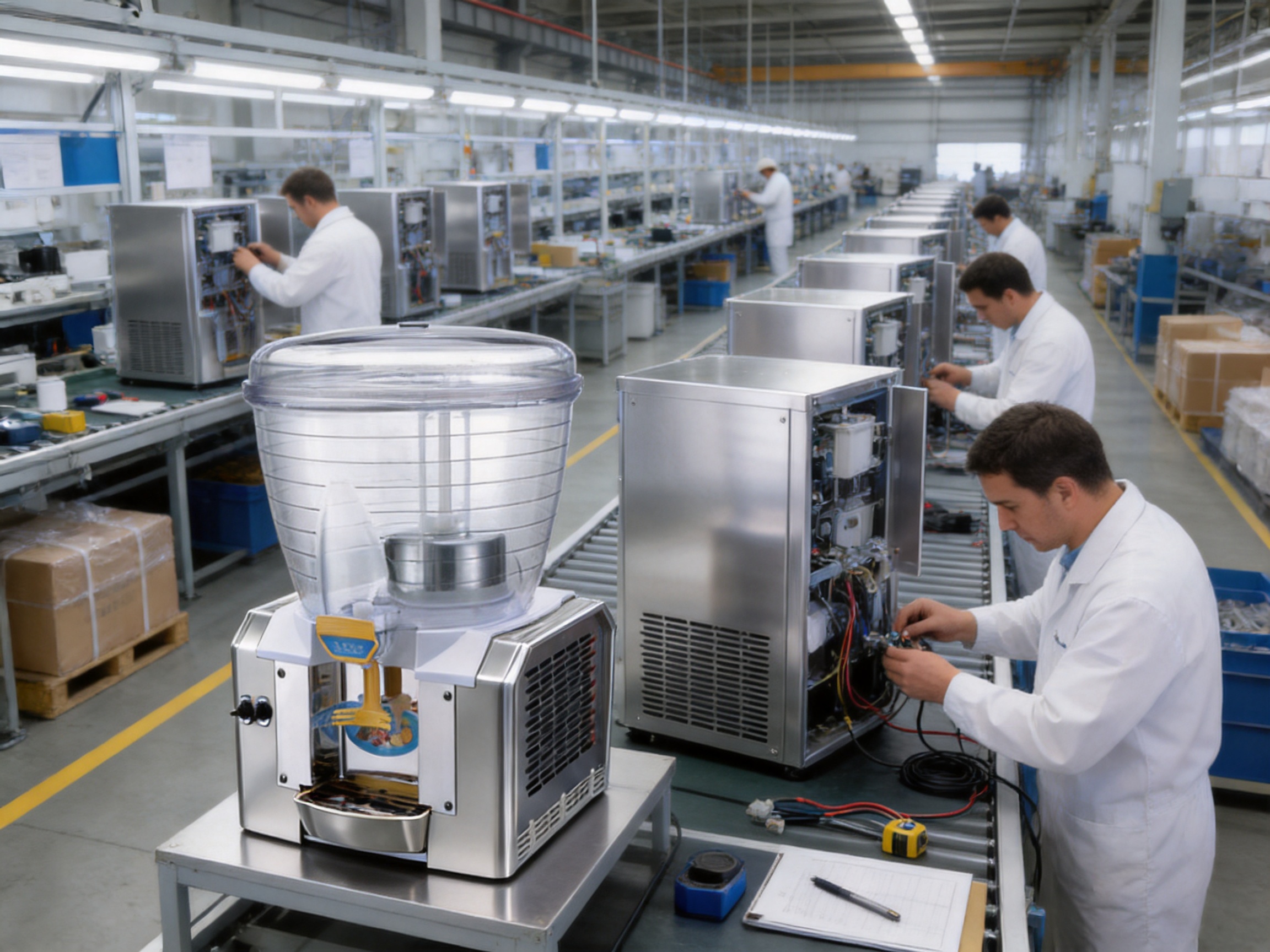
In busy cafés, restaurants, hotels, bars, beverage shops, supermarkets, and institutional foodservice operations, beverage equipment must do more than hold liquid. It must help operators serve consistently, maintain a suitable drinking temperature, simplify daily work, and remain dependable during extended operating hours. The 30L Single Tank Stirring Commercial Juice Dispenser is designed for precisely these demands. With a generous 30-liter capacity, continuous stirring, stable refrigeration, a food-grade stainless-steel body, and a compact commercial format, it offers a practical solution for establishments that need chilled juice and other cold beverages available throughout the service period.
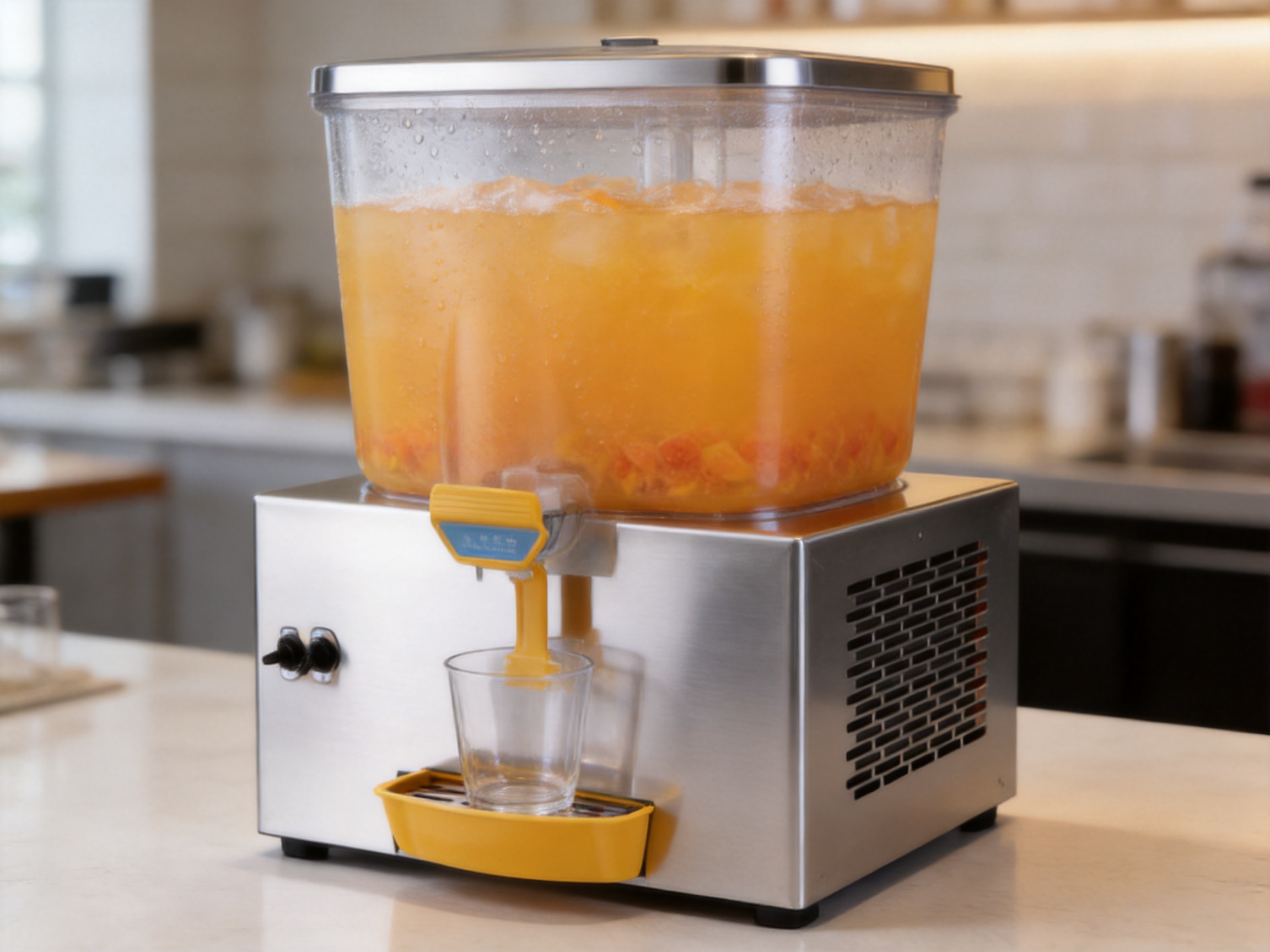
Model PL-130AJ is a refrigeration-only beverage dispenser with a stirring input power of 255W. Its design combines a large single tank with an even-blending system, allowing thick, pulpy, or fruit-based drinks to remain more consistent from the first serving to the last. The unit operates within a temperature range of 7°C to 12°C and measures 450 × 450 × 665 mm, making it suitable for counters, beverage stations, self-service areas, and back-of-house preparation spaces where floor area is limited.
Beyond its operating specifications, the machine reflects a wider manufacturing capability. Spelor Electrical Appliances (Zhejiang) Co., Ltd. is a professional manufacturer involved in design, research and development, production, sales, and service. Its modern manufacturing facilities cover more than 60,000 square meters, supporting the production of commercial refrigeration, kitchen, buffet, and beverage equipment. This combination of focused product engineering and broad production experience gives buyers access to a supplier capable of supporting standard equipment procurement as well as OEM and ODM requirements.
Why Beverage Dispensing Efficiency Matters in Commercial Foodservice
Beverage service can become a major source of delay when drinks must be mixed manually, refrigerated in separate containers, or replenished in small batches. These methods may be acceptable for occasional service, but they create problems in high-volume settings. Staff may need to stir beverages repeatedly, check temperatures frequently, transfer liquid between containers, and manage spills or uneven flavor distribution. Each additional task takes time and increases the possibility of inconsistent service.
A commercial juice dispenser addresses these challenges by combining storage, stirring, cooling, and dispensing in one coordinated unit. The operator can prepare a beverage in the tank, switch on the stirring function, and allow the machine to maintain a more uniform mixture while refrigeration keeps the contents chilled. This reduces the amount of manual intervention required between servings and supports a smoother workflow during breakfast service, lunch periods, buffet operations, parties, and other busy occasions.
Capacity is also important. A 30-liter tank provides a substantial quantity of beverage without requiring constant refilling. For a restaurant or hotel, this can help staff prepare a larger batch before service begins. For a beverage shop or bar, it can support repeated servings while keeping the dispensing area organized. The single-tank configuration is particularly useful when the establishment wants one featured juice, tea, punch, flavored water, or similar beverage available in a dedicated dispenser.
The PL-130AJ is not intended to replace every type of beverage machine. Its design is especially appropriate for chilled drinks that need stirring and refrigeration rather than heating, freezing, carbonating, or making frozen slush. Understanding this intended application allows buyers to select the machine for the right operating environment and obtain better performance from the equipment.
Core Product Specifications
The following table summarizes the key specifications of the 30L Single Tank Stirring Commercial Juice Dispenser.
| Model | PL-130AJ |
| Product Type | Single-tank commercial juice dispenser |
| Capacity | 30L |
| Stirring Input Power | 255W |
| Net Weight | 24kg |
| Overall Dimensions | 450 × 450 × 665mm |
| Temperature Range | 7°C–12°C |
| Refrigeration Function | Refrigeration only |
| Primary Application | Chilled juice, tea, fruit beverages, and cold drinks |
| Tank Configuration | One large stirring tank |
Large 30-Liter Capacity for Continuous Service
The 30-liter capacity is one of the machine’s most important advantages. In commercial operations, a small domestic container may require frequent refilling, especially when a beverage is popular or when many customers are served in a short period. Repeated refilling interrupts staff routines and may make it more difficult to keep the beverage station clean and organized. A 30-liter tank gives the operator greater preparation flexibility and helps reduce the frequency of replenishment.
The capacity is also suitable for advance preparation. Staff can mix or load the beverage before the main service period and then use the dispenser as a controlled serving point. This can be helpful for hotel breakfast buffets, catered events, school or institutional dining areas, and quick-service restaurants. When the drink is stored and served from one dedicated unit, employees can focus on customer service, food preparation, payment, and cleaning rather than constantly managing small beverage containers.
A large tank does not merely increase volume; it can improve the consistency of the service process. Every serving is drawn from the same refrigerated and stirred reservoir. This makes it easier to maintain a standardized beverage offering and reduces variation caused by separate batches being stored in different places. For businesses building a recognizable beverage menu, consistent service can contribute to customer satisfaction and repeat purchases.
The single-tank design is also straightforward to operate. Establishments that do not need multiple beverage flavors in one machine can avoid paying for a more complicated multi-tank configuration. A single tank provides a clear purpose: prepare one beverage, keep it chilled, stir it evenly, and dispense it efficiently. This can make the PL-130AJ a cost-conscious choice for operations with a focused menu or a signature drink.

30L Single Tank Stirring Commercial Juice Dispenser
Continuous Stirring for More Uniform Beverages
Many fruit-based beverages contain pulp, suspended particles, concentrates, syrups, or ingredients with different densities. Without movement, these components may settle at the bottom or separate over time. The first customer and the last customer could then receive drinks with different flavor intensity or texture. Manual stirring can help, but it requires regular attention and is not always practical during a busy service period.
The PL-130AJ uses a stirring system with a specified input power of 255W to maintain continuous and even movement within the tank. This feature is particularly valuable for thick or fruit-based beverages. By keeping the liquid in motion, the machine supports a more uniform distribution of ingredients and helps the beverage retain a consistent taste from serving to serving.
Continuous stirring can also reduce the need for staff to open the tank and mix the beverage manually. Fewer manual interventions may support better hygiene routines, reduce the chance of accidental spills, and make the dispenser easier to manage during peak periods. The operator can monitor the beverage and replenish it according to the site’s operating procedures without repeatedly interrupting the service process to remix the contents.
Stirring is not the same as high-speed blending. The machine is designed for dispensing and maintaining beverage uniformity rather than pulverizing ingredients or producing a smoothie texture. This distinction is important when selecting recipes. Juice, tea, fruit drinks, flavored water, and similar cold beverages are suitable applications, while extremely hard ingredients or recipes requiring high-speed processing should be prepared separately before being placed in the tank.
Stable Refrigeration for Chilled Drink Service
The machine operates within a temperature range of 7°C to 12°C. This range is intended for chilled beverage service, helping keep drinks refreshing without turning them into frozen products. Stable refrigeration is useful for operators who want the beverage to remain ready for service over an extended period rather than relying on ice that melts and dilutes the drink.
Ice-based cooling can change a beverage’s flavor and concentration as the ice melts. It may also introduce additional handling, storage, and cleanup requirements. A refrigerated tank offers a more controlled approach: the drink remains in one container while the cooling system works to maintain a suitable serving temperature. This can help preserve the intended recipe and improve the visual presentation of the beverage.
The refrigeration-only configuration also makes the machine easier to classify and operate. It is designed for chilled drinks rather than frozen desserts or slush production. Buyers can therefore integrate it into a beverage station without confusing its function with that of a frozen drink machine, ice cream machine, or commercial ice maker. Selecting equipment according to the actual product requirement is one of the most effective ways to control operating costs and avoid unnecessary complexity.
In practical use, temperature performance depends on several factors, including the starting temperature of the beverage, ambient conditions, ventilation around the machine, quantity loaded, frequency of dispensing, and adherence to cleaning and maintenance procedures. The stated range provides a specification for the equipment, while responsible operation helps the dispenser work effectively in its intended environment.
Food-Grade Stainless-Steel Construction
The machine body is made with food-grade stainless steel panels. Stainless steel is widely used in professional foodservice equipment because it offers a combination of durability, cleanability, and resistance to the demands of commercial environments. Beverage stations may experience splashes, condensation, frequent wiping, and repeated contact with cleaning materials. A robust stainless-steel exterior helps the equipment maintain a professional appearance while supporting daily service requirements.
The all-stainless-steel panel design also contributes to the machine’s visual presentation. Cafés, hotels, restaurants, and bars often place beverage equipment where customers can see it. An orderly and professional appearance can reinforce the overall impression of the foodservice operation. The European and American design influences described for the model emphasize a clean commercial aesthetic that can fit into a variety of interior environments.
Stainless steel does not eliminate the need for cleaning. Any beverage equipment must be cleaned according to the beverage recipe, operating frequency, local food safety requirements, and manufacturer guidance. However, a smooth and durable exterior can make routine wiping more convenient. Operators should pay particular attention to the tank, stirring components, dispensing areas, seals, and any surfaces that come into contact with juice or other beverages.
The material choice is also appropriate for long-term commercial use. A machine that is repeatedly moved, wiped, loaded, emptied, and operated during demanding service should be built with materials selected for more than occasional household use. The stainless-steel structure supports the product’s role as a professional foodservice appliance rather than a temporary beverage container.
Compact Dimensions and Practical Placement
Measuring 450 × 450 × 665mm, the dispenser offers a relatively compact footprint for a 30-liter commercial beverage unit. Counter and service-line space is often limited, especially in cafés, snack shops, small restaurants, bars, and compact hotel breakfast areas. A machine that provides useful capacity without occupying excessive floor area can help businesses use their available workspace more efficiently.
The square footprint makes planning straightforward. Operators can position the unit on a suitable counter, beverage table, buffet station, or other stable support surface with sufficient clearance for operation and ventilation. Before installation, the buyer should confirm that the counter can safely support the machine’s 24kg net weight plus the weight of the beverage when the tank is full. A filled 30-liter tank adds substantial load, so the supporting surface must be stable, level, and designed for commercial equipment.
Its 665mm height allows the dispenser to remain visible and accessible while leaving room for customers or staff to place cups beneath the dispensing area, depending on the final service arrangement. The exact placement should consider cup access, operator reach, electrical connection, cleaning access, and customer movement. A well-planned installation can improve both convenience and safety.
The compact format may also reduce transportation and installation challenges compared with larger multi-tank beverage systems. At 24kg net weight, the machine can be handled by trained personnel using appropriate lifting practices. Businesses with changing layouts, seasonal service areas, or event-based operations may appreciate equipment that can be repositioned without requiring a permanent installation project.
Advantages Compared with Basic Beverage Containers
A basic beverage container can hold liquid, but it does not necessarily provide refrigeration or continuous stirring. When used for commercial service, a simple container may require ice, manual mixing, frequent temperature checks, and repeated staff attention. The 30L Single Tank Stirring Commercial Juice Dispenser integrates these functions in a dedicated appliance, creating a more organized and repeatable service method.
The dispenser can help improve beverage availability because the drink is stored at the service point rather than being transferred from a refrigerator each time a customer orders. It can also support a cleaner presentation than open tubs, pitchers, or improvised storage vessels. A purpose-built machine provides a defined tank, dispensing location, and equipment body, which can make the beverage station easier for employees and customers to understand.
Manual stirring may be adequate for small quantities, but it becomes inefficient when a drink must remain consistent for many hours. Continuous stirring reduces dependence on staff memory and timing. It also helps minimize the risk that a beverage will separate while employees are occupied with other responsibilities.
The unit’s 30-liter capacity offers another benefit over small pitchers or containers. Instead of placing multiple vessels in a refrigerator and bringing them out one at a time, an operator can prepare a larger quantity in a single machine. This may reduce clutter and simplify inventory planning during high-demand service windows.
Advantages Compared with Non-Stirring Refrigerated Dispensers
Some refrigerated dispensers keep beverages cold but do not continuously move them. These units may be suitable for clear drinks or liquids that do not separate easily, but they may be less appropriate for pulp-containing or thicker beverages. The PL-130AJ adds a stirring function specifically to address the need for more uniform distribution.
The combination of refrigeration and stirring is important because temperature control alone does not guarantee consistency. A beverage can remain cold while ingredients settle. Conversely, stirring without refrigeration may produce an even drink that is not sufficiently chilled for customer expectations. By integrating both functions, the machine is better suited to drinks that need stable cooling and ongoing movement.
This combination can help operators broaden the types of beverages they serve. While recipe compatibility must always be checked, the machine can be considered for fruit drinks, juice blends, teas with suspended ingredients, flavored beverages, and other chilled products that benefit from gentle, continuous circulation. This flexibility can support seasonal menus and promotional drinks without requiring a separate dispensing process for every recipe.
Advantages Compared with Ice-Based Cooling
Ice can provide immediate cooling, but it introduces several operational limitations. Melting ice changes the beverage concentration, creates additional water, and requires a supply of clean ice. Staff must monitor the ice level and may need to replenish it during service. The presence of melting water can also increase the likelihood of spills around the beverage station.
Refrigeration provides a more controlled cooling method. The PL-130AJ is designed to maintain chilled drinks within its specified temperature range without relying on ice placed directly in the beverage. This supports a more consistent recipe and can reduce the need for ice handling. It may also be useful in locations where ice storage is limited or where the menu does not require an iced presentation.
Ice-based cooling still has appropriate applications, and the best method depends on the beverage and service model. However, for operators seeking a dedicated, refrigerated, stirred dispensing solution, the PL-130AJ offers a more integrated alternative.
Suitable Commercial Applications
Cafés and Beverage Shops
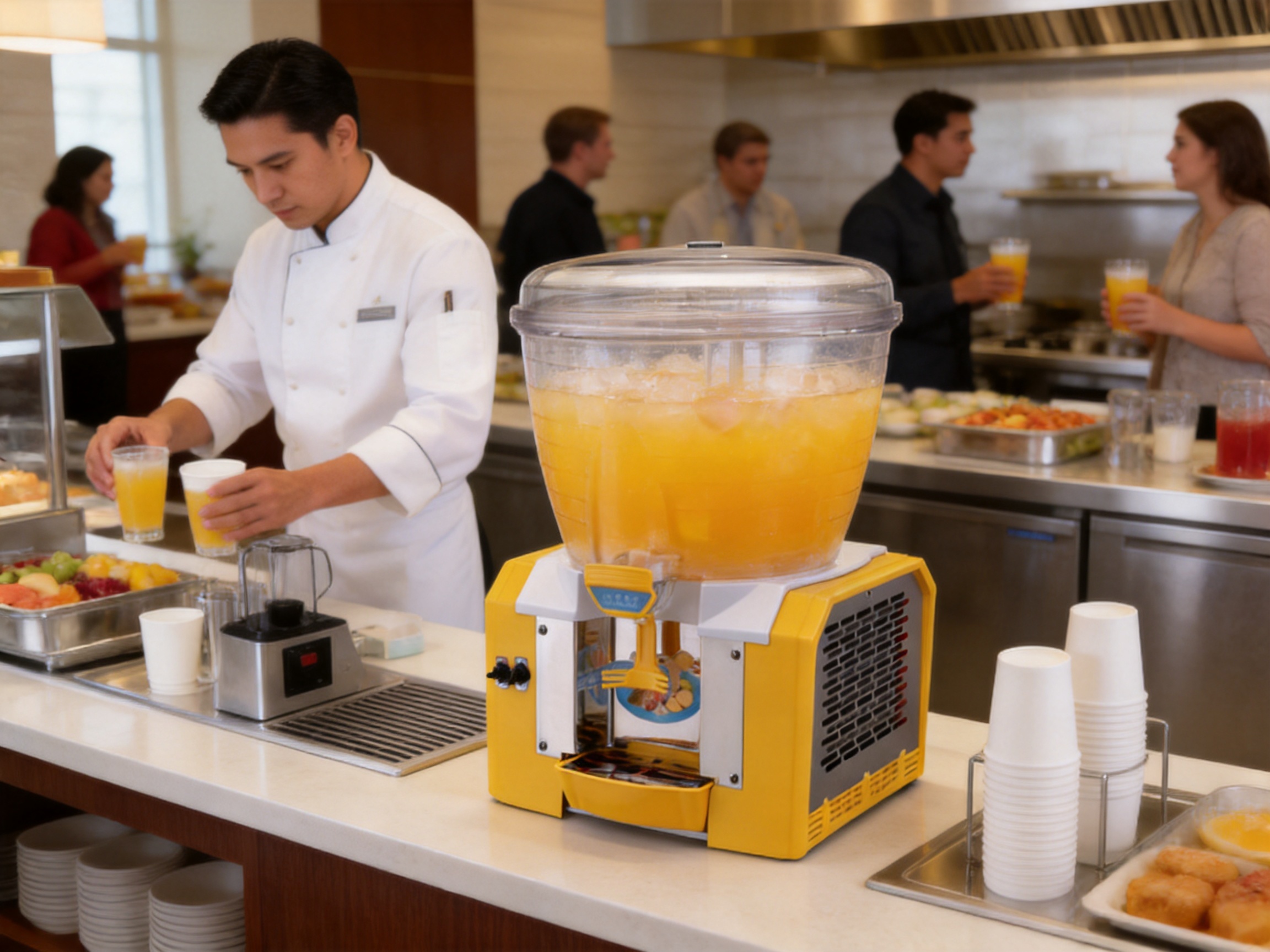
Cafés and beverage shops can use the dispenser for featured juices, fruit drinks, iced tea, flavored water, and seasonal refreshments. The large tank supports repeated orders, while the compact footprint helps preserve valuable counter space for coffee equipment, food displays, or point-of-sale operations. A visible dispenser can also help customers identify available cold drinks quickly.
Restaurants and Quick-Service Operations
Restaurants and quick-service outlets often need efficient beverage service during concentrated meal periods. A 30-liter tank can reduce the number of refills required during lunch or dinner, and the stirring system helps keep certain beverages uniform while staff manage food orders. The machine may be placed near the service counter, self-service area, or beverage preparation section according to the restaurant’s workflow.
Hotels and Breakfast Buffets
Hotels can benefit from a dedicated chilled beverage dispenser during breakfast service, conferences, banquets, and events. A single tank is suitable when one selected beverage is offered in a defined service area. The machine’s stainless-steel appearance can fit within a professional buffet presentation, while refrigeration helps keep the beverage ready during longer service periods.
Bars and Entertainment Venues
Bars may use the machine for fruit beverages, non-alcoholic refreshments, cocktail ingredients, or specialty chilled drinks, provided the selected recipe is compatible with the equipment. Continuous stirring can be beneficial for mixtures containing pulp or ingredients that settle. The machine may also support faster service when several customers request the same drink during busy periods.
Supermarkets and Institutional Foodservice
Supermarkets, schools, hospitals, company cafeterias, and other institutions may use the dispenser where a reliable cold beverage station is needed. In these environments, simple operation, clear capacity, convenient cleaning, and consistent service are important. The machine can be incorporated into a broader foodservice plan that includes hot food equipment, refrigeration cabinets, buffet products, and other commercial appliances.
Simple Operation and Workflow Benefits
The product is designed with ease of operation in mind. A typical workflow includes preparing or selecting an appropriate beverage, loading the tank, activating the stirring and refrigeration functions according to operating instructions, and dispensing the drink when it reaches the desired serving condition. Because the machine combines several functions, staff do not need to coordinate multiple separate containers or cooling methods.
Simple operation is valuable when employees have different levels of experience or when service areas operate with limited staffing. Clear procedures can help new team members understand how to load, monitor, serve, and clean the unit. The beverage station can then operate in a consistent manner even when staff assignments change.
The transparent observation area described for the machine supports liquid-level management. Operators can see how much beverage remains and decide when to prepare a new batch. This improves planning and can help reduce unexpected shortages during peak service. Visual monitoring is particularly useful in self-service areas, where the machine may be located away from the main preparation counter.
Although the equipment is easy to operate, commercial users should establish internal procedures for recipe preparation, temperature monitoring, cleaning frequency, ingredient labeling, and end-of-day shutdown. Good procedures complement the machine’s design and help maintain product quality over time.
Cleaning and Maintenance Considerations
Cleaning is an essential part of beverage equipment ownership. Juice, sugar, pulp, tea, and flavored syrups can leave residues if they remain in the tank or dispensing path. Regular cleaning helps preserve taste, appearance, hygiene, and equipment performance. Operators should follow the manufacturer’s instructions and comply with local food safety regulations.
A practical cleaning routine generally includes emptying remaining beverage, disconnecting the equipment from power when appropriate, removing accessible beverage-contact components, washing them with approved cleaning materials, rinsing thoroughly, and allowing parts to dry or reinstalling them according to the operating procedure. The exterior stainless-steel panels should be wiped with suitable products that do not damage the surface.
Special attention should be given to the stirring mechanism and dispensing outlet. These areas may collect pulp or sediment, especially when the machine is used for thick or fruit-based drinks. Seals and removable parts should be inspected regularly for wear, damage, or incorrect placement. Any issue that could affect hygiene or leakage should be addressed before the machine returns to service.
Ventilation around the refrigeration system should also be maintained. Dust and obstructions can affect heat dissipation and may reduce cooling efficiency. The installation area should remain clean, dry, and free from objects that block airflow. Staff should avoid placing the dispenser directly beside equipment that produces excessive heat unless the layout has been evaluated for suitability.
Preventive maintenance can help extend the useful life of commercial equipment. Operators should monitor unusual noise, changes in cooling behavior, visible leakage, electrical irregularities, or stirring performance. If a problem occurs, the machine should be stopped and inspected by qualified service personnel rather than being operated under unsafe conditions.
Manufacturing Strengths Behind the Product
The quality of a commercial dispenser depends not only on its visible design but also on the processes used to develop, assemble, test, and support it. Spelor Electrical Appliances (Zhejiang) Co., Ltd. integrates design, research and development, manufacturing, sales, and service. This integrated structure allows product requirements to be considered across the entire equipment lifecycle.
Design and research activities help translate commercial user needs into practical equipment features. For a dispenser such as the PL-130AJ, those needs include capacity, temperature control, stirring performance, material selection, dimensional planning, operating convenience, and cleaning access. A manufacturer with experience in several categories of commercial equipment can evaluate the product within the broader context of professional kitchens and beverage stations.
Manufacturing facilities covering more than 60,000 square meters provide a substantial base for organized production. Large modern facilities can support dedicated work areas for material processing, component assembly, electrical integration, inspection, packaging, and logistics preparation. Efficient organization is important when serving international customers that require consistent product specifications and dependable shipment schedules.
The company’s product range includes commercial refrigeration, kitchen equipment, buffet equipment, ice cream machines, juice dispensers, fried ice cream machines, slush machines, flake ice machines, griddles, fryers, insulation products, barbecue equipment, refrigeration cabinets, and related solutions. This broad product portfolio indicates familiarity with the different requirements found in snack shops, fast-food chains, bars, supermarkets, institutions, hotels, and other foodservice environments.
Manufacturing strength also involves coordination between product categories. Beverage dispensers often operate alongside refrigerators, ice machines, buffet stations, cooking equipment, and display units. A supplier that understands the wider foodservice environment can be better positioned to help customers plan equipment combinations, identify compatible solutions, and simplify procurement.
Quality-Oriented Production and Process Control
Commercial equipment must be produced with attention to repeatability. A unit used in a professional environment should meet its intended dimensions, electrical requirements, material specifications, and functional expectations. Process control helps reduce variation between production batches and supports more reliable installation for distributors and end users.
For the PL-130AJ, relevant production considerations include the forming and finishing of stainless-steel panels, assembly of the stirring system, installation of refrigeration components, electrical connection, sealing of beverage-contact areas, and verification of overall dimensions. Each stage contributes to the final user experience. A well-finished exterior supports appearance and cleanability, while accurate internal assembly supports the machine’s operational functions.
Inspection procedures may include visual checks, dimensional checks, electrical safety evaluation, functional operation, refrigeration testing, stirring verification, and packaging inspection. The exact testing protocol depends on the production requirements and destination market. Regardless of the specific process, a systematic approach helps identify problems before shipment and supports customer confidence.
Packaging is another important part of commercial equipment manufacturing. The machine must be protected against movement, impact, moisture, and handling during transportation. Proper packaging preparation helps the unit arrive in a condition suitable for installation and use. Export-oriented manufacturing experience is valuable because international shipments may pass through several logistics stages before reaching the customer.
OEM and ODM Support for Foodservice Buyers
Not every buyer needs a standard machine with an unchanged configuration. Distributors, chain restaurants, hospitality groups, equipment dealers, and project contractors may require customized dimensions, branding, electrical specifications, color treatments, packaging, or functional adjustments. Spelor offers OEM and ODM support based on drawings or customer requirements, enabling the supplier relationship to extend beyond standard catalog purchasing.
OEM service can be useful when a customer wants equipment manufactured under its own brand or according to an established product specification. ODM cooperation may be appropriate when the customer wants assistance developing a product or adapting an existing design to a particular market. In both cases, clear communication is essential. Buyers should provide information about capacity, voltage, frequency, plug type, target application, available space, required certifications, packaging expectations, and projected order quantity.
Customization should be evaluated carefully because changes may affect production time, testing, minimum order quantities, spare parts, service procedures, and shipping arrangements. A capable manufacturer can help identify which requirements are practical and which may require design review. Early technical communication reduces misunderstandings and supports more efficient project execution.
For international distributors, OEM and ODM capability can also support market differentiation. A customized beverage dispenser may be integrated into a specific equipment package or positioned for a particular hospitality segment. The underlying platform can provide a starting point while adjustments are made for local market needs.
Procurement and Customer Support
Commercial equipment procurement involves more than selecting a product and arranging delivery. Buyers may need assistance with technical consultation, product customization, documentation, logistics, payment arrangements, installation planning, spare parts, and after-sales maintenance. Spelor describes its service model as a one-stop approach that includes pre-sales consultation, customization, flexible logistics and payment solutions, and after-sales support.
Pre-sales consultation can help customers confirm whether a refrigeration-only, stirring dispenser is appropriate for the intended beverage. It can also clarify installation conditions, capacity planning, usage frequency, and compatibility with the buyer’s existing foodservice layout. These discussions are particularly useful for first-time commercial equipment buyers or companies developing a new beverage program.
After-sales service is important because commercial equipment is an operational asset. When a dispenser requires attention, a prolonged interruption may affect sales and customer satisfaction. Access to maintenance guidance, replacement components, and technical communication can help reduce downtime. Buyers should discuss warranty terms, service responsibilities, spare-parts availability, and recommended maintenance schedules before completing an order.
The company’s product categories include optional components and spare parts, reflecting the practical need to support equipment over its service life. Keeping suitable replacement parts available can make maintenance more efficient and help operators avoid replacing an entire machine when only a serviceable component requires attention.
Installation Planning for Commercial Use
Before delivery, the buyer should select a stable and level installation surface capable of supporting both the 24kg machine and the weight of a full beverage load. The surface should be positioned at a convenient height for staff and customers and should allow adequate access to the tank, dispensing area, electrical connection, and ventilation zones.
The power supply must match the product’s electrical configuration for the destination market. Buyers should confirm voltage, frequency, plug requirements, and applicable safety standards with the supplier before ordering. Electrical connections should be handled according to local regulations and, where required, by qualified personnel.
The unit should not be installed in a location exposed to excessive heat, direct water spray, unstable flooring, or severe environmental conditions outside its intended operating range. Adequate airflow around refrigeration equipment can help support cooling performance. The installation plan should also leave enough room for cleaning and maintenance rather than placing the machine tightly against walls or neighboring appliances.
For self-service use, the dispenser should be positioned so customers can access cups and the dispensing area without obstructing staff routes. For staff-served use, the unit may be placed behind or beside the counter to support quick filling and controlled distribution. The best arrangement depends on the establishment’s menu, service model, and available space.
How to Select Suitable Beverage Recipes
The PL-130AJ is intended for chilled beverages that benefit from stirring. Suitable recipes may include fruit juice blends, pulpy beverages, iced tea, flavored water with suspended ingredients, non-carbonated fruit drinks, and other cold mixtures that remain fluid at the stated temperature range. The recipe should be evaluated for thickness, particle size, acidity, sugar content, and storage requirements before regular commercial use.
Very thick mixtures may place additional demand on the stirring system and may not dispense smoothly. Large pieces of fruit, ice, hard ingredients, or products that freeze at the operating temperature should not be placed in the tank unless the manufacturer specifically confirms compatibility. Carbonated drinks may require equipment designed for carbonation and pressure management rather than a standard refrigerated stirring dispenser.
Recipe consistency is important. Ingredients should be measured accurately, dissolved or blended appropriately before loading, and prepared according to food safety procedures. If a beverage contains pulp or particles, the operator should confirm that the texture remains suitable for the dispensing outlet. A well-prepared recipe allows the machine’s stirring and cooling functions to work more effectively.
Operators should also establish a batch rotation procedure. Even when a machine provides refrigeration, beverages should not be left in the tank indefinitely. The storage period should reflect the recipe, local regulations, business policy, and food safety guidance. Regular emptying and cleaning protect both the beverage quality and the equipment.
Operating Cost and Efficiency Considerations
The stated stirring input power is 255W. Actual energy consumption depends on operating duration, refrigeration cycling, ambient temperature, beverage temperature, service frequency, and equipment condition. A disciplined operating routine can help businesses manage energy use while maintaining service quality.
Loading beverages at an appropriate starting temperature can reduce the time required for cooling. Keeping the machine away from heat sources and maintaining ventilation can support refrigeration efficiency. Operators should avoid unnecessary opening of the tank and should keep the beverage station organized so that the machine is not exposed to avoidable contamination or heat.
The economic value of the dispenser also includes labor efficiency. Continuous stirring and a 30-liter tank may reduce the number of manual mixing and refilling tasks required during service. Labor savings will vary by business, but even small improvements can be meaningful when repeated throughout a busy day.
Durability and serviceability are additional cost factors. A stainless-steel commercial construction, organized maintenance routine, and access to technical support can help protect the buyer’s investment. The lowest purchase price is not always the lowest total cost of ownership. Buyers should consider capacity, expected service frequency, cleaning requirements, energy use, spare parts, warranty coverage, and supplier responsiveness when comparing equipment.
Recommended Daily Operating Routine
At the beginning of the work period, staff should inspect the exterior, tank, dispensing area, stirring components, power cord, and surrounding workspace. The machine should be clean, correctly assembled, and positioned securely. The beverage recipe should be prepared according to the establishment’s food safety procedure.
After loading the beverage, the operator should activate the appropriate functions and allow the drink to reach a suitable serving condition. The tank level and beverage appearance should be monitored during service. If ingredients show unusual separation, excessive thickness, or other changes, staff should stop and investigate rather than assuming the issue will correct itself.
During service, spills should be wiped promptly, cups should be replenished, and the dispensing outlet should be kept clean. Employees should avoid using sharp tools or abrasive materials that could damage surfaces. Any unusual noise, smell, leakage, or temperature behavior should be reported immediately.
At the end of the service period, remaining beverage should be handled according to the recipe and food safety policy. The machine should be emptied, cleaned, rinsed, and prepared for the next operating cycle. A simple checklist can help ensure that cleaning and shutdown tasks are completed consistently by every shift.
Comparison of Key Selection Factors
| Selection Factor | Value of the PL-130AJ | Operational Benefit |
| Capacity | 30L single tank | Supports larger batches and reduces frequent refilling |
| Mixing Method | Continuous stirring | Helps maintain more uniform flavor and texture |
| Cooling | Refrigeration only | Keeps beverages chilled without direct ice dilution |
| Construction | Food-grade stainless-steel panels | Supports durability, cleanability, and professional appearance |
| Temperature Range | 7°C–12°C | Suitable for chilled beverage service |
| Footprint | 450 × 450mm base | Helps conserve counter or service-line space |
| Net Weight | 24kg | Allows practical handling with proper lifting procedures |
| Supplier Capability | Design, manufacturing, OEM, ODM, and service | Supports standard purchases and customized projects |
Why the Supplier’s Broader Product Portfolio Matters
Foodservice businesses rarely purchase only one type of equipment. A new beverage station may require a juice dispenser, ice machine, refrigeration cabinet, buffet equipment, cooking appliances, or frozen dessert machinery. Working with a supplier that manufactures several related categories can simplify communication and procurement.
Spelor’s product range covers commercial refrigeration, ice cream machines, juice dispensers, fried ice cream machines, slush machines, flake ice machines, cooking equipment, griddles, fryers, insulation products, barbecue equipment, and buffet solutions. This breadth gives buyers the opportunity to coordinate equipment for snack shops, fast-food restaurants, bars, supermarkets, institutions, and hospitality projects.
A broad portfolio does not remove the need to evaluate each individual product. Buyers should still confirm specifications, capacity, local compliance, installation requirements, and service arrangements. However, a manufacturer with experience across multiple commercial categories may be able to provide more coherent project support than a supplier focused on a single isolated appliance.
Quality, Appearance, and Long-Term Business Value
Commercial beverage equipment contributes to more than immediate drink production. It influences how the service area looks, how employees work, and how reliably the business can deliver its menu. The PL-130AJ’s stainless-steel body, compact dimensions, large capacity, stirring function, and refrigeration system are designed to support these practical and commercial objectives together.
A professional appearance can be particularly important when the dispenser is placed in a customer-facing area. Customers are more likely to trust a beverage station that appears clean, organized, and purpose-built. The equipment should be incorporated into a complete presentation that includes clean cups, clear beverage labeling, proper drainage or spill control, and regular staff attention.
Long-term business value depends on matching the machine to the correct application. A 30-liter stirring dispenser can be highly effective when the establishment needs one chilled, continuously mixed beverage. It may not be the best solution for frozen desserts, carbonated products, multiple simultaneous flavors, or drinks requiring heating. Careful product selection ensures that the equipment’s strengths are used rather than asking it to perform tasks outside its design.
For buyers seeking dependable commercial refrigeration equipment from China, the manufacturer’s integrated capabilities, modern production facilities, OEM and ODM services, and international customer support can provide a useful foundation for long-term cooperation. The machine itself is one part of a larger supply relationship that may include technical consultation, logistics, spare parts, and after-sales assistance.
Frequently Asked Questions
What is the capacity of the commercial juice dispenser?
The PL-130AJ has a 30-liter single tank. This capacity is suitable for cafés, restaurants, hotels, bars, beverage shops, buffets, supermarkets, and institutional foodservice operations that need a relatively large quantity of chilled beverage available for repeated service.
Does the machine heat beverages?
No. The product is specified as refrigeration only. It is designed to cool and dispense chilled beverages rather than heat tea, soup, milk, or other hot products.
What is the operating temperature range?
The stated temperature range is 7°C to 12°C. Actual performance may depend on the starting beverage temperature, ambient conditions, loading quantity, ventilation, and operating practices.
Why is continuous stirring useful?
Continuous stirring helps keep ingredients more evenly distributed. It is especially useful for thick or fruit-based beverages containing pulp, suspended particles, or components that may settle during storage.
What drinks can be used in the machine?
Potential applications include juice, fruit drinks, iced tea, flavored water, and other chilled non-carbonated beverages that remain fluid within the operating temperature range. The recipe should be evaluated for thickness, particle size, and compatibility with the stirring and dispensing system.
Is the tank suitable for frozen beverages or slush?
The machine is designed for refrigerated beverages, not frozen slush or frozen desserts. Businesses requiring slush production should select a commercial slush machine designed for that purpose.
What are the dimensions and net weight?
The overall dimensions are 450 × 450 × 665mm, and the net weight is 24kg. The installation surface must also support the additional weight of a full 30-liter beverage load.
What material is used for the machine body?
The product uses food-grade stainless-steel panels. This material supports a durable, professional, and cleanable exterior suitable for commercial foodservice environments.
Can the dispenser be placed on a counter?
Its compact footprint makes counter or service-station placement practical when the surface is stable, level, sufficiently strong, and large enough to provide safe clearance. Buyers should plan for ventilation, cleaning access, electrical connection, and customer or staff movement.
How should the machine be cleaned?
The tank, beverage-contact parts, stirring components, and dispensing area should be cleaned according to the manufacturer’s instructions and applicable food safety requirements. Beverage residues should not be allowed to remain for extended periods, and removable components should be inspected during cleaning.
Does the manufacturer support OEM and ODM projects?
Yes. Spelor provides OEM and ODM support based on customer drawings or requirements. Buyers should discuss capacity, dimensions, electrical specifications, branding, packaging, compliance, order quantity, and delivery expectations during the project planning stage.
What industries can use this product?
The dispenser can serve cafés, restaurants, hotels, bars, snack shops, fast-food chains, supermarkets, catering operations, schools, institutions, and other commercial foodservice environments requiring chilled stirred beverages.
What should buyers confirm before ordering?
Buyers should confirm the intended beverage, capacity requirements, temperature expectations, power supply, installation space, ventilation, cleaning procedures, shipping arrangements, warranty terms, spare-parts support, and any local certification or compliance requirements.
Conclusion
The 30L Single Tank Stirring Commercial Juice Dispenser is designed to make chilled beverage service more consistent, organized, and efficient. Its 30-liter capacity supports high-volume operations, while continuous stirring helps maintain an even beverage mixture. Refrigeration within the 7°C to 12°C range keeps drinks suitable for chilled service without relying on ice that can dilute the recipe. Food-grade stainless-steel panels provide a durable and professional exterior, and the compact 450 × 450mm footprint helps businesses make better use of limited counter and service-line space.
Compared with basic containers, non-stirring dispensers, or ice-based cooling methods, the PL-130AJ offers a more integrated solution for beverages that need both consistent movement and controlled refrigeration. It is best suited to juice, tea, fruit drinks, flavored water, and similar non-carbonated cold beverages, rather than frozen or heated products.
The product is supported by Spelor Electrical Appliances (Zhejiang) Co., Ltd., a manufacturer with integrated design, research and development, production, sales, and service capabilities. Its more than 60,000-square-meter modern production facilities and broad foodservice equipment portfolio support standard supply, customized OEM and ODM projects, logistics coordination, and after-sales service. For commercial buyers seeking a practical beverage dispenser and a capable manufacturing partner, this combination of product functionality and supplier strength makes the PL-130AJ a compelling option for professional foodservice operations.
References
1. Product specification sheet for Model PL-130AJ, 30L Single Tank Stirring Commercial Juice Dispenser.
2. Commercial foodservice equipment selection and workflow planning principles.
3. General food hygiene practices for beverage preparation, storage, dispensing, and equipment cleaning.
4. Manufacturer-provided information regarding commercial refrigeration, beverage dispensing, OEM, ODM, production, and after-sales service capabilities.
5. General stainless-steel care and maintenance practices for professional kitchen and beverage equipment.
Product: 30L Single Tank Stirring Commercial Juice Dispenser

For exclusive deals and latest offers, sign up by entering your email address below.


-
spelor@spelor.com
-
+86-576-85229688
-
No.528, Changxi Road, Linhai City, Zhejiang Province, China
Commercial Refrigeration Equipment Manufacturer China
Copyright © 2025 by Spelor Electrical Appliances (Zhejiang) Co., Ltd. Rights Reserved.
