


 中文简体
15L Spraying and Stirring Commercial Juice Dispenser: Efficient Cooling for Modern Foodservice Operations
Admin 2026-08-20Commercial beverage service depends on more than attractive presentation. Operators need equipment that can maintain a suitable serving temperature, protect product quality, support fast service, and remain simple to operate throughout a busy working day. The 15L Spraying/Stirring Commercial Juice Dispenser is designed around these practical requirements. With a compact single-tank format, stainless steel construction, transparent product visibility, and two circulation options, it provides a flexible solution for cafes, restaurants, convenience stores, snack shops, bars, supermarkets, and other foodservice environments.
Model PL-115A/AJ combines refrigeration with either spraying or stirring circulation. The spraying version uses a 200W input, while the stirring version uses a 150W input. Both configurations are intended to keep juice evenly cooled and consistently presented. Its 15L capacity is large enough for regular commercial service while remaining compact enough for counters and limited preparation areas. This balance between capacity, footprint, operating simplicity, and product visibility gives the dispenser a practical advantage over equipment that is either too small for commercial demand or too large for compact outlets.
The unit is manufactured by Spelor Electrical Appliances (Zhejiang) Co., Ltd., a professional producer of commercial refrigeration, kitchen, buffet, and foodservice equipment. The company integrates design, research and development, manufacturing, sales, and service. Its modern production facilities cover more than 60,000 square meters, supporting the production of equipment for global foodservice markets. This manufacturing background is important because a beverage dispenser is not an isolated appliance: its performance depends on refrigeration engineering, material selection, assembly control, quality management, and long-term service support.

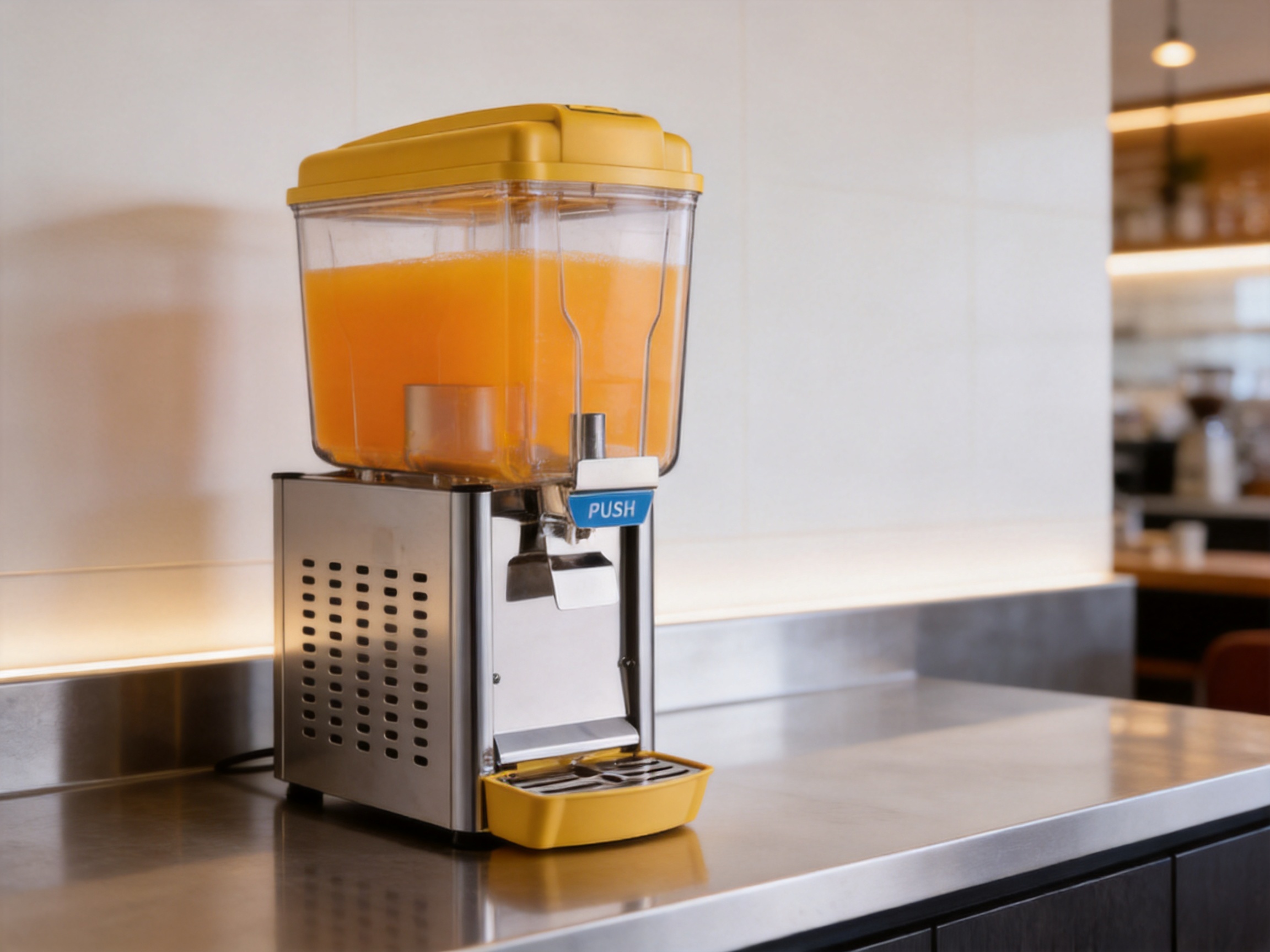
15L Spraying/Stirring Commercial Juice Dispenser
Why a 15L Commercial Juice Dispenser Matters
Juice service can become inefficient when beverages are held in unsuitable containers or cooled inconsistently. A standard open container may expose the liquid to ambient heat, create uneven temperatures, and make it difficult for staff to control serving conditions. A commercial dispenser addresses these problems by combining a dedicated tank, a refrigeration system, and a circulation mechanism in one compact unit.
The 15L capacity is especially suitable for businesses that need a meaningful volume of prepared juice without committing to a large multi-tank installation. It can support breakfast service, lunch periods, snack-time sales, buffet presentation, and daily beverage service in smaller venues. The capacity also helps reduce the need for constant refilling, allowing staff to focus on customers and other operational duties.
At the same time, a 15L tank is easier to manage than a much larger reservoir. Staff can prepare a reasonable quantity according to forecast demand, monitor consumption through the transparent tank, and replenish the product when necessary. This can help reduce unnecessary waste, particularly in locations where beverage demand changes throughout the day.
The dispenser’s refrigeration-only configuration is focused on maintaining a chilled serving condition rather than heating or cooking the beverage. The stated temperature range is 7°C to 12°C. This range is appropriate for many chilled juice service applications and gives operators a clear operating target when planning recipes, storage procedures, and daily service routines.
Core Product Specifications
The following table summarizes the main specifications of the PL-115A/AJ commercial juice dispenser.
| Model | PL-115A/AJ |
| Product Type | Commercial juice dispenser |
| Tank Capacity | 15L |
| Circulation Options | Spraying or stirring |
| Spraying Input Power | 200W |
| Stirring Input Power | 150W |
| Net Weight | 15kg |
| Overall Dimensions | 210 x 450 x 665mm |
| Temperature Range | 7°C to 12°C |
| Cooling Function | Refrigeration only |
| Construction | Stainless steel panels with transparent product tank |
The combination of a narrow 210mm dimension, a 450mm depth, and a 665mm height makes the unit suitable for counter-based installation where horizontal working space is limited. Operators should still confirm the available clearance, ventilation requirements, electrical supply, and service access before installation. Proper placement is essential for dependable refrigeration performance and convenient cleaning.
Two Circulation Modes for Different Beverage Requirements
Spraying Circulation
The spraying configuration uses a circulation method that distributes the beverage through the tank to support even cooling and an attractive presentation. With 200W input power, it is designed for applications in which visible movement and continuous circulation are important. The movement can help prevent the beverage from appearing stagnant during service and can contribute to a more appealing display at the point of sale.
Spraying circulation may be particularly useful for juice products that benefit from active movement during presentation. It gives customers a clear visual indication that the dispenser is operating and that the product is being circulated. For self-service areas, buffet counters, and front-of-house beverage stations, this presentation value can be commercially important.
Stirring Circulation
The stirring version uses a 150W input and provides a different circulation approach. It is appropriate for operators who prefer a more controlled internal movement or who want a lower-power configuration for specific beverage service conditions. Stirring helps promote consistency throughout the tank and can support an even distribution of the beverage during ordinary operation.
The availability of both spraying and stirring options makes the product more adaptable than a dispenser limited to one circulation design. Different juice formulations, service styles, and customer preferences may call for different movement characteristics. The operator can select the configuration that best matches the intended application rather than adapting the business to a fixed machine design.
Supporting Consistent Beverage Quality
Circulation is valuable because a beverage tank may otherwise develop differences in temperature or composition from one area to another. Continuous movement helps the cooling effect reach more of the liquid and can contribute to a more consistent serving experience. Operators should always follow the recommended preparation, storage, and cleaning procedures for the particular beverage being served, but the machine’s circulation system provides an important mechanical foundation for stable presentation.
Advantages Compared with Basic Beverage Containers and Less Specialized Equipment
The main advantage of a dedicated commercial dispenser is that it is engineered for repeated beverage service rather than temporary storage. A basic container may hold juice, but it does not necessarily provide active refrigeration, controlled circulation, or a professional point-of-sale presentation. The PL-115A/AJ brings these functions together in one unit.
More Consistent Cooling
The integrated refrigeration system is designed to maintain the beverage within a stated 7°C to 12°C range. This gives operators a defined temperature range instead of relying on ice, intermittent refrigeration, or manual rotation of containers. Stable cooling can help maintain a more consistent customer experience during long service periods.
Better Product Visibility
The transparent tank allows staff to monitor the liquid level at a glance. This helps with production planning and reduces the possibility of unexpectedly empty service equipment. Customers can also see the beverage being served, which can improve product visibility and support impulse purchases when the dispenser is positioned in a front-of-house location.
Professional Appearance
Stainless steel panels create a clean, durable appearance that fits professional commercial environments. Compared with improvised containers or domestic beverage appliances, the unit presents a more organized and credible image. This is useful for restaurants, cafes, snack stores, and convenience retailers where equipment is visible to customers.
Efficient Use of Space
The compact footprint is a significant advantage for small and medium-sized businesses. Many outlets have limited counter space, particularly near cashier stations, buffet lines, preparation counters, or self-service areas. A narrow commercial dispenser can provide chilled beverage service without occupying the same area as a large multi-tank machine.
Simple Daily Operation
The machine is designed around straightforward operation. Staff can fill the tank, select the relevant circulation mode, monitor the beverage level, and serve through the dispensing outlet. Simplicity reduces training requirements and helps new employees become productive more quickly. It can also reduce the likelihood of operating errors during busy periods.
Potential Energy Benefits
The stated input power of 200W for spraying and 150W for stirring represents a relatively modest electrical demand for a commercial refrigerated beverage appliance. Actual energy consumption will depend on ambient temperature, operating duration, product temperature at loading, ventilation, maintenance, and usage frequency. Even so, the compact design and moderate rated input support an equipment strategy focused on practical operating costs.
Construction and Materials for Commercial Environments
Commercial equipment must withstand more frequent use than household appliances. The use of stainless steel panels supports durability, appearance retention, and easier integration into professional kitchens and service counters. Stainless steel is widely used in foodservice equipment because it offers a robust surface that can be cleaned regularly when appropriate procedures are followed.
The external panels also contribute to the machine’s visual identity. A commercial dispenser should look clean and dependable throughout the day, especially when located where customers can see it. The stainless steel finish provides a neutral appearance that can complement different interior designs, from modern cafes to convenience stores and buffet operations.
The transparent tank serves both operational and merchandising functions. Staff can inspect the beverage level without opening the machine, while customers can identify the available product. Visibility can improve service planning, help prevent overfilling, and make the beverage more attractive at the point of sale.
Food-grade materials are identified as part of the product’s safety and durability characteristics. Operators should maintain a documented sanitation routine, use suitable cleaning agents, and follow the applicable food-contact requirements in their market. Equipment performance and food safety depend not only on material selection but also on correct installation, daily cleaning, and responsible product handling.
Applications Across Different Foodservice Businesses
Cafes and Coffee Shops
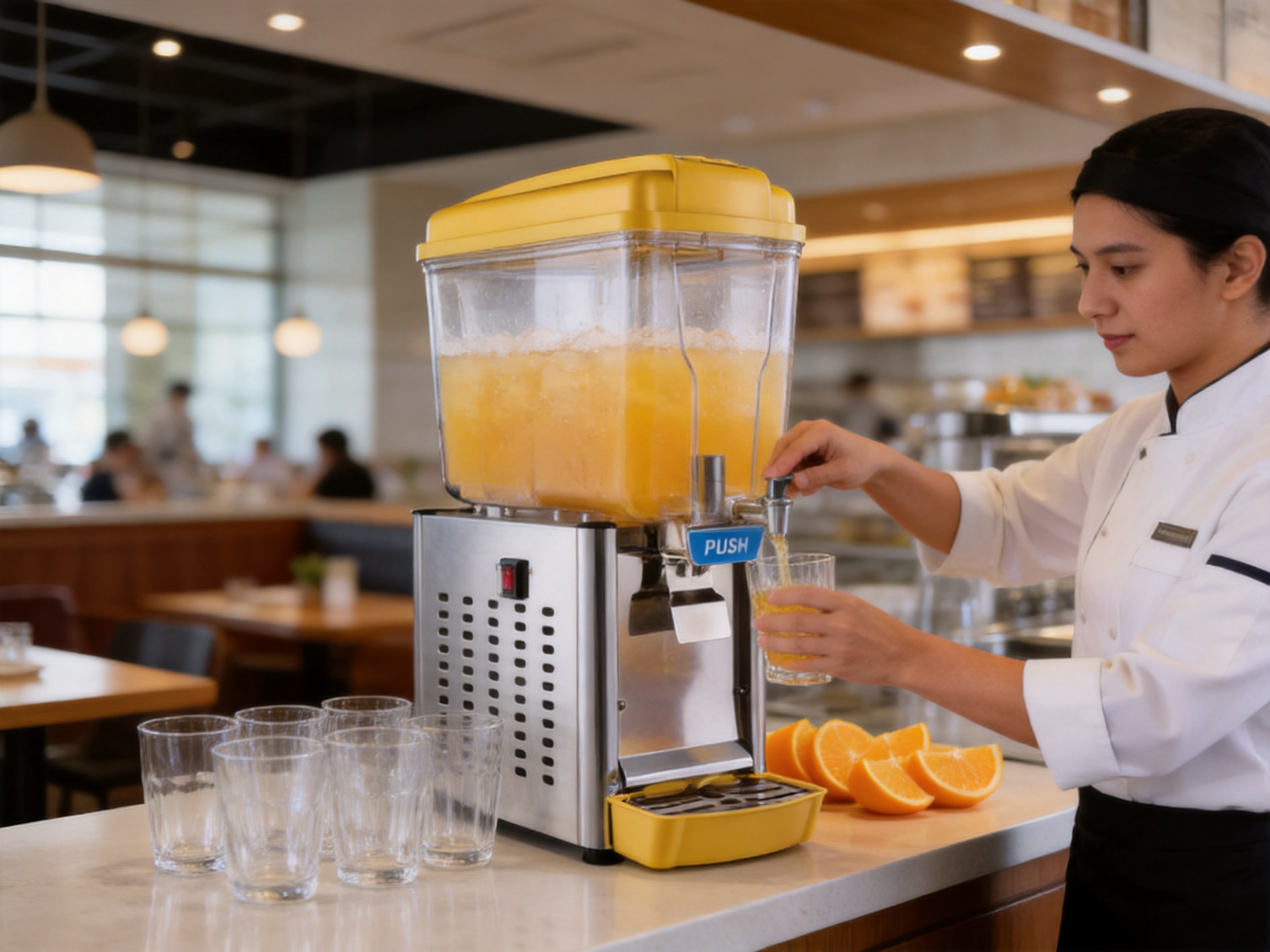
Small and medium-sized cafes can use the dispenser to add chilled juice service without installing a large beverage station. The 15L capacity is suitable for daily specialty juice, breakfast beverages, seasonal refreshments, or self-service options. Its compact dimensions help preserve valuable counter space for coffee machines, display cases, and order preparation.
Restaurants
Restaurants can position the unit near the entrance, buffet, breakfast area, or pickup counter. It can support regular meal service and provide an additional beverage option for customers who want a cold juice without waiting for table service. The transparent tank enables employees to identify the remaining volume before busy periods and prepare refills in advance.
Convenience Stores
Convenience stores often need equipment that is visible, compact, and easy for employees to manage. A 15L dispenser can be placed on a suitable service counter or beverage station, offering a ready-to-serve product while minimizing the floor area required. The professional appearance can also help create a more organized retail presentation.
Snack Shops and Fast-Food Outlets
Snack shops and fast-food businesses typically prioritize speed, ease of use, and consistent presentation. The circulation options allow an operator to select a machine configuration that matches the beverage recipe and service style. The dispenser can support peak periods by holding a prepared quantity of chilled product close to the service point.
Bars and Leisure Venues
Bars and leisure venues may use chilled juice for mixed drinks, breakfast service, mocktails, or non-alcoholic beverage programs. The stainless steel appearance can fit behind a counter, while the compact format allows the operator to combine the dispenser with other beverage equipment. Because the appliance is refrigeration-only, it is best suited to products that are prepared and served cold.
Buffets and Institutional Foodservice
Buffet lines, schools, offices, hospitals, and other institutions can benefit from a visible, self-service-oriented beverage station. A 15L tank provides a manageable quantity for controlled service. The transparent reservoir helps staff supervise the level, while the circulation system supports an even and appealing presentation throughout the serving period.
Manufacturing Capabilities Behind the Product
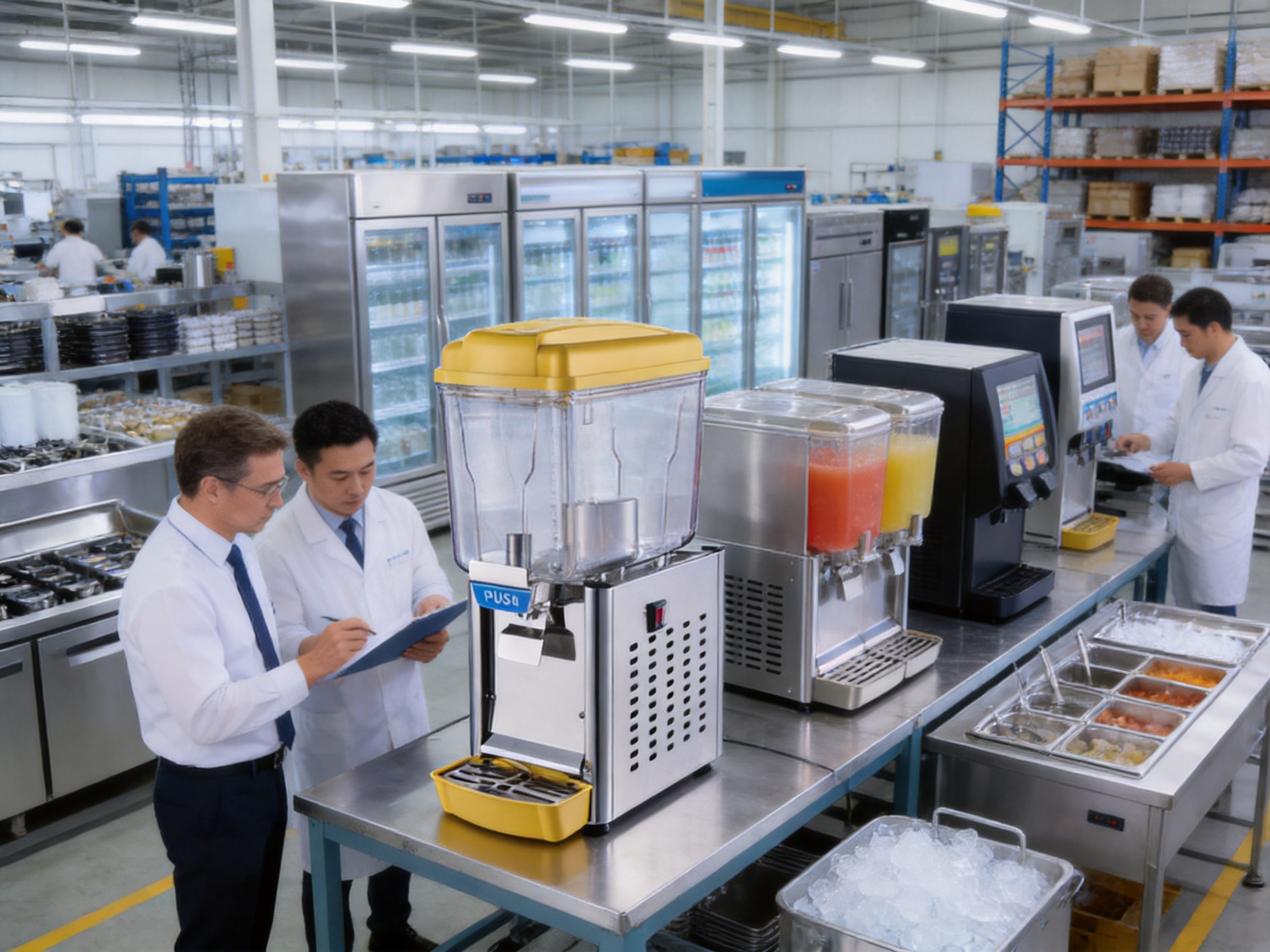
The quality of commercial refrigeration equipment is closely connected to the manufacturer’s production system. Spelor Electrical Appliances (Zhejiang) Co., Ltd. operates as an integrated manufacturer covering design, research and development, production, sales, and service. This structure allows the company to coordinate product engineering with factory execution and customer support.
The company has more than 60,000 square meters of modern production facilities. A production base of this scale can support dedicated manufacturing areas, equipment assembly, component management, testing procedures, warehouse operations, and logistics coordination. It also provides a foundation for producing several categories of foodservice equipment while maintaining specialized knowledge in commercial refrigeration.
The company’s product portfolio includes commercial ice cream machines, juice dispensers, fried ice cream machines, refrigeration cabinets, slush machines, flake ice machines, cooking equipment, griddles, fryers, insulation products, barbecue equipment, and buffet solutions. This broad range indicates experience with the different requirements of foodservice equipment, including thermal management, food-contact surfaces, mechanical components, controls, and commercial operating conditions.
Integrated Design and Development
In-house design and research and development can help a manufacturer respond to practical market requirements. For a product such as the 15L dispenser, development considerations include tank capacity, external dimensions, cooling performance, circulation behavior, material selection, operator access, and visual presentation. Bringing these considerations together during product development helps create a more balanced machine rather than optimizing only one feature.
Manufacturing Consistency
Commercial buyers need repeatable products for multiple locations or ongoing procurement. A professional factory structure can support standardized assembly, component coordination, production scheduling, and inspection procedures. Consistency matters because customers expect machines ordered at different times to deliver comparable performance and appearance.
Application-Oriented Product Portfolio
A manufacturer serving snack shops, fast-food chains, bars, supermarkets, institutions, and other foodservice applications gains exposure to a wide range of operating conditions. This experience can inform product design and help the company understand the needs of businesses that require compact equipment, high availability, easy cleaning, reliable cooling, and flexible procurement.
Support for OEM and ODM Projects
The company offers OEM and ODM foodservice equipment solutions based on drawings or customer requirements. This is an advantage for distributors, importers, hospitality groups, and project contractors seeking equipment that matches their own market positioning. Depending on the project, customization discussions may involve appearance, branding, packaging, electrical requirements, configuration, documentation, or other agreed specifications.
OEM and ODM cooperation can also help buyers develop a more consistent equipment range. A distributor may want a specific design language across several products, while a restaurant group may require equipment that fits a standardized counter layout. An experienced factory with multiple product categories can be better positioned to coordinate such requirements than a supplier focused on a single basic appliance.
Quality, Safety, and Production Considerations
Commercial beverage equipment should be evaluated as a complete system. A suitable purchasing assessment includes the refrigeration function, circulation system, tank materials, exterior construction, electrical compatibility, cleaning access, spare-part support, and supplier responsiveness. The PL-115A/AJ addresses several of these considerations through stainless steel panels, a transparent tank, defined electrical ratings, and two circulation configurations.
Foodservice operators should verify the electrical specification required for the destination market before placing an order. They should also confirm the correct operating environment, ventilation clearance, plug configuration, local compliance requirements, and installation instructions. These details help ensure that the dispenser performs safely and reliably after delivery.
Cleaning is another essential part of safe operation. Juice residue can accumulate around the tank, circulation components, dispensing outlet, seals, and other food-contact areas if the unit is not cleaned promptly. Operators should establish a routine that includes emptying unused product according to their food safety policy, cleaning food-contact surfaces, rinsing thoroughly, sanitizing with an appropriate product, and allowing components to dry as recommended.
Regular maintenance can support long-term refrigeration performance. Staff should keep ventilation areas clear, inspect the power cord and plug, monitor unusual sounds, and report changes in cooling behavior. A commercial appliance should not be operated with damaged electrical components or when a fault has been identified. Professional service should be used for technical repairs that require access to refrigeration or electrical systems.
Operational Advantages for Business Owners
Reduced Staff Workload
A dispenser can simplify beverage service by combining storage, cooling, circulation, and dispensing in one station. Staff do not need to move chilled containers repeatedly from a refrigerator to the service counter. They can prepare the beverage, load the tank, and monitor the machine while completing other tasks.
Improved Service Readiness
Having a prepared quantity of chilled juice available at the point of sale can improve readiness during breakfast, lunch, and other peak service periods. The 15L tank is a practical middle capacity: it can support regular demand while avoiding the bulk and management complexity of a large industrial installation.
More Attractive Merchandising
Customers respond to clear product visibility and an organized service area. The transparent tank displays the beverage, while the stainless steel exterior gives the station a professional appearance. In retail environments, these visual features can help the product attract attention and encourage additional beverage purchases.
Flexible Product Planning
Operators can plan the quantity of juice according to expected demand, daypart, weather, promotions, or seasonal traffic. The visible tank makes it easier to estimate consumption and decide when to prepare a new batch. Better visibility may help reduce both stockouts and excessive preparation.
Suitability for Multiple Business Sizes
The product is suitable for small and medium-sized cafes, restaurants, convenience stores, snack shops, bars, and institutional settings. It can be used as a primary juice dispenser in a small outlet or as an additional beverage station in a larger operation. This flexibility may make it attractive to distributors serving different customer segments.
How It Compares with Common Alternatives
| Evaluation Factor | 15L Spraying/Stirring Dispenser | Basic Manual Container | Large Multi-Tank System |
| Cooling | Integrated refrigeration | Usually requires external cooling or ice | Integrated refrigeration, often at larger scale |
| Circulation | Spraying or stirring options | Normally none | Usually available, depending on model |
| Capacity Position | Moderate 15L capacity | Small to moderate, depending on container | High capacity and multiple products |
| Space Requirement | Compact counter format | Small, but with fewer functions | Generally larger |
| Product Visibility | Transparent tank | Varies | Often available, but design varies |
| Best Fit | Small and medium foodservice operations | Temporary or low-volume service | High-volume and multi-flavor operations |
The comparison shows that the 15L dispenser occupies a useful middle position. A basic container may have a lower initial cost, but it normally does not provide integrated cooling or circulation. A large multi-tank system may offer greater output, but it can require more space, investment, cleaning time, and operating resources than a small business needs.
The PL-115A/AJ is therefore most competitive when the buyer wants professional refrigeration and presentation without moving to a large, complex system. It is not intended to replace every type of beverage dispenser. Instead, its strength lies in providing a focused solution for businesses that need one chilled juice tank, compact dimensions, and a choice of circulation modes.
Installation and Daily Use Recommendations
Before installation, the operator should measure the counter and confirm that the 210 x 450 x 665mm dimensions fit the intended location. Adequate access should be left for loading, cleaning, inspection, and service. The machine should be positioned on a stable, level surface and connected to a suitable electrical supply in accordance with local requirements.
Ventilation should not be blocked by walls, packaging, appliances, or stored materials. Refrigeration equipment releases heat during operation, and restricted airflow may reduce cooling efficiency. The exact clearance requirements should be confirmed in the product documentation supplied with the machine.
For daily operation, the beverage should be prepared according to the recipe and food safety procedures used by the business. The tank should not be filled beyond its permitted level. Operators should select the spraying or stirring mode appropriate for the configuration purchased and allow the machine to reach the desired serving condition before service begins when necessary.
During service, staff should monitor the temperature, liquid level, dispensing performance, and any unusual noise or vibration. The transparent tank makes visual monitoring easy. If the product level falls rapidly, a refill can be prepared before the tank becomes empty. If the machine does not cool correctly, the operator should check basic conditions such as ventilation, power, and placement before requesting technical support.
At the end of service, the business should follow its cleaning and product-disposal procedures. Leaving juice in the tank for extended periods without proper refrigeration and sanitation may affect product quality and hygiene. The exact cleaning method should follow the manufacturer’s instructions and the requirements of the local food safety authority.
Procurement and Customization Support
For an individual restaurant, the main purchasing priorities may be capacity, dimensions, appearance, operating simplicity, and delivery. For a distributor or multi-site foodservice group, additional priorities may include packaging, documentation, spare parts, warranty arrangements, electrical configuration, private labeling, and repeat-order consistency.
The manufacturer’s OEM and ODM capabilities allow buyers to discuss requirements based on drawings or specific project needs. This can be useful when standard equipment must be adapted to a particular market or incorporated into a broader equipment program. Buyers should provide clear information about the intended application, voltage and frequency, destination market, expected order quantity, branding requirements, and preferred packaging at the quotation stage.
Customization should be evaluated in relation to production quantity, lead time, testing, certification, and after-sales support. A professional supplier can help identify which changes are practical and which may affect cost or performance. Clear technical communication before production helps reduce misunderstandings and supports a smoother delivery process.
Spelor provides one-stop support that includes pre-sales consultation, product customization, flexible logistics and payment solutions, and after-sales maintenance. For international buyers, this combination can simplify procurement by reducing the need to coordinate separate product, engineering, and service contacts.
Why Choose an Experienced Foodservice Equipment Factory
Choosing a manufacturer rather than an anonymous trading source can provide greater visibility into product development, production capability, quality control, and service responsibility. An established factory is more likely to have structured processes for handling technical questions, repeat orders, component requirements, and after-sales issues.
Spelor’s specialization covers commercial refrigeration as well as related kitchen and buffet equipment. This category experience is valuable because many foodservice projects require several types of equipment from the same supplier. A buyer may source juice dispensers together with slush machines, ice cream machines, ice makers, refrigeration cabinets, cooking equipment, or buffet products.
The company’s integrated operations also support a more complete customer relationship. Pre-sales consultation can help identify an appropriate configuration. Production resources can support standard or customized orders. Logistics coordination can assist with international delivery. After-sales maintenance can help customers protect their investment once the equipment is operating in the field.
For global foodservice markets, responsiveness is as important as product specification. A machine that meets the technical requirements but lacks reliable communication or replacement support can create unnecessary downtime. A supplier that combines manufacturing capacity with customer service provides a stronger basis for long-term cooperation.
Recommended Buyer Checklist
Before ordering the 15L Spraying/Stirring Commercial Juice Dispenser, buyers should review the following points:
| Requirement | Recommended Confirmation |
| Application | Confirm the beverage type, service location, and expected daily volume. |
| Capacity | Verify that 15L is suitable for peak demand and replenishment planning. |
| Circulation | Select spraying at 200W or stirring at 150W according to the intended use. |
| Dimensions | Confirm that 210 x 450 x 665mm fits the counter and service area. |
| Electrical Supply | Check destination voltage, frequency, plug, and local electrical requirements. |
| Temperature | Review the stated 7°C to 12°C operating range and product requirements. |
| Installation | Provide a stable surface, service access, and adequate ventilation. |
| Cleaning | Establish a daily cleaning and sanitation procedure before operation. |
| Documentation | Request operating, cleaning, maintenance, and spare-part information. |
| Customization | Discuss OEM or ODM requirements before production begins. |
| After-Sales Support | Confirm warranty terms, technical assistance, and maintenance arrangements. |
Frequently Asked Questions
What is the capacity of this commercial juice dispenser?
The dispenser has a 15L single-tank capacity. This makes it suitable for small and medium-sized cafes, restaurants, convenience stores, snack shops, bars, buffet counters, and institutional beverage stations.
What is the difference between the spraying and stirring versions?
The spraying version uses a spraying circulation method and has a stated input power of 200W. The stirring version uses stirring circulation and has a stated input power of 150W. Both are intended to support even cooling and consistent beverage presentation, but the preferred option depends on the product and service style.
Does the machine heat beverages?
No. The product is specified as refrigeration only. It is designed for chilled beverage service within a stated temperature range of 7°C to 12°C.
What are the dimensions of the unit?
The overall dimensions are 210 x 450 x 665mm. Buyers should also allow additional space for ventilation, operation, cleaning, and service access.
Is the tank transparent?
Yes. The transparent tank allows staff to monitor the beverage level and lets customers see the product being served. This supports both operational control and front-of-house presentation.
What materials are used in the construction?
The product uses stainless steel panels and food-grade materials identified for safety and durability. Operators must still follow appropriate cleaning, sanitation, and food-handling procedures.
Is the dispenser suitable for a small cafe?
Yes. Its compact format, 15L capacity, easy operation, and refrigeration function make it suitable for many small and medium-sized cafes. The operator should confirm that the capacity and electrical requirements match the intended service volume.
How does the product compare with a basic juice container?
Unlike a basic container, this dispenser combines refrigeration, circulation, dispensing, and product visibility. It provides a more professional solution for repeated commercial service, although it requires proper installation, cleaning, and maintenance.
Can the manufacturer provide OEM or ODM services?
Yes. The manufacturer offers OEM and ODM foodservice equipment solutions based on drawings or customer requirements. Buyers should discuss technical specifications, branding, packaging, electrical configuration, quantity, and delivery expectations before production.
What other equipment does the manufacturer produce?
The company’s product range includes ice cream machines, juice dispensers, fried ice cream machines, refrigeration cabinets, slush machines, flake ice machines, cooking equipment, griddles, fryers, insulation products, barbecue equipment, and buffet solutions.
What should be checked before placing an international order?
Buyers should confirm the destination electrical standard, operating environment, dimensions, required documentation, packaging, shipping terms, warranty conditions, spare parts, maintenance support, and any local compliance requirements.
How should the machine be maintained?
Operators should clean and sanitize food-contact areas according to the manufacturer’s instructions, keep ventilation areas clear, inspect electrical components, monitor cooling performance, and contact qualified service personnel for refrigeration or electrical repairs.
Conclusion
The 15L Spraying/Stirring Commercial Juice Dispenser provides a balanced solution for businesses that need reliable chilled beverage service in a compact format. Its 15L capacity supports regular commercial demand, while the 210 x 450 x 665mm dimensions make it practical for counters and beverage stations with limited space. The transparent tank improves monitoring and presentation, and the stainless steel panels provide a professional appearance suited to foodservice environments.
The choice between spraying and stirring circulation gives operators greater flexibility than a single-mode dispenser. The spraying model uses 200W input, while the stirring model uses 150W input. Both configurations are designed to assist even cooling and consistent beverage presentation within the stated 7°C to 12°C temperature range.
Its advantages are strongest when compared with basic containers that lack active refrigeration and circulation or with oversized multi-tank systems that require more space and investment than a smaller business needs. The machine offers a practical middle ground: professional functionality without unnecessary complexity.
Behind the product is a manufacturer with more than 60,000 square meters of modern production facilities and experience across commercial refrigeration, kitchen equipment, and buffet solutions. Its integrated design, research and development, manufacturing, sales, and service capabilities support both standard products and OEM or ODM cooperation. For distributors, restaurant groups, and foodservice buyers seeking a dependable equipment partner, this combination of product specialization, manufacturing capacity, customization support, and after-sales service can create long-term value.
References
1. Product specification information for the PL-115A/AJ 15L Spraying/Stirring Commercial Juice Dispenser.
2. Manufacturer-provided information regarding product capacity, input power, dimensions, temperature range, construction, and applications.
3. Manufacturer company profile describing integrated design, research and development, manufacturing, sales, and service operations.
4. Manufacturer information concerning commercial refrigeration, kitchen equipment, buffet equipment, OEM services, ODM services, logistics support, and after-sales maintenance.
5. General foodservice equipment principles concerning refrigeration, circulation, food-contact materials, sanitation, installation, and preventive maintenance.
Product: 15L Spraying/Stirring Commercial Juice Dispenser

For exclusive deals and latest offers, sign up by entering your email address below.


-
spelor@spelor.com
-
+86-576-85229688
-
No.528, Changxi Road, Linhai City, Zhejiang Province, China
Commercial Refrigeration Equipment Manufacturer China
Copyright © 2025 by Spelor Electrical Appliances (Zhejiang) Co., Ltd. Rights Reserved.
