


 中文简体
中文简体18L Single-Tank Stirring Commercial Juice Dispenser: A Practical Guide to Efficient Cold Beverage Service
Admin 2026-08-13Cold beverage service is an important part of modern foodservice operations. Restaurants, hotel breakfast areas, cafés, convenience stores, buffet counters, snack shops, and institutional dining facilities all need equipment that can keep drinks cold, present them attractively, and support fast service during busy periods. The 18L single-tank stirring commercial juice dispenser is designed for these requirements. It combines a large-capacity beverage tank, continuous stirring, stable refrigeration, stainless-steel construction, and a compact footprint in one practical commercial appliance.
Designed for concentrated juices, fruit-based beverages, and other cold drinks, this dispenser helps operators maintain a consistent beverage texture while keeping the product within a chilled temperature range of approximately 3°C to 10°C. Its continuous stirring function is especially useful for drinks that may separate during storage or service. By gently blending the beverage, the machine supports a more uniform mixture from the first serving to the last.
This article examines the product’s construction, operating principles, commercial advantages, application value, maintenance requirements, purchasing considerations, and manufacturing background. It also explains how a specialized foodservice equipment manufacturer can support customization, OEM and ODM projects, quality control, and long-term commercial use.
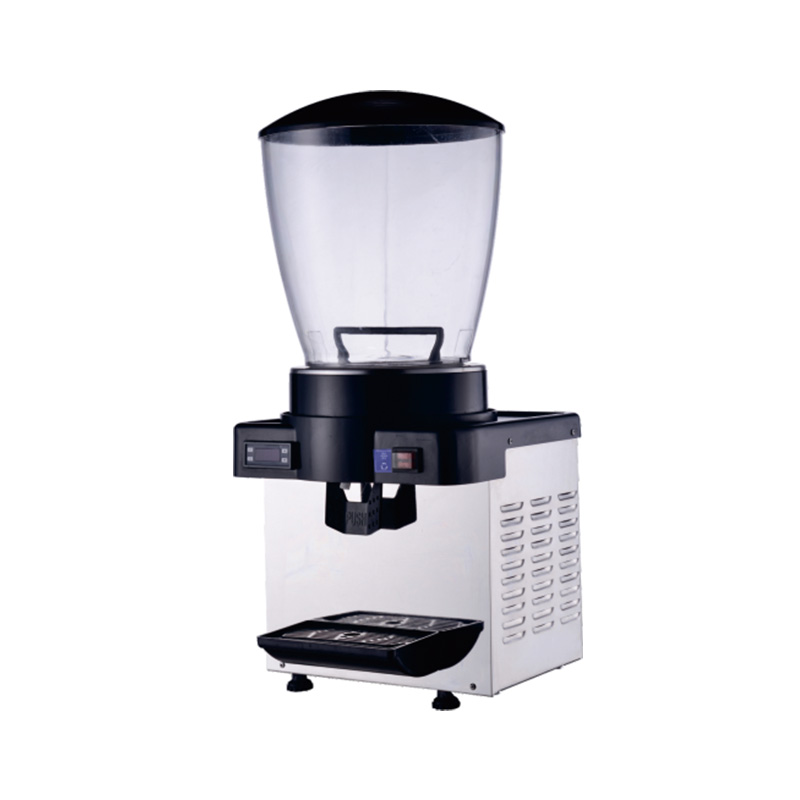
18L Single Tank Stirring Commercial Juice Dispenser
1. Product Overview
The 18L single-tank stirring commercial juice dispenser is a refrigeration-only beverage machine identified by model PL-118AJ. It is built around one large 18-liter tank that stores and cools a prepared beverage. A stirring system continuously circulates the liquid, helping maintain a consistent texture and reducing the risk of ingredients settling at the bottom of the tank.
The machine has an overall size of approximately 390 × 350 × 790 millimeters. This vertical configuration allows the dispenser to provide substantial beverage capacity without occupying excessive counter space. Its relatively narrow width makes it suitable for beverage stations where every centimeter of workspace matters.
The unit uses a 250-watt stirring input and is intended for refrigeration rather than freezing. This distinction is important. It is designed to keep juice and cold drinks chilled, not to produce frozen desserts, shaved ice, or semi-frozen slush beverages. Operators should therefore select the machine according to the intended beverage category and follow the manufacturer’s operating instructions.
Its stainless-steel exterior gives the machine a professional appearance while supporting durability in demanding foodservice environments. Stainless steel is widely used in commercial kitchens and beverage equipment because it is resistant to corrosion, relatively easy to clean, and compatible with hygienic operating practices.
2. Main Product Specifications
| Product Type | Single-tank stirring commercial juice dispenser |
| Model | PL-118AJ |
| Tank Capacity | 18 liters |
| Stirring Input Power | 250 watts |
| Temperature Range | Approximately 3°C to 10°C |
| Overall Dimensions | Approximately 390 × 350 × 790 millimeters |
| Refrigeration Function | Refrigeration only |
| Construction | Stainless-steel body with a transparent viewing area |
| Application | Juice, fruit-based drinks, and other chilled beverages |
| Reported Net Weight | Approximately 19 to 23 kilograms, depending on the specification version |
The supplied product materials list the net weight as both 19 kilograms and 23 kilograms in different specification sections. This may reflect different configuration standards, packaging references, or document revisions. Buyers should confirm the final net weight, packed weight, and shipping dimensions before placing an order, especially when planning freight, palletization, or installation.
3. How the Dispenser Works
The machine operates through the coordinated action of a beverage tank, refrigeration system, stirring mechanism, dispensing outlet, and control components. Prepared juice or another suitable cold beverage is poured into the tank. The refrigeration system removes heat from the beverage, while the stirring mechanism keeps the liquid moving at a controlled rate.
Continuous stirring is valuable because many fruit drinks contain pulp, concentrate, natural particles, flavoring components, or ingredients with different densities. Without movement, these components may gradually settle or separate. Stirring helps distribute them more evenly throughout the tank, creating a more consistent serving experience.
The refrigeration function is intended to maintain a cold serving temperature rather than rapidly freeze the drink. The stated temperature range of 3°C to 10°C is suitable for many chilled juice and beverage applications. Actual performance may vary according to ambient temperature, beverage temperature when loaded, beverage formulation, ventilation, cleaning condition, and frequency of dispensing.
The transparent viewing area allows staff to monitor the approximate beverage level without opening the tank. This is useful for planning refills, checking product availability, and recognizing when the dispenser needs cleaning or replenishment. Visibility also improves customer confidence because the beverage can be seen before purchase.
4. Capacity and Service Efficiency
An 18-liter tank offers a practical balance between capacity and equipment size. It is large enough to support regular commercial service while remaining more compact than many multi-tank or high-volume beverage systems. For a breakfast buffet, café counter, or restaurant beverage station, this capacity can reduce the frequency of refilling during normal service periods.
Capacity planning should always consider the actual serving size. An 18-liter tank contains approximately 72 servings of 250 milliliters before allowing for operational reserves, foam, spillage, or remaining liquid in the dispensing system. At a 300-milliliter serving size, the theoretical output is approximately 60 servings. Actual service volume will depend on customer behavior and the beverage program.
The single-tank design is particularly suitable when an operation focuses on one main juice or beverage flavor. It avoids the additional cleaning, electrical, and counter-space requirements associated with multiple tanks. Businesses that need several flavors may install multiple single-tank units or select a different machine configuration with multiple compartments.
A single large tank can also simplify inventory control. Staff can prepare one beverage batch, load it into the dispenser, monitor the level through the viewing window, and refill according to demand. This can improve workflow in locations where a consistent signature drink is more important than offering a wide range of flavors.
5. Continuous Stirring for Better Beverage Uniformity
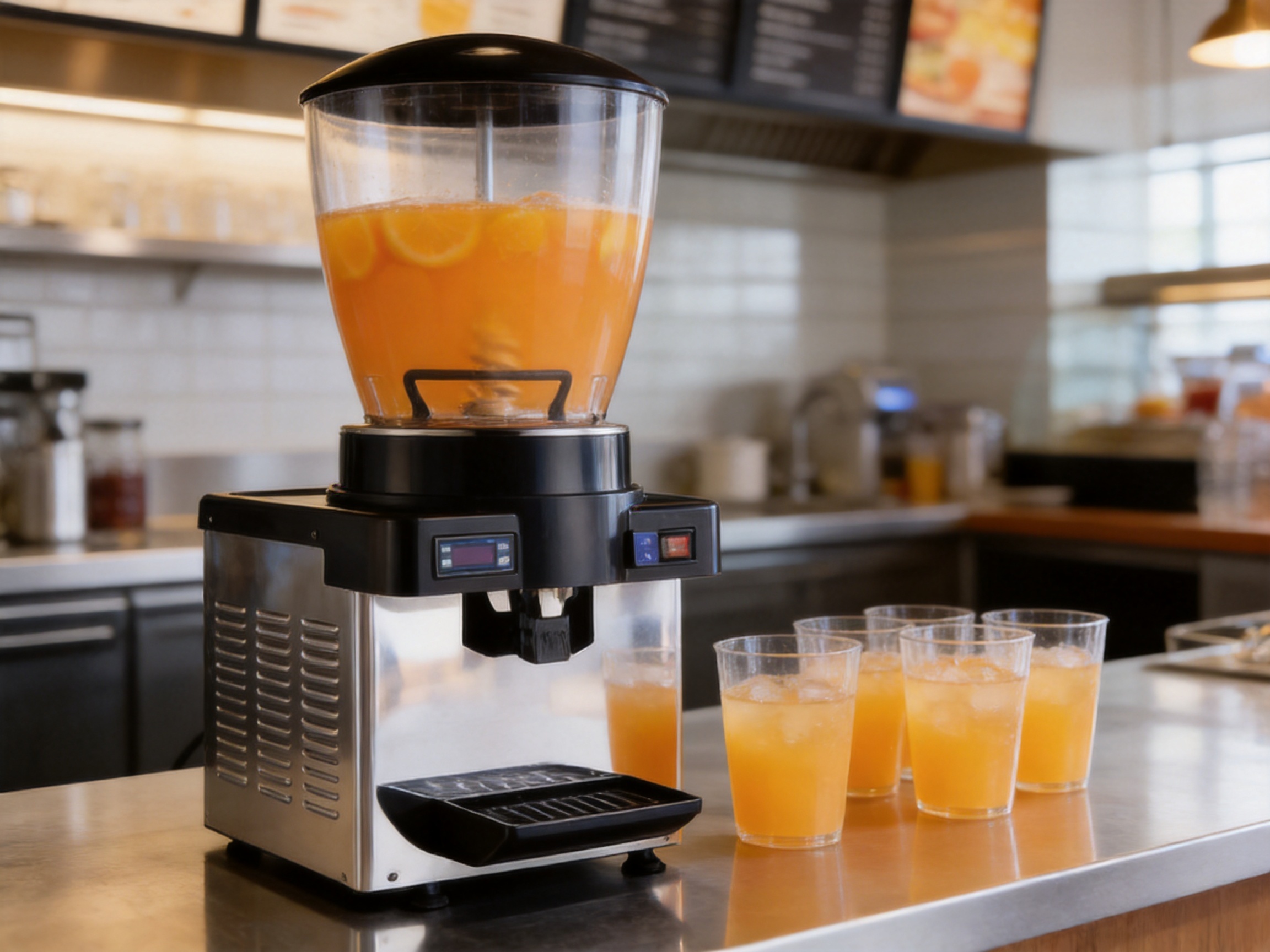
One of the most important features of this product is its stirring function. Many commercial juices are not completely uniform liquids. Fruit particles, pulp, concentrated ingredients, syrups, and natural solids may separate over time. A stationary beverage can therefore taste or look different depending on whether it is taken from the upper or lower part of the container.
Continuous stirring helps reduce this variation. By maintaining movement throughout the tank, the machine supports a more even distribution of ingredients. This is especially useful for fruit-based drinks and concentrated juice products that require blending after dilution.
Uniformity also contributes to presentation. A drink that remains visually consistent is more attractive at a buffet or service counter. Customers can see that the beverage is being maintained rather than left stagnant. For operators, consistent mixing can reduce the need for manual stirring and provide a more predictable serving process.
The stirring system should be used with beverages that are compatible with the equipment. Operators should avoid overloading the tank, introducing excessively thick mixtures, or using ingredients that may damage the mechanism. Recipes should be prepared according to suitable dilution and viscosity requirements.
Continuous stirring does not replace recipe control. A beverage must still be mixed properly before loading, and operators should follow food safety practices for preparation, storage, and service. The dispenser supports consistency, but it does not correct an improperly formulated or improperly handled drink.
6. Refrigeration Performance and Temperature Management
Cold beverage quality depends heavily on temperature stability. Drinks served too warm may taste less refreshing and may not meet the expectations of customers or foodservice operators. The refrigeration system in this dispenser is intended to maintain chilled beverages within a practical range of approximately 3°C to 10°C.
The refrigeration-only design makes the machine straightforward to use. It is not intended to freeze the liquid or produce a semi-frozen texture. This makes it appropriate for juices, fruit drinks, iced tea, flavored water, and similar beverages that should remain liquid while cold.
To support stable cooling, the machine should be installed in a location with sufficient airflow. Ventilation openings must remain unobstructed, and the unit should not be placed next to high-heat equipment unless adequate separation is provided. Excessive ambient heat can increase cooling demand and reduce efficiency.
Operators should also avoid loading the dispenser with a very large quantity of warm beverage during peak periods. When possible, pre-chilled beverage should be added to the tank. This reduces the initial cooling load and helps the dispenser reach the desired serving condition more efficiently.
Temperature performance can be influenced by room temperature, beverage composition, tank fill level, door or cover opening frequency, condenser cleanliness, and electrical supply. Regular inspection and cleaning are therefore important for reliable operation.
7. Stainless-Steel Construction and Commercial Durability
The use of stainless-steel panels supports the machine’s suitability for commercial environments. Foodservice equipment is frequently exposed to moisture, splashes, cleaning agents, repeated handling, and daily operating cycles. A durable exterior helps the dispenser retain its appearance and function over time.
Stainless steel is also associated with professional hygiene standards. Its smooth surface can be wiped down efficiently, and it does not absorb liquids in the way that porous materials may. Operators should still clean the machine regularly and use cleaning products that are appropriate for stainless steel and food-contact applications.
The all-stainless-steel appearance gives the dispenser a clean and modern visual character. This is valuable when the unit is positioned in an open buffet, hotel breakfast area, retail counter, or front-of-house beverage station. The machine can present a more coordinated appearance than equipment made primarily from low-durability materials.
Durability involves more than the outer panels. Internal components, seals, dispensing parts, refrigeration assemblies, electrical connections, and stirring components all contribute to service life. A professional manufacturer must therefore coordinate material selection, assembly accuracy, testing, and after-sales support rather than focusing only on appearance.
8. Compact Design for Commercial Workspaces
The approximate footprint of 390 × 350 millimeters allows the machine to fit into many beverage service layouts. Its vertical height of approximately 790 millimeters provides a useful tank volume while keeping the equipment relatively narrow. This can be an advantage in compact cafés, convenience stores, food stalls, and hotel service areas.
Space efficiency is particularly important when a counter must accommodate cups, lids, straws, ice, garnish, payment equipment, and other appliances. A dispenser that offers 18 liters of capacity within a relatively small footprint can help operators use their available workspace more effectively.
Before installation, the operator should measure the complete location, including clearance around the machine. Adequate space may be required for ventilation, cleaning, electrical access, staff movement, and service work. The supporting counter must also be level and capable of carrying the filled weight of the dispenser.
A filled 18-liter tank contains a substantial amount of liquid. The weight of the beverage must be considered together with the machine’s own weight. Operators should not place the unit on an unstable shelf or a surface that cannot safely support the combined load.
9. Advantages Compared with Basic Beverage Containers
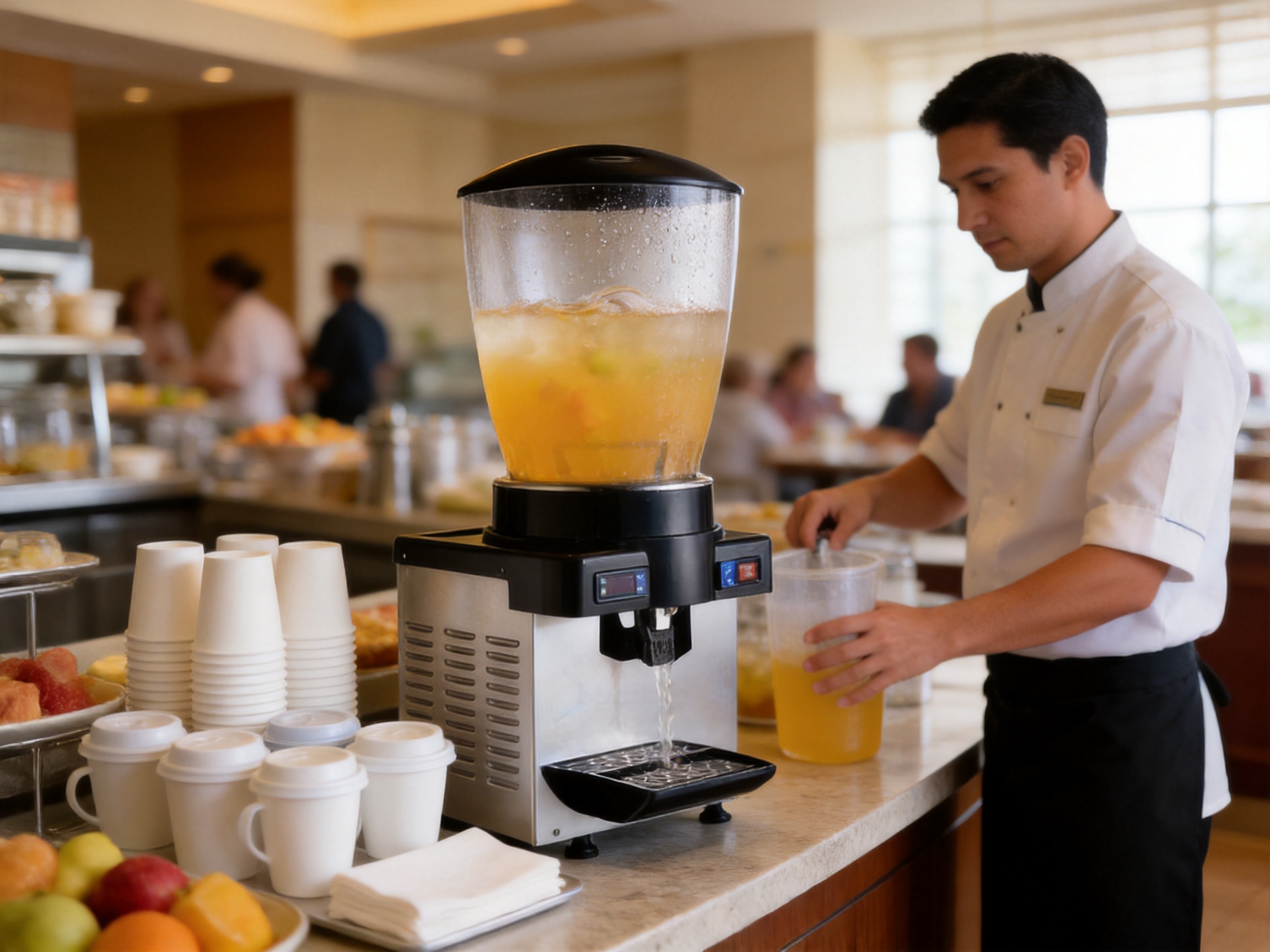
Compared with a basic non-refrigerated beverage container, this dispenser provides active cooling and continuous stirring. A conventional container may require ice, manual mixing, or frequent replacement to maintain acceptable serving conditions. The commercial dispenser is designed to reduce these manual tasks and create a more controlled service process.
Compared with an open pitcher or large manual dispenser, the enclosed tank can support a cleaner and more professional presentation. The dispensing outlet helps control serving, while the viewing area allows product visibility without requiring staff to open the container repeatedly.
Compared with a simple refrigerated storage container without stirring, this model offers better support for drinks that tend to separate. The stirring function helps maintain beverage uniformity and reduces the need for staff intervention.
Compared with larger multi-tank systems, the single-tank format can be more economical in terms of footprint, initial investment, cleaning time, and operation. It is a focused solution for businesses that need one high-demand beverage rather than a wide selection of flavors.
10. Advantages Compared with Less Specialized Equipment
General-purpose refrigeration equipment is not always suitable for beverage dispensing. A refrigerator may cool bottles or containers, but it does not provide a visible service tank, controlled dispensing point, or continuous beverage stirring. The 18L dispenser is purpose-built for front-line cold drink service.
Similarly, a food storage container may hold a beverage but may not be designed for repeated dispensing, temperature control, or commercial presentation. Specialized equipment integrates these functions into one machine, helping operators maintain a more consistent service routine.
The product also offers a more professional appearance than improvised beverage arrangements. In customer-facing areas, the visual quality of the equipment can influence perceptions of cleanliness, organization, and product quality.
Its compact design, stainless-steel body, refrigeration system, stirring function, and transparent viewing area create a combination of features that may not be available in simpler alternatives. The value lies not in one isolated feature, but in how the functions work together during daily service.
11. Suitable Commercial Applications
Restaurants
Restaurants can use the dispenser for fruit juice, lemonade, iced tea, flavored water, and other chilled beverages. It can be placed near the service counter or included in a self-service beverage area. The 18-liter capacity is suitable for regular dining periods and can be refilled according to demand.
Hotel Breakfast Areas
Breakfast operations often require equipment that can serve many customers within a limited period. A visible, chilled beverage dispenser can support organized self-service and reduce the workload on staff. The viewing window makes it easier to monitor the remaining quantity during busy breakfast hours.
Cafés and Beverage Counters
Cafés can use the machine for one signature juice or fruit drink. The stainless-steel appearance fits modern service counters, while the compact footprint helps preserve room for coffee equipment and other beverage tools.
Convenience Stores
Convenience stores may use the dispenser to offer ready-to-serve cold drinks in a customer-facing area. The machine can support faster service and make the beverage more visible than products stored only inside a refrigerator.
Buffets and Institutional Dining
Buffets, schools, hospitals, corporate cafeterias, and other institutions may benefit from a reliable single-tank system for a frequently served beverage. The simple format can make daily operation and cleaning easier to organize.
Snack Shops and Quick-Service Businesses
Snack shops and quick-service outlets often need compact equipment that can withstand repeated use. The 18-liter dispenser can provide a dedicated cold beverage option without requiring the larger footprint of a multi-tank installation.
12. Beverage Compatibility and Recipe Planning
The machine is primarily intended for concentrated juices and fruit-based drinks that are served cold and remain liquid. Suitable products may include diluted juice concentrates, lemonade, fruit punch, iced tea, and flavored non-carbonated beverages, subject to recipe and equipment compatibility.
Before using a new beverage, operators should consider its viscosity, pulp content, acidity, sugar concentration, and tendency to separate. Very thick beverages may place additional demand on the stirring mechanism. Drinks containing large particles may require straining or recipe adjustment to prevent blockage at the dispensing outlet.
Carbonated beverages may not be suitable unless the equipment has been specifically designed for carbonation. Carbon dioxide can affect dispensing behavior, pressure, foaming, and component performance. Operators should consult the product supplier before using carbonated recipes.
Dairy-based drinks and beverages containing proteins may require especially strict cleaning and temperature-control procedures. They can spoil more rapidly and may leave residues inside the tank and dispensing system. Any product used in the machine should comply with the supplier’s operating guidance and local food safety requirements.
Recipe consistency is important. Staff should measure concentrate, water, sugar, flavoring, and other ingredients accurately. A standardized recipe improves taste, supports predictable cooling performance, and helps control operating costs.
13. Cleaning and Hygiene Practices
Regular cleaning is essential for any commercial beverage dispenser. Juice residues, pulp, sugar, and organic materials can accumulate in the tank, stirring system, outlet, seals, and surrounding surfaces. If these residues are not removed, they may affect flavor, appearance, hygiene, and equipment performance.
At the end of each service cycle, operators should follow the recommended shutdown and cleaning procedure. The beverage should be removed, and the tank should be emptied in accordance with food safety practices. Removable components should be handled carefully to avoid damaging seals or connectors.
The tank and product-contact parts should be washed using an appropriate foodservice cleaning method. Rinsing is important because detergent residue can affect the flavor of the next beverage. Sanitizing should be performed according to the operator’s food safety program and applicable local requirements.
The dispensing outlet deserves special attention because small amounts of beverage may remain in this area after service. Seals, gaskets, stirring components, and corners should be inspected for residue. The external stainless-steel body can be wiped with a suitable cleaner and dried to reduce water marks.
Cleaning frequency depends on the beverage type, operating hours, ambient conditions, and local regulations. Beverages containing pulp, sugar, dairy, or other perishable ingredients may require more frequent cleaning than clear, low-residue drinks.
14. Installation and Daily Operation
The dispenser should be installed on a stable, level surface. The location should provide access to an appropriate electrical supply and sufficient clearance for ventilation. Operators should keep the surrounding area free from excessive moisture, grease, and heat.
Before the first use, the tank and product-contact components should be cleaned according to the operating instructions. Staff should verify that all parts are correctly assembled and that the dispensing outlet is secure. The machine should be allowed to operate as recommended before beverage service begins.
During loading, operators should avoid exceeding the marked capacity. The beverage should be prepared at a suitable consistency and, when practical, pre-chilled before being added to the tank. Overfilling can interfere with operation and make cleaning more difficult.
Staff should monitor the beverage level, temperature, appearance, and dispensing performance during service. Unusual noise, excessive vibration, unstable cooling, leakage, or a change in stirring behavior should be reported promptly.
At the end of the day, the unit should be shut down and cleaned according to the established procedure. Leaving sugary or pulpy beverages in the tank for extended periods can increase residue and hygiene risks.
15. Energy and Operating Considerations
The product is designed with a relatively modest 250-watt stirring input. Actual total energy consumption also depends on the refrigeration system, operating duration, ambient temperature, beverage load, and control cycle. Operators should consider the complete electrical rating shown on the final product label when planning installation.
Energy efficiency is supported by proper operating conditions. Keeping the condenser and ventilation area clean, avoiding unnecessary exposure to high ambient heat, and loading pre-chilled beverage can reduce the cooling workload. A correctly maintained machine is generally better positioned to operate consistently than one with blocked airflow or heavy residue.
Operators should avoid repeatedly switching the machine on and off without following the recommended procedure. Refrigeration systems may require an appropriate interval before restarting. The supplier’s instructions should be followed for startup, shutdown, and service.
Although energy use is important, food safety and beverage quality must remain the primary considerations. Raising the beverage temperature beyond an acceptable service range simply to reduce energy consumption may create quality or compliance problems.
16. Manufacturing Strengths and Production Capability
The manufacturer described in the supplied materials is a professional foodservice equipment company integrating design, research and development, manufacturing, sales, and service. Its production facilities cover more than 60,000 square meters and support a broad range of commercial refrigeration, kitchen, buffet, and beverage equipment.
A substantial manufacturing facility can support more organized production planning, component management, assembly coordination, inspection, and product development. For distributors and commercial buyers, this matters because reliable supply involves more than the production of one unit. It includes repeatability across batches, documentation, packaging, spare parts, and technical support.
The company’s product range includes ice cream machines, juice dispensers, fried ice cream machines, refrigeration cabinets, slush machines, flake ice machines, cooking equipment, griddles, fryers, insulation products, barbecue equipment, and buffet solutions. This broad portfolio indicates experience across several foodservice categories and allows customers to source complementary equipment from one manufacturing partner.
Integrated design and production can improve communication between engineering and manufacturing teams. Product requirements can be reviewed earlier, design details can be evaluated for manufacturability, and improvements can be incorporated into later production runs. This is particularly useful for OEM and ODM projects.
A manufacturer with in-house research and development capabilities can also respond to changing market demands. Customers may require different voltage standards, plug types, labels, packaging formats, colors, capacities, control systems, or structural details. Engineering support helps determine which modifications are practical and how they may affect performance, cost, and certification.
17. Advanced Manufacturing Processes
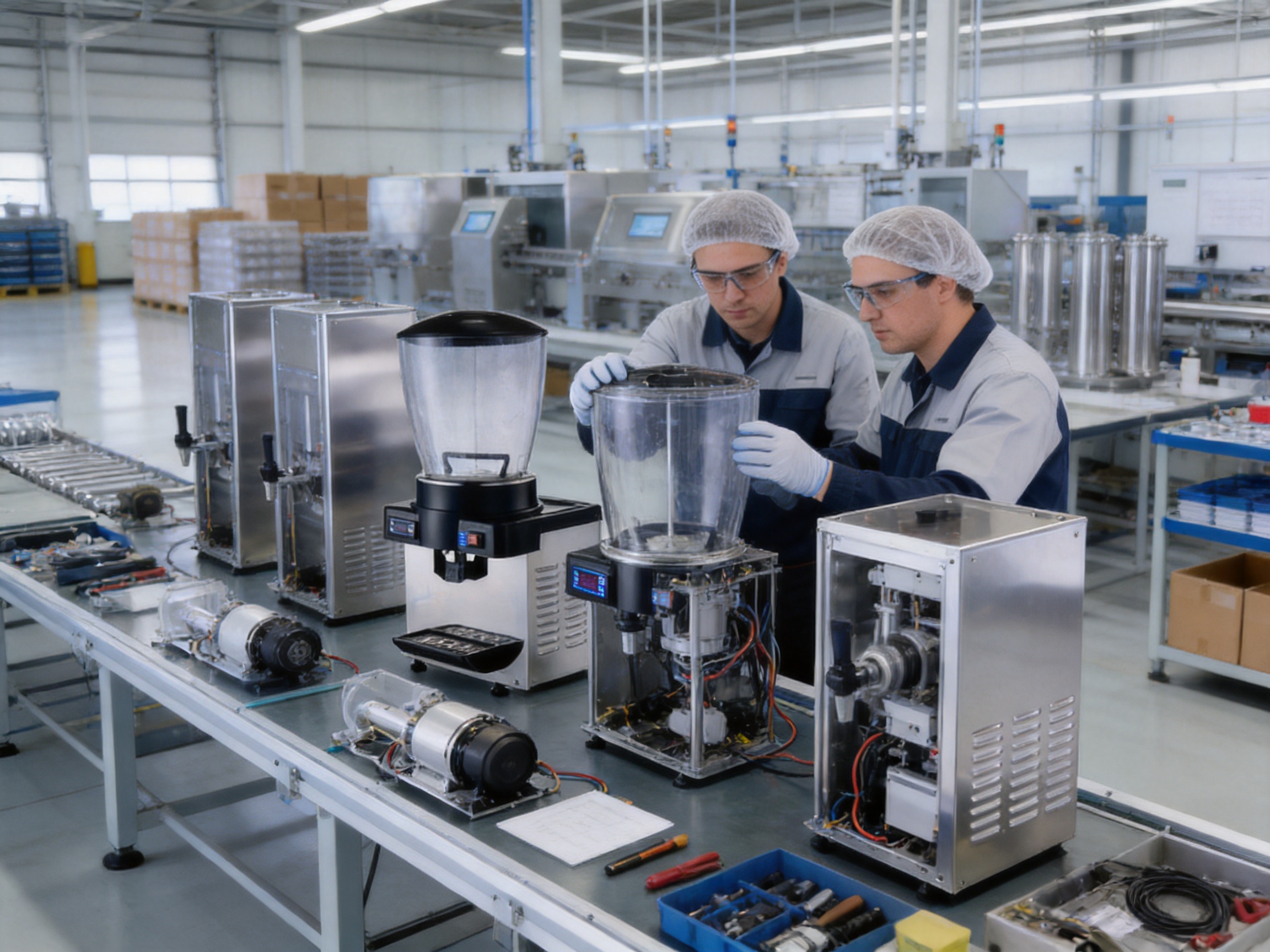
Commercial beverage equipment requires careful coordination of metalwork, refrigeration, electrical assembly, mechanical movement, sealing, and final testing. The manufacturing process begins with material selection and component preparation. Stainless-steel panels must be cut, formed, finished, and assembled with suitable accuracy so that the completed machine has a clean appearance and stable structure.
Sheet-metal processing influences both appearance and durability. Consistent dimensions help ensure that panels fit correctly and that gaps, edges, and mounting points are controlled. Proper surface finishing makes cleaning easier and supports a professional front-of-house appearance.
The refrigeration system requires reliable assembly of cooling components, tubing, electrical connections, controls, and insulation. Attention to connection quality is essential because refrigeration performance depends on the integrity of the complete system. Testing can help identify leaks, abnormal pressure, unstable cooling, or other issues before shipment.
The stirring assembly must be aligned correctly and securely mounted. Poor alignment may create noise, vibration, uneven mixing, or unnecessary wear. Manufacturing controls should therefore include inspection of mechanical fit, rotation, fastening, and operational soundness.
Electrical assembly is another important stage. Wiring, switches, controls, motors, and protective components must be installed according to the applicable design requirements. Correct labeling and inspection help reduce installation errors and improve serviceability.
Final testing should evaluate the functions that matter during real operation. Depending on the production standard and order requirements, this may include visual inspection, dimensional verification, electrical safety checks, refrigeration operation, stirring performance, dispensing function, leakage inspection, and packaging review.
Quality management is most effective when it is applied throughout the process rather than only at the final inspection stage. Incoming material checks, process controls, assembly standards, worker training, and finished-product testing all contribute to a more reliable result.
18. OEM and ODM Support
Foodservice equipment buyers may have requirements that differ from the standard product configuration. An OEM project may involve customer branding, packaging, labels, manuals, plug specifications, or other commercial details. An ODM project may require deeper cooperation involving product appearance, dimensions, functions, or structural changes.
The manufacturer’s stated OEM and ODM capabilities are relevant to distributors, importers, restaurant groups, hotel suppliers, and regional equipment brands. Customers can provide drawings, technical requirements, target markets, or intended application details for evaluation.
Customization should be assessed carefully. Changes to tank capacity, cooling performance, stirring configuration, electrical rating, materials, dimensions, or control systems may affect the complete machine. A responsible engineering process should review feasibility, cost, lead time, testing, documentation, and regulatory requirements before production.
For international projects, voltage and frequency are particularly important. Buyers should specify the destination market, electrical standard, plug type, language requirements, labeling expectations, and any relevant certification needs at the beginning of the project.
Packaging can also be customized to support export handling and distribution. Protective materials, carton markings, pallet arrangements, manuals, spare parts, and shipping labels should be discussed before mass production.
19. Quality Control and Long-Term Reliability
Commercial buyers generally need equipment that can operate repeatedly rather than only perform well during a short demonstration. Long-term reliability depends on robust design, consistent components, correct assembly, suitable operating conditions, and timely maintenance.
A manufacturing partner should be able to explain how products are inspected and tested. Buyers may request information about material standards, refrigeration testing, electrical safety procedures, product inspection records, packaging methods, and available spare parts.
Reliability also depends on selecting the correct machine for the application. An 18-liter refrigeration-only dispenser is a strong fit for liquid cold beverages, but it is not a substitute for a slush machine, ice cream machine, or frozen dessert system. Matching product capability to the intended use reduces the risk of overload and premature wear.
After-sales service is another important part of product value. The supplied company information emphasizes pre-sales consultation, product customization, flexible logistics and payment solutions, and after-sales maintenance. These services can help international customers address installation questions, replacement components, technical issues, and future procurement needs.
20. Purchasing Checklist for Commercial Buyers
Before purchasing the dispenser, buyers should confirm the exact model, tank capacity, dimensions, net weight, packed weight, electrical rating, plug type, temperature performance, and included accessories.
The intended beverage should also be described clearly. Buyers should state whether they plan to serve clear juice, pulpy fruit drinks, lemonade, iced tea, flavored water, dairy beverages, or another formulation. This allows the supplier to confirm compatibility and identify any special requirements.
Installation conditions should be reviewed in advance. The buyer should measure the available counter space, verify the load-bearing capacity, confirm ventilation clearance, and ensure that the electrical supply is appropriate.
For import projects, buyers should request export packaging information, carton dimensions, loading quantity, shipping weight, customs documentation, and spare-parts availability. These details affect landed cost and logistics planning.
Commercial customers should also discuss warranty terms, technical support, cleaning guidance, user manuals, replacement seals, stirring components, dispensing parts, and refrigeration service procedures.
| Purchasing Item | Key Question |
| Capacity | Is one 18-liter tank suitable for expected demand? |
| Beverage Type | Is the recipe compatible with refrigeration and stirring? |
| Electrical Supply | Does the voltage, frequency, and plug match the destination market? |
| Installation Space | Is there enough room for the machine, ventilation, and service access? |
| Weight | Which net and packed weight should be used for logistics planning? |
| Cleaning | Are the tank and product-contact parts easy to remove and sanitize? |
| Support | Are manuals, spare parts, warranty, and maintenance assistance available? |
| Customization | Can labels, packaging, electrical specifications, or design details be adapted? |
21. Common Operating Mistakes to Avoid
One common mistake is treating a refrigeration-only dispenser as a freezing or slush machine. The machine is designed to keep beverages cold in liquid form. Using it for frozen or excessively thick products may lead to poor results or unnecessary strain.
Another mistake is neglecting the stirring function. If the beverage is prone to separation, the stirrer should be operated according to the instructions throughout service. Turning it off for extended periods may reduce uniformity.
Overfilling the tank can create spills and make cleaning more difficult. Operators should respect the indicated capacity and leave appropriate room for movement and dispensing.
Blocking ventilation openings can negatively affect refrigeration performance. The machine should not be pushed tightly against walls or surrounded by heat-producing appliances without suitable clearance.
Skipping daily cleaning is another serious error. Beverage residue can harden, create odors, affect the next batch, and increase hygiene risks. A documented cleaning schedule helps ensure that responsibilities are clear among staff members.
Finally, operators should not attempt unauthorized repairs to refrigeration or electrical systems. Specialized service personnel should handle technical repairs, particularly when refrigerant circuits or electrical safety components are involved.
22. Role in a Complete Foodservice Equipment Program
The dispenser can form part of a broader equipment solution for foodservice businesses. A restaurant or snack shop may combine it with refrigeration cabinets, ice machines, slush machines, cooking equipment, buffet products, or frozen dessert equipment according to its menu and service model.
Working with a manufacturer that offers several equipment categories may simplify procurement. A customer can discuss layout, capacity, appearance, shipping, and after-sales needs with one supplier rather than coordinating unrelated vendors for every product type.
This integrated approach can be especially useful for new restaurant projects, hotel renovations, franchise rollouts, convenience-store programs, and regional distribution. Standardized equipment across multiple locations may improve staff training, maintenance planning, and brand consistency.
The 18-liter single-tank format is also useful as a scalable starting point. A business can begin with one unit and add additional units as demand grows. Alternatively, several units can be arranged for different beverages while maintaining a consistent appearance and operating method.
23. Why the Product Is a Practical Commercial Choice
The strongest value of this dispenser comes from its balance of capacity, cooling, stirring, durability, visibility, and compact design. It does not attempt to serve every beverage category. Instead, it focuses on a specific commercial need: keeping a substantial quantity of liquid juice or cold beverage chilled, mixed, and ready for dispensing.
The 18-liter capacity supports routine commercial service without requiring a large multi-tank installation. The stirring system helps maintain a consistent mixture. The temperature range is appropriate for liquid cold drinks. The stainless-steel body supports durability and professional presentation. The transparent viewing area helps staff monitor beverage levels. The vertical footprint makes the unit suitable for many counters and service stations.
Compared with basic beverage storage solutions, it provides a more complete service system. Compared with larger or more complex equipment, it may offer simpler operation and easier integration into a compact workspace. These advantages make it relevant to restaurants, cafés, buffets, hotels, convenience stores, and other foodservice businesses.
Its effectiveness will depend on correct installation, suitable beverage formulation, regular cleaning, adequate ventilation, and proper maintenance. When these conditions are met, the machine can contribute to efficient beverage service and a more consistent customer experience.
24. Questions and Answers
Q1: What is the capacity of the dispenser?
The dispenser has an 18-liter single tank. The usable service quantity may be slightly lower than the nominal capacity because operators should avoid overfilling and may need to retain a small operating reserve.
Q2: What types of beverages can it serve?
It is designed for chilled liquid beverages such as concentrated juices, fruit-based drinks, lemonade, iced tea, and flavored water, provided the beverage is compatible with the tank, stirring system, and dispensing outlet.
Q3: Does the machine make frozen drinks?
No. The supplied specification identifies the machine as refrigeration only. It is intended to cool and dispense liquid beverages, not to freeze products or produce slush textures.
Q4: Why is continuous stirring useful?
Continuous stirring helps distribute pulp, concentrate, flavoring, and other ingredients more evenly. This reduces separation and supports a more consistent appearance and taste throughout the service period.
Q5: What temperature range does it provide?
The stated temperature range is approximately 3°C to 10°C. Actual results depend on ambient conditions, beverage temperature at loading, recipe composition, ventilation, maintenance, and operating conditions.
Q6: How much power does the stirring system use?
The supplied product information lists stirring input power at 250 watts. Buyers should confirm the complete electrical rating, including refrigeration requirements, on the final technical specification and product label.
Q7: Is the machine suitable for a hotel breakfast buffet?
Yes. Its 18-liter capacity, chilled beverage function, visible tank, and commercial construction make it suitable for many hotel breakfast areas, buffet counters, and self-service beverage stations.
Q8: Is the tank easy to monitor during service?
The transparent viewing area allows staff to see the beverage level and observe the product without repeatedly opening the tank. This supports refill planning and service management.
Q9: What should be considered before installation?
Operators should confirm counter dimensions, ventilation clearance, electrical compatibility, surface stability, cleaning access, and the load-bearing capacity required for the machine and its full beverage load.
Q10: How often should the machine be cleaned?
Cleaning frequency depends on the beverage recipe, operating hours, local food safety rules, and manufacturer instructions. At minimum, the tank, dispensing components, stirring parts, and product-contact surfaces should be cleaned according to an established commercial hygiene schedule.
Q11: Can the product be customized?
The manufacturer provides OEM and ODM services based on drawings or requirements. Possible project details may include branding, packaging, electrical specifications, labels, dimensions, and selected design features, subject to engineering review.
Q12: Why should the net weight be confirmed before ordering?
The supplied materials list different net weights in separate specification sections. Confirming the final net and packed weights helps buyers plan freight, storage, palletization, installation, and labor accurately.
Q13: What makes stainless steel useful in this application?
Stainless steel provides a durable, professional-looking surface that is suitable for commercial environments. It is relatively easy to wipe clean and can support long-term use when properly maintained.
Q14: Can the machine replace a multi-flavor dispenser?
It depends on the operation. This model has one tank and is suitable when one main beverage is required. Businesses offering several flavors may need multiple units or a purpose-built multi-tank model.
Q15: What support can a commercial buyer request?
Buyers can discuss product selection, customization, logistics, payment arrangements, user documentation, spare parts, warranty conditions, and after-sales maintenance with the supplier before ordering.
25. Conclusion
The 18L single-tank stirring commercial juice dispenser is a focused solution for businesses that need reliable cold beverage service in a compact format. Its large single tank, continuous stirring, refrigeration-only design, stainless-steel construction, transparent viewing area, and practical dimensions address the everyday requirements of restaurants, cafés, buffets, hotels, convenience stores, and institutional foodservice operations.
Its advantages over basic beverage containers include active cooling, improved beverage uniformity, controlled dispensing, visible product presentation, and a more professional commercial design. Compared with larger multi-tank systems, its single-tank structure can simplify operation, reduce space requirements, and support businesses centered on one high-demand beverage.
The manufacturer’s integrated capabilities in design, research and development, production, sales, and service provide additional value for distributors and commercial buyers. A modern manufacturing base, broad foodservice equipment portfolio, OEM and ODM experience, and after-sales support can help customers develop practical equipment programs for different markets.
For the best results, buyers should confirm the final technical details, electrical configuration, beverage compatibility, installation requirements, cleaning procedures, warranty terms, and logistics information before purchase. When correctly selected and maintained, this dispenser can support efficient service, consistent product quality, and long-term value in commercial beverage operations.
References
1. Product specification sheet for the 18L single-tank stirring commercial juice dispenser, model PL-118AJ.
2. Manufacturer-provided product information concerning capacity, power, dimensions, temperature range, construction, and applications.
3. Commercial foodservice equipment hygiene and cleaning practices for beverage dispensing systems.
4. General principles of refrigeration equipment installation, ventilation, inspection, and preventive maintenance.
5. Foodservice equipment procurement guidelines covering electrical compatibility, installation space, packaging, spare parts, and after-sales service.
Product: 18L Single Tank Stirring Commercial Juice Dispenser
For exclusive deals and latest offers, sign up by entering your email address below.


-
spelor@spelor.com
-
+86-576-85229688
-
No.528, Changxi Road, Linhai City, Zhejiang Province, China
Commercial Refrigeration Equipment Manufacturer China
Copyright © 2025 by Spelor Electrical Appliances (Zhejiang) Co., Ltd. Rights Reserved.
