


 中文简体
How a 2×12L Commercial Slush Machine Supports Faster, More Flexible Foodservice Operations
Admin 2026-10-30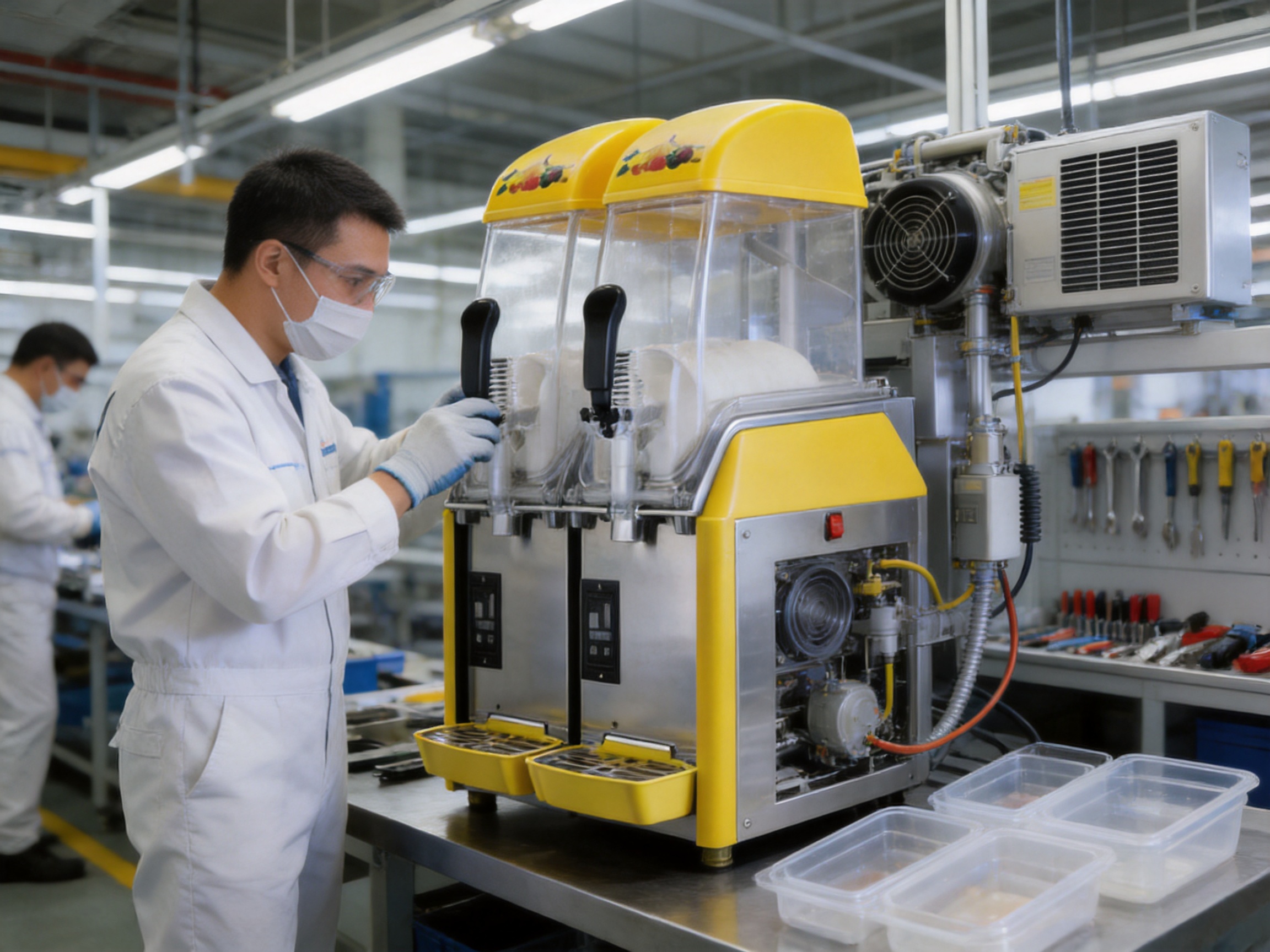
Commercial beverage service depends on consistency, speed, and the ability to offer attractive products throughout the day. A high-quality slush machine must do more than freeze a beverage. It must support continuous operation, maintain a stable texture, simplify cleaning, use space efficiently, and provide enough capacity for busy cafés, bars, restaurants, snack shops, and other foodservice businesses.
The 2×12L double-tank commercial slush machine is designed around these requirements. With two independent 12-liter tanks, the X-240 model can prepare two flavors or recipes at the same time. This dual-tank format gives operators greater menu flexibility than a single-tank machine while remaining more compact and economical than installing two separate units.
Manufactured by Spelor Electrical Appliances (Zhejiang) Co., Ltd., the machine combines a food-grade stainless steel body, colorful sprayed steel components, independent operating zones, circulation systems, commercial refrigeration technology, and a practical footprint. It is intended for establishments that require reliable frozen beverage production during peak service periods.
This article examines the machine’s design, operating advantages, commercial applications, manufacturing strengths, maintenance considerations, and purchasing value. It also explains how a dual-tank slush machine compares with common alternatives and provides a detailed question-and-answer section for buyers, distributors, and foodservice operators.

2*12L Double Tank Commercial Slush Machine for Bar Cafe Restaurant
1. The Role of a Commercial Slush Machine in Modern Foodservice
Frozen beverages have become an important part of menus in cafés, bars, restaurants, convenience stores, amusement venues, hotels, and outdoor service locations. Slush drinks are visually appealing, easy to customize, and suitable for a wide range of flavors. They can be sold as fruit beverages, non-alcoholic refreshments, cocktails, mocktails, dessert drinks, or seasonal specialties.
However, commercial production differs significantly from household preparation. A domestic blender or small freezer may be acceptable for occasional use, but it cannot normally provide a stable product texture or maintain sufficient output during a busy service period. Commercial operators need equipment that can continuously cool and circulate a prepared mixture while keeping the product ready for dispensing.
A dedicated slush machine addresses this need by combining refrigerated cooling with mixing or circulation. The product is held at a controlled frozen beverage consistency rather than being frozen into a solid block. This allows staff to dispense portions quickly, while the machine continues to maintain the remaining mixture in the tank.
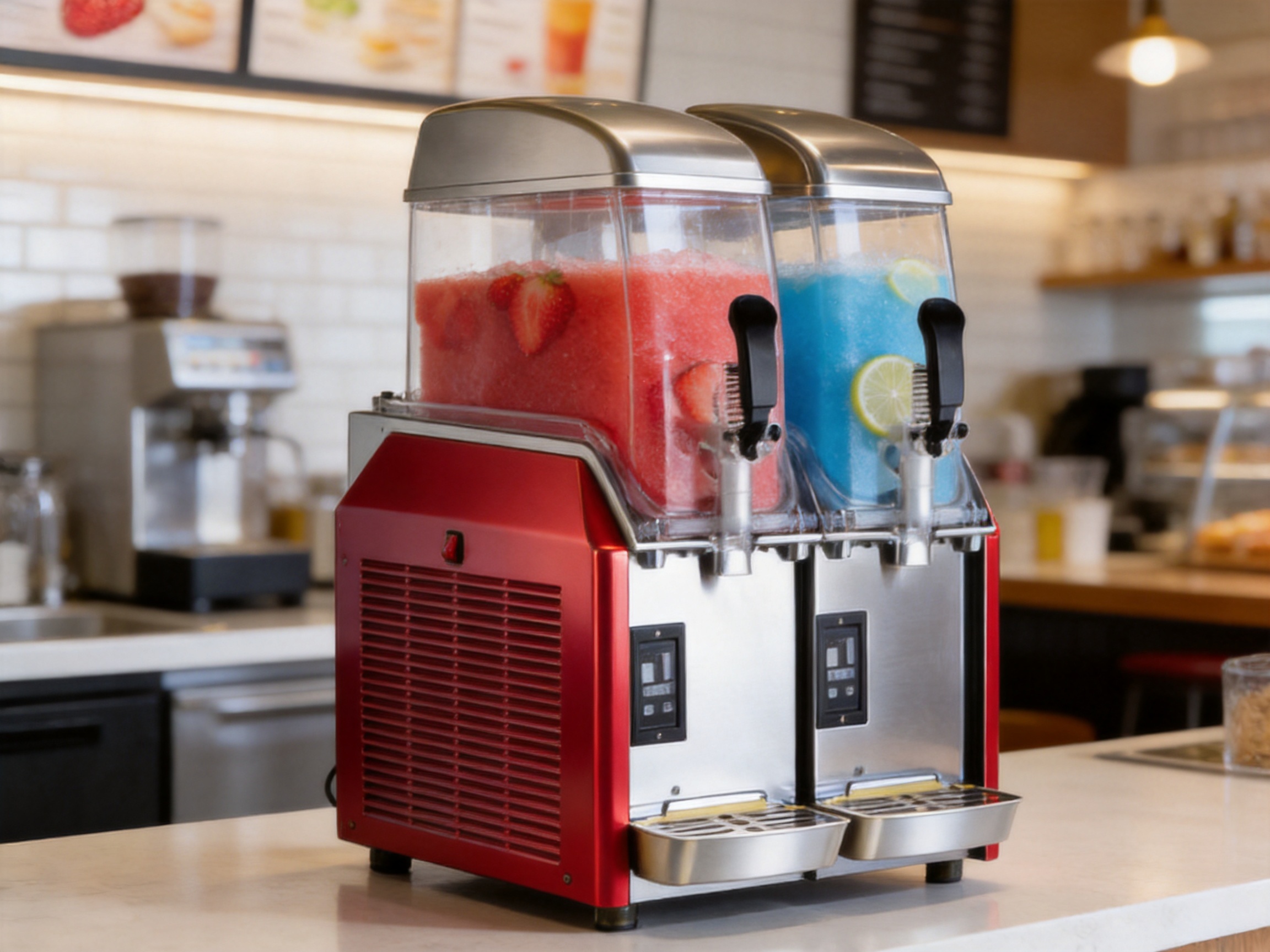
The 2×12L configuration is especially useful for businesses that want to provide more than one flavor. Each tank can be assigned to a different recipe, allowing operators to offer options such as lemon and strawberry, cola and orange, mango and passion fruit, or a standard slush alongside a specialty cocktail. The two-tank design also allows a business to dedicate one side to a non-alcoholic recipe and the other to a separate seasonal or premium drink.
2. Product Overview and Core Specifications
The X-240 commercial slush machine has two tanks, each with a nominal capacity of 12 liters. Together, the machine provides 24 liters of product-holding capacity. This format is suitable for medium-sized foodservice businesses and for larger operations that need an additional frozen beverage station.
| Specification | Product Information |
| Model | X-240 |
| Tank configuration | Two tanks |
| Tank capacity | 2 × 12 liters |
| Rated output | Approximately 890–900 watts, depending on the published configuration |
| Refrigerant | R407C; certain specifications also list R410-compatible configurations |
| Net weight | Approximately 42–43 kilograms |
| Dimensions | Approximately 410–430 × 530–535 × 800–810 millimeters, depending on configuration |
| Body materials | Food-grade stainless steel and sprayed steel components |
| Primary application | Commercial slush beverages, frozen drinks, smoothies, and related recipes |
The differences between the listed output, weight, and dimensions may reflect different production batches, regional specifications, or documentation versions. Buyers should confirm the final nameplate data, refrigerant configuration, electrical requirements, and shipping dimensions with the supplier before placing an order.
Even with those configuration differences, the principal design remains consistent: two 12-liter tanks, a commercial refrigeration system, a durable body, and a layout intended for efficient daily operation.
3. Advantages of the Dual 12-Liter Tank Design
3.1 Two flavors from one machine
The clearest advantage of the double-tank layout is the ability to produce two flavors simultaneously. A single-tank machine limits the operator to one recipe at a time, which can create delays when customers request different flavors. With two tanks, the operator can maintain two products in ready-to-serve condition.
This feature is valuable in locations where customer preferences vary. A café may offer a traditional fruit slush on one side and a low-sugar or specialty drink on the other. A bar may prepare a frozen cocktail and a non-alcoholic mocktail at the same time. A restaurant may use one tank for a regular menu item and reserve the second tank for rotating seasonal promotions.
3.2 Better use of counter space
Installing two independent single-tank machines may provide similar total capacity, but it generally requires more counter space, more electrical connections, more cleaning procedures, and a larger investment. A double-tank machine consolidates two production zones into one commercial unit.
The X-240 measures approximately 410–430 millimeters in width and 530–535 millimeters in depth, subject to the final configuration. This compact footprint helps operators preserve valuable workspace for preparation, payment, packaging, or other equipment.
3.3 Improved service efficiency
When both tanks are in operation, staff can dispense the requested flavor without changing containers or waiting for a new batch. This reduces preparation steps during peak periods. The machine is particularly helpful at counters where speed affects customer satisfaction and queue length.
Because each tank can be managed as an individual production zone, operators may also turn off one side when demand for a particular flavor is low. This creates greater flexibility than a machine that treats the entire capacity as one undivided batch.
3.4 More opportunities for menu development
A two-tank machine supports product testing and menu variety. Operators can compare flavor performance, introduce limited-time recipes, or create paired offerings. For example, a business may offer two complementary colors for special events or use one side for a standard recipe and the other for a premium recipe with fruit concentrate or cocktail ingredients.
This flexibility can increase the perceived value of the beverage station. Customers see a broader selection, while the operator uses one piece of equipment to support several sales strategies.
4. Refrigeration and Circulation Performance
A commercial slush machine must balance cooling power with product movement. If the beverage is cooled without adequate circulation, the texture may become uneven or the mixture may freeze against the tank surface. If the mixture is circulated without effective refrigeration, it may remain too liquid and fail to achieve the desired frozen consistency.
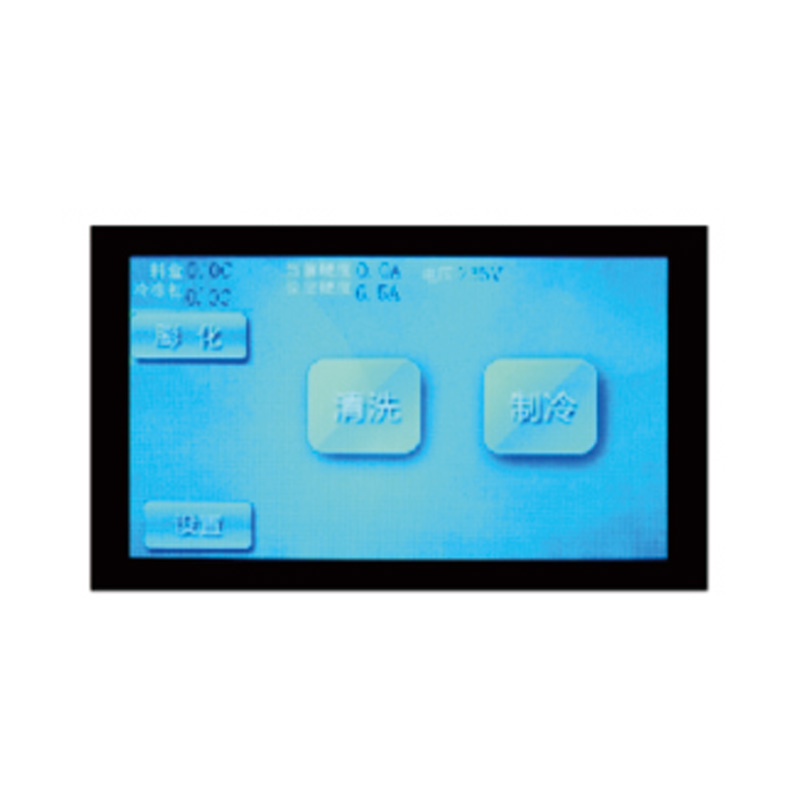
The X-240 design combines refrigerated cooling with circulation for each tank. Independent temperature control and circulation systems help each side maintain a consistent condition according to its recipe and operating requirements. This is an important advantage when two products have different characteristics.
For example, a fruit-based slush and a cocktail-style frozen beverage may require different settings. The ability to operate the tanks separately gives staff greater control than a shared single-zone design. Operators should still follow the recommended recipe ratios and temperature settings supplied by the manufacturer, because sugar content, alcohol content, acidity, and solids influence freezing behavior.
Uniform circulation also improves the serving experience. A well-maintained slush should have a consistent texture from the beginning of the service period to the end. The circulation system helps distribute the cooled mixture within the tank and reduces the risk of separated ingredients or localized freezing.
4.1 Refrigerant considerations
The product materials identify R407C as the refrigerant, while another specification lists R407C/R410. Refrigerant selection can vary according to the final configuration, market requirements, or production version. The correct refrigerant must always match the compressor, refrigeration circuit, service procedures, and nameplate information.
Foodservice buyers should confirm refrigerant details before installation, especially when local regulations, service availability, or import requirements apply. Refrigeration maintenance should be performed by qualified technicians using appropriate recovery, charging, and leak-testing procedures.
4.2 Stable production during busy periods
With a rated output of approximately 890–900 watts, the machine is designed for commercial frozen beverage production rather than occasional household use. The actual production speed will depend on ambient temperature, starting mixture temperature, recipe composition, initial load, ventilation, and service frequency.
Operators can support stable performance by loading pre-mixed ingredients at a suitable temperature, leaving adequate ventilation around the machine, avoiding direct heat sources, and not exceeding the recommended fill level. These operating practices help the refrigeration system work efficiently and reduce unnecessary thermal stress.
5. Materials, Hygiene, and Exterior Construction
The body is made from food-grade stainless steel and colorful sprayed steel. This combination provides a balance between hygiene, structural durability, visual appeal, and manufacturing flexibility.
Stainless steel is widely used in commercial foodservice equipment because it is resistant to corrosion, relatively easy to clean, and suitable for environments where regular contact with moisture and food residues occurs. A smooth metal surface also supports a professional appearance and helps the machine fit into cafés, bars, restaurants, and retail counters.
The sprayed steel sections provide opportunities for color and exterior styling. This can make the machine more visible at the point of sale and allow distributors or operators to select an appearance that matches their brand environment. A visually attractive beverage machine can function not only as production equipment but also as a display feature that encourages impulse purchases.
5.1 Hygiene benefits
Hygiene depends on both machine construction and operator practice. Food-contact areas should be accessible for cleaning, and beverage residues should not be allowed to remain in the tanks, dispensing areas, seals, or circulation components. The stainless steel exterior supports routine sanitation, but it does not replace a complete cleaning schedule.
Operators should establish procedures for product changeovers, daily cleaning, periodic deep cleaning, inspection of gaskets, and sanitation of dispensing components. The exact cleaning chemical, concentration, contact time, and disassembly steps should follow the manufacturer’s instructions and local food safety requirements.
6. Comparison with Common Alternatives
6.1 Compared with a single-tank slush machine
A single-tank machine may require less initial investment and less counter width, making it suitable for very small outlets or businesses that sell only one frozen beverage. However, it limits flavor choice and may require a complete product changeover when the operator wants to introduce another recipe.
The dual-tank X-240 provides substantially greater flexibility. It allows two recipes to be available at the same time, supports more varied menus, and can improve service speed when customers request different products. Although the double-tank unit requires more purchase and operating resources than a single-tank model, the added capacity may provide better commercial value for businesses with steady demand.
6.2 Compared with two separate single-tank machines
Two single-tank machines can provide two flavors, but they often occupy more floor or counter space. They may also require two separate control interfaces, separate maintenance schedules, and additional electrical planning. A dual-tank machine integrates the two production zones into one body.
The integrated design can simplify staff training and improve the appearance of the beverage station. It may also reduce the complexity of purchasing, delivery, installation, and routine inspection.
6.3 Compared with manual ice blending
Manual blending can be useful for made-to-order beverages, but it is labor-intensive during peak periods. Staff must measure ingredients, add ice, operate a blender, clean the container, and repeat the process for every order. The results may vary depending on operator technique and ingredient temperature.
A commercial slush machine prepares product in advance and keeps it ready for dispensing. This supports faster service and more consistent portioning. It also allows employees to focus on customer service, order assembly, and other tasks instead of blending every drink individually.
6.4 Compared with a basic frozen beverage dispenser
Some low-cost frozen beverage dispensers may use simpler materials, less powerful refrigeration, or a single shared control system. They may be suitable for light-duty applications but can be less adaptable when different recipes or high service volumes are involved.
The X-240’s dual independent operating concept, commercial construction, and 24-liter total capacity provide a more practical solution for medium-duty foodservice environments. Buyers should evaluate not only the purchase price but also output, cleaning requirements, service availability, expected operating life, and menu flexibility.
7. Manufacturing Strengths and Production Capabilities
Spelor Electrical Appliances (Zhejiang) Co., Ltd. is described as a professional manufacturer integrating design, research and development, manufacturing, sales, and service. Its production facilities cover more than 60,000 square meters, supporting a broad range of commercial refrigeration, kitchen, buffet, and foodservice equipment.
This type of integrated structure can provide several advantages to equipment buyers. Design and production teams can communicate directly when a product requires modification. Manufacturing experience across multiple equipment categories can support better component coordination. Sales and after-sales teams can also provide feedback to engineering and production departments.
7.1 Product development and engineering integration
Commercial equipment must balance appearance, refrigeration performance, capacity, safety, cleanability, shipping efficiency, and serviceability. Product development therefore involves more than selecting a compressor and placing it inside a cabinet. Engineers must consider tank geometry, circulation paths, material compatibility, insulation, controls, access panels, electrical components, and the relationship between internal and external dimensions.
An experienced manufacturer can refine these details through repeated production, field feedback, and product testing. The X-240 reflects a design approach focused on practical commercial use: two tanks, separate product zones, a durable exterior, and a footprint suited to foodservice counters.
7.2 Manufacturing process overview
Although exact internal production procedures may vary by model and order, the manufacturing process for a commercial slush machine generally includes material preparation, sheet-metal forming, welding or assembly, surface treatment, tank and circulation installation, refrigeration system integration, electrical installation, inspection, and packaging.
Material preparation begins with the selection and cutting of stainless steel, sprayed steel panels, internal supports, insulation materials, and other components. Accurate cutting and forming help ensure that panels fit correctly and that the finished cabinet has a stable structure.
Cabinet assembly may include bending, joining, welding, fastening, and surface finishing. These operations must be controlled carefully because poor alignment can affect appearance, door or panel fit, vibration, and access to internal components.
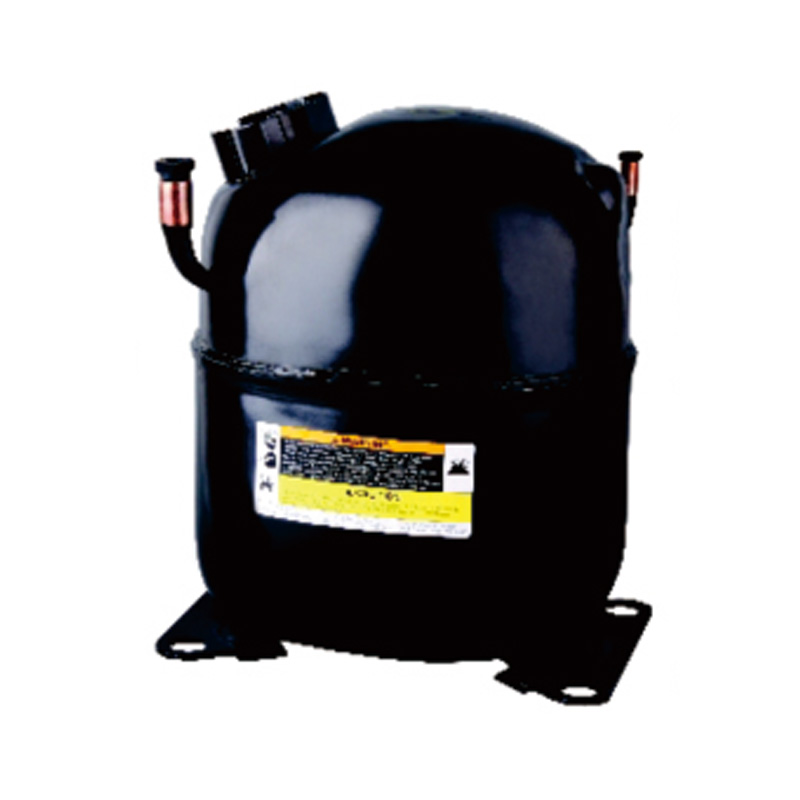
The refrigeration system is then integrated with the tanks and internal structure. This stage requires proper positioning of the compressor, condenser, evaporator-related components, tubing, electrical connections, and ventilation paths. Refrigerant circuits should be assembled and tested according to applicable manufacturing and safety procedures.
The circulation components and dispensing assemblies must be aligned with the tanks so that the product can move consistently and be dispensed smoothly. Seals and food-contact components require particular attention because they influence both hygiene and leakage prevention.
Electrical assembly includes controls, wiring, protection devices, switches, and connections appropriate to the final market specification. A commercial machine should be inspected for correct wiring, grounding, insulation, operating current, and control response before shipment.
7.3 Quality control and functional testing
Quality control is essential for refrigeration equipment because performance depends on the interaction of mechanical, electrical, and thermal systems. Functional testing may include start-up checks, temperature or freezing performance checks, circulation verification, leakage inspection, noise and vibration observation, control testing, and visual inspection.
Manufacturers also need to verify that the machine remains stable during transport. Packaging should protect tanks, panels, dispensing components, and refrigeration parts from impact, moisture, and movement. Clear product identification and technical documentation support smoother installation and after-sales service.
For distributors and importers, factory quality control can reduce the risk of receiving equipment that requires extensive adjustment before sale. For end users, it can contribute to more predictable operation and lower downtime over the product’s service life.
8. Applications Across Different Business Types
8.1 Cafés and beverage shops
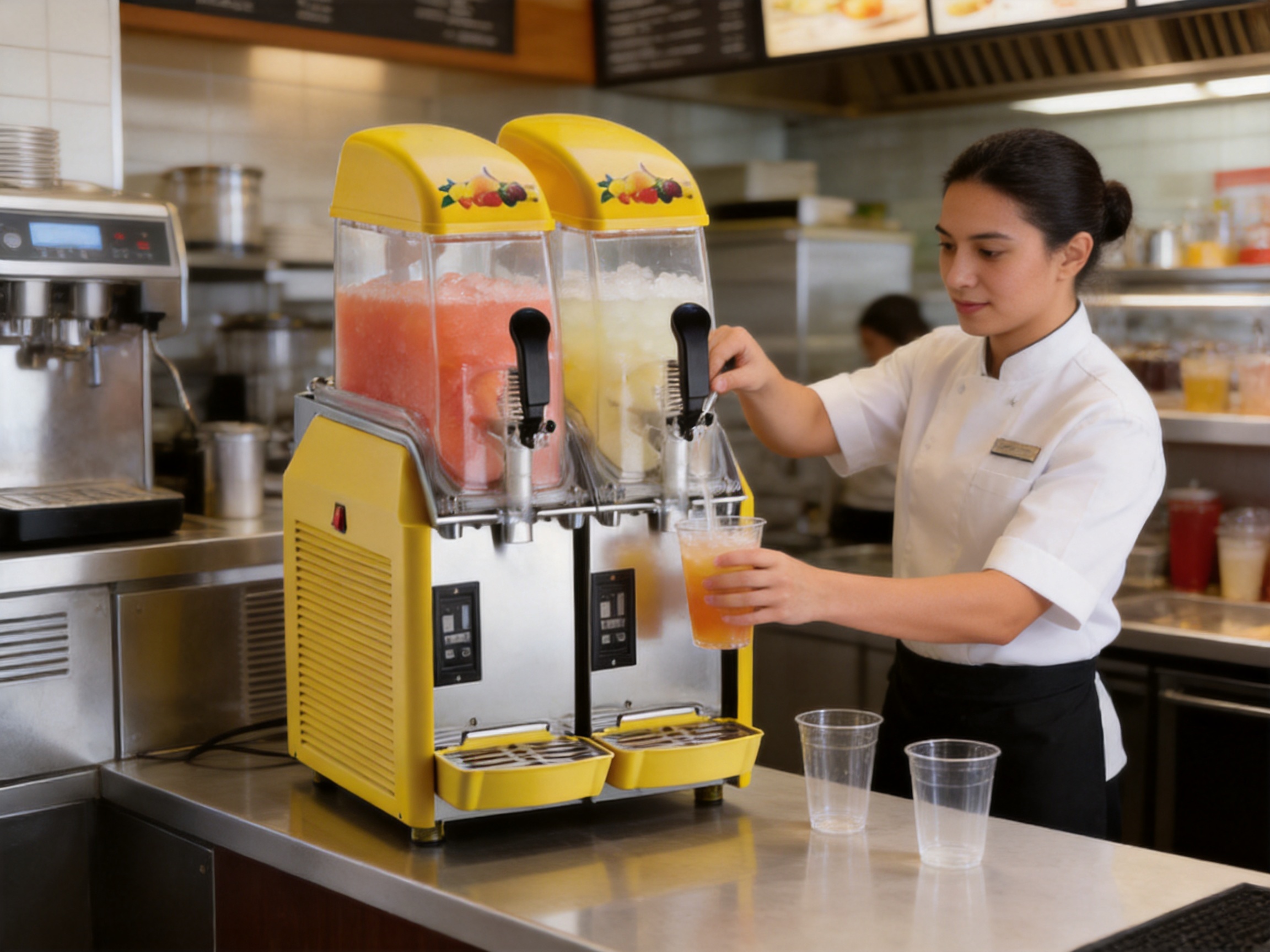
Cafés can use the two tanks to add frozen beverages without significantly expanding the preparation area. One tank may serve a fruit-based product while the other supports a coffee, tea, citrus, or seasonal recipe. The machine can complement existing juice dispensers, coffee equipment, and dessert counters.
8.2 Bars and nightlife venues
Bars can use the machine for frozen cocktails, mocktails, and non-alcoholic slush drinks. Two tanks make it possible to offer contrasting recipes or separate alcoholic and non-alcoholic products. Operators should ensure that every recipe is compatible with the machine and that alcohol content does not prevent the product from reaching the desired consistency.
8.3 Restaurants and fast-food outlets
Restaurants can position the machine near the beverage station, takeaway counter, or dessert area. During meals, quick dispensing helps reduce preparation time. The two-flavor format also makes it easier to offer drinks for different age groups and taste preferences.
8.4 Snack shops and convenience stores
Snack shops and convenience stores often depend on visual merchandising and rapid service. A colorful two-tank slush machine can attract attention and support impulse purchases. The 24-liter total capacity is suitable for businesses that need more than a small countertop batch but do not require a large industrial frozen beverage system.
8.5 Hotels, institutions, and event service
Hotels, cafeterias, institutional dining areas, and event venues can use the machine for self-service or staff-assisted beverage stations. Its two-tank layout provides menu variety while keeping the equipment footprint under control. For temporary events, transportation and installation requirements should be evaluated carefully because the net weight is approximately 42–43 kilograms.
9. Installation and Operating Recommendations
Correct installation is important for refrigeration performance and equipment longevity. The machine should be placed on a stable, level surface capable of supporting its operating weight. Adequate space must be left around ventilation areas so that heat can dissipate effectively.
The machine should not be positioned next to ovens, fryers, radiators, direct sunlight, or other strong heat sources. Excessive ambient heat can increase refrigeration demand and reduce energy efficiency. Operators should also avoid placing objects on ventilation openings or using the machine in locations where water can enter electrical components.
Before loading product, staff should inspect the tanks, dispensing areas, seals, and controls. Ingredients should be prepared according to the recommended recipe. Sugar concentration, acidity, solids, and alcohol content can all affect freezing behavior. A recipe that is too concentrated, too dilute, or unsuitable for frozen dispensing may produce poor texture or place additional stress on the refrigeration system.
Both tanks should be filled within the manufacturer’s recommended range. Overfilling can cause spills, obstruct circulation, or increase cleaning requirements. Underfilling may reduce the effectiveness of product movement in certain designs. Operators should allow the machine to reach the intended consistency before serving large volumes.
During operation, staff should monitor product texture, temperature behavior, dispensing performance, unusual noise, vibration, and visible leakage. Early attention to abnormal conditions can prevent a minor issue from becoming a major service interruption.
10. Cleaning and Preventive Maintenance
Cleaning is one of the most important responsibilities associated with a commercial slush machine. Beverage residues can attract microorganisms, affect flavor, obstruct moving parts, and damage seals if they remain in the system for extended periods.
A practical cleaning program should include product removal, tank rinsing, disassembly of approved food-contact components, washing, sanitizing, drying, and reassembly. The exact frequency depends on the recipe, operating hours, local food regulations, and manufacturer instructions.
Special attention should be given to dispensing nozzles, handles, gaskets, circulation components, tank corners, and areas where syrup or fruit solids may collect. Operators should use cleaning tools and chemicals that are suitable for foodservice equipment and compatible with stainless steel, plastics, and seals.
Preventive maintenance should include inspection of electrical cables, control functions, condenser cleanliness, ventilation openings, fasteners, seals, and refrigerant-related performance. Dust accumulation around the condenser can reduce heat transfer and make the compressor work harder. The machine should be disconnected from the power supply before appropriate cleaning or maintenance procedures are performed.
Refrigeration repairs, refrigerant recovery, electrical troubleshooting, and component replacement should be completed by qualified service personnel. Unauthorized modification may create safety risks and may affect warranty coverage or regulatory compliance.
11. Purchasing Considerations for Distributors and End Users
Businesses should evaluate a commercial slush machine according to the complete operating requirement rather than purchase price alone. Important factors include capacity, expected daily demand, flavor variety, available counter space, electrical supply, ambient conditions, cleaning labor, service support, spare parts, and delivery requirements.
For distributors, the product’s two-tank configuration creates several market opportunities. It can be offered to cafés, bars, restaurants, entertainment venues, convenience stores, and catering businesses. The stainless steel and colorful exterior support both practical and visual selling points, while the 12-liter-per-tank capacity fits a broad range of applications.
Buyers should request confirmation of the following details before final order approval:
1. Final rated power and voltage.
2. Refrigerant type and applicable regional requirements.
3. Final net weight, gross shipping weight, and package dimensions.
4. Exact machine width, depth, and height.
5. Warranty terms and service procedures.
6. Availability of seals, dispensing components, controls, and refrigeration parts.
7. Recommended recipes and operating instructions.
8. Cleaning and sanitation procedures.
9. Required ventilation clearance.
10. Certification and documentation required for the destination market.
These checks are especially important because product specifications may be adjusted for different markets, electrical standards, production batches, or customer requirements.
12. OEM and ODM Potential
The manufacturer provides OEM and ODM services based on drawings or customer requirements. This can be valuable for importers, wholesalers, foodservice chains, and hospitality groups that need equipment adapted to a specific market or operating concept.
Possible areas of customization may include exterior color, logo application, packaging, electrical configuration, language of manuals, control layout, tank identification, and other approved design details. Any modification should be reviewed carefully because changes to the refrigeration system, electrical components, tank structure, or controls can affect certification, performance, and warranty conditions.
A manufacturer with design, research and development, production, sales, and service capabilities can provide a more coordinated customization process. Instead of relying on unrelated suppliers for cabinet production, refrigeration assembly, and after-sales support, the buyer can work with one integrated equipment partner.
OEM and ODM projects should begin with a clear technical brief. The brief should identify capacity, target application, voltage, frequency, refrigerant requirements, materials, appearance, packaging, certification, order quantity, delivery schedule, and expected operating conditions. Clear documentation helps both parties reduce misunderstandings and control development costs.
13. Why Factory Experience Matters
Commercial refrigeration equipment is exposed to demanding operating conditions. It may run for long hours, experience frequent loading and dispensing, operate in warm kitchens, and require repeated cleaning. Factory experience helps manufacturers understand the practical problems that arise after installation.
Spelor’s reported product range includes ice cream machines, juice dispensers, fried ice cream machines, refrigeration cabinets, slush machines, flake ice machines, cooking equipment, griddles, fryers, insulation products, barbecue equipment, and buffet solutions. Experience across these categories can support knowledge of food-contact materials, commercial controls, refrigeration systems, thermal performance, stainless steel fabrication, and foodservice workflows.
The company’s more than 60,000 square meters of modern production facilities indicate a substantial manufacturing base. Facility scale alone does not guarantee product quality, but it can support dedicated production areas, organized material handling, equipment investment, process control, quality inspection, warehouse management, and larger order capacity.
For international customers, an experienced factory may also provide practical support with packaging, logistics, documentation, product customization, payment arrangements, and after-sales maintenance. These services are important because the value of commercial equipment depends not only on its initial performance but also on the support available throughout its operating life.
14. Total Value for Commercial Operators
The total value of the X-240 comes from the relationship between capacity, flexibility, footprint, appearance, and operating efficiency. A business receives two 12-liter production zones in one machine, allowing it to provide multiple flavors without purchasing two complete units.
The machine can help reduce preparation labor compared with manual blending. It can also support more consistent product texture because the beverage is held and circulated under controlled refrigerated conditions. Its stainless steel construction and commercial design are suited to regular foodservice use when the machine is operated and maintained correctly.
Menu flexibility may create additional revenue opportunities. Seasonal flavors, paired promotions, children’s drinks, frozen cocktails, and specialty beverages can be introduced without replacing the core equipment. Operators can adjust the use of each tank according to demand, time of day, weather, or promotional activity.
For distributors, the machine offers a clear product story: two flavors, 24 liters of total capacity, commercial construction, independent tank operation, and factory customization support. These characteristics make it suitable for a broad customer base rather than a narrow specialty application.
15. Practical Limitations and Responsible Use
No commercial machine is suitable for every application. The 2×12L format may not provide enough capacity for very large stadiums, high-volume amusement parks, or major event concessions without additional machines. Conversely, a small kiosk with limited demand may find a single-tank model more economical.
Performance also depends on environmental and recipe conditions. High ambient temperature, poor ventilation, warm ingredients, unsuitable sugar levels, or excessive alcohol can affect freezing time and final texture. Operators should not assume that every beverage formula will perform identically.
The machine should not be treated as a substitute for food safety procedures. Tanks and product-contact components must be cleaned according to applicable regulations. Staff must be trained to identify product spoilage, cross-contamination risks, leakage, and equipment abnormalities.
Responsible purchasing includes confirming technical specifications for the destination market. The published materials include some variations in output, gas designation, weight, and dimensions. These details should be verified in the official quotation, technical drawing, nameplate, and final order documents.
16. Frequently Asked Questions
What does 2×12L mean?
It means the machine has two separate tanks, with each tank holding approximately 12 liters. The total nominal capacity is approximately 24 liters.
Can the two tanks hold different flavors?
Yes. The dual-tank design is intended to support two flavors or recipes at the same time. Each side can be used as an independent product zone, subject to recipe compatibility and operating instructions.
Is this machine suitable for a bar?
Yes. It is suitable for bars that serve frozen cocktails, mocktails, fruit slush beverages, and other frozen drinks. Alcohol content must be controlled because excessive alcohol can lower the freezing point and prevent the product from reaching the desired consistency.
Is it suitable for a café or restaurant?
Yes. The capacity and dual-flavor layout are suitable for cafés, restaurants, snack shops, and similar foodservice locations that need frozen beverages during regular service.
What is the rated power?
The published specifications identify approximately 890–900 watts. The exact rated power should be confirmed according to the final model configuration, voltage, and nameplate.
What refrigerant does the machine use?
The primary product description identifies R407C. Another specification lists R407C/R410, so buyers should confirm the final refrigerant configuration with the supplier before ordering or servicing the machine.
What materials are used for the body?
The body uses food-grade stainless steel and colorful sprayed steel components. Stainless steel supports hygiene and durability, while sprayed steel allows a wider range of exterior finishes.
How much counter space is required?
The listed dimensions are approximately 410–430 millimeters wide, 530–535 millimeters deep, and 800–810 millimeters high. Buyers should use the final technical drawing and leave additional clearance for ventilation, operation, cleaning, and service access.
Can one tank be used while the other is turned off?
The independent tank concept is intended to provide flexible operation, but the exact operating modes should be confirmed in the user manual. Operators should follow the manufacturer’s instructions for partial loading and single-side operation.
How often should the machine be cleaned?
Cleaning frequency depends on the recipe, operating hours, local regulations, and product turnover. Food-contact components should be cleaned and sanitized regularly, with particular attention to dispensing parts, seals, tank surfaces, and circulation areas.
Can the machine be customized?
OEM and ODM support is available based on drawings or customer requirements. Potential customization may include approved exterior, electrical, packaging, documentation, and identification details. Technical changes should be reviewed for safety, certification, and performance effects.
Is the machine easy to move?
The listed net weight is approximately 42–43 kilograms. It can be moved by trained personnel using appropriate handling methods, but delivery and installation planning should account for the machine’s weight, dimensions, packaging, and access route.
What should buyers confirm before placing an order?
Buyers should confirm the final model, capacity, rated power, voltage, frequency, refrigerant, dimensions, weight, certification, warranty, spare parts, packaging, delivery terms, and operating instructions.
What makes a double-tank machine more useful than a single-tank unit?
The main advantage is simultaneous preparation of two flavors. This improves menu variety and can reduce service delays. It also provides greater flexibility for promotions, seasonal products, and different customer preferences.
17. Conclusion
The 2×12L double-tank commercial slush machine is a practical solution for foodservice businesses that need variety, steady production, and efficient use of counter space. Its two independent 12-liter tanks allow operators to prepare two frozen beverage flavors at the same time, while refrigerated circulation helps maintain a consistent serving texture.
The machine’s stainless steel and sprayed steel construction supports a professional appearance and routine commercial use. Its approximately 890–900-watt refrigeration system, 24-liter total capacity, independent product zones, and compact commercial footprint make it suitable for cafés, bars, restaurants, snack shops, convenience stores, hotels, institutions, and event operations.
Its value is strengthened by the manufacturer’s integrated capabilities in design, research and development, production, sales, service, OEM, and ODM support. With more than 60,000 square meters of production facilities and a broad foodservice equipment portfolio, Spelor is positioned to support both standard equipment orders and customized commercial projects.
For the best results, buyers should verify the final technical configuration, install the machine with adequate ventilation, use compatible recipes, maintain strict cleaning procedures, and arrange qualified technical service when required. When selected and operated correctly, the X-240 can become a dependable part of a commercial beverage program and a useful tool for expanding frozen drink sales.
References
1. Product specification sheet for the X-240 2×12L commercial slush machine.
2. Manufacturer-provided product information for commercial slush equipment.
3. Manufacturer-provided company profile for commercial refrigeration and foodservice equipment production.
4. General commercial refrigeration equipment installation and maintenance practices.
5. General foodservice sanitation and food-contact equipment cleaning principles.
6. General guidance for commercial frozen beverage recipe management and equipment operation.
Product: 2*12L Double Tank Commercial Slush Machine for Bar Cafe Restaurant

For exclusive deals and latest offers, sign up by entering your email address below.


-
spelor@spelor.com
-
+86-576-85229688
-
No.528, Changxi Road, Linhai City, Zhejiang Province, China
Commercial Refrigeration Equipment Manufacturer China
Copyright © 2025 by Spelor Electrical Appliances (Zhejiang) Co., Ltd. Rights Reserved.
