


 中文简体
Single Square Commercial Fried Ice Cream Roll Cart Machine with Four Tanks
Admin 2026-08-28Fried ice cream has become a popular live-preparation dessert in snack shops, food courts, night markets, cafés, mobile stalls, and entertainment venues. Customers are attracted not only by the finished dessert, but also by the visible preparation process: liquid cream is poured onto a chilled metal pan, ingredients are mixed, the mixture freezes rapidly, and the finished product is scraped into attractive rolls. For operators, the challenge is to create this experience consistently while maintaining speed, cleanliness, product quality, and control over operating costs.
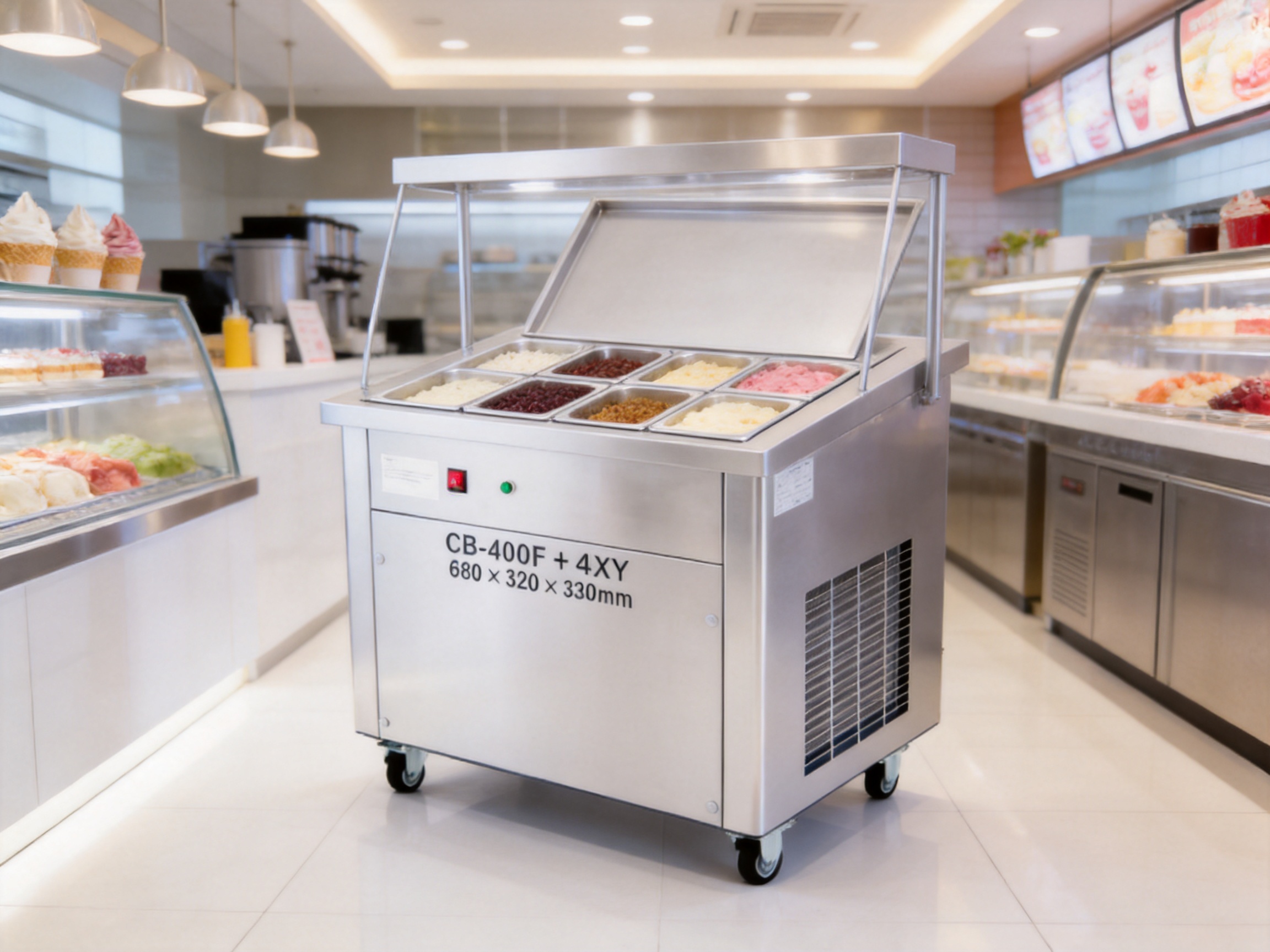
The Single Square Commercial Fried Ice Cream Roll Cart Machine with Four Tanks is designed to meet these needs in a compact commercial format. With one 40-centimeter square freezing pan and a four-compartment ingredient or storage layout, the machine provides a practical balance between product presentation, flavor flexibility, cooling performance, and mobility. Its model designation is CB-400F+4XY, and its 1,300-watt power system is intended for dependable operation in medium-volume foodservice environments.
Unlike large multi-pan systems designed for high-output factories or permanent dessert counters, this machine concentrates on flexibility and efficient use of space. It can be positioned in a snack shop, market stall, shopping-center kiosk, café, mobile food business, or event-service area. The cart-style configuration makes it easier to move, display, and integrate into a customer-facing service line.
The machine is supplied by Spelor Electrical Appliances (Zhejiang) Co., Ltd., a Chinese manufacturer specializing in commercial refrigeration, kitchen equipment, buffet equipment, and foodservice machinery. The company combines product design, research and development, manufacturing, sales, and after-sales service within its business structure. Its production capabilities support both standard products and OEM or ODM projects based on customer drawings, specifications, or market requirements.
This article examines the machine’s construction, operating value, refrigeration characteristics, four-tank layout, manufacturing strengths, customization potential, maintenance requirements, and suitability for different businesses. It also explains how buyers can compare this model with competing fried ice cream roll machines and how to evaluate the product before purchase.

Single Square Commercial Fried Ice Cream Roll Cart Machine with Four Tanks
Product Overview and Commercial Purpose
The machine is built around a single square freezing pan with a working size of 40 centimeters. This dimension gives the operator a useful preparation surface while keeping the overall footprint relatively compact. The square format is well suited to demonstrations because it provides visible working space for spreading liquid mix, incorporating fruit or toppings, creating a smooth frozen sheet, and forming multiple rolls.
The pan depth is listed as 2 centimeters. A shallow freezing surface is important for fried ice cream because the mix must be spread into a relatively thin layer to freeze quickly and scrape cleanly. A properly controlled thin layer can support faster service and more uniform roll formation than a deep vessel would provide. It also allows the operator to work directly in front of customers without requiring a large production area.
The four-compartment layout is one of the machine’s principal commercial advantages. The compartments can support the organized handling of different ingredients, sauces, toppings, or prepared mixes, depending on the operator’s workflow and local food-safety requirements. By keeping several ingredients within reach of the pan, the machine can reduce unnecessary movement and help employees create varied menu combinations more efficiently.
A single-pan design also simplifies the service process. The operator only needs to monitor one active freezing area, one main work surface, and one customer-facing preparation sequence. This can be easier to learn than a larger machine with several independent pans and multiple refrigeration controls. For businesses with a small team or limited training time, a straightforward layout can be an important operational benefit.
The machine’s overall dimensions are listed as 680 by 520 by 730 millimeters, and its net weight is approximately 50 kilograms. These dimensions make it suitable for businesses that need commercial functionality without dedicating an entire room or long counter to production. Although the unit is not a lightweight tabletop appliance, its size remains practical for a fixed kiosk, stall, shop counter, or carefully planned mobile service setup.
Key Technical Specifications
The following table summarizes the principal information provided for the CB-400F+4XY model.
| Specification | Stated Information |
|---|---|
| Product type | Single square commercial fried ice cream roll cart machine |
| Model | CB-400F+4XY |
| Freezing pan shape | Square |
| Pan size | 40 centimeters |
| Pan depth | 2 centimeters |
| Number of compartments | Four |
| Input power | 1,300 watts |
| Power supply | 220 volts, 50 hertz |
| Temperature range | -17°C to -20°C |
| Refrigerant information | R410 listed in one specification; R22/R404A listed in another |
| Compressor | Chinese compressor |
| Net weight | Approximately 50 kilograms |
| Machine dimensions | 680 × 520 × 730 millimeters |
Buyers should note that the supplied product information includes different refrigerant references: R410 appears in the specification section, while R22/R404A appears in the additional information section. Refrigerant selection can vary according to production configuration, market, electrical standard, and production date. Importers should confirm the exact refrigerant, compressor configuration, labeling, and compliance documentation with the manufacturer before placing an order.
Advantages of the Single Square Configuration
Efficient Use of Counter and Floor Space
One of the clearest advantages of a single square machine is its compact operating footprint. Many independent food businesses cannot accommodate a large multi-pan machine. A smaller unit allows the operator to preserve space for payment equipment, ingredient storage, packaging, display boards, or customer queuing.
The dimensions of 680 by 520 millimeters provide a manageable rectangular footprint, while the 730-millimeter height supports a comfortable working position for many operators. The design can be placed in a dedicated counter area or incorporated into a cart-style presentation. This is especially useful in commercial environments where every square meter affects rent, customer flow, and sales capacity.
Compared with oversized systems, the single-pan configuration can also simplify transport and installation. It may be more practical for businesses that relocate equipment between seasonal sites, festivals, fairs, markets, or promotional events. Operators should still consider the 50-kilogram net weight and use appropriate handling equipment, but the overall format is more manageable than a large industrial unit.
Balanced Output for Medium-Volume Operations
The machine is intended for medium-volume production rather than continuous factory-scale manufacturing. This positioning is valuable because many dessert businesses experience variable demand. During ordinary periods, a single pan can support regular service without excessive equipment capacity. During peak periods, the visible preparation process can help organize customer expectations and encourage additional purchases.
A machine that is too large for the business may create unnecessary electricity consumption, occupy valuable floor space, and require more extensive cleaning and maintenance. A machine that is too small may produce long waiting times and inconsistent results. The single 40-centimeter square pan provides an intermediate solution for operators who need commercial performance but do not require multiple simultaneous preparation zones.
Strong Product Presentation
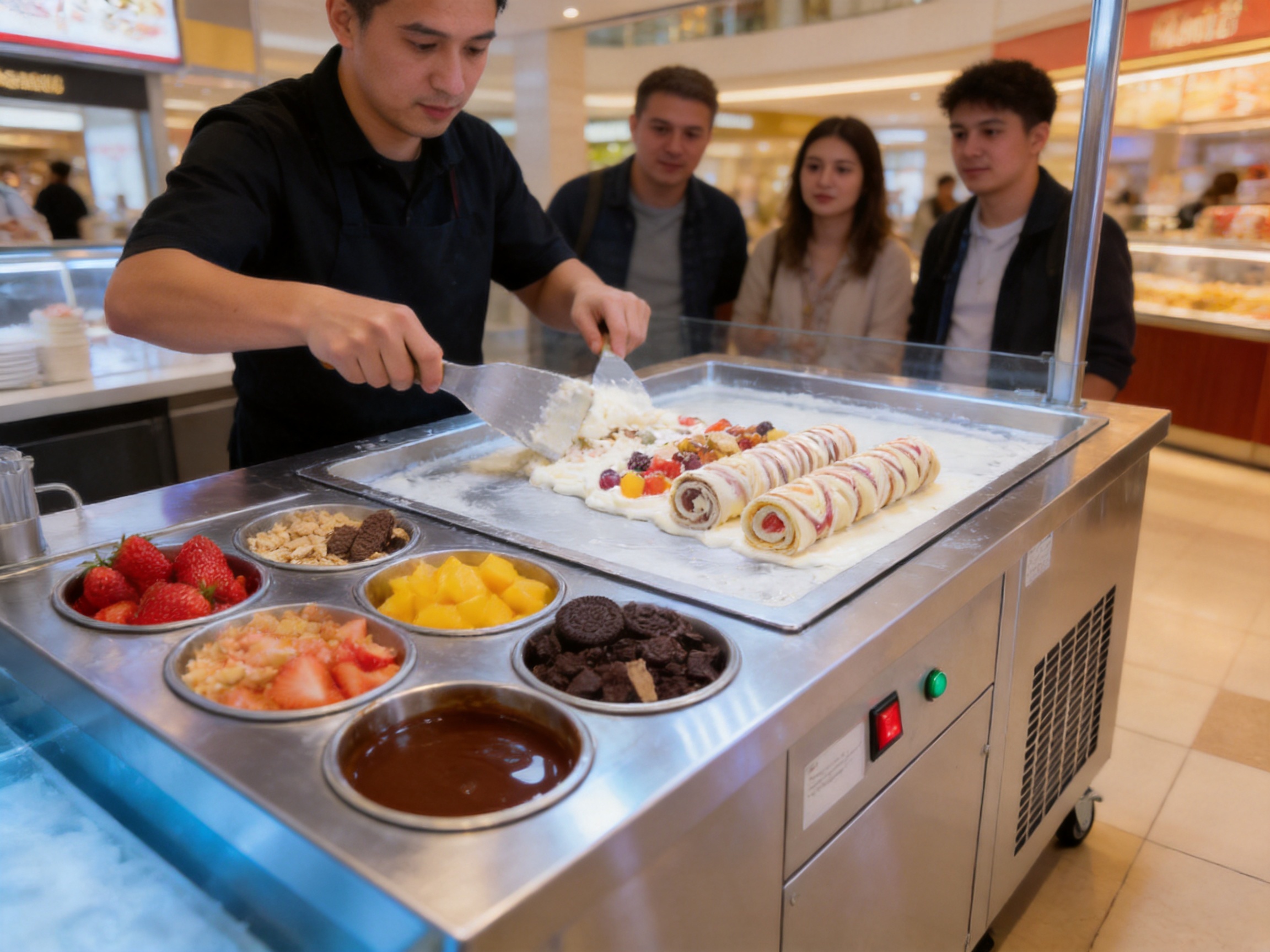
Fried ice cream is a visual product. Customers enjoy seeing the mixture spread, freeze, mix, and roll. The square pan offers a clear, open work surface that makes the process easy to observe. This can turn dessert preparation into an attraction and help distinguish the business from operators selling prepackaged frozen products.
The cart-style format can position the preparation area close to the customer. In a market stall or kiosk, this can support impulse purchases. In a café or snack shop, the machine can serve as both production equipment and a visual merchandising element. The operator can display menu combinations, demonstrate ingredient additions, and make the finished product directly in front of the buyer.
Organized Four-Compartment Workflow
The four-compartment layout helps create a more orderly preparation sequence. An operator may assign separate compartments to fruit, cookies, sauces, nuts, candy, flavor ingredients, or prepared bases. This arrangement reduces the need to repeatedly turn away from the pan or search through separate containers.
Good organization can improve consistency. When ingredients are stored in designated positions, employees are more likely to follow standardized recipes. This helps control portion sizes, reduce waste, and maintain a consistent customer experience. It may also make staff training easier because the work area has a predictable arrangement.
The compartments are not a substitute for proper food storage. Perishable ingredients must be handled according to applicable food-safety regulations, and operators should determine whether additional refrigerated storage, covered containers, or temperature monitoring is required. Nevertheless, the integrated layout provides a useful starting point for efficient ingredient organization.
Cooling Performance and Temperature Control
The product information identifies an operating temperature range of approximately -17°C to -20°C. This range is appropriate for a cold preparation surface intended to freeze liquid dessert mixtures quickly. Actual freezing speed depends on several factors, including ambient temperature, mix composition, sugar content, portion size, pan loading, compressor condition, ventilation, and the time between production cycles.
Rapid cooling is important for both productivity and texture. If the pan is not cold enough, the mixture may remain soft for too long, making it difficult to form clean rolls. Excessively slow freezing can also increase customer waiting time and encourage the operator to scrape before the product has reached a suitable consistency. Consistent cooling allows the worker to focus on recipe execution rather than compensating for unstable temperatures.
Even mixing is another stated benefit of the model. The square surface gives the operator room to distribute ingredients across the mixture. A flat, accessible pan can support more controlled spreading than a deep or irregular work area. When the operator uses suitable tools and standardized portions, the result can be a more uniform product with balanced flavor throughout each roll.
The listed input power is 1,300 watts. This rating indicates the electrical input required by the machine under its specified operating conditions. Before installation, buyers should verify that the local power supply is compatible with 220 volts and 50 hertz. Electrical protection, grounding, plug configuration, circuit capacity, and local certification should also be checked for the destination market.
Proper ventilation is essential for refrigeration equipment. The machine should not be placed tightly against walls or other heat-producing equipment unless the manufacturer’s installation instructions permit it. Airflow around the refrigeration system helps support efficient heat rejection and may reduce unnecessary strain on the compressor.
Comparison with Other Fried Ice Cream Machines
Compared with Tabletop Consumer Units
Consumer-oriented tabletop appliances may be less expensive and lighter, but they are generally designed for occasional or low-volume use. They may have smaller working surfaces, less robust refrigeration components, limited ingredient organization, and weaker support for continuous commercial service. The CB-400F+4XY is positioned as commercial equipment with a larger 40-centimeter pan, 1,300-watt input, and a 50-kilogram structure.
For a business serving customers throughout the day, a commercial configuration is often preferable because it is designed around workflow, durability, display, and repeatable operation. The larger pan can support more practical preparation space, while the four-compartment arrangement reduces the need for separate ingredient furniture.
Compared with Double-Pan Machines
Double-pan machines can produce more portions simultaneously, which may be helpful for high-volume locations. However, they normally require more floor space, may cost more to purchase, and can demand greater electrical capacity. They may also require operators to monitor two separate preparation areas.
The single-pan machine has a different competitive advantage: it focuses on space efficiency and operational simplicity. For a snack shop, small kiosk, or start-up business, the ability to purchase a commercial machine without committing to the cost and footprint of a double-pan system can improve investment flexibility.
Businesses should match capacity to demand. A high-traffic chain location may eventually require several pans or multiple machines, while an independent stall may benefit more from compactness and lower complexity. The single-square format is particularly suitable when customer engagement and moderate output are more important than maximum simultaneous production.
Compared with Round-Pan Designs
Round pans can provide a distinctive appearance, but square pans often make better use of available counter geometry. A square 40-centimeter surface gives the operator defined edges and corners for ingredient placement, scraping, and portion organization. It can also fit more naturally into a rectangular cart or straight service counter.
The choice between square and round should depend on the intended menu, shop layout, and visual identity. The square format of this model is practical for operators who value predictable working boundaries and an efficient relationship between the pan and the surrounding compartments.
Compared with Large Industrial Systems
Industrial fried ice cream systems are designed for substantially higher output and may include multiple freezing drums, automated controls, advanced storage systems, or integrated production lines. Such equipment can be excessive for a small or medium retail operation. It may involve higher investment, complex installation, greater energy requirements, and more specialized maintenance.
The CB-400F+4XY offers a more accessible entry point into commercial fried ice cream service. It delivers a professional work surface and refrigeration system while remaining compact enough for many retail environments. This balance can help businesses test a new dessert concept, expand an existing menu, or add a live-preparation feature without restructuring the entire premises.
| Evaluation Area | Single Square Four-Compartment Machine | Typical Larger Multi-Pan System |
|---|---|---|
| Space requirement | Compact and suitable for small or medium premises | Higher floor and counter-space demand |
| Operator training | One main pan and straightforward workflow | Multiple pans and more complex coordination |
| Output potential | Suitable for medium-volume service | Suitable for higher-volume simultaneous production |
| Ingredient organization | Four integrated compartments | May require separate storage or larger integrated systems |
| Mobility | More practical for carts, kiosks, and events | Often more difficult to relocate |
| Investment approach | Balanced entry-level commercial investment | Higher capital commitment |
Manufacturing Strengths Behind the Product
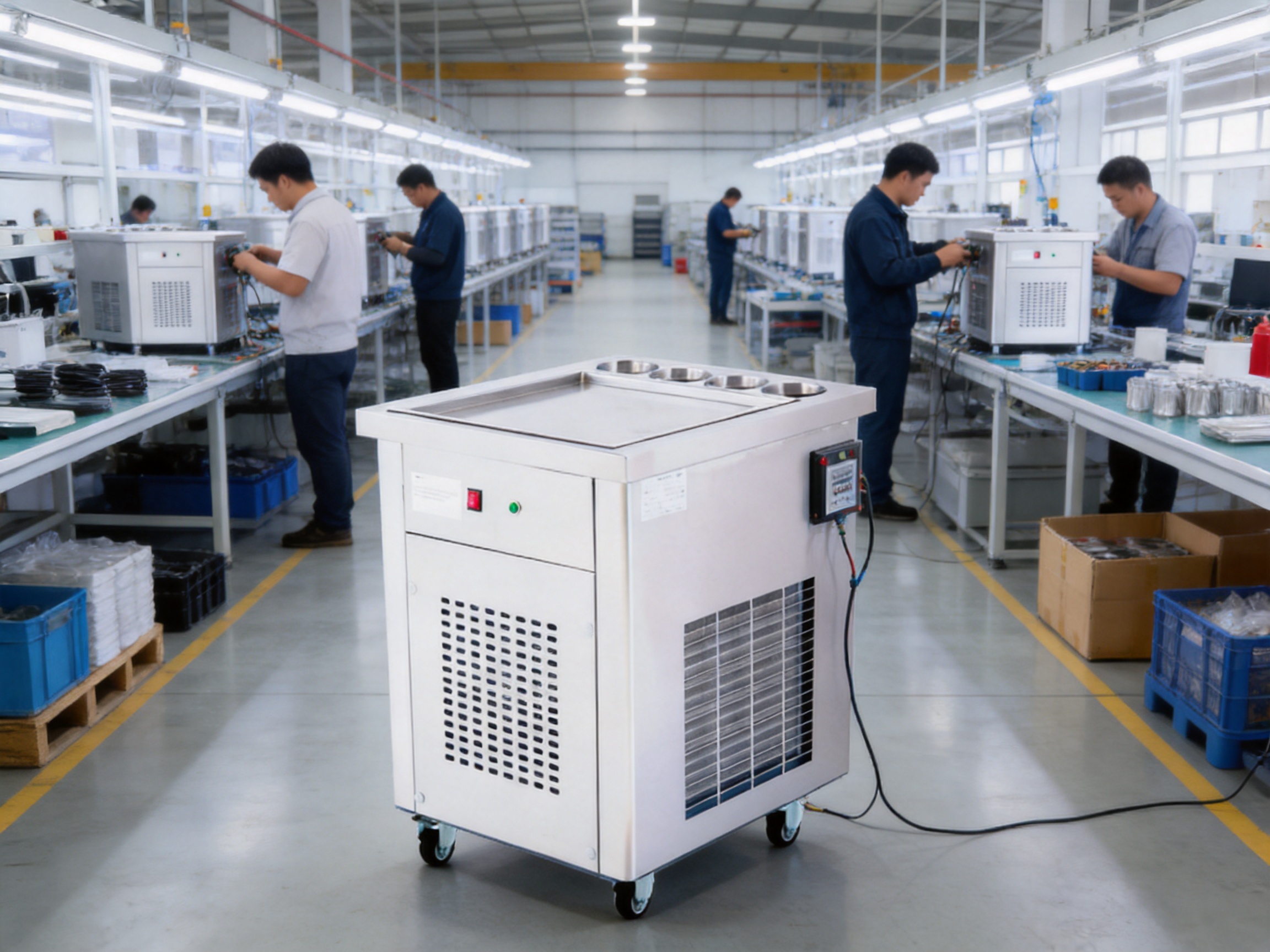
Product performance depends not only on the visible pan and cart structure, but also on the manufacturer’s production system. Spelor Electrical Appliances (Zhejiang) Co., Ltd. is described as a professional manufacturer integrating design, research and development, manufacturing, sales, and service. This integrated structure can support better coordination between product engineering, production planning, quality control, logistics, and customer support.
The company operates more than 60,000 square meters of modern production facilities. A facility of this scale can support organized production areas, component preparation, assembly, testing, warehousing, and finished-goods handling. For international buyers, manufacturing scale may also provide greater capacity for repeat orders, project-based procurement, and OEM or ODM cooperation.
The product range includes commercial refrigeration equipment, ice cream machines, juice dispensers, fried ice cream machines, refrigeration cabinets, slush machines, flake ice machines, cooking equipment, griddles, fryers, insulation products, barbecue equipment, and buffet solutions. This breadth is valuable for distributors and foodservice contractors seeking to source several categories from one supplier.
A broad product portfolio can also encourage useful engineering knowledge across related equipment categories. Refrigeration design, cabinet construction, temperature control, compressor integration, electrical protection, and commercial cleaning requirements are relevant to many products in the manufacturer’s range. Experience across these areas can support practical design decisions in a fried ice cream roll machine.
Design and Research Capability
Design and research are essential when developing equipment for live food preparation. The machine must balance cooling requirements with ergonomics, pan accessibility, cart dimensions, ingredient placement, electrical safety, cleaning access, and visual presentation. A manufacturer with internal design and development functions can coordinate these factors instead of treating the product as a collection of unrelated components.
For OEM and ODM customers, design capability is particularly important. A buyer may require a different logo position, control-panel arrangement, voltage configuration, exterior finish, packaging method, pan dimension, compartment layout, or documentation package. Engineering support can help translate those requirements into a production-ready solution.
Production and Assembly
Commercial refrigeration equipment typically requires several coordinated assembly stages. These may include cabinet preparation, pan installation, refrigeration-system assembly, electrical wiring, component fitting, insulation work, control installation, exterior finishing, and final inspection. Each stage affects the reliability and serviceability of the finished machine.
Consistent assembly is important for maintaining the relationship between the cooling system and the freezing pan. Poorly fitted components can contribute to uneven cooling, vibration, heat loss, electrical faults, or difficult maintenance. Organized production procedures and inspection points help reduce these risks.
For international orders, repeatability is also critical. Distributors need products that remain consistent across batches so that installation, marketing, spare-parts planning, and after-sales support can be standardized. A manufacturer with established production resources is better positioned to support this consistency than an informal workshop with limited process control.
Quality and Functional Testing
Functional testing is especially important for refrigeration equipment. A suitable testing program may include electrical inspection, compressor operation, cooling performance, temperature stability, control response, structural checks, and visual inspection. The precise testing protocol should be confirmed with the supplier, but buyers should expect commercial equipment to be tested before shipment.
Testing should also consider the machine’s intended working environment. A unit destined for a warm market stall may experience higher ambient temperatures than one installed in an air-conditioned café. Buyers should provide accurate destination information and ask about recommended operating conditions, ventilation clearance, packaging, and transport protection.
OEM and ODM Cooperation
The company’s stated SEO and business information emphasizes OEM and ODM foodservice equipment supply based on drawings or customer requirements. This can benefit importers, distributors, chain restaurants, and project contractors that need equipment adapted to a specific market or brand system.
OEM cooperation may involve manufacturing a standard or modified product under the buyer’s brand. Possible elements include exterior labeling, control-panel graphics, product identification plates, packaging design, user manuals, and marketing materials. ODM cooperation may involve a deeper level of product adaptation, such as changes to dimensions, pan specifications, compartment configuration, electrical standards, or operating features.
Customization should be managed through a clear technical specification. Buyers should document the required voltage, frequency, plug type, refrigerant, compressor expectations, temperature range, pan size, exterior material, color, wheel or cart requirements, packaging, certifications, and spare parts. A written specification reduces misunderstandings and creates a reference for sample approval and mass production.
For large orders, it is advisable to request a pre-production sample or approved reference unit. The sample can be evaluated for cooling speed, pan uniformity, physical appearance, controls, noise, mobility, packaging, and cleaning access. Any changes should be recorded before production begins.
Business Applications
Snack Shops and Dessert Counters
Snack shops can use the machine to add a visually engaging dessert category without requiring extensive kitchen reconstruction. The operator can place it near the front counter, where customers can observe production and select toppings. The four compartments support a menu with several combinations while keeping the working area organized.
A small dessert menu may include classic vanilla, chocolate, mango, strawberry, cookie, banana, coffee, and mixed-fruit options. Operators can also adapt the menu to local preferences, seasonal ingredients, or dietary requirements. The machine itself does not determine the recipe; it provides a controlled frozen surface for creating the finished product.
Market Stalls and Food Carts
The cart-style design is appropriate for market stalls and mobile food businesses that need a recognizable, customer-facing machine. In these environments, the visual process can be a major part of the sales proposition. The compact footprint allows the operator to combine the machine with a small topping display, menu board, payment station, and takeaway packaging area.
Mobility should be planned carefully. At approximately 50 kilograms, the machine may require two-person handling or a suitable trolley when being transported. The operating location should have a stable, level surface, reliable power, weather protection, and sufficient ventilation. Outdoor operators should also protect the equipment from rain, dust, direct sunlight, and extreme ambient conditions.
Cafés and Fast-Food Locations
Cafés and fast-food outlets can use fried ice cream rolls as an add-on product. The machine can be scheduled for peak afternoon, evening, or weekend periods rather than operated continuously throughout the day. This approach may help businesses control labor and energy use while still offering an attractive specialty item.
In a fast-food environment, standardized recipes and portion control are essential. Employees should be trained to prepare the pan, add the correct quantity of mix, distribute ingredients evenly, freeze the mixture adequately, scrape consistent rolls, and clean the work surface between recipes where required.
Events and Promotional Activations
Live fried ice cream preparation can attract attention at exhibitions, festivals, shopping-center promotions, school events, corporate gatherings, and private functions. The square pan creates a clear demonstration area, and the four compartments permit a range of visible ingredients.
Event operators should confirm electrical availability in advance. They should also prepare a transport plan, ingredient storage system, handwashing arrangements, waste collection process, food-contact utensils, and sufficient serving materials. The machine can support event service effectively, but the surrounding foodservice system determines the overall customer experience.
Operating Workflow
A consistent operating routine helps achieve better product quality and protects the equipment. Before service, the operator should inspect the machine, confirm that the pan is clean and dry, check the electrical connection, verify ventilation clearance, and ensure that ingredients are prepared and stored appropriately.
The machine should be started with adequate time for the pan to reach its operating temperature. The exact pre-cooling period depends on ambient conditions and manufacturer instructions. Operators should avoid judging readiness only by appearance; a thermometer or built-in temperature display, if provided, can help confirm operating conditions.
Once the pan is sufficiently cold, the operator can pour a controlled amount of dessert mixture onto the surface. The quantity should be appropriate for the 40-centimeter pan and the desired thickness. Overloading may slow freezing and produce uneven texture, while using too little mixture may make scraping and rolling difficult.
Ingredients should be added according to standardized recipes. The operator can use suitable spatulas to mix, spread, and level the product. The goal is to create an even sheet with a consistent thickness. When the mixture has frozen to the desired texture, the operator can divide the sheet and scrape it into rolls.
Finished rolls should be placed in clean serving containers and topped according to the customer’s order. The work area should then be prepared for the next serving. If ingredients contain allergens, the operator should follow the business’s allergen-control procedures and use separate utensils or cleaning protocols where necessary.
Cleaning, Maintenance, and Serviceability
Daily cleaning is essential for any machine used in direct food preparation. At the end of service, the operator should remove remaining ingredients, disconnect the equipment according to the manufacturer’s procedure, and clean the food-contact surface with approved materials. Abrasive tools or harsh chemicals that may damage the pan surface should be avoided unless specifically permitted.
The four compartments should also be emptied, washed, sanitized, and dried as required. Food residue left in ingredient areas can create hygiene problems and may affect the taste or appearance of later products. Removable containers should be checked for cracks, deformation, or damaged edges.
The exterior should be wiped regularly to maintain presentation. A clean machine is part of the customer experience, particularly when the equipment is positioned in a highly visible location. Operators should pay attention to handles, edges, control areas, cart surfaces, and areas around the refrigeration vents.
Ventilation openings should remain free of dust and obstructions. Restricted airflow can increase refrigeration-system workload and may reduce cooling performance. A scheduled inspection should include the power cord, plug, switches, controls, fasteners, pan surface, wheels or supports, and visible refrigeration components.
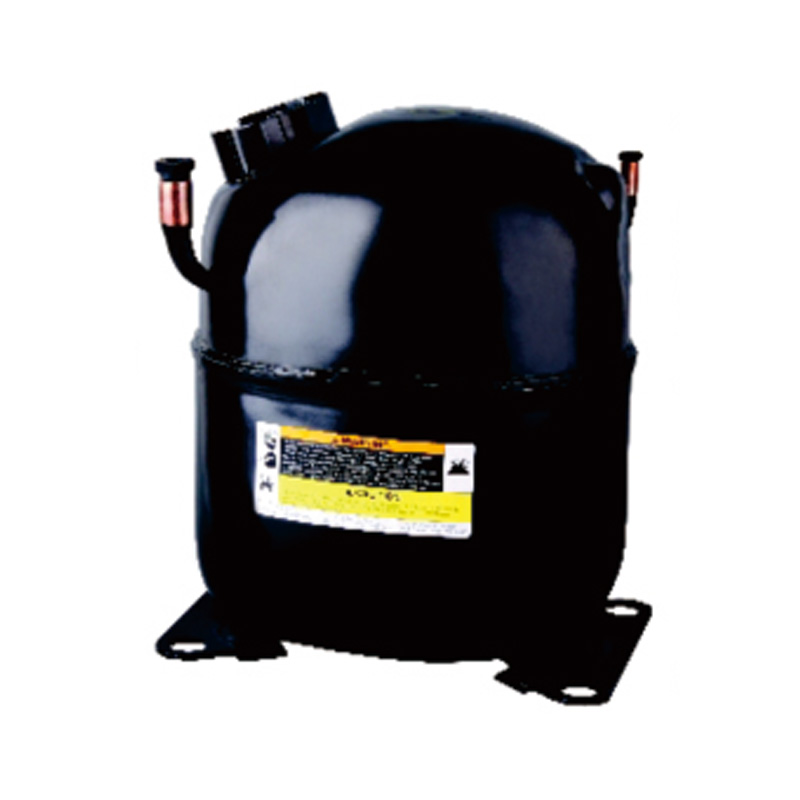
Because the product uses a refrigeration system and compressor, service should be performed by qualified technicians when a fault involves refrigerant, sealed-system components, electrical wiring, or compressor replacement. Operators should not attempt to release, recover, or recharge refrigerant without appropriate training and equipment.
The refrigerant discrepancy in the supplied information makes documentation particularly important. Before maintenance or importation, the exact refrigerant must be confirmed from the nameplate, purchase specification, or manufacturer’s technical documentation. Using an incorrect refrigerant can damage the system, create safety risks, and compromise regulatory compliance.
Installation and Purchasing Considerations
Before ordering, buyers should confirm that the machine’s electrical requirements match the destination market. The listed power supply is 220 volts and 50 hertz. Some regions use different voltage or frequency standards, and a machine configured for one electrical system may not operate correctly on another without an approved adaptation.
The buyer should also assess the installation location. The space must allow the operator to work comfortably around the 40-centimeter pan and access the four compartments. There should be enough clearance for ventilation, cleaning, loading ingredients, customer service, and maintenance. The floor or counter must support a machine weighing approximately 50 kilograms.
Importers should request product drawings, packing dimensions, gross weight, loading information, spare-parts recommendations, and electrical documentation. These details assist with freight planning and customs preparation. If the equipment will be sold commercially in another country, the buyer should identify all required safety, electromagnetic compatibility, food-contact, and refrigeration regulations before shipment.
Packaging is important because the machine contains a precision freezing pan, refrigeration components, electrical controls, and exterior panels. Buyers should ask how the unit is protected against impact, moisture, vibration, and tilting during transport. After delivery, the equipment may need to remain upright for a specified period before operation, depending on transport conditions and manufacturer guidance.
Commercial buyers should also evaluate the supplier’s spare-parts and after-sales policy. Useful questions include whether replacement controls, switches, thermostats, compressors, fan components, seals, containers, and electrical parts are available; how long parts remain supported; whether manuals are supplied; and whether remote troubleshooting or technician assistance is provided.
Why Manufacturer Support Matters
Equipment procurement does not end when the machine arrives. A foodservice operator needs support during installation, recipe testing, employee training, maintenance, and future expansion. Spelor describes its service structure as including pre-sales consultation, product customization, flexible logistics and payment solutions, and after-sales maintenance.
Pre-sales consultation can help buyers select a suitable configuration for their expected volume, location, electrical system, and menu. This is particularly useful for first-time operators who may not know whether a single pan, double pan, or larger system is appropriate.
Customization support can help distributors create a more relevant product for their target market. For example, a buyer may need a particular exterior color, language on controls, packaging style, or documentation format. These details can be important when introducing equipment under a private label or building a consistent store design.
After-sales assistance can reduce downtime. A machine that is temporarily unavailable may affect dessert sales, customer satisfaction, and staff scheduling. Clear troubleshooting guidance, access to spare parts, and communication with technical personnel can help operators resolve routine issues more efficiently.
The manufacturer’s product range also creates opportunities for one-stop procurement. A customer developing a complete snack shop may need fried ice cream equipment, juice dispensers, slush machines, ice machines, refrigeration cabinets, cooking equipment, or buffet products. Sourcing related products from one established supplier can simplify coordination, documentation, shipping, and future service.
Quality, Efficiency, and Long-Term Value
The value of a commercial machine should not be judged only by its purchase price. A more useful assessment considers the relationship between capacity, space, labor, energy, product quality, maintenance, and expected service life. The CB-400F+4XY is designed to deliver a practical commercial function without the scale and complexity of a large production system.
Its single pan can help reduce training complexity. Employees only need to learn one primary preparation process, and managers can standardize recipes around one work surface. The four compartments can reduce ingredient-search time and make the service station more organized. These operational details may contribute to faster service and lower waste over the life of the equipment.
The compact format can also improve space utilization. A business may be able to place the machine in an existing shop area rather than rent additional space or redesign a complete kitchen. In a kiosk or market stall, the ability to combine refrigeration, preparation, ingredient access, and customer presentation in one unit can be particularly valuable.
Product consistency is another part of long-term value. A stable freezing surface supports repeatable preparation, while a standardized pan size helps employees produce portions with similar appearance. Consistent presentation can strengthen customer trust and make menu pricing easier to manage.
However, performance depends on correct use. Operators should not exceed the intended workload, block ventilation, neglect cleaning, use unsuitable tools, or operate the unit on an incorrect power supply. Proper installation and regular maintenance are necessary to realize the machine’s commercial advantages.
Recommended Customer Profiles
This machine is a strong candidate for small and medium-sized snack businesses that want a live dessert station. It is also suitable for entrepreneurs testing a new concept, distributors seeking a compact commercial model, and foodservice operators that need a mobile or semi-mobile display unit.
It may be especially appropriate for businesses with the following characteristics:
• The business expects medium-volume rather than factory-scale output.
• The available installation area is limited.
• Customer-facing preparation is part of the sales strategy.
• Several flavors or toppings must remain accessible during service.
• The operator values a simple single-pan workflow.
• The business needs equipment that can be integrated into a cart, kiosk, or compact counter.
• The buyer may require OEM or ODM adaptation for a local market.
Businesses expecting extremely high throughput should compare this model with multi-pan or automated alternatives. Similarly, operators located in regions with different electrical or refrigerant requirements should confirm a compliant configuration before purchase.
Frequently Asked Questions
What type of business is this machine designed for?
It is designed for commercial foodservice applications such as snack shops, dessert counters, market stalls, cafés, fast-food locations, shopping-center kiosks, mobile food operations, and event service. Its single pan and medium-volume positioning make it more suitable for compact retail operations than for large industrial production.
How large is the freezing pan?
The pan is square and measures approximately 40 centimeters. Its listed depth is 2 centimeters. The shallow, open surface supports the preparation of thin frozen sheets that can be mixed and scraped into rolls.
What is the electrical requirement?
The supplied information lists a power supply of 220 volts and 50 hertz, with an input power of 1,300 watts. Buyers must verify compatibility with their local electrical system and confirm the exact configuration with the manufacturer before installation.
What temperature does the machine reach?
The stated operating range is approximately -17°C to -20°C. Actual performance may vary according to ambient temperature, mix formulation, loading quantity, ventilation, and maintenance condition.
What is the benefit of the four compartments?
The four compartments help organize ingredients, toppings, sauces, or prepared components near the freezing pan. This can reduce movement during service, improve recipe consistency, and support a broader menu. Food-safety procedures must determine how ingredients are stored and whether additional refrigeration is required.
Is the machine easy to move?
The compact cart-style format is more mobile than many large multi-pan systems. However, the machine weighs approximately 50 kilograms, so safe handling equipment or two-person lifting may be required. The unit should be moved on a stable route and installed on a level surface.
What refrigerant does the machine use?
The supplied materials contain two refrigerant references: R410 in the specification section and R22/R404A in the additional information section. The exact refrigerant should be confirmed from the machine nameplate and final technical documents before purchase, importation, installation, or service.
Can the product be customized?
The manufacturer states that it offers OEM and ODM solutions based on drawings or customer requirements. Potential customization may include branding, appearance, electrical configuration, packaging, documentation, and certain structural or functional details. All requirements should be agreed in a written specification.
Does the machine require professional installation?
Basic placement and electrical connection should follow the manufacturer’s instructions, while refrigerant, sealed-system, and electrical repairs should be handled by qualified technicians. Buyers should confirm installation requirements, ventilation clearances, grounding, and local compliance obligations.
How should the pan be cleaned?
The pan should be cleaned after service using food-safe methods recommended by the manufacturer. Operators should remove residue, avoid damaging tools or chemicals, and ensure that the surface is dry before the next use. Cleaning procedures should be adapted to local hygiene regulations and the ingredients served.
What information should an importer request?
An importer should request the final specification sheet, electrical details, refrigerant confirmation, product drawings, packing dimensions, gross weight, user manual, spare-parts list, warranty terms, compliance documents, and recommended maintenance procedures. These documents support purchasing, installation, customs clearance, and after-sales planning.
Conclusion
The Single Square Commercial Fried Ice Cream Roll Cart Machine with Four Tanks is a practical solution for businesses that want to offer freshly prepared rolled ice cream in a compact commercial format. Its 40-centimeter square pan provides a visible and accessible preparation surface, while the four-compartment layout supports organized ingredient handling and menu variety.
With 1,300 watts of input power, a stated operating range of -17°C to -20°C, a 50-kilogram net weight, and dimensions of 680 by 520 by 730 millimeters, the machine is positioned for medium-volume foodservice operations. Its key strengths include space efficiency, simple single-pan operation, customer-facing presentation, ingredient organization, and suitability for snack shops, stalls, cafés, kiosks, and events.
Compared with consumer tabletop appliances, it offers a more commercial-oriented structure and working area. Compared with larger multi-pan machines, it can require less space, lower investment, and simpler staff training. These advantages make it a useful choice for operators who need a balance between visual appeal, production capability, and practical installation.
The manufacturer adds value through integrated design, research and development, manufacturing, sales, and service capabilities. Its more than 60,000-square-meter production base and broad foodservice equipment portfolio support standard procurement, OEM projects, ODM development, and complete equipment sourcing.
Buyers should confirm the exact refrigerant, electrical configuration, certification requirements, installation conditions, warranty policy, and spare-parts availability before ordering. With correct specification, careful installation, disciplined cleaning, and appropriate operator training, this machine can become an efficient centerpiece for a profitable fried ice cream dessert program.
References
1. Product specification sheet for CB-400F+4XY, Single Square Commercial Fried Ice Cream Roll Cart Machine with Four Tanks.
2. Manufacturer-provided technical information covering power supply, temperature range, dimensions, weight, and refrigeration details.
3. Manufacturer company profile for Spelor Electrical Appliances (Zhejiang) Co., Ltd.
4. General principles of commercial refrigeration equipment operation, ventilation, electrical installation, and preventive maintenance.
5. General foodservice hygiene practices for food-contact surfaces, ingredient storage, allergen control, and equipment sanitation.
Product: Single Square Commercial Fried Ice Cream Roll Cart Machine with Four Tanks

For exclusive deals and latest offers, sign up by entering your email address below.




-
spelor@spelor.com
-
+86-576-85229688
-
No.528, Changxi Road, Linhai City, Zhejiang Province, China
Commercial Refrigeration Equipment Manufacturer China
Copyright © 2025 by Spelor Electrical Appliances (Zhejiang) Co., Ltd. Rights Reserved.
