


 中文简体
Big and Small Plastic Water Receiver Basin Trays for Commercial Beverage Coolers
Admin 2026-09-05In commercial foodservice environments, small accessories often have a major influence on cleanliness, operating efficiency, and equipment longevity. A water receiver basin tray is one such component. Positioned beneath or inside a beverage cooler, this tray collects condensation, splashed liquid, and occasional drainage water before it reaches the floor, countertop, cabinet base, or surrounding electrical components. Although simple in appearance, a properly designed plastic water receiver basin tray helps maintain a safer, cleaner, and more professional working environment.
Big and small plastic water receiver basin trays are designed for beverage coolers and related commercial refrigeration equipment that require dependable liquid collection. They are available in different sizes to accommodate varying cabinet structures, cooler dimensions, drainage arrangements, and installation spaces. Because they are designed as optional components and spare parts, they can support equipment maintenance, replacement programs, service operations, and customized procurement.
The trays are not sold separately as ordinary standalone consumer products. Instead, they are intended to be supplied as compatible accessories or replacement components for suitable commercial equipment. This approach allows distributors, equipment operators, maintenance teams, and original equipment customers to obtain the correct tray as part of a broader equipment solution.
For foodservice businesses, the value of these trays extends beyond collecting water. They contribute to improved hygiene, easier cleaning, reduced floor maintenance, and more orderly equipment operation. When combined with disciplined manufacturing processes, durable materials, dimensional control, and responsive technical support, they become a practical part of a complete commercial refrigeration system.

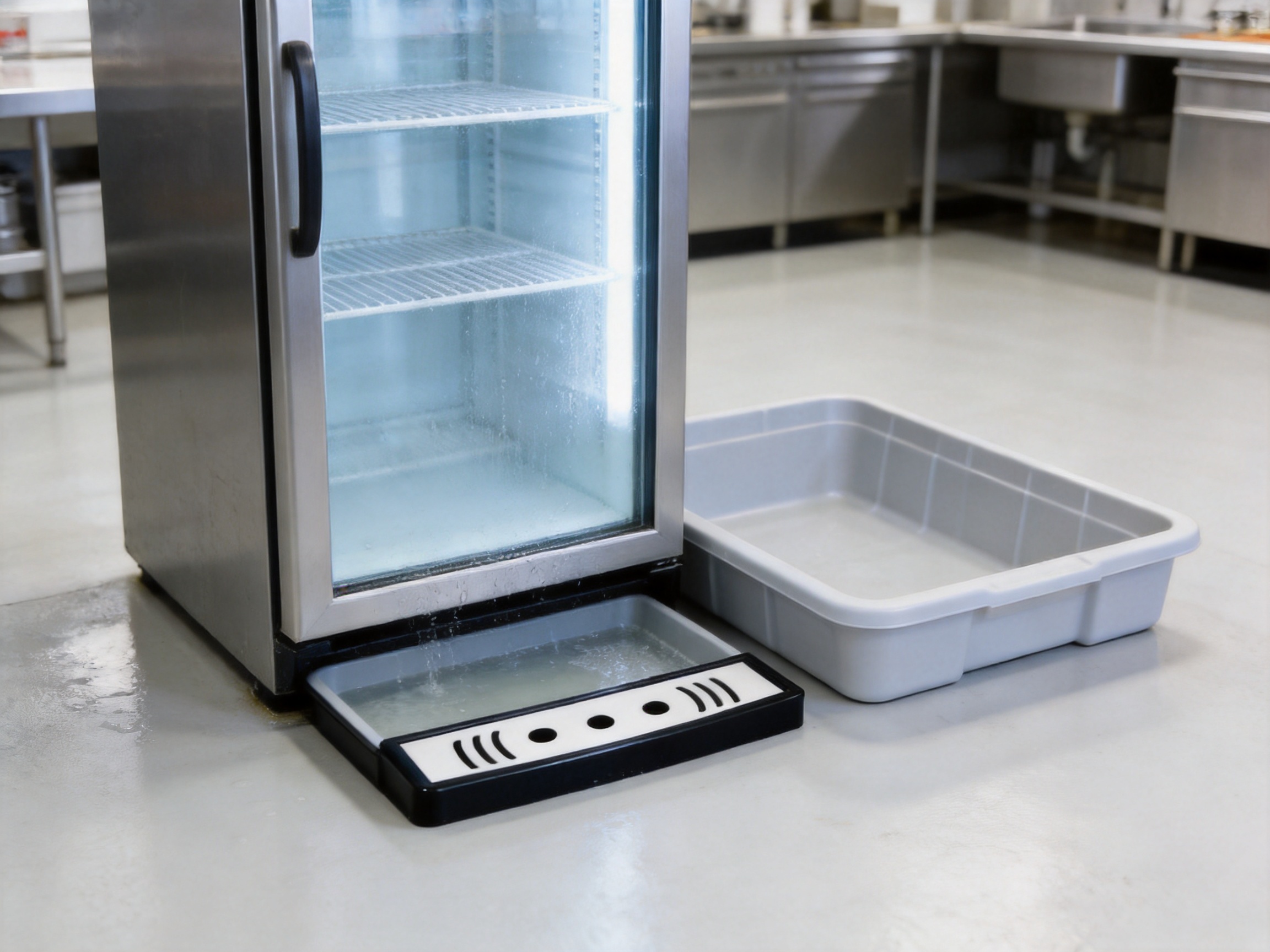
Big/Small Plastic Water Receiver Basin Trays(Not sold separately)
Understanding the Function of a Water Receiver Basin Tray
Commercial beverage coolers regularly encounter moisture. Condensation can form when warm and humid air meets cold internal surfaces. Opening and closing the door or cabinet may introduce additional humidity. Bottles, cans, containers, and drink dispensers can also create small spills during loading and service. In some equipment designs, defrost water or drainage liquid may need to be directed toward a collection point.
Without an appropriate receiver basin tray, liquid may drip directly onto the floor or countertop. Even a small amount of water can create several operational problems. It may produce slippery conditions, stain nearby surfaces, damage flooring materials, encourage unpleasant odors, or require staff to interrupt their work for repeated cleaning. If the liquid reaches electrical connections, cabinet insulation, structural joints, or other sensitive parts, it may also contribute to premature deterioration.
A plastic water receiver basin tray provides a defined collection area. Its raised edges help contain liquid, while its shape allows the tray to fit into a designated location beneath or within the cooler. Once collected, the liquid can be removed through routine cleaning or managed according to the equipment’s drainage design.
The tray also helps create a more predictable maintenance routine. Instead of searching for the source of water across the floor or cabinet exterior, an operator can inspect a known collection area. This simplifies daily checks and makes it easier to identify unusual amounts of water that may indicate a blocked drain, damaged seal, poor leveling, or another service issue.
Primary Operating Functions
The first function is liquid containment. The tray receives condensation and other non-pressure drainage liquids and keeps them within a controlled boundary. Its second function is surface protection. By preventing water from reaching the supporting surface, the tray helps reduce staining, swelling, corrosion, and other forms of damage associated with repeated moisture exposure.
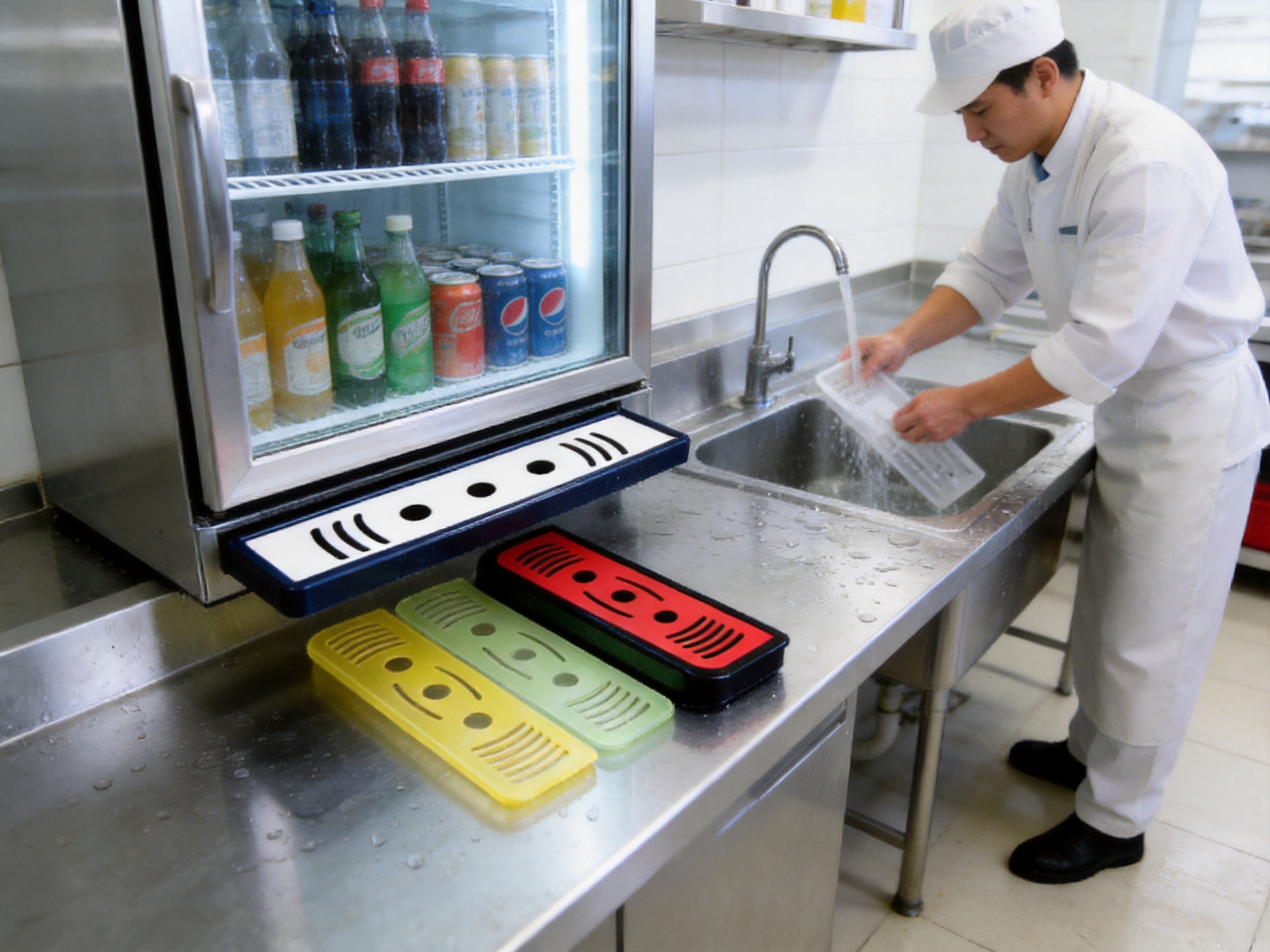
The third function is hygiene support. A removable plastic tray can generally be taken out, emptied, washed, and returned to service more easily than a permanently integrated collection area. This supports cleaning schedules in restaurants, cafés, bars, supermarkets, institutional kitchens, snack shops, and other busy locations.
The fourth function is equipment preservation. By directing water away from cabinet joints, base panels, and nearby components, the tray can help reduce the effects of long-term moisture exposure. It is not a substitute for correct refrigeration maintenance, but it is an important part of a well-designed moisture-management system.
Why Plastic Is a Practical Material for Receiver Trays
Plastic is widely used for receiver trays because it offers a useful combination of low weight, corrosion resistance, cleanability, and manufacturing flexibility. Unlike untreated metal, plastic does not rust when exposed to water during normal use. This is particularly valuable in beverage service environments where the tray may experience repeated contact with condensation, spilled drinks, cleaning water, and mild food residues.
A plastic tray is also light enough to remove during cleaning without adding unnecessary handling difficulty. This matters in commercial settings where staff may need to inspect several pieces of equipment during a shift. A lighter accessory can reduce strain and make routine maintenance faster.
Plastic manufacturing allows designers to create rounded corners, raised edges, formed channels, and other practical features within a single component. Smooth or semi-smooth surfaces can reduce the number of locations where residue accumulates. Rounded internal corners are especially helpful because they are easier to wipe and rinse than sharp internal angles.
Another benefit is dimensional adaptability. Plastic components can be produced in different lengths, widths, depths, profiles, and mounting arrangements. This makes it possible to provide big and small tray options for different beverage cooler models. A tray intended for a compact countertop cooler may require a different footprint from one used in a larger commercial cabinet.
Plastic also supports cost-effective replacement. Since a receiver tray is a service accessory rather than the primary refrigeration system, it should be durable without adding unnecessary expense to equipment ownership. A well-made plastic tray can provide a practical balance between performance, manufacturing efficiency, and replacement value.
Material Characteristics That Matter in Service
The most important material characteristics include adequate rigidity, resistance to ordinary moisture exposure, stable dimensions, and compatibility with routine cleaning practices. The tray should maintain its general shape under normal operating conditions and should not easily crack during careful removal and installation.
Surface quality is also important. Excessively rough surfaces can hold residue and make cleaning more difficult. Uneven edges or flashing may create areas that collect dirt or interfere with fitting. Properly controlled molding and finishing help produce a tray that is functional as well as visually acceptable.
Operators should always follow the cleaning and maintenance instructions associated with the specific equipment. The tray is intended for commercial cooler applications, but compatibility with harsh chemicals, high-temperature sanitation, or industrial cleaning systems should be confirmed before use.
Advantages Compared with Basic or Poorly Matched Alternatives
Many low-cost liquid collection containers can technically hold water, but not every container is suitable for commercial beverage cooler service. A tray that is too shallow may overflow quickly. A tray that is too large may obstruct ventilation, interfere with doors, or fail to sit securely. A tray made from unsuitable material may become brittle, deform, retain odors, or react poorly to cleaning chemicals.
Purpose-designed big and small plastic water receiver basin trays offer several advantages over improvised containers and poorly matched alternatives. The first is compatibility. These trays are developed for the spatial and functional requirements of beverage coolers rather than being adapted from unrelated storage products.
The second advantage is installation practicality. A correctly sized tray is easier to position and less likely to shift during routine operation. Better fit reduces the risk of liquid escaping around the sides and helps maintain the intended relationship between the cooler, drainage area, and supporting surface.
The third advantage is serviceability. A purpose-designed tray can be removed for cleaning and returned to its designated position without requiring complicated tools or equipment modifications. This is especially useful for foodservice operators who need simple maintenance procedures that staff can perform consistently.
The fourth advantage is product consistency. Commercial equipment buyers often require repeatable parts for multiple locations or replacement orders. Standardized manufacturing helps ensure that trays supplied for the same model or configuration maintain consistent dimensions and quality.
The fifth advantage is integration with broader equipment support. When trays are supplied by an experienced commercial equipment manufacturer, buyers may have access to compatible spare parts, technical consultation, customized production, and coordinated logistics. This can be more efficient than sourcing generic containers from unrelated suppliers.
| Evaluation Area | Purpose-Designed Plastic Tray | Improvised Container | Potential Benefit in Commercial Use |
|---|---|---|---|
| Fit | Produced in sizes intended for compatible cooler configurations | May not match the available space | Improved stability and reduced overflow risk |
| Material | Selected for routine moisture and cleaning exposure | Material suitability may be unknown | More predictable service performance |
| Cleaning | Designed for accessible removal and washing | Shape may contain difficult-to-reach areas | More efficient hygiene routines |
| Replacement | Can be ordered as a compatible accessory or spare part | May require repeated searching for substitutes | More efficient maintenance planning |
| Equipment Integration | Developed for beverage cooler applications | May obstruct components or airflow | Lower risk of installation interference |
| Supply Consistency | Manufactured under controlled production procedures | Dimensions and quality may vary | More reliable multi-unit procurement |
Big and Small Sizes for Different Equipment Requirements
Commercial beverage coolers are not uniform. They may be compact countertop units, under-counter cabinets, upright display coolers, multi-door beverage refrigerators, or specialized service systems. Each design can have different requirements for water collection. A tray that works well in one model may be unsuitable for another.
The availability of big and small options allows the component to be matched more closely to the equipment. A small tray may be appropriate for a compact cooler with limited condensation and a restricted installation area. A larger tray may be required for a cabinet with greater surface area, a higher frequency of door opening, or a larger drainage zone.
Size selection should consider more than length and width. Depth, rim height, clearance, mounting position, drainage direction, and access for removal may all affect compatibility. Buyers should identify the cooler model, component location, and existing tray dimensions before placing a replacement order.
In commercial procurement, correct size selection can reduce service delays. Ordering an undersized tray may lead to repeated overflow and cleaning problems. Ordering an oversized tray may cause interference with cabinet panels or service access. A supplier that can discuss the application and provide suitable component options can help reduce these risks.
Important Compatibility Checks
Before installation, the operator or service technician should check the available space, the tray’s supporting surface, the position of nearby drainage outlets, and the movement of doors, panels, or removable parts. The tray should sit level enough to retain liquid while still supporting the equipment’s intended drainage path.
The operator should also confirm that the tray does not block ventilation openings or contact hot surfaces. Beverage coolers have different internal and external layouts, so a replacement component should be evaluated in the context of the complete equipment design.
If the tray is intended to work with a particular cooler model, the model number, production version, and component code may be necessary for accurate matching. When dimensions or identification information are unavailable, photographs and measurements of the existing installation area can assist the supplier in confirming the correct option.
Hygiene and Cleaning Benefits in Foodservice Environments
Cleanliness is a central requirement in beverage service. Customers expect counters, display areas, and equipment bases to appear orderly and dry. Staff also need cleaning procedures that are practical during busy service periods. A receiver tray supports these goals by concentrating water in a defined, removable component.
When liquid spreads across a floor or counter, it can carry beverage residues, dust, and other contaminants over a wider area. A contained collection area reduces the spread of moisture and makes the cleaning task more targeted. Although the tray itself must still be cleaned, its removable form can make the process more manageable.
Regular inspection is recommended. Staff can check whether the tray contains water, sticky drink residue, food particles, or unusual discoloration. The tray can then be emptied and washed according to the equipment’s operating instructions. If excessive water is present, the tray should not simply be emptied repeatedly without investigation. High water accumulation may indicate a drainage obstruction, damaged door gasket, condensation problem, improper installation, or equipment malfunction.
Cleaning should generally use methods suitable for the plastic material and the commercial cooler environment. Abrasive tools may scratch the surface, while overly aggressive chemicals may damage or weaken certain plastics. After washing, the tray should be rinsed as appropriate and returned only when it is correctly positioned.
A clean tray also supports a more professional appearance. In open kitchens, self-service areas, cafés, bars, and retail beverage displays, customers may see the lower parts of equipment. A well-maintained receiver tray helps communicate attention to hygiene and equipment care.

Manufacturing Strengths Behind a Reliable Component
The performance of a plastic receiver basin tray begins with manufacturing control. Even a relatively simple molded part requires attention to material selection, tooling, dimensional accuracy, surface finish, edge quality, inspection, packaging, and compatibility. Inconsistent production can result in trays that warp, fit poorly, crack during handling, or fail to support the intended cleaning routine.
The manufacturer of these trays operates as a professional producer of commercial refrigeration, kitchen, buffet, and foodservice equipment. Its capabilities extend across design, research and development, manufacturing, sales, and service. This broad organizational structure is important because an accessory such as a water receiver tray is often most useful when understood in relation to the equipment with which it operates.
With more than 60,000 square meters of modern production facilities, the company has the physical scale to support different equipment categories, component production, assembly activities, quality procedures, warehousing, and coordinated order fulfillment. A substantial manufacturing base can also support the production of multiple product families while maintaining specialized knowledge of commercial foodservice applications.
The company’s product scope includes ice cream machines, juice dispensers, fried ice cream machines, refrigeration cabinets, slush machines, flake ice machines, cooking equipment, griddles, fryers, insulation products, barbecue equipment, and buffet solutions. This range gives the manufacturer experience with the operating conditions found in snack shops, fast-food chains, bars, supermarkets, institutions, and other professional foodservice locations.
Design and Research Capability
Design and research capability helps ensure that components are considered as part of a real working system. For a water receiver tray, this may include evaluating the available installation space, the direction of condensation flow, the expected cleaning routine, the relationship between tray depth and capacity, and the ease of removal during service.
Research and development also supports product adaptation. Different markets may use different cooler formats, counter designs, electrical standards, cleaning procedures, and procurement expectations. A supplier capable of working from drawings or customer requirements can help develop suitable solutions rather than relying only on a fixed catalog.
For original equipment customers, the ability to review drawings and requirements can be particularly valuable. The tray may need a specific profile, mounting feature, edge shape, or material specification. A coordinated design process can reduce the risk of incompatibility between the accessory and the finished equipment.
Controlled Production and Quality Awareness
Controlled production involves more than forming plastic into a shape. It includes preparing the correct materials, maintaining consistent processing conditions, monitoring tooling, inspecting finished parts, and protecting products during storage and shipment. Each stage contributes to the final reliability of the tray.
Dimensional inspection is important because the tray must fit within a defined equipment space. Visual inspection is also necessary to identify excessive flash, sharp edges, surface defects, deformation, or other conditions that could affect cleaning or installation. Packaging inspection helps ensure that parts arrive without damage caused by compression, impact, or unsuitable stacking.
Quality awareness is especially important when accessories are supplied for commercial equipment in multiple locations. A replacement tray should provide a consistent user experience and should not require extensive modification by local maintenance staff. Consistency can reduce downtime and simplify spare-parts management.
OEM and ODM Support for Commercial Equipment Buyers
Commercial equipment distributors and foodservice brands may require more than standard replacement parts. They may need customized trays based on drawings, existing equipment dimensions, private-label programs, or specific application requirements. Original equipment manufacturing and original design manufacturing support can provide a path toward these requirements.
OEM support generally involves producing a component or equipment solution according to the customer’s specifications, drawings, branding requirements, or established design. In the case of a receiver basin tray, this may involve matching an existing cooler model, reproducing a replacement component, or manufacturing a part for a customer’s equipment platform.
ODM support may involve adapting an existing design or developing a new solution based on the customer’s performance goals. This can be useful when the buyer knows the required function but needs assistance with product structure, production feasibility, tooling, or material selection.
The ability to provide OEM and ODM services is a competitive advantage over suppliers that only offer generic accessories. It allows commercial equipment buyers to coordinate product development and sourcing with one manufacturing partner. It can also support the creation of differentiated equipment for specific foodservice channels.
Customization should be based on clear technical information. Useful materials may include drawings, three-dimensional files, sample parts, cooler photographs, measurements, expected operating conditions, target quantities, packaging requirements, and cleaning expectations. Detailed information helps the manufacturer evaluate feasibility and reduce unnecessary revisions.
Applications Across Commercial Foodservice
Plastic water receiver basin trays are relevant to many locations where beverage coolers or related refrigeration equipment operate. In cafés, the tray can help manage condensation beneath compact beverage equipment placed near service counters. In bars, it can help contain moisture in an environment where ice, chilled bottles, and frequent service create repeated liquid exposure.
Fast-food restaurants may use multiple beverage and refrigeration units in areas where speed and cleanliness are essential. A removable tray supports routine inspections without requiring complex maintenance procedures. Snack shops and dessert stores may also benefit from organized moisture collection around beverage coolers, ice cream machines, and related equipment.
Supermarkets and convenience stores often operate display coolers for long hours. The surrounding floor must remain safe for customers and employees, while the equipment must maintain a professional appearance. A correctly fitted receiver tray can help reduce the spread of minor condensation and support scheduled cleaning.
Institutions such as schools, hospitals, offices, and public facilities may also use commercial beverage equipment. In these environments, simple maintenance and dependable component supply are important because service personnel may manage many units across different areas.
Equipment distributors and service companies can use big and small tray options as part of a spare-parts program. Maintaining suitable accessories in inventory can shorten repair times and help customers restore equipment to proper working condition without waiting for an improvised substitute.
| Application | Typical Operating Concern | Tray-Related Value |
|---|---|---|
| Café and Coffee Counter | Limited counter space and frequent service | Compact liquid containment and easier daily cleaning |
| Bar and Beverage Service | Repeated contact with chilled containers and moisture | Defined collection area beneath or within compatible equipment |
| Fast-Food Restaurant | High operating speed and multiple equipment units | Simple inspection and accessible maintenance |
| Supermarket Display Area | Long operating hours and visible equipment bases | Improved appearance and reduced floor moisture |
| Institutional Facility | Need for standardized maintenance across locations | Repeatable spare-part procurement |
| Equipment Distributor | Requirement for compatible replacement accessories | Broader support for after-sales service programs |
Installation and Maintenance Recommendations
Before installing a receiver basin tray, switch off or safely isolate the related equipment when necessary and follow the equipment manufacturer’s service instructions. Remove the existing tray carefully, especially if it contains liquid or residue. Inspect the supporting area for dirt, damage, standing water, or objects that could prevent the replacement tray from sitting correctly.
Compare the new tray with the original component or approved specification. Check the overall dimensions, edge profile, mounting points, and clearance around the tray. If the component does not fit naturally, do not force it into position. Forcing a part can cause deformation, damage the cooler, or create a new path for liquid leakage.
After positioning the tray, confirm that it is stable and level enough for its intended function. Make sure that doors, panels, racks, ventilation openings, and drainage outlets are not obstructed. If the tray is connected to a drainage arrangement, confirm that the connection is secure and does not leak.
Routine maintenance should include visual inspection, emptying when necessary, washing, and drying or draining according to the equipment’s instructions. The frequency depends on humidity, operating hours, cooler design, door-opening frequency, and the quantity of condensation produced.
Inspect the tray for cracks, distortion, discoloration, unusual brittleness, or persistent odor. A damaged tray should be replaced rather than repaired with unsuitable adhesive or temporary materials. A repair may alter the tray’s surface, create a hygiene concern, or fail under repeated handling.
The tray should not be overloaded with objects or used as a storage container unless the equipment design specifically permits that use. It is intended for liquid collection, not for holding tools, cleaning chemicals, food products, or unrelated materials.
Recognizing Possible Equipment Problems
A receiver tray can provide useful information about the condition of the cooler. A small amount of condensation may be normal, depending on the design and environment. However, sudden or excessive water accumulation may require investigation.
Possible causes include a blocked drain, damaged or poorly seated door gasket, inadequate ventilation, incorrect leveling, excessive humidity, frequent door opening, or a refrigeration system issue. The tray should be emptied as part of normal maintenance, but repeated overflow should be treated as a service warning rather than a simple cleaning task.
Operators should also inspect the surrounding surface. If water appears outside the tray, the tray may be incorrectly positioned, damaged, undersized for the application, or receiving liquid from a path not covered by its design. Technical assistance may be required to confirm the cause.
Procurement Considerations for Distributors and Operators
When purchasing a big or small plastic water receiver basin tray, the first consideration is compatibility. Buyers should provide the equipment model, production information, photographs, original part details, and measurements whenever possible. A clear description of where the tray is installed can also help identify the correct option.
The second consideration is quantity. A single replacement may be needed for immediate service, while distributors or multi-location operators may require a larger quantity for inventory. Planned procurement can reduce emergency purchasing and ensure that commonly used components remain available.
The third consideration is packaging. Plastic parts should be protected from impact, bending, excessive compression, and contamination during storage and transportation. Packaging requirements may vary according to order volume, shipping method, and destination.
The fourth consideration is communication. A manufacturer that offers pre-sales consultation can help buyers clarify size, application, customization, and logistics requirements before production or shipment. This is particularly useful when the product is an optional component rather than a fully independent retail item.
The fifth consideration is after-sales support. If a tray does not fit as expected or if the equipment configuration has changed, responsive technical assistance can help identify the issue. A supplier offering dependable service can provide more value than a supplier that only ships a low-cost part.
Why Manufacturing Scale and Product Breadth Matter
A company with broad experience in commercial refrigeration and foodservice equipment can evaluate receiver trays from a system perspective. It understands that equipment accessories must support real operating conditions such as continuous use, repeated cleaning, limited service time, transport requirements, and varied installation environments.
Manufacturing scale also supports supply continuity. Commercial buyers may need components for new equipment production, replacement orders, warranty service, or long-term maintenance programs. A supplier with modern facilities and multiple product categories may be better positioned to coordinate materials, production schedules, quality processes, packaging, and shipping.
Product breadth provides another advantage. Experience with juice dispensers, ice cream machines, slush machines, ice machines, refrigeration cabinets, cooking equipment, and buffet systems creates a wider understanding of foodservice workflows. This can help the manufacturer recognize how a small accessory contributes to sanitation, service efficiency, equipment reliability, and customer satisfaction.
The company’s one-stop service model includes pre-sales consultation, product customization, flexible logistics and payment solutions, and after-sales maintenance. For international customers, these services can simplify the purchasing process by bringing technical and commercial discussions together. A coordinated supplier relationship can be especially valuable for OEM and ODM projects.
Environmental and Operational Considerations
Durable accessories can support responsible equipment ownership by reducing the frequency of premature replacement. A tray that remains serviceable through repeated cleaning and handling may reduce waste compared with a fragile or poorly fitted substitute. Proper maintenance also helps protect the main cooler and surrounding surfaces, potentially extending the useful life of the installation.
Plastic products should be managed responsibly at the end of their service life according to local waste and recycling rules. The exact recycling options depend on the material type, local collection systems, contamination level, and regional regulations. Buyers seeking specific material or recycling information should request the applicable documentation for the selected component.
Operational efficiency is also related to maintenance time. A tray that is easy to access, remove, clean, and reinstall may reduce the labor required for routine care. In a busy commercial environment, small time savings across multiple units can contribute to improved staff productivity.
Preventive maintenance remains the most effective approach. Regular cleaning, inspection, correct installation, and timely replacement are more efficient than waiting for overflow, surface damage, or customer complaints. The receiver tray is a simple component, but its condition should be included in the overall equipment maintenance schedule.
Frequently Asked Questions
What is a plastic water receiver basin tray used for?
It is used to collect condensation, spilled liquid, and other water generated around a compatible commercial beverage cooler. By holding the liquid in a defined area, it helps prevent direct dripping onto floors, counters, cabinet bases, and nearby components.
Are these trays sold as independent consumer products?
They are intended as optional components and spare parts for compatible commercial equipment and are not sold separately as ordinary standalone products. Buyers should confirm the related cooler model or installation requirements before ordering.
Why are both big and small sizes available?
Commercial beverage coolers have different cabinet dimensions, drainage arrangements, and installation spaces. Big and small options make it easier to match the tray to the available area and the expected volume of collected liquid.
Can one tray fit every beverage cooler?
No. Compatibility depends on dimensions, profile, mounting position, clearance, and the design of the cooler. The model number, existing part, measurements, or photographs should be reviewed before selecting a replacement.
Is plastic suitable for commercial foodservice use?
Suitable plastic can provide low weight, corrosion resistance, cleanability, and dimensional flexibility. However, the tray must be used according to its intended application and cleaned with methods appropriate for the material.
How often should the tray be cleaned?
The cleaning frequency depends on the cooler design, humidity, operating hours, door-opening frequency, and the amount of condensation or spilled liquid. It should be inspected regularly and cleaned whenever water or residue is present.
What does excessive water in the tray indicate?
It may indicate normal high condensation in some environments, but it can also suggest a blocked drain, damaged gasket, poor leveling, excessive humidity, inadequate ventilation, or another equipment problem. Repeated overflow should be investigated by a qualified technician.
Can the tray be modified on site?
On-site drilling, cutting, heating, or reshaping is generally not recommended unless approved by the equipment manufacturer or a qualified service professional. Modifications may weaken the part, affect hygiene, interfere with drainage, or void applicable equipment support.
What information should be supplied when requesting a tray?
Useful information includes the cooler model, serial or production details, original tray dimensions, installation photographs, overall length and width, depth, rim height, mounting details, and the required quantity. Drawings or sample components may be useful for customized projects.
Can the manufacturer produce customized trays?
The manufacturer provides OEM and ODM support based on drawings or customer requirements. Customization should be discussed in advance so that material, design, tooling, production quantity, inspection, packaging, and delivery requirements can be evaluated.
What industries can use these accessories?
Applications include cafés, bars, snack shops, fast-food restaurants, supermarkets, convenience stores, institutional facilities, commercial kitchens, beverage service areas, and other foodservice environments using compatible coolers.
How does a purpose-designed tray compare with a generic container?
A purpose-designed tray is more likely to provide an appropriate fit, stable positioning, accessible cleaning, predictable material performance, and compatibility with the related equipment. A generic container may be too large, too shallow, unstable, difficult to clean, or disruptive to ventilation and service access.
Does the tray replace professional equipment maintenance?
No. It is a moisture-collection accessory and does not replace inspection of refrigeration systems, drainage components, door seals, ventilation, electrical systems, or other equipment functions. It should be included as one part of a complete maintenance program.
Conclusion
Big and small plastic water receiver basin trays provide a simple but valuable solution for managing condensation and other liquids around commercial beverage coolers. Their main benefits include controlled liquid collection, easier cleaning, protection for floors and countertops, improved equipment appearance, and support for routine preventive maintenance.
Compared with improvised containers or poorly matched alternatives, purpose-designed trays offer better opportunities for compatibility, stable installation, consistent procurement, and integration with commercial equipment. Their plastic construction supports low-weight handling, corrosion resistance, and practical cleaning when the material is properly selected and maintained.
The manufacturing strength behind the component is equally important. A professional supplier with design, research and development, modern production facilities, quality awareness, OEM and ODM capabilities, and international service support can provide more than a replacement part. It can help customers identify the correct option, develop customized solutions, coordinate logistics, and maintain equipment over the long term.
For distributors, foodservice operators, equipment brands, and maintenance teams, the best selection process combines accurate compatibility information with a clear understanding of operating conditions. When the tray is correctly sized, properly installed, regularly cleaned, and supported by a capable manufacturer, this small accessory contributes to safer, cleaner, and more reliable commercial refrigeration operations.
References
1. Commercial Refrigeration Equipment Maintenance Principles, general guidance on condensation control, drainage, cleaning, and preventive service.
2. Foodservice Equipment Sanitation Practices, general recommendations for maintaining removable components and liquid-contact areas in commercial kitchens.
3. Plastic Component Design and Manufacturing Fundamentals, general information on molded plastic parts, dimensional control, surface finish, and service durability.
4. Preventive Maintenance for Beverage Cooling Systems, general guidance on inspecting drains, door seals, ventilation paths, collection trays, and surrounding surfaces.
5. Commercial Foodservice Equipment Procurement Guidelines, general considerations for compatibility checks, spare-parts planning, OEM production, ODM development, packaging, and after-sales support.
Product: Big/Small Plastic Water Receiver Basin Trays(Not sold separately)

For exclusive deals and latest offers, sign up by entering your email address below.




-
spelor@spelor.com
-
+86-576-85229688
-
No.528, Changxi Road, Linhai City, Zhejiang Province, China
Commercial Refrigeration Equipment Manufacturer China
Copyright © 2025 by Spelor Electrical Appliances (Zhejiang) Co., Ltd. Rights Reserved.
