


 中文简体
Commercial Desktop Soft Serve Ice Cream Machine with LCD Touchscreen: Smart Performance for Modern Foodservice
Admin 2026-10-28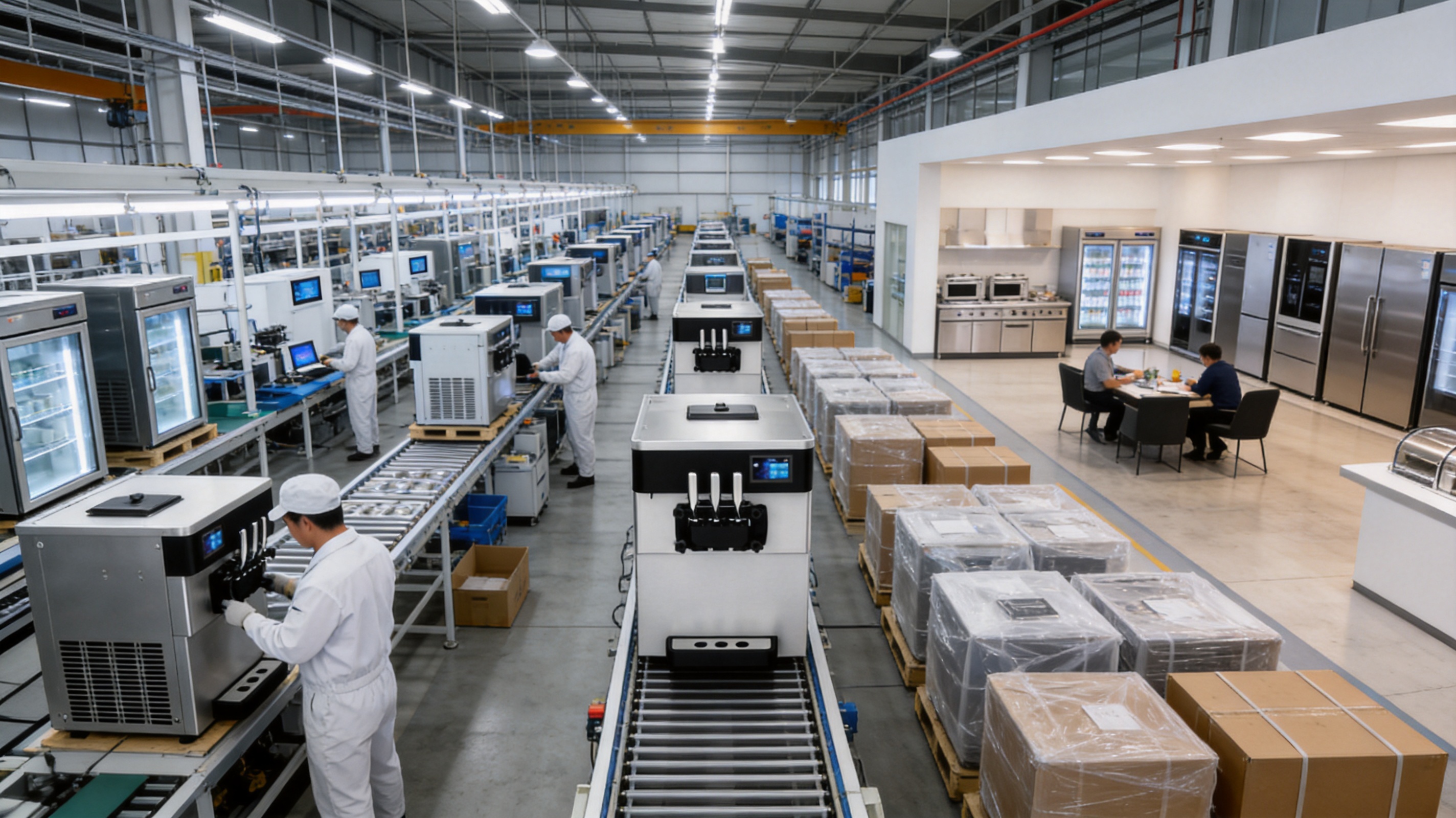
Soft serve ice cream is a high-demand product in cafés, dessert shops, quick-service restaurants, snack bars, convenience stores, and many other foodservice environments. Customers expect a smooth texture, attractive appearance, consistent portioning, and a fast serving experience. For operators, however, producing high-quality soft serve requires more than a basic freezing cylinder. The machine must combine dependable refrigeration, intuitive controls, hygienic construction, efficient cleaning, stable output, and a compact footprint.
The BQL-825T commercial desktop soft serve ice cream machine is designed to meet these needs through an integrated touchscreen control system, an efficient cooling arrangement, self-cleaning functionality, pre-cooling capability, and a durable stainless-steel and sprayed-steel body. With a rated capacity of 25 liters per hour and a power rating of 2400 watts, it provides a practical balance between production performance and space efficiency.
This type of countertop machine is especially suitable for businesses that need professional soft serve output but do not have enough room for a large floor-standing unit. Its desktop configuration enables operators to install it on a suitable work counter while keeping preparation and service areas organized. The machine is also designed for straightforward operation, which can help reduce training requirements and improve consistency during busy service periods.

Commercial Desktop Soft Serve Ice Cream Machine with LCD Touch Screen
Why Soft Serve Equipment Matters in Commercial Foodservice
Soft serve ice cream is often purchased as an impulse item. Customers may decide to buy a cone, cup, sundae, or dessert topping after seeing the product displayed at the point of sale. This makes appearance, serving speed, and texture particularly important. A machine that produces a smooth and stable product can support a more attractive presentation and a better customer experience.
Commercial operators also need predictable production. A machine that freezes unevenly, operates inconsistently, or requires complicated manual adjustment may create waste and slow down service. In contrast, equipment with a clear control interface and stable temperature management can help staff follow repeatable procedures. This is important for businesses serving many customers throughout the day.
Soft serve machines are also expected to support food hygiene. Product-contact areas must be cleaned carefully and regularly. A design that simplifies the cleaning process can reduce the time required between operating periods and help staff maintain better sanitation practices. The self-cleaning function of the BQL-825T is intended to assist with this routine, although operators must still follow their own cleaning, sanitizing, and food safety procedures.
Space is another major consideration. Many cafés, dessert shops, and small restaurants operate in compact premises where every square meter must be used efficiently. A desktop machine can provide commercial serving capability without requiring the floor space associated with a larger freestanding system. This makes it particularly useful for outlets that want to add soft serve without undertaking a major layout change.
Product Overview
The BQL-825T is a commercial desktop soft serve ice cream machine equipped with an LCD touchscreen. The machine combines a compact countertop format with a production capacity of 25 liters per hour. Its main operating functions are controlled through an intelligent visual interface, allowing staff to interact with the equipment more conveniently than with a basic mechanical control panel.
| Model | BQL-825T |
| Product Type | Commercial Desktop Soft Serve Ice Cream Machine |
| Control System | LCD Touchscreen |
| Capacity | 25 L/H |
| Power | 2400 W |
| Net Weight | 102 kg |
| Dimensions | 540 x 710 x 780 mm |
| Body Materials | Food-grade stainless steel and colorful sprayed steel |
| Key Functions | Self-cleaning and pre-cooling |
| Recommended Applications | Cafés, dessert shops, small restaurants, snack shops, and other foodservice locations |
The combination of a 25-liter-per-hour capacity and countertop design makes the unit appropriate for operations that require regular soft serve production without the output scale of a large industrial system. Its 2400-watt power rating supports the refrigeration and operating functions necessary for commercial use, while the 102-kilogram net weight reflects a substantial machine intended for stable placement in a professional environment.
The listed dimensions are 540 millimeters wide, 710 millimeters deep, and 780 millimeters high. Before installation, operators should verify counter strength, ventilation clearance, electrical requirements, access routes, and working space around the dispensing area. Proper installation is essential to support safe operation and reliable refrigeration performance.
LCD Touchscreen Control for More Intuitive Operation
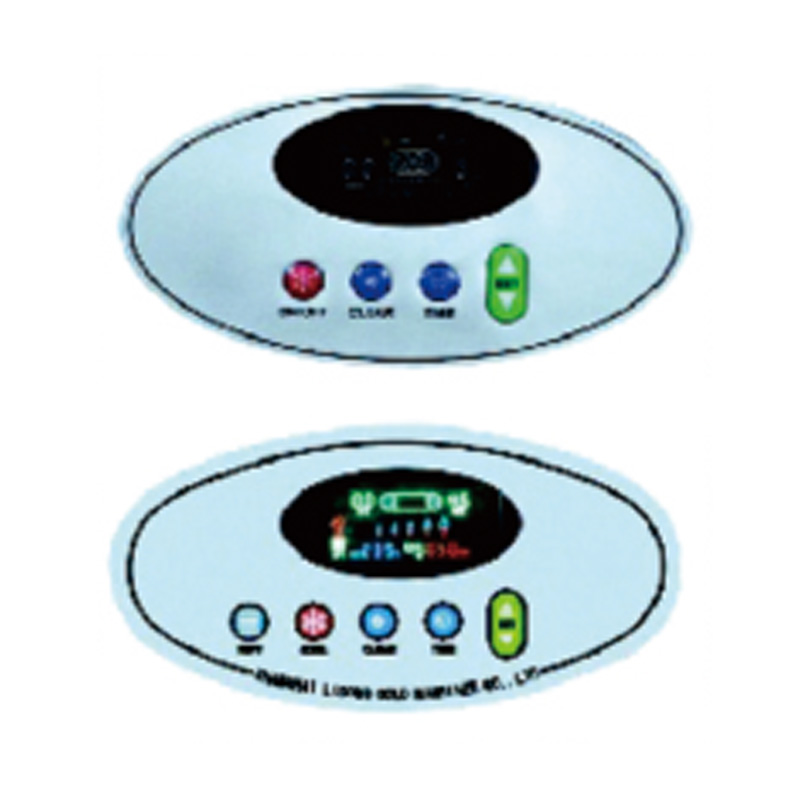
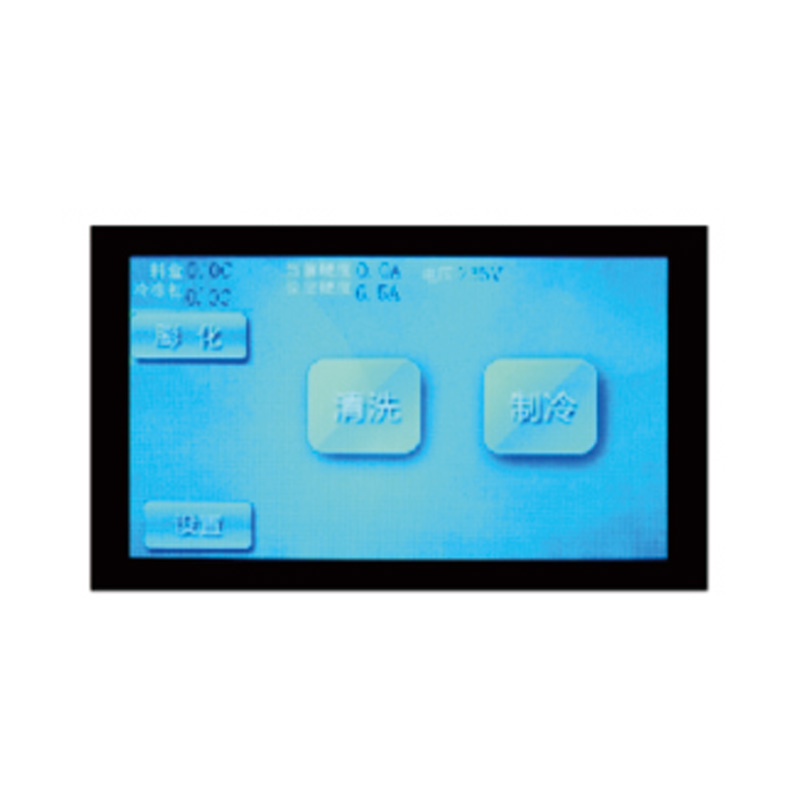
One of the most visible advantages of the BQL-825T is its LCD touchscreen control system. Traditional commercial ice cream machines may use mechanical switches, multiple knobs, or small indicator lights. Although these systems can be functional, they may require operators to learn several control positions and interpret limited information. A touchscreen offers a more direct and visual interaction method.
The LCD interface is designed to provide intelligent operation and real-time visualization. This can help staff understand the machine’s operating condition more quickly. A clear display may also make it easier to access relevant settings, monitor temperature-related information, and adjust dispensing speed according to the serving requirements of the business.
For a café or dessert shop, ease of use is important because employees may have different levels of technical experience. A visual control panel can reduce uncertainty during operation and support more consistent procedures between shifts. New employees can generally understand a touchscreen interface more quickly than a complex collection of mechanical controls, particularly when the screen presents functions in an organized manner.
The control system also supports adjustment of temperature and dispensing speed. Temperature adjustment can help operators manage product consistency under different working conditions, while dispensing-speed adjustment can provide better control over portioning and presentation. For example, a business may prefer a slower dispensing speed when serving decorative cones or a quicker setting during a high-volume rush.
These controls should always be used according to the product formulation, ambient conditions, and manufacturer guidance. Soft serve texture depends on several factors, including mix composition, temperature, overrun, freezing performance, and serving speed. The touchscreen cannot replace good operating practices, but it gives staff a more practical interface for managing the available settings.
Real-Time Visualization and Staff Efficiency
Real-time visualization can improve operational awareness. Instead of relying only on sound, feel, or guesswork, staff can refer to the display when checking the machine. This can be especially helpful during busy periods when the operator is also handling orders, toppings, payment, and customer service.
A visible operating interface may also support better communication between employees. If one employee prepares the machine and another handles service, the display can provide a shared reference point for operating status and adjustments. This contributes to a more organized workflow and can reduce unnecessary interruptions.
Compared with a basic machine that offers minimal feedback, an LCD touchscreen can provide a more modern user experience. This is an important competitive advantage for businesses that want their back-of-house equipment to match a professional, technology-oriented operating environment.
Compact Desktop Configuration for Space-Conscious Businesses
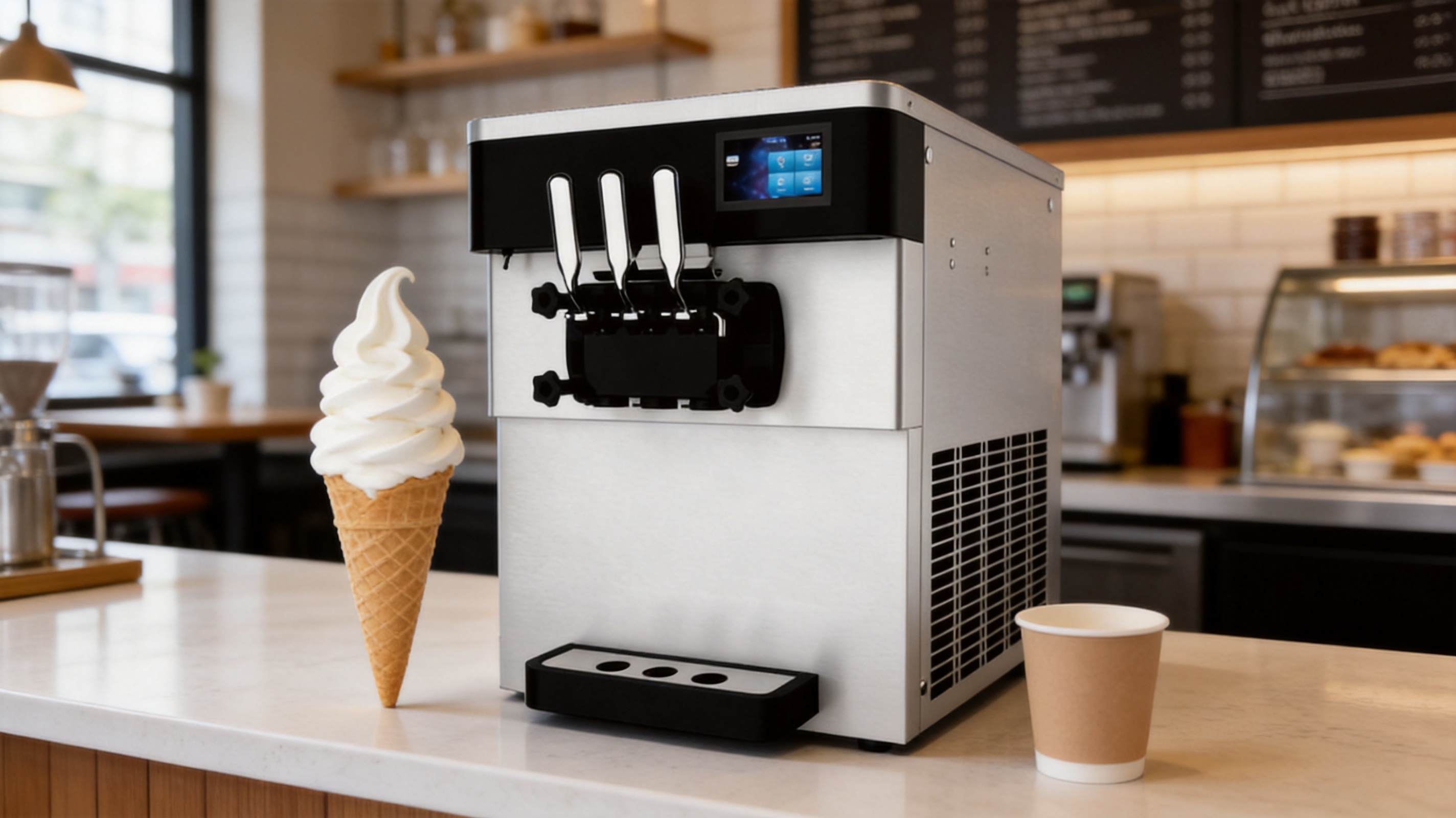
The countertop structure is one of the machine’s most practical advantages. Large floor-standing soft serve machines can deliver significant output, but they may be unsuitable for small premises. A desktop machine allows operators to use vertical counter space rather than dedicating a large section of the floor to refrigeration equipment.
This format can be particularly useful in cafés where the counter already serves as the main customer-service area. It may also be suitable for dessert shops that need to display the machine close to the serving station. In small restaurants, the unit can support a dessert menu without requiring a separate production room.
A compact configuration can simplify the overall workflow. Staff can prepare the mix, operate the machine, dispense the product, and complete basic cleaning tasks within a relatively concentrated area. This can reduce unnecessary movement and help preserve valuable space for other equipment such as beverage machines, refrigeration cabinets, topping stations, or preparation tables.
However, compact does not mean that installation requirements can be ignored. The machine weighs 102 kilograms, so the counter must be strong and level. Operators should leave sufficient room for ventilation, cleaning, service access, and safe employee movement. The unit should not be placed where water, excessive heat, or unstable surfaces could affect operation.
The desktop design also offers flexibility for businesses that may relocate or remodel their service area. Compared with permanently installed floor equipment, a countertop unit can be incorporated into different layouts more easily, provided that the new location meets electrical, ventilation, structural, and hygiene requirements.
Efficient Cooling for Smooth Product Texture
The cooling system is central to the performance of any soft serve machine. The mix must be cooled and frozen under controlled conditions so that it develops a smooth, creamy, and dispensable texture. If freezing is uneven, the product may become too soft, too hard, icy, or difficult to dispense.
The BQL-825T is described as having an efficient cooling system that supports a smooth ice cream texture. This is important for businesses where product consistency directly affects customer satisfaction. A stable texture helps create a more attractive swirl, supports better portion control, and improves the overall eating experience.
Product texture can be affected by many operating conditions, including the formulation of the mix, the temperature of incoming ingredients, ambient room temperature, frequency of dispensing, and machine settings. The operator should therefore use a compatible commercial soft serve mix and follow proper preparation procedures. The machine’s cooling function provides the necessary equipment platform, while daily operation and recipe control remain important responsibilities for the business.
For commercial users, efficient cooling can also help maintain a more stable operating rhythm. During busy periods, the machine must recover effectively after repeated dispensing. The 25-liter-per-hour capacity gives operators a useful reference for planning production, but actual output can vary according to mix conditions, serving size, environmental temperature, and operating practices.
Supporting Consistency During Repeated Service
Consistency is one of the key differences between domestic equipment and commercial foodservice machinery. A commercial unit must be designed for repeated operation and regular customer service. The BQL-825T provides controls and cooling functions intended to support dependable output across the working day.
Consistent output is valuable for portion planning. If each serving has a similar texture and dispensing behavior, employees can work more quickly and managers can estimate mix consumption more accurately. This can help reduce product waste and support more reliable menu pricing.
Consistent freezing may also help businesses standardize their presentation. Whether the product is served in a cone, paper cup, sundae glass, or as part of a specialty dessert, a stable soft serve texture is easier to shape and decorate. This can be important for businesses that use photographs, promotional displays, or signature serving styles.
Pre-Cooling Function for Product Freshness
The machine includes a pre-cooling function intended to help keep the product fresh for up to one week. This feature can be valuable for foodservice operators that prepare mix in advance or need to manage product availability across several service periods. Pre-cooling supports cold holding within the machine’s operating system, helping reduce the need for frequent disposal and refilling when used correctly.
Operators should interpret the one-week freshness statement in relation to food safety requirements, the specific mix formulation, storage conditions, local regulations, and the manufacturer’s operating instructions. The pre-cooling function is a useful equipment feature, but it does not eliminate the need for proper ingredient handling, date labeling, temperature monitoring, and sanitation.
For businesses, better cold management may improve workflow. Staff can prepare an appropriate quantity of mix, place it into the machine, and maintain readiness for service instead of repeatedly starting from the beginning. This can be especially convenient for cafés with predictable daily demand or dessert shops that operate during extended hours.
Pre-cooling can also support smoother opening procedures. When the machine and product are prepared appropriately before peak service, employees may be able to begin serving more efficiently. This helps reduce delays during lunch periods, evening dessert service, weekends, and promotional events.
Self-Cleaning Function and Maintenance Efficiency
Cleaning is a critical part of soft serve machine operation. Mix residue can accumulate in product pathways, dispensing components, seals, and other contact areas if the machine is not cleaned properly. Regular cleaning supports hygiene, product quality, equipment performance, and long-term serviceability.
The BQL-825T includes a self-cleaning function designed to simplify routine maintenance. A self-cleaning cycle can reduce manual effort and make the cleaning process more systematic. It may also help operators maintain a more regular cleaning schedule by making the procedure easier to initiate and manage.
Even with an automated function, staff must follow the complete cleaning and sanitizing procedure specified for the machine and the applicable food safety rules. Removable parts may still need to be disassembled, inspected, washed, sanitized, dried, and reinstalled correctly. Gaskets, dispensing components, mix containers, and other contact surfaces should be checked regularly for wear or residue.
The practical benefit of self-cleaning is that it can save labor time and reduce uncertainty. In a busy business, employees may postpone complicated maintenance tasks because they take too long. A more convenient process encourages better compliance with cleaning routines and can help maintain a more consistent level of hygiene between operating periods.
Designing Maintenance into the Daily Workflow
Efficient maintenance should be treated as part of production planning rather than as an afterthought. Managers can assign cleaning responsibilities by shift, record completed procedures, and ensure that employees understand the correct sequence. The touchscreen may make the machine easier to operate, while staff training ensures that automated and manual steps are completed correctly.
Regular maintenance should also include checking the exterior, inspecting power connections, keeping ventilation areas clear, and observing any changes in sound, temperature, dispensing behavior, or product texture. Early attention to unusual conditions can help prevent larger operational interruptions.
The machine’s food-grade stainless-steel body is also helpful from a hygiene and maintenance perspective. Stainless steel is widely used in professional food equipment because it is durable, resistant to many common cleaning conditions, and relatively easy to wipe down. The colorful sprayed-steel sections add visual appeal while contributing to the machine’s professional appearance.
Food-Grade Stainless Steel and Sprayed-Steel Construction
The plate body of the machine is made from food-grade stainless steel and colorful sprayed steel. These materials provide a combination of hygiene, durability, and appearance. Stainless steel surfaces are commonly preferred in foodservice environments because they can be cleaned efficiently and present a smooth, professional finish.
The construction is designed to meet the practical demands of commercial service. A machine placed in a café, dessert shop, or restaurant may be exposed to frequent handling, splashes, cleaning chemicals, and repeated operating cycles. A robust exterior helps protect the equipment and supports a longer service life when the machine is installed, operated, and maintained correctly.
Appearance is also commercially relevant. Customers often see countertop soft serve equipment directly, especially in open-kitchen cafés, dessert counters, and self-service-oriented businesses. A clean, modern, colorful exterior can complement the interior design of a shop and help draw attention to the dessert offering.
The combination of stainless steel and sprayed steel allows the machine to balance function with visual presentation. Compared with an equipment body that looks purely industrial, the colorful finish can help the unit integrate more naturally into a customer-facing environment.
Advantages Over Basic and Less Flexible Competitors
The BQL-825T offers several advantages when compared with basic soft serve machines that rely on limited controls, larger floor layouts, or more labor-intensive cleaning procedures. These advantages are especially relevant to small and medium-sized foodservice businesses.
More Accessible Control
The LCD touchscreen provides a clearer and more intuitive interface than a simple collection of switches or mechanical dials. Operators can access temperature and dispensing-speed adjustments through a visual control system. This can reduce the learning curve and support more consistent use across different shifts.
Better Space Utilization
The desktop form uses counter space instead of requiring a large dedicated floor area. This makes it a practical choice for compact cafés, dessert shops, and small restaurants. Businesses can add a soft serve program while preserving floor space for tables, refrigeration, preparation, or customer circulation.
Convenient Maintenance Support
The self-cleaning function can reduce the labor burden associated with routine maintenance. While manual cleaning and sanitation remain necessary, an assisted process can make the daily workflow more manageable than on equipment that provides no cleaning support.
Product Readiness and Cold Holding
The pre-cooling function supports product freshness management and can help businesses prepare for service more efficiently. This is useful for operators that need reliable availability throughout the day or want to reduce the number of times mix must be reloaded.
Commercial-Level Output in a Compact Format
A capacity of 25 liters per hour provides a meaningful level of production for many small and medium-sized outlets. The machine is not positioned as a high-volume industrial system, but it offers a practical commercial capacity for businesses that need regular service without the footprint of a large floor model.
Professional Exterior Construction
The use of food-grade stainless steel and sprayed steel supports both hygiene and appearance. This is an advantage over equipment that is difficult to clean, visually outdated, or unsuitable for customer-facing installation.
Suitable Applications and Business Models
The machine can serve a wide range of foodservice applications. In cafés, it can expand the menu with cones, cups, affogato-style desserts, sundaes, and seasonal specialties. A compact unit can be positioned near the beverage counter so that one service area supports both drinks and frozen desserts.
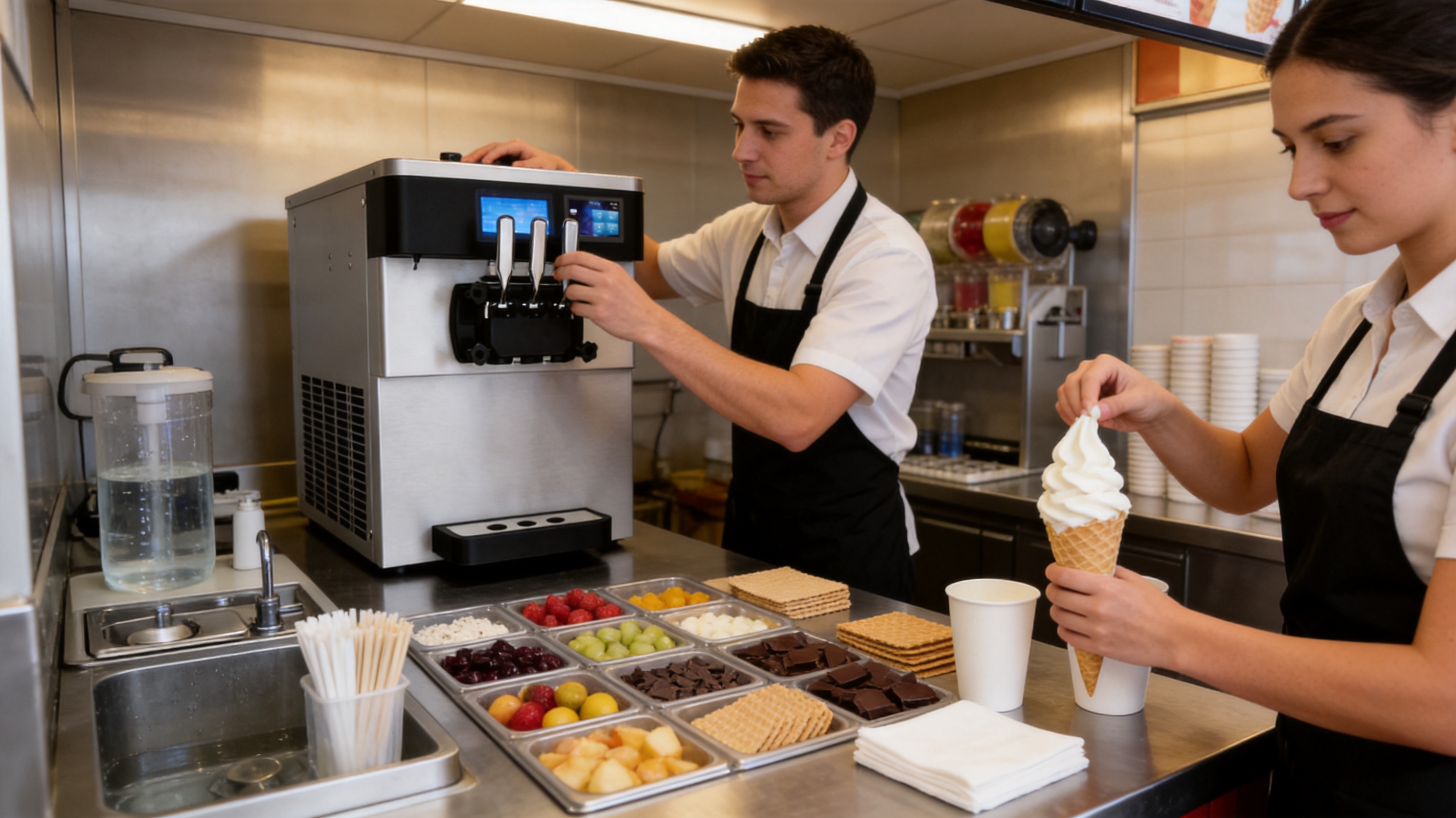
For dessert shops, soft serve can function as a core product or as a base for customized creations. Operators may add fruit, sauces, cookies, cereal, nuts, chocolate, or other toppings. A stable texture and adjustable dispensing speed can help staff create attractive presentations with repeatable portions.
Small restaurants can use the machine to add a dessert option without installing a full frozen dessert production line. It may be suitable for family restaurants, snack shops, fast-food locations, food courts, and casual dining venues. The unit can also complement fried dessert products, waffles, crepes, or specialty beverages.
Convenience stores and small retail food outlets may benefit from the compact footprint and straightforward interface. In such environments, employees often perform several different tasks, so equipment that is easy to understand and clean can be especially valuable.
Catering operations and temporary promotional events may also consider a desktop soft serve machine when suitable power, transport, counter support, and operating conditions are available. Before using the machine in a mobile or temporary setting, the operator should confirm that the installation environment can safely support its weight and electrical demand.
Manufacturing Strengths and Production Capability
The equipment is produced by Spelor Electrical Appliances (Zhejiang) Co., Ltd., a manufacturer integrating design, research and development, manufacturing, sales, and service. The company operates more than 60,000 square meters of modern production facilities and specializes in commercial refrigeration, kitchen, and buffet equipment.
This integrated structure is important because commercial equipment development requires coordination among engineering, manufacturing, quality control, market support, and after-sales service. When these functions work together, the manufacturer can respond more effectively to customer requirements and develop equipment for different foodservice environments.
The company’s product range includes ice cream machines, juice dispensers, fried ice cream machines, refrigeration cabinets, slush machines, flake ice machines, cooking equipment, griddles, fryers, insulation products, barbecue equipment, and buffet solutions. This broad portfolio provides experience across several categories of professional food equipment.
A manufacturer with products across related categories can better understand the workflow of foodservice customers. For example, a café may require soft serve equipment alongside beverage machines and refrigerated storage. A fast-food chain may need cooking equipment, ice production, and frozen dessert solutions. A supplier capable of supporting multiple equipment categories can provide more coordinated procurement assistance.
The company also supports OEM and ODM cooperation based on drawings or customer requirements. This capability is relevant to distributors, equipment importers, restaurant groups, and private-label businesses that may need customized appearance, specifications, packaging, controls, or product configurations.
Design and Research Orientation
Commercial equipment must be designed around practical operating conditions. Product developers need to consider available space, customer flow, cleaning requirements, temperature control, service access, material selection, and user interaction. The BQL-825T reflects this type of application-oriented development through its combination of desktop dimensions, touchscreen operation, cooling management, self-cleaning, and pre-cooling.
Research and development also supports product improvement over time. Feedback from foodservice users can identify opportunities to improve interface design, cleaning convenience, material durability, energy management, and service access. A manufacturer that combines market experience with internal design and development can use this information to refine future models.
Modern Production Facilities
More than 60,000 square meters of modern production facilities provide a substantial base for manufacturing and assembly. Large-scale facilities can support organized production workflows, component storage, assembly operations, inspection, packaging, and logistics coordination.
Facility size alone does not guarantee product quality, but it can provide the infrastructure needed for systematic production. The most important value comes from how manufacturing space is organized and how processes are controlled. For commercial buyers, it is useful to evaluate a supplier’s production capability together with its engineering support, quality practices, documentation, and service response.
The company’s integrated manufacturing model is designed to support both standard products and customized projects. This can be beneficial for international customers that need specific product configurations or coordinated equipment procurement for different markets.
Quality-Oriented Manufacturing Considerations
Commercial soft serve machines must be assembled with attention to mechanical stability, refrigeration performance, electrical safety, material quality, and hygiene. The use of food-grade stainless steel in the product-contact and exterior construction reflects the importance of selecting materials suitable for professional food environments.
Quality-oriented manufacturing should also include careful inspection of refrigeration components, control systems, dispensing mechanisms, seals, fasteners, wiring, and surface finishing. Each area affects reliability in daily use. A touchscreen must respond correctly, the cooling system must operate consistently, and the dispensing path must remain secure and hygienic.
Production quality is supported by clear work instructions, trained assembly personnel, process inspection, functional testing, and final review. These activities help identify issues before equipment is shipped to customers. For international foodservice buyers, reliable packaging and shipping preparation are also important because commercial machines may travel long distances before installation.
As a factory supplier, the company can coordinate manufacturing, sales support, logistics, and after-sales communication. This integrated approach may help reduce misunderstandings between the customer and different third-party organizations. It can also make it easier to discuss product specifications, replacement parts, installation questions, and service requirements.
OEM and ODM Support for International Customers
OEM and ODM services are useful for importers, distributors, restaurant chains, and foodservice equipment brands that require more than a standard catalog item. Customers may request particular colors, branding arrangements, packaging formats, voltage configurations, control language, dimensions, or accessory combinations, subject to technical feasibility and project requirements.
OEM cooperation generally focuses on producing equipment according to a customer’s established design or specifications. ODM cooperation may involve adapting an existing product platform or developing a solution around the customer’s functional requirements. For a commercial soft serve machine, this could include changes to exterior presentation, interface language, labeling, serving configuration, or procurement packaging.
Successful customization requires detailed communication. Buyers should provide information about target markets, electrical standards, expected capacity, installation conditions, mix type, service frequency, user preferences, packaging needs, and applicable regulations. The manufacturer can then assess the project and clarify which requirements can be supported.
Customization can help distributors create a differentiated product range. It may also allow restaurant groups to standardize equipment appearance and operating procedures across multiple locations. A factory with experience in design, production, sales, and service is well positioned to coordinate these projects.
Installation and Operating Recommendations
Before installation, inspect the delivery package for visible damage and confirm that the model and accessories match the order. The machine should be placed on a firm, level counter capable of supporting at least its net weight along with the product load and any operational movement.
Provide appropriate clearance around the machine. Ventilation openings must remain unobstructed, and the equipment should not be positioned next to heat-producing appliances unless the installation instructions permit it. Excessive ambient heat can influence refrigeration performance and product consistency.
The electrical supply should match the equipment requirements and local regulations. A qualified professional should verify the outlet, grounding, circuit capacity, plug configuration, and any required protective devices. Do not use damaged cables, overloaded extension cords, or unsuitable adapters.
After installation, clean and sanitize the relevant food-contact components according to the operating instructions. Prepare the soft serve mix correctly, load the machine without introducing unnecessary contamination, and allow the cooling system to reach the appropriate operating condition before serving.
During operation, monitor product consistency, dispensing behavior, temperature indications, and unusual noises. Avoid exceeding the recommended capacity or using an unsuitable mix. Adjust temperature and dispensing speed carefully rather than making frequent extreme changes.
At the end of service, follow the complete cleaning and sanitation procedure. Use the self-cleaning function as intended, and complete any manual disassembly or inspection steps required by the manufacturer. Record maintenance activities if the business operates under a formal food safety or equipment management system.
Commercial Value and Return on Equipment Investment
The value of a soft serve machine is determined by more than its purchase price. Operators should consider product output, labor efficiency, cleaning time, counter space, menu potential, maintenance requirements, and customer appeal. The BQL-825T addresses several of these factors through its compact format, touchscreen controls, pre-cooling, self-cleaning, and commercial capacity.
A business can potentially increase revenue by offering soft serve as a standalone product or as an addition to existing menu items. Soft serve can be sold in different portion sizes and combined with toppings or other desserts. This flexibility allows operators to create multiple price points without requiring a completely different production process.
Labor efficiency is another consideration. A visual interface can simplify training, while cleaning assistance can reduce the time required for routine maintenance. These benefits may become more significant as the business grows or operates across several shifts.
Counter space also has economic value. In a small outlet, using a desktop machine may allow the business to add a profitable product category without removing another important service station. The compact form can therefore support more efficient use of the existing premises.
To evaluate the investment accurately, buyers should estimate expected daily servings, average selling price, mix cost, topping revenue, labor time, cleaning requirements, electricity usage, and anticipated maintenance. The equipment is most suitable when the business has sufficient demand to use its capacity consistently while still benefiting from the compact design.
Ordering and Procurement Guidance
Commercial buyers should provide complete information when requesting a quotation. Important details include destination country, voltage and frequency, expected order quantity, required capacity, preferred exterior finish, language requirements, packaging needs, delivery terms, and intended application.
Buyers should also ask for product documentation, operating instructions, maintenance guidance, spare-parts information, warranty terms, and installation requirements. These documents help ensure that the machine can be installed and operated correctly after delivery.
For distributors and project buyers, it is useful to discuss lead times, production schedules, inspection arrangements, loading methods, shipping protection, and after-sales communication. If OEM or ODM service is required, the project should include drawings, artwork, technical specifications, sample approval procedures, and packaging details.
The manufacturer provides flexible logistics and payment solutions as part of its customer support approach. Specific arrangements should be confirmed during the quotation and order process. Clear documentation at this stage can help prevent delays and ensure that the delivered equipment matches the customer’s expectations.
After-Sales Support and Long-Term Service
Reliable after-sales support is essential for commercial refrigeration and frozen dessert equipment. Even a well-designed machine requires correct installation, periodic maintenance, cleaning, and occasional replacement of wear components. Customers should have access to technical guidance and a clear communication channel for service questions.
The company provides pre-sales consultation, product customization, logistics coordination, and after-sales maintenance support. This one-stop approach is valuable for international customers that may need assistance before ordering and throughout the operating life of the machine.
Service quality depends on accurate product information. Buyers should keep the model number, serial information, purchase documents, operating records, and maintenance history available. When requesting assistance, it is helpful to describe the symptoms clearly, including error messages, changes in texture, temperature behavior, unusual sounds, or dispensing problems.
Regular maintenance can extend equipment usability and help protect business continuity. Operators should not wait until a serious failure occurs before inspecting the machine. Routine cleaning, proper mix handling, ventilation clearance, and prompt attention to abnormal operation are all part of responsible equipment ownership.
Frequently Asked Questions
What type of machine is the BQL-825T?
The BQL-825T is a commercial desktop soft serve ice cream machine with an LCD touchscreen control system. It is designed for professional foodservice environments such as cafés, dessert shops, small restaurants, snack shops, and similar businesses.
What is the production capacity?
The listed capacity is 25 liters per hour. Actual output may vary according to the mix formulation, serving size, ambient temperature, cooling conditions, operating frequency, and dispensing settings.
How does the LCD touchscreen help operators?
The touchscreen provides an intuitive visual interface for machine operation. It supports real-time visualization and allows operators to adjust functions such as temperature and dispensing speed, helping staff manage the equipment more conveniently.
Does the machine have a self-cleaning function?
Yes. The BQL-825T includes a self-cleaning function intended to simplify routine maintenance. Operators must still complete all required manual cleaning, sanitation, inspection, and disassembly procedures according to the operating instructions and applicable food safety requirements.
What is the purpose of the pre-cooling function?
The pre-cooling function helps maintain product freshness and supports cold holding. The product information states that it can help keep the mix fresh for up to one week. Operators should apply this feature together with proper ingredient storage, date control, temperature monitoring, and local food safety procedures.
Is this machine suitable for a small café?
Yes. Its desktop design and dimensions of 540 x 710 x 780 millimeters make it suitable for many cafés and dessert shops with limited space. The installation counter must be strong, level, properly ventilated, and capable of supporting the machine’s 102-kilogram net weight.
What materials are used for the body?
The plate body is made from food-grade stainless steel and colorful sprayed steel. This combination supports a professional appearance, cleanability, and durability in commercial foodservice environments.
Can the dispensing speed be adjusted?
Yes. The product information indicates that the touchscreen system allows adjustment of dispensing speed. Operators should select settings that suit the mix, desired texture, serving style, and operating conditions.
Is the machine suitable for high-volume industrial production?
The machine has a commercial capacity of 25 liters per hour and is designed for foodservice applications. It is particularly appropriate for small and medium-sized commercial outlets. Businesses requiring substantially higher production should compare their demand with the machine’s rated capacity and consider a larger system if necessary.
What should be considered before installation?
Buyers should confirm counter strength, available dimensions, ventilation clearance, electrical requirements, grounding, operator access, cleaning space, and delivery access. Professional installation and electrical verification are recommended where required by local regulations.
Can international customers request OEM or ODM service?
Yes. The manufacturer offers OEM and ODM cooperation based on drawings or customer requirements. Customers should provide detailed technical, appearance, packaging, electrical, and market information so that the project can be evaluated accurately.
What types of businesses can use this machine?
Potential applications include cafés, dessert shops, snack shops, small restaurants, fast-food outlets, convenience stores, food courts, and other foodservice operations that want to sell soft serve products.
How can operators maintain consistent soft serve quality?
Operators should use a compatible mix, follow the correct preparation process, maintain appropriate temperatures, avoid overloading the machine, monitor dispensing behavior, clean the equipment regularly, and use the touchscreen settings carefully. Consistent procedures between shifts are also important.
What information should be included in a quotation request?
A quotation request should include the destination, quantity, voltage and frequency, intended application, capacity expectations, customization requirements, packaging needs, delivery terms, and any OEM or ODM specifications. This allows the supplier to prepare a more accurate proposal.
Conclusion
The commercial desktop soft serve ice cream machine with LCD touchscreen is designed for foodservice operators that need professional frozen dessert production in a compact format. The BQL-825T combines a 25-liter-per-hour capacity with intelligent touchscreen operation, temperature and dispensing-speed adjustment, efficient cooling, pre-cooling, self-cleaning, and a food-grade stainless-steel and sprayed-steel body.
Its strongest advantages are its balance of usability, space efficiency, maintenance support, and commercial functionality. The countertop design is suitable for businesses that cannot dedicate significant floor space to a large machine. The LCD interface can make operation more intuitive, while pre-cooling and self-cleaning support more organized daily workflows.
The manufacturer’s integrated capabilities in design, research and development, production, sales, customization, logistics, and after-sales service provide additional value for domestic and international foodservice buyers. With more than 60,000 square meters of modern production facilities and a broad portfolio of commercial refrigeration and kitchen equipment, the company is positioned to support both standard product procurement and OEM or ODM projects.
For cafés, dessert shops, small restaurants, and similar businesses, the machine can provide a practical way to expand the menu, improve serving efficiency, and create attractive soft serve products. Proper installation, mix handling, cleaning, sanitation, and maintenance remain essential, but the equipment’s integrated features provide a strong foundation for reliable commercial operation.
References
1. Spelor Electrical Appliances (Zhejiang) Co., Ltd. Product information for the BQL-825T commercial desktop soft serve ice cream machine.
2. Spelor Electrical Appliances (Zhejiang) Co., Ltd. Manufacturing and company capability information for commercial refrigeration, kitchen, and buffet equipment.
3. General commercial foodservice equipment maintenance principles covering cleaning, sanitation, refrigeration operation, and preventive maintenance.
4. General food safety practices for the handling, storage, temperature control, and service of frozen dairy and dessert products.
5. General equipment procurement principles for OEM, ODM, installation planning, technical documentation, logistics, and after-sales support.
6. Commercial refrigeration and frozen dessert equipment design considerations, including material selection, cooling performance, operator usability, and space planning.
Product: Commercial Desktop Soft Serve Ice Cream Machine with LCD Touch Screen

For exclusive deals and latest offers, sign up by entering your email address below.


-
spelor@spelor.com
-
+86-576-85229688
-
No.528, Changxi Road, Linhai City, Zhejiang Province, China
Commercial Refrigeration Equipment Manufacturer China
Copyright © 2025 by Spelor Electrical Appliances (Zhejiang) Co., Ltd. Rights Reserved.
