


 中文简体
Double Round Commercial Fried Ice Cream Cart Machine for High-Efficiency Foodservice Operations
Admin 2026-09-30Fried ice cream is a visually engaging dessert that combines fresh preparation, customized ingredients, and an entertaining serving experience. For snack bars, market stalls, dessert counters, mobile food businesses, and quick-service operations, the equipment used to prepare it must do more than freeze a mixture. It must support attractive presentation, fast service, consistent results, simple cleaning, and dependable daily operation. The Double Round Commercial Fried Ice Cream Cart Machine is designed around these practical requirements.
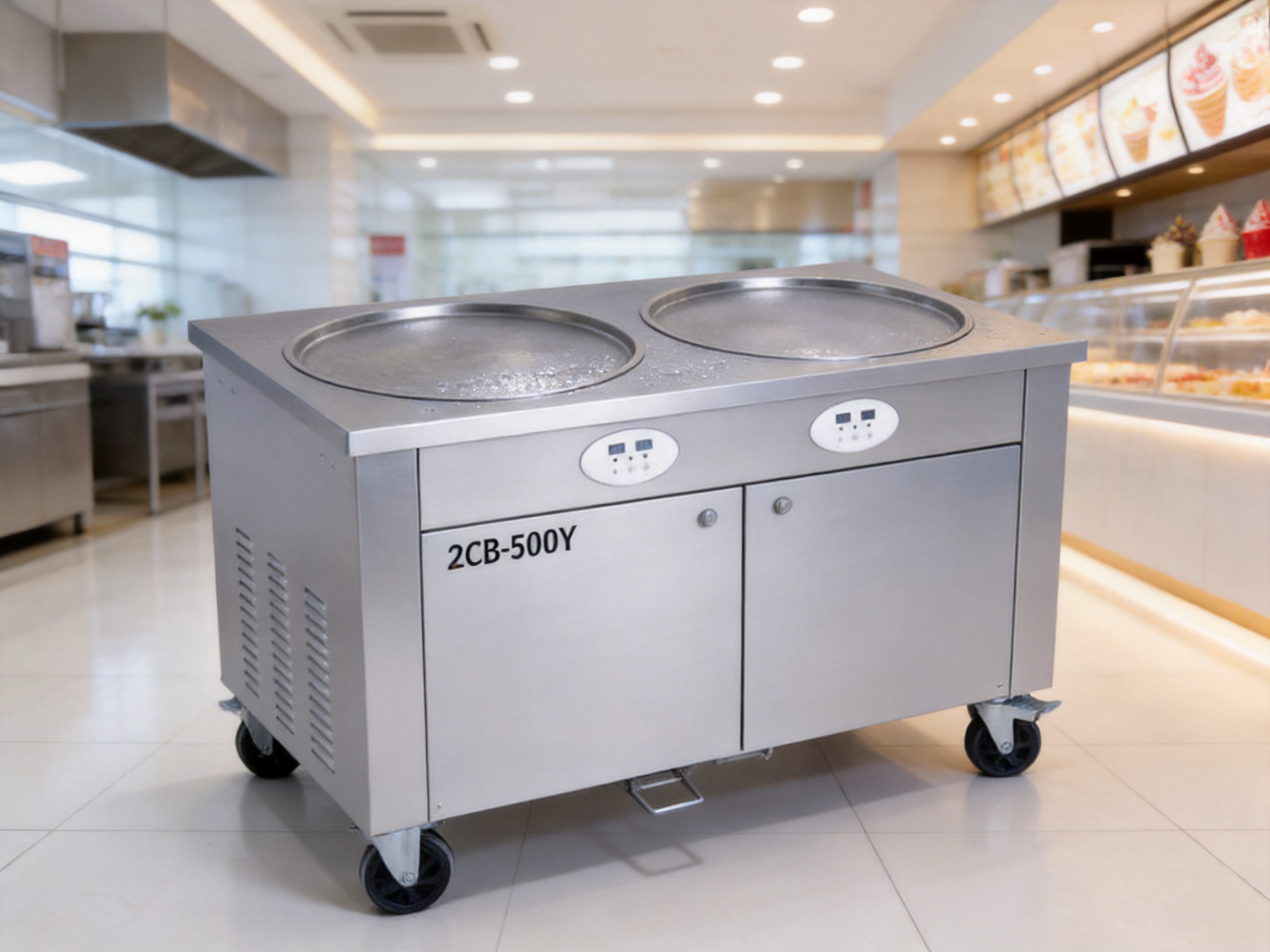
Model 2CB-500Y features two round work pans, each with a 50-centimeter diameter, a 2,800-watt power rating, a working temperature range of approximately minus 25 degrees Celsius to minus 30 degrees Celsius, and a compact cart-style structure measuring 1,350 by 680 by 800 millimeters. With a net weight of 74 kilograms, it provides the stability required for commercial use while remaining suitable for organized shop layouts, market stalls, and selected mobile applications.
The machine’s double-round configuration is one of its most important advantages. Instead of limiting production to one preparation surface, it allows operators to prepare two portions, batches, or flavor combinations at the same time. This can help shorten customer waiting times during busy periods and gives businesses more freedom to organize their workflow. One operator may prepare two orders simultaneously, or two staff members may work side by side when demand is high.
Behind this product is Spelor Electrical Appliances (Zhejiang) Co., Ltd., a professional manufacturer specializing in commercial refrigeration, kitchen equipment, buffet equipment, and related foodservice solutions. The company integrates design, research and development, manufacturing, sales, and service. Its large modern production facilities, broad product range, and OEM and ODM capabilities support customers looking for both standard equipment and customized commercial solutions.
This article examines the structure, working value, operational advantages, manufacturing strengths, application scenarios, maintenance requirements, purchasing considerations, and frequently asked questions associated with the Double Round Commercial Fried Ice Cream Cart Machine.

Double Round Commercial Fried Ice Cream Cart Machine for Snack Bar & Market Stall
1. Product Overview and Commercial Positioning
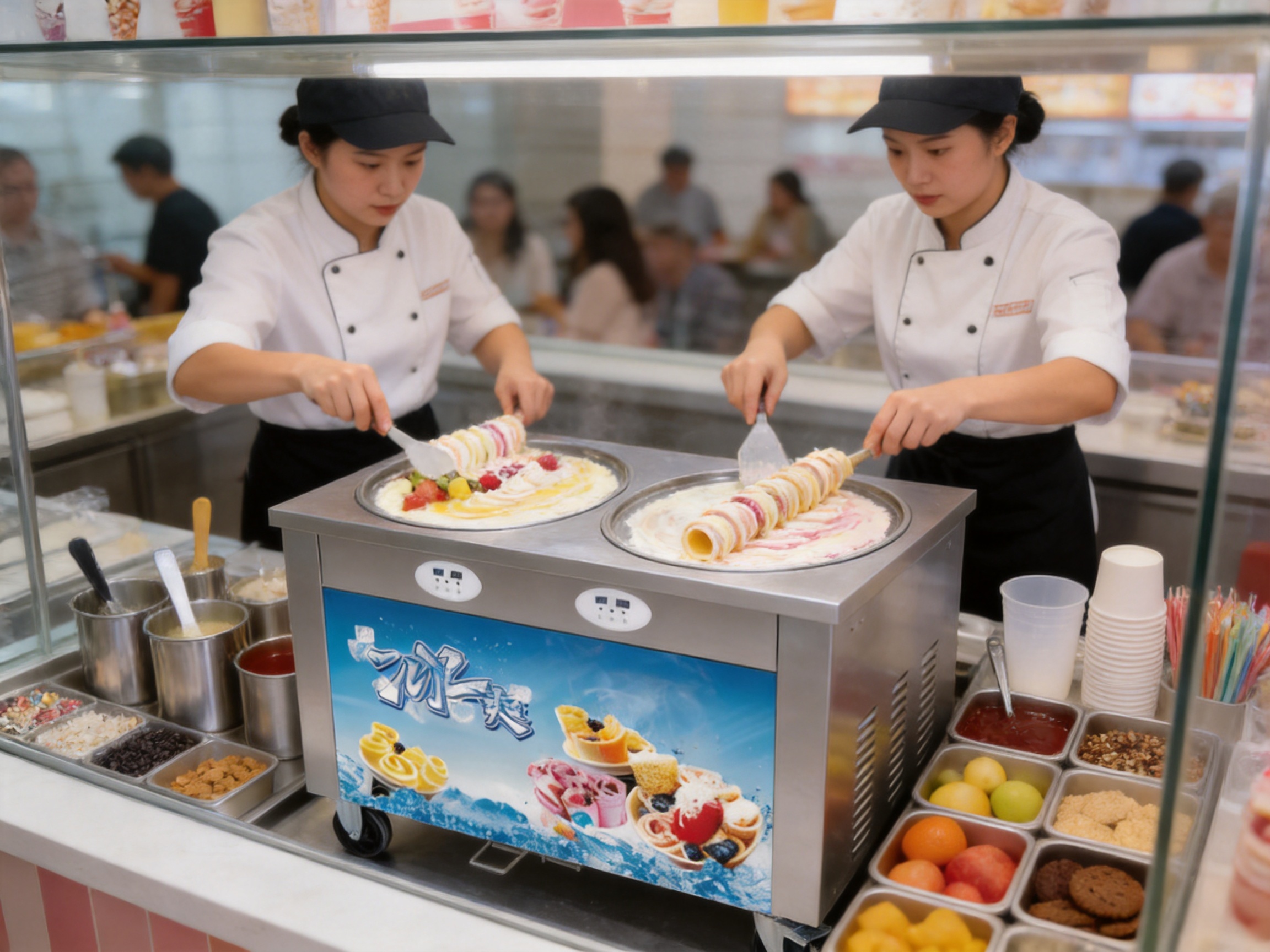
The Double Round Commercial Fried Ice Cream Cart Machine is a professional cold-surface dessert machine intended for businesses that prepare rolled ice cream or similar frozen desserts in front of customers. Unlike conventional batch freezers that produce a stored quantity of ice cream, a fried ice cream roll machine creates the dessert directly on a refrigerated work surface. The operator pours a prepared liquid mixture onto the cold pan, adds ingredients, mixes or spreads the preparation, and then scrapes the frozen product into decorative rolls.
This preparation method gives the customer a visible connection to the production process. It can attract attention in open kitchens, shopping areas, food courts, night markets, tourist locations, and dessert shops. The performance of the machine therefore affects not only product quality but also the speed, cleanliness, and visual appeal of the entire service experience.
The 2CB-500Y is configured with two round pans. Each pan has a diameter of 50 centimeters and a depth of 2 centimeters. This provides a broad, shallow working area that supports the spreading, mixing, and scraping movements needed for rolled ice cream. The two surfaces can be used together for higher throughput or separately for different orders, recipes, colors, or dietary requirements.
The machine is suitable for medium-sized snack shops and mobile market operations that need greater capacity than a single-pan model can provide. It is also appropriate for dessert counters in larger foodservice businesses where fried ice cream is offered as a specialty item. Its dimensions allow it to fit into many commercial layouts while providing enough surface area for customer-facing preparation.
2. Main Technical Specifications
| Specification | Product Information |
|---|---|
| Model | 2CB-500Y |
| Product Type | Double-round commercial fried ice cream roll machine |
| Input Power | 2,800 watts |
| Power Supply | 220 volts, 50 hertz |
| Number of Round Pans | Two |
| Pan Diameter | 50 centimeters per pan |
| Pan Depth | 2 centimeters |
| Working Temperature Range | Approximately minus 25 degrees Celsius to minus 30 degrees Celsius |
| Net Weight | 74 kilograms |
| Machine Dimensions | 1,350 by 680 by 800 millimeters |
| Compressor | Chinese compressor configuration |
| Refrigerant Information | Configuration should be confirmed according to the final order and market requirements |
The specifications indicate that this is a substantial commercial machine rather than a light-duty countertop appliance. Its 2,800-watt input power supports rapid cooling performance and helps the machine maintain a low working temperature while the operator prepares product. Actual cooling speed and production capacity may vary according to ambient temperature, ingredient volume, recipe composition, operating habits, and electrical conditions.
The stated power supply is 220 volts at 50 hertz. Buyers should verify that the electrical infrastructure at the installation site matches this requirement. If the machine will be used in a country with a different voltage or frequency, the appropriate electrical configuration should be confirmed with the supplier before purchase.
The 74-kilogram net weight provides useful operational stability. A machine that remains firmly positioned during mixing and scraping can be easier and safer to operate than a lightweight unit that shifts under pressure. The weight also reflects the presence of refrigeration components, structural materials, and a commercial work surface designed for repeated use.
3. Advantages of the Double-Round Design
3.1 Higher Preparation Flexibility
The two round pans provide more flexibility than a single-pan arrangement. Operators can prepare two different flavors at the same time, keep separate recipes apart, or use one pan for preparation while the other is being cleaned or organized. A business can use this flexibility to support a wider menu without requiring a second complete machine.
For example, one pan may be used for a fruit-based recipe while the second pan handles a chocolate or dairy-based recipe. Alternatively, the two pans can be used for separate customer orders. This is especially valuable for shops that emphasize customization, because customers may request different toppings, sauces, or flavor combinations.
3.2 Improved Peak-Period Productivity
During busy hours, the ability to work on two surfaces can reduce bottlenecks. A single-pan machine forces every order into one preparation sequence. The double-round design gives operators additional space to organize orders and process more than one portion at once.
Higher productivity does not automatically mean that every business will double its output. Actual capacity depends on recipe size, employee skill, service style, and customer demand. However, two independent working areas create a meaningful operational advantage over basic single-pan competitors, particularly when several customers are waiting or when the product is prepared as a performance item in front of an audience.
3.3 Better Staff Cooperation
The two worktables can support collaborative operation. One employee can prepare the base mixture and manage ingredients while another employee scrapes, rolls, garnishes, and packages the finished product. In a larger snack shop, two staff members may each manage one pan. This helps businesses adapt the equipment to different staffing levels without changing the machine itself.
3.4 More Attractive Customer Presentation
Fried ice cream is often purchased because of the preparation spectacle as much as the final taste. Two visible round work areas can make the equipment more engaging in an open service environment. Operators can demonstrate parallel preparation, show different flavor combinations, and create a more active counter presentation.
This visual quality can be particularly useful for market stalls, shopping centers, food festivals, and tourist-oriented businesses. A well-organized preparation area can encourage customers to stop, observe, and place an order.
4. Cooling Performance and Product Consistency
The purpose of a fried ice cream roll machine is to freeze a liquid mixture quickly enough for the operator to spread and roll it before it becomes too hard or too soft. The reported working range of approximately minus 25 degrees Celsius to minus 30 degrees Celsius provides the low-temperature environment required for this type of preparation.
Consistent surface temperature is important. If the pan is not cold enough, the mixture may remain soft and difficult to roll. If the temperature varies significantly across the working area, the operator may obtain uneven texture or inconsistent freezing times. A well-designed refrigeration system helps create a more predictable preparation process.
The 2,800-watt power rating supports the machine’s refrigeration and operating requirements. Commercial power capacity is especially important during continuous service, when the pan must recover its low temperature after each preparation cycle. Businesses should still allow the machine to reach its operating condition before beginning peak production and should avoid placing excessive quantities of warm mixture on the pan at one time.
Ingredient formulation also affects results. Mixtures containing different levels of sugar, cream, milk, fruit, water, or other ingredients freeze at different rates. Operators should standardize recipes and portion sizes to make the most effective use of the machine. Training employees to spread the mixture evenly can further improve consistency.
The machine is not limited to one flavor profile. Depending on the business recipe and food safety program, it can support fruit, chocolate, coffee, vanilla, cookie, nut, caramel, and other fried ice cream concepts. The operator can add toppings, inclusions, syrups, and decorative ingredients during preparation, provided that the recipe and sanitation procedures are suitable for the cold-surface process.
5. Work Surface Design and Ease of Operation
Each round pan has a 50-centimeter diameter and a 2-centimeter depth. The circular shape provides a continuous work area without corners that interrupt scraping movements. This is useful when the operator spreads the mixture across the surface, divides it into sections, or gathers it into rolls.
The shallow depth is appropriate for a product that is spread in a thin layer. A thin layer freezes more quickly than a deep mass and can be scraped into rolls with greater control. The operator can also divide the surface into separate flavor areas or work on multiple small portions in sequence.
Although the machine is designed for commercial use, the operating method remains straightforward. A typical process includes preparing the recipe, placing the desired quantity on the cold pan, spreading it evenly, incorporating toppings or ingredients, allowing the mixture to freeze, and scraping it into rolls. The finished rolls can then be transferred to a serving container and decorated.
Simple operation is important for businesses with changing staff members or seasonal employees. A machine that does not require a complicated production sequence can reduce training time. Written operating procedures should still be established to cover start-up, temperature checks, portion control, scraping technique, cleaning, and shutdown.
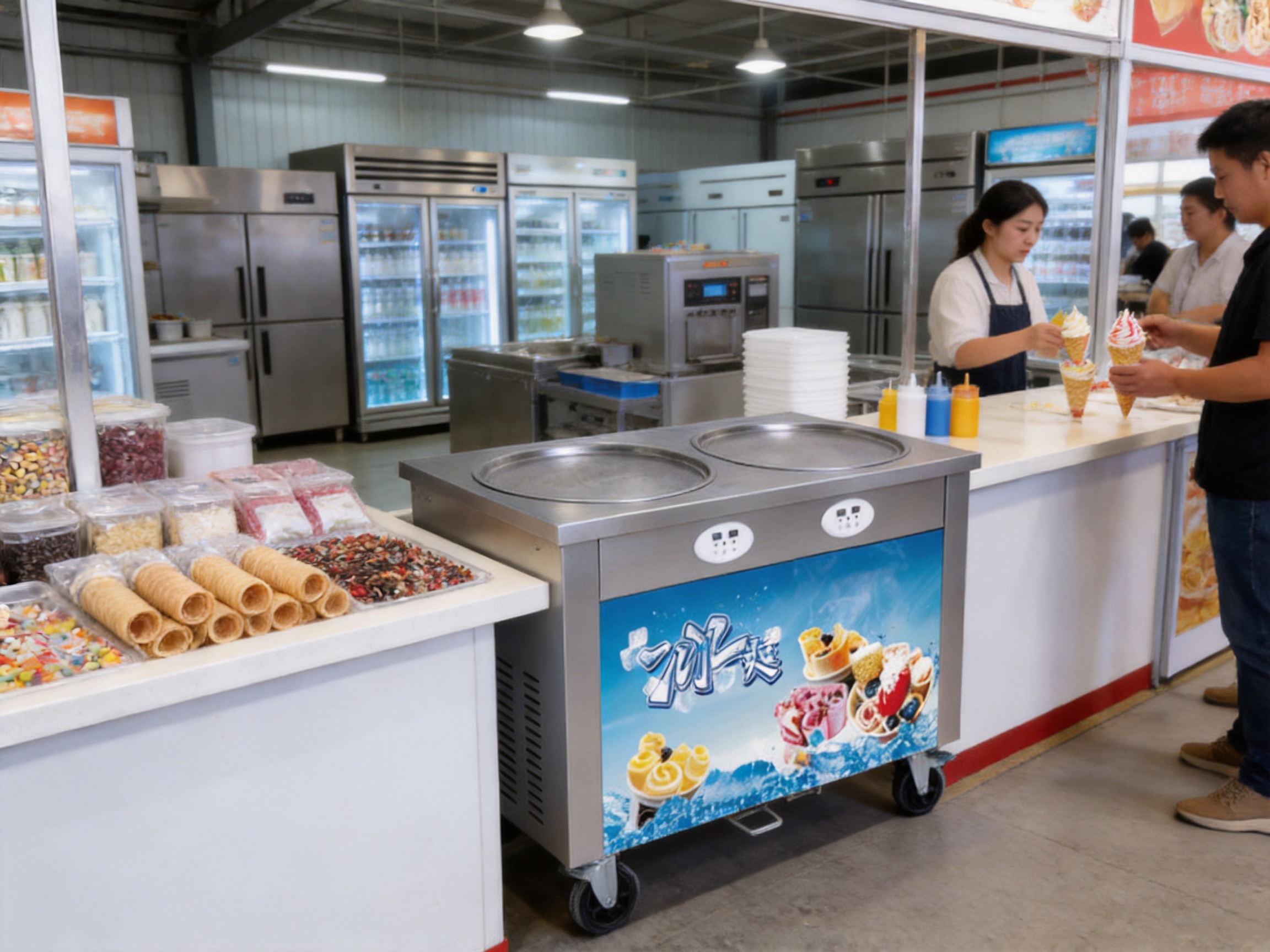
The cart-style format also helps the machine function as a visible service station. It can be positioned near the front of a shop, in a food court, or at a market stall where customers can observe the preparation. Before installation, businesses should confirm access routes, door widths, floor strength, electrical outlet locations, and ventilation conditions.
6. Competitive Advantages Compared with Basic Alternatives
Commercial buyers often compare fried ice cream machines based on price alone. A more useful comparison considers productivity, flexibility, stability, serviceability, manufacturing support, and suitability for the intended business model. The Double Round Commercial Fried Ice Cream Cart Machine offers several advantages over basic single-pan or light-duty alternatives.
6.1 Two Pans Instead of One
The most direct advantage is the double-pan arrangement. A basic single-pan machine may be suitable for low-volume use, but it limits the operator to one preparation area. The double-round model creates more room for parallel work and menu diversification.
6.2 Commercial Power and Low-Temperature Operation
The 2,800-watt input power and stated minus 25 degrees Celsius to minus 30 degrees Celsius working range are aligned with the demands of commercial fried ice cream preparation. Lower-capacity equipment may struggle to recover during continuous service or may be designed primarily for occasional use. The selected machine is intended for more regular foodservice operation.
6.3 Stable Construction
At 74 kilograms, the machine offers a stable platform for scraping and mixing. Stability is a practical advantage that can improve operator control and reduce unwanted movement during busy service. It may also contribute to a more professional customer-facing presentation.
6.4 Space-Efficient Commercial Format
The dimensions of 1,350 by 680 by 800 millimeters provide two working pans without requiring the footprint of a much larger production line. This balance makes the machine appropriate for medium-sized snack shops, dessert counters, market stalls, and selected mobile foodservice environments.
6.5 Customization and Procurement Support
Because the manufacturer provides OEM and ODM services, buyers may have access to more flexible procurement options than they would receive from a purely retail-oriented equipment supplier. Depending on project requirements, customization may involve product configuration, branding, packaging, electrical specifications, documentation, or other agreed details. All customization should be confirmed in a formal quotation and technical order document.
These advantages do not mean that the machine is suitable for every business. A very small operator with limited demand may prefer a single-pan model, while a high-volume factory may require a larger production system. The double-round machine is best positioned for businesses seeking a practical middle ground between entry-level equipment and large industrial installations.
7. Manufacturing Strengths and Engineering Capabilities
Product performance is strongly influenced by the manufacturing system behind the equipment. Spelor Electrical Appliances (Zhejiang) Co., Ltd. operates as an integrated manufacturer covering design, research and development, production, sales, and service. This integrated structure can simplify communication between engineering, manufacturing, quality control, and customer support.
The company has more than 60,000 square meters of modern production facilities. A large manufacturing base can support organized production planning, dedicated assembly areas, component management, testing procedures, and logistics coordination. It also provides a foundation for serving customers that require multiple product categories or repeat orders.
7.1 Product Development
Integrated research and development allows the manufacturer to consider the relationship between refrigeration performance, work-surface design, cabinet structure, user operation, cleaning access, and production cost. For commercial foodservice equipment, successful development is not only about achieving a low temperature. It must also address operator convenience, durability, food-contact requirements, service access, and the practical realities of busy kitchens.
Feedback from different applications can be used to refine product details. Snack shops may prioritize fast service and easy cleaning. Market-stall operators may focus on compact dimensions and visual presentation. Foodservice chains may require consistent specifications, packaging standards, and repeatable quality across multiple locations. An experienced manufacturer can align development priorities with these different needs.
7.2 Manufacturing Coordination
When design and production are managed within one organization, technical adjustments can be communicated more efficiently. The manufacturer can coordinate material selection, component sourcing, assembly procedures, electrical configuration, refrigeration installation, and final inspection. This can reduce the risk of misunderstanding that sometimes occurs when equipment is designed by one party and assembled by another.
7.3 Broad Product Knowledge
Spelor’s product range includes ice cream machines, juice dispensers, fried ice cream machines, refrigeration cabinets, slush machines, flake ice machines, cooking equipment, griddles, fryers, insulation products, barbecue equipment, and buffet solutions. This broad portfolio gives the company experience across several areas of commercial foodservice equipment.
For buyers developing a complete snack shop or beverage operation, a broad product range can simplify sourcing. Instead of coordinating multiple unrelated suppliers, a customer may be able to discuss refrigeration, frozen dessert, beverage, cooking, and buffet requirements with one experienced manufacturer.
7.4 OEM and ODM Capability
The company offers OEM and ODM services based on customer drawings or requirements. OEM production can be valuable for distributors and established brands that need equipment produced under their own commercial identity. ODM cooperation can support buyers that want to adapt an existing product platform to a specific market or application.
Customization should be managed carefully. Buyers should specify electrical standards, refrigerant requirements, dimensions, control systems, packaging, labeling, spare parts, manuals, certification needs, and inspection procedures at the quotation stage. Clear technical documentation helps avoid differences between the requested configuration and the delivered equipment.
7.5 Service-Oriented Support
Spelor provides pre-sales consultation, product customization, flexible logistics and payment solutions, and after-sales maintenance support. For commercial equipment, service is an important part of the total purchase value. A machine can be well designed, but the customer also needs guidance on selection, installation, operation, cleaning, troubleshooting, and replacement parts.
A responsive support structure can be particularly valuable for overseas buyers. Importers, distributors, and foodservice operators may need assistance with shipping documents, packaging, electrical configuration, technical specifications, spare parts, and warranty communication. These factors influence the long-term business value of the equipment.
8. Quality Control Considerations
Quality control for a fried ice cream machine should cover both refrigeration performance and general commercial construction. Important inspection points include the condition of the pans, the stability of the cabinet, the quality of electrical connections, compressor operation, temperature performance, control response, and the condition of external surfaces.
The work surfaces should be checked for smoothness, cleanliness, and freedom from visible damage. Since the pans are used in direct contact with food mixtures, the operator must be able to clean them thoroughly. Any accessories used for scraping or mixing should also be appropriate for the surface and should not create unnecessary scratches.
Refrigeration testing should verify that the machine reaches the expected working range under suitable ambient conditions. Buyers should understand that temperature performance can be affected by room temperature, airflow around the condenser, voltage stability, load size, and maintenance condition. Factory testing and on-site commissioning should be documented where possible.
Electrical safety checks should confirm that the machine corresponds to the specified 220-volt, 50-hertz supply. Commercial users should provide suitable grounding and protective devices according to local regulations. Installation and electrical work should be completed by qualified personnel when required by local law or site policy.
For export projects, buyers may also request inspection reports, product photographs, packaging records, spare-part lists, manuals, and other documentation. The exact requirements depend on the destination market and the customer’s procurement system.
9. Installation and Site Planning
Before delivery, the customer should measure the intended installation area. The machine measures 1,350 by 680 by 800 millimeters, but additional clearance may be required for operator movement, cleaning, ventilation, service access, and customer circulation. A machine placed too close to walls or other equipment can become difficult to operate and maintain.
The floor should be level and strong enough to support the 74-kilogram machine together with ingredients, tools, and operator activity. If the machine is installed on a cart or platform, that supporting structure should be stable and appropriate for commercial use.
Airflow is important for refrigeration equipment. The condenser area should not be blocked by boxes, walls, plastic sheets, or other appliances. Excessive heat around the machine can reduce cooling efficiency and increase compressor workload. The installation area should be kept clean and should allow heat to dissipate as intended by the equipment design.
The electrical outlet should be accessible but protected from water and cleaning chemicals. Extension cords should not be used unless they are correctly rated and approved for the machine’s power demand. The equipment should be connected to a suitable grounded supply with appropriate electrical protection.
Market-stall operators should consider transportation and positioning. Although the product is described as a cart machine, its 74-kilogram net weight means that moving it may require two or more people or suitable handling equipment. The route from delivery point to operating location should be checked in advance.
10. Operating Practices for Better Results
10.1 Pre-Operation Preparation
Place the machine on a stable, level surface and confirm that the power supply is suitable. Inspect the pans and surrounding work area before starting. Make sure that ingredients, containers, scrapers, gloves, toppings, and packaging materials are ready so the machine does not remain active while the operator searches for supplies.
Allow the refrigeration system to reach its operating condition before placing a large amount of mixture on the pans. Pre-cooling supports faster freezing and more consistent results. The exact preparation time depends on ambient conditions and the machine’s operating state.
10.2 Recipe and Portion Control
Use standardized recipes and consistent portion sizes. Excessive liquid on the pan can increase freezing time and make rolling difficult. Very small quantities may freeze too quickly or be difficult to spread evenly. Staff should record successful recipes and repeatable portion methods.
Ingredients should be prepared before service. Fruit, cookies, nuts, sauces, and other additions should be portioned and stored according to the business’s food safety plan. Operators should avoid introducing contaminants to the work surface and should use clean utensils for different ingredients where necessary.
10.3 Scraping Technique
Scraping should be performed with suitable tools and controlled pressure. The operator should work in a consistent direction and avoid striking the pan aggressively. Proper technique helps form attractive rolls and protects the work surface from unnecessary damage.
Training is important because the visual quality of the roll contributes to customer satisfaction. Employees should learn how to judge firmness, divide the mixture, shape the rolls, and transfer them to the serving container without excessive melting.
10.4 Managing Two Pans
The two pans should be assigned a clear workflow. For example, one pan may be dedicated to standard flavors and the other to customized orders. Alternatively, staff may use both pans for the same recipe during peak demand. A clear system prevents confusion and helps reduce cross-contact between ingredients.
When two employees operate the machine, they should coordinate ingredient storage, order numbering, topping selection, and finished-product handoff. Good organization allows the additional work surface to improve productivity rather than create clutter.
11. Cleaning, Hygiene, and Maintenance
Daily cleaning is essential for any food-contact machine. After service, remove leftover ingredients from the pans and surrounding areas. Clean the work surfaces with products approved for the material and foodservice application. Avoid harsh chemicals, abrasive pads, or tools that may damage the pan surface.
Cleaning should include the areas around the pans, control components, handles, shelves, and any locations where ingredients may accumulate. Water should not be allowed to enter electrical parts, controls, motors, or refrigeration components. The machine should be switched off and disconnected according to the operating manual before detailed cleaning.
Operators should inspect the condenser area regularly. Dust and grease can restrict airflow and reduce refrigeration efficiency. The cleaning interval depends on the environment. A market stall exposed to dust may require more frequent attention than a controlled indoor dessert shop.
At the end of each shift, staff should check for unusual sounds, abnormal vibration, damaged cables, loose components, temperature problems, or refrigerant-related concerns. Any suspected fault should be reported promptly rather than ignored until the machine fails during peak service.
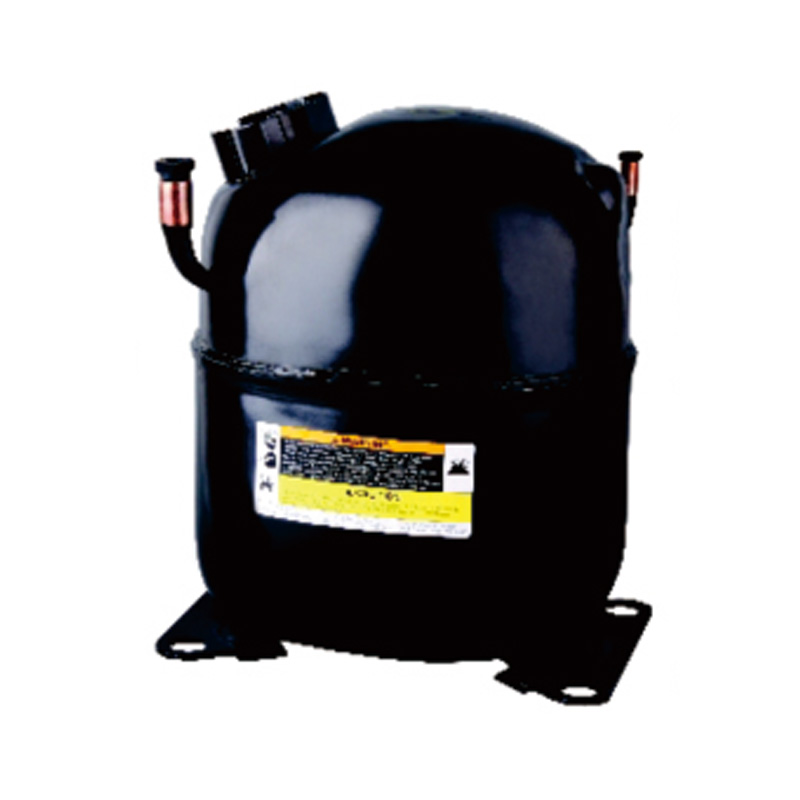
Preventive maintenance should be arranged according to the manufacturer’s recommendations and local service conditions. Compressor and refrigeration work should be completed by qualified technicians. The refrigerant specification must be confirmed for the exact machine configuration before any service or replacement procedure is undertaken.
12. Refrigerant Configuration and Purchasing Verification
The supplied product materials contain more than one refrigerant reference. One specification lists R410, while another information table lists R22, R404A, and R290. This difference should not be treated as a contradiction to be resolved by assumption. Refrigerant selection can vary according to production configuration, destination market, environmental requirements, and customer order.
Before purchasing, buyers should request written confirmation of the refrigerant used in the exact machine being quoted. The commercial documents should identify the refrigerant clearly and consistently across the quotation, nameplate, manual, packing list, and service information. This is especially important for international shipments because refrigerant regulations differ between markets.
Customers should also confirm compressor details, electrical specifications, control voltage, plug type, certification requirements, and any restrictions applying in the destination country. A professional supplier should be able to explain the available configuration and identify which details are standard and which are optional.
13. Suitable Application Scenarios
13.1 Snack Shops
Medium-sized snack shops can use the machine as a dedicated dessert station. Its double-round structure supports several menu options and allows the shop to handle higher demand than a small single-pan unit. The machine can be positioned near the front counter to make preparation visible.
13.2 Market Stalls
Market-stall businesses often rely on visual attraction and fast service. The cart-style machine can become a central feature of the stall, drawing attention through the preparation process. Operators should plan carefully for electrical access, transport, weather protection, and cleaning facilities.
13.3 Dessert Counters
Restaurants, cafés, food courts, and dessert counters can add fried ice cream to an existing menu. The product can complement beverages, waffles, crepes, fruit desserts, and other snack items. The two pans make it possible to prepare specialty flavors without taking up the space required for a large production system.
13.4 Foodservice Chains
Multi-location businesses may use the machine as part of a standardized dessert concept. Consistent recipes, employee training, cleaning procedures, and branding can help create a repeatable customer experience. OEM and ODM cooperation may support chain-specific requirements, subject to technical evaluation.
13.5 Events and Promotional Food Operations
Fried ice cream is well suited to events because the preparation creates a visible performance. The machine can be used at festivals, shopping events, exhibitions, tourist attractions, and promotional activities where customers value fresh preparation and customization. Event operators must provide safe electrical connections, appropriate food storage, and a hygienic service area.
14. Business and Menu Development Benefits
The machine can support more than a single dessert recipe. A business may develop a menu organized around base flavors, seasonal ingredients, premium toppings, children’s combinations, fruit selections, and special event offerings. The ability to prepare different recipes on two pans makes menu experimentation easier.
Operators can also use the preparation process as a form of customer engagement. Staff may allow customers to choose flavors and toppings, then prepare the order in view of the customer. This can increase perceived freshness and create opportunities for social media content, provided that the business follows appropriate privacy and marketing practices.
Menu pricing should account for ingredients, labor, packaging, utilities, cleaning, maintenance, delivery costs, and equipment investment. A high-output machine is valuable only when the business has an effective plan for generating demand and controlling operating costs.
Because the machine is designed for commercial use, it can support a more professional presentation than improvised or domestic equipment. A clean stainless-style work area, organized topping station, clear menu board, and trained staff can help the machine become part of a complete customer experience.
15. Procurement Guidance for Importers and Distributors
Importers should evaluate the product as part of a complete supply arrangement. The purchase discussion should include the exact model, pan configuration, voltage, frequency, refrigerant, compressor, dimensions, weight, packaging, warranty terms, spare parts, manuals, inspection standards, and delivery conditions.
Distributors may benefit from requesting product photographs, technical drawings, carton dimensions, loading information, and recommended spare-part packages. These details support warehousing, transportation planning, customer installation, and after-sales service.
OEM customers should provide branding files, labels, packaging requirements, control-panel language, manuals, and certification specifications early in the development process. ODM customers should clearly identify any required changes to structure, dimensions, cooling performance, appearance, or accessories.
Buyers should also confirm what is included with the machine. Scrapers, containers, covers, spare parts, electrical plugs, manuals, and other accessories may differ by order. A detailed packing list helps prevent misunderstandings.
For larger projects, a sample order or pre-shipment inspection can be useful. The buyer may assess temperature performance, surface quality, electrical operation, machine dimensions, packaging condition, and documentation before mass production or repeat purchasing.
16. Why Manufacturer Support Matters
Commercial refrigeration and frozen dessert equipment must perform reliably over an extended period. Manufacturer support contributes to the total ownership experience by helping the customer select the right configuration, install the machine correctly, solve operating questions, and obtain replacement components when needed.
Spelor’s one-stop service approach includes pre-sales consultation, customization, logistics and payment coordination, and after-sales maintenance. This approach can be valuable for businesses that do not have an internal engineering department. It can also help distributors create a more dependable support system for their own customers.
Effective communication is especially important when technical information varies by market. Refrigerant, voltage, certification, packaging, and language requirements should be reviewed before production. A supplier that can coordinate these details reduces the administrative burden on the buyer.
The company’s combination of commercial refrigeration experience, kitchen equipment knowledge, manufacturing facilities, and product development capability positions it as a potential long-term partner for foodservice equipment procurement rather than only a single-product vendor.
17. Practical Limitations and Responsible Expectations
No machine can eliminate the need for proper recipes, trained employees, regular cleaning, and suitable installation. The Double Round Commercial Fried Ice Cream Cart Machine provides a strong platform for commercial preparation, but final performance depends on how it is used.
Businesses should not assume that two pans automatically guarantee twice the output. Production depends on recipe quantities, freezing time, operator technique, order complexity, toppings, packaging, and customer flow. The main advantage is increased flexibility and parallel working capacity.
The machine also requires sufficient electrical capacity and appropriate ventilation. It should not be installed in a location exposed to uncontrolled rain, excessive dust, standing water, or extreme heat unless suitable protection has been arranged.
Buyers should confirm all technical details before placing an order, especially the refrigerant configuration, electrical requirements, control system, accessories, certification, warranty, and shipping conditions. Clear confirmation helps ensure that the delivered unit matches the needs of the intended market.
18. Frequently Asked Questions
What type of business is this machine designed for?
It is designed for commercial snack shops, dessert counters, market stalls, food courts, cafés, restaurants, mobile food operations, and other businesses that prepare fried ice cream or rolled frozen desserts.
How many pans does the machine have?
The machine has two round pans. Each pan has a diameter of 50 centimeters and a depth of 2 centimeters.
Can both pans be used at the same time?
Yes. The double-round configuration is intended to support parallel preparation. Operators can use both pans for the same recipe, different flavors, or separate customer orders, depending on the workflow.
What is the machine’s power rating?
The stated input power is 2,800 watts. The specified power supply is 220 volts at 50 hertz. Buyers should verify compatibility with the electrical system at the installation site.
What temperature can the machine reach?
The listed working temperature range is approximately minus 25 degrees Celsius to minus 30 degrees Celsius. Actual performance may vary according to ambient temperature, ingredient load, maintenance, and operating conditions.
How much does the machine weigh?
The net weight is approximately 74 kilograms. Appropriate handling equipment or multiple people may be required when moving or installing the machine.
What are the machine dimensions?
The stated dimensions are 1,350 millimeters in length, 680 millimeters in width, and 800 millimeters in height.
Which refrigerant does the machine use?
The supplied materials reference R410 in one specification and R22, R404A, or R290 in another configuration table. The exact refrigerant should be confirmed in writing for the final order, because it may depend on the product configuration and destination market.
Is the machine easy to clean?
The work-surface format is designed for direct access during cleaning, but the operator must follow suitable foodservice sanitation procedures. The machine should be switched off as required, food residue should be removed promptly, and water or cleaning chemicals should be kept away from electrical and refrigeration components.
Can the machine be customized?
The manufacturer provides OEM and ODM services based on drawings or customer requirements. Possible customization should be discussed in detail and confirmed in the formal technical documentation for the order.
Can one person operate the machine?
One trained operator can use the machine, particularly during moderate demand. During peak periods, two staff members may use the two pans simultaneously to improve workflow and service speed.
What ingredients can be used?
Depending on the business recipe, operators may prepare fruit, chocolate, vanilla, coffee, cookie, caramel, nut, and other flavor combinations. Recipes should be tested and standardized before commercial service.
Is the machine suitable for outdoor use?
It can be used in selected market or event environments if the site provides safe electrical service, weather protection, stable flooring, sufficient ventilation, hygienic ingredient storage, and suitable cleaning arrangements. Outdoor exposure should not be assumed to be acceptable without proper protection.
What should buyers confirm before ordering?
Buyers should confirm the model, pan size, power supply, frequency, refrigerant, compressor, dimensions, accessories, certifications, packaging, warranty, spare parts, delivery terms, and after-sales support. These details should appear consistently in the quotation and order documents.
19. Final Assessment
The Double Round Commercial Fried Ice Cream Cart Machine is a practical solution for businesses that want to prepare rolled frozen desserts with higher flexibility and stronger peak-period capacity than a basic single-pan machine can provide. Its two 50-centimeter round pans create a broad working platform for parallel preparation, flavor customization, and customer-facing presentation.
Its 2,800-watt power rating, stated low-temperature operating range, 74-kilogram structure, and commercial dimensions make it suitable for medium-sized snack shops, market stalls, dessert counters, food courts, and related foodservice applications. The machine balances production capability with a format that can fit into many commercial environments.
The product’s value is strengthened by the manufacturer’s integrated capabilities. Spelor Electrical Appliances (Zhejiang) Co., Ltd. combines design, research and development, manufacturing, sales, customization, logistics coordination, and after-sales service. Its more than 60,000 square meters of production facilities and broad foodservice equipment portfolio support both standard procurement and larger OEM or ODM projects.
For the best result, customers should treat the machine as part of a complete operating system. Correct installation, standardized recipes, trained staff, food hygiene, preventive maintenance, and accurate technical confirmation all contribute to performance. Particular attention should be given to refrigerant selection and electrical compatibility before the order is finalized.
With the right business model and operating procedures, the Double Round Commercial Fried Ice Cream Cart Machine can become more than a freezing appliance. It can serve as a high-visibility dessert station, a flexible menu-development platform, and a productive commercial asset for foodservice businesses seeking fresh preparation and customer interaction.
References
1. Spelor Electrical Appliances (Zhejiang) Co., Ltd. Product specification materials for model 2CB-500Y.
2. Spelor Electrical Appliances (Zhejiang) Co., Ltd. Commercial refrigeration and foodservice equipment company information.
3. General commercial refrigeration principles relating to low-temperature equipment operation, condenser airflow, preventive maintenance, and electrical safety.
4. General foodservice sanitation principles for cleaning food-contact surfaces and preventing cross-contact during dessert preparation.
5. General equipment procurement practices for OEM and ODM foodservice machinery, including specification confirmation, inspection, packaging, and after-sales support.
Product: Double Round Commercial Fried Ice Cream Cart Machine for Snack Bar & Market Stall

For exclusive deals and latest offers, sign up by entering your email address below.


-
spelor@spelor.com
-
+86-576-85229688
-
No.528, Changxi Road, Linhai City, Zhejiang Province, China
Commercial Refrigeration Equipment Manufacturer China
Copyright © 2025 by Spelor Electrical Appliances (Zhejiang) Co., Ltd. Rights Reserved.
