


 中文简体
Dual-Tank Commercial Slush Machine: Capacity, Control, and Reliable Frozen Beverage Service
Admin 2026-10-27Introduction
Commercial beverage businesses need equipment that can produce attractive, consistent, and profitable drinks throughout the day. In a bar, café, restaurant, snack shop, hotel, convenience store, or catering operation, frozen beverages must be prepared quickly while maintaining a stable texture and appealing presentation. A machine that is difficult to operate, slow to recover, or limited to one flavor can create unnecessary pressure during busy service periods.
The XN240B dual-tank commercial slush machine is designed to meet these practical foodservice requirements. With two independent 15-liter tanks, a total capacity of 30 liters, a rated output of 1000 watts, and a compact vertical structure, it provides a suitable solution for businesses that need multiple frozen drink flavors in a relatively limited footprint. The machine is intended for continuous commercial use and is suitable for frozen beverages, slush drinks, chilled fruit preparations, and other appropriate drink formulations.
Its value is not based only on tank capacity. The design combines separate circulation and temperature control, a food-grade stainless-steel body, colorful sprayed steel exterior components, an environmentally considerate R290 refrigerant system, and a structure that is comparatively straightforward to clean and maintain. These features help operators balance product quality, service speed, visual presentation, energy considerations, and long-term operating convenience.
This article examines the machine’s construction, performance characteristics, commercial advantages, application scenarios, maintenance requirements, and manufacturing strengths. It also explains why a dual-tank configuration can be more useful than a basic single-tank model when a business wants to serve different flavors or manage demand more efficiently.
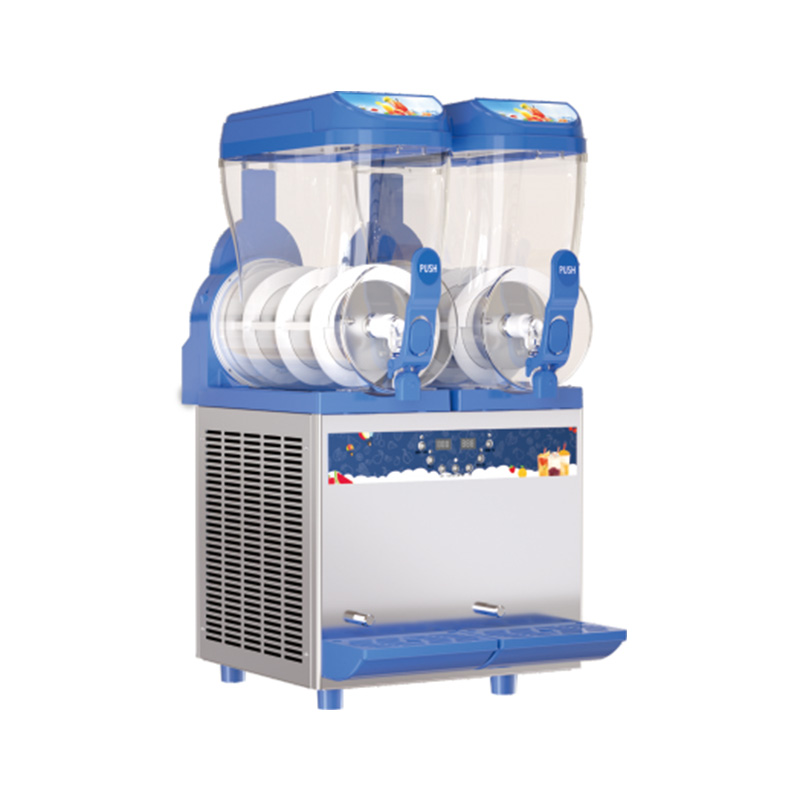
2*15L Commercial Slush Maker Frozen Drink Machine for Bar Cafe Restaurant
Product Overview
The machine is identified as model XN240B and is configured with two 15-liter tanks. Each tank can be used for a separate flavor or beverage formula, allowing the operator to offer greater variety without purchasing two independent machines. The total nominal capacity is 30 liters, which gives the unit a practical balance between service volume and equipment size.
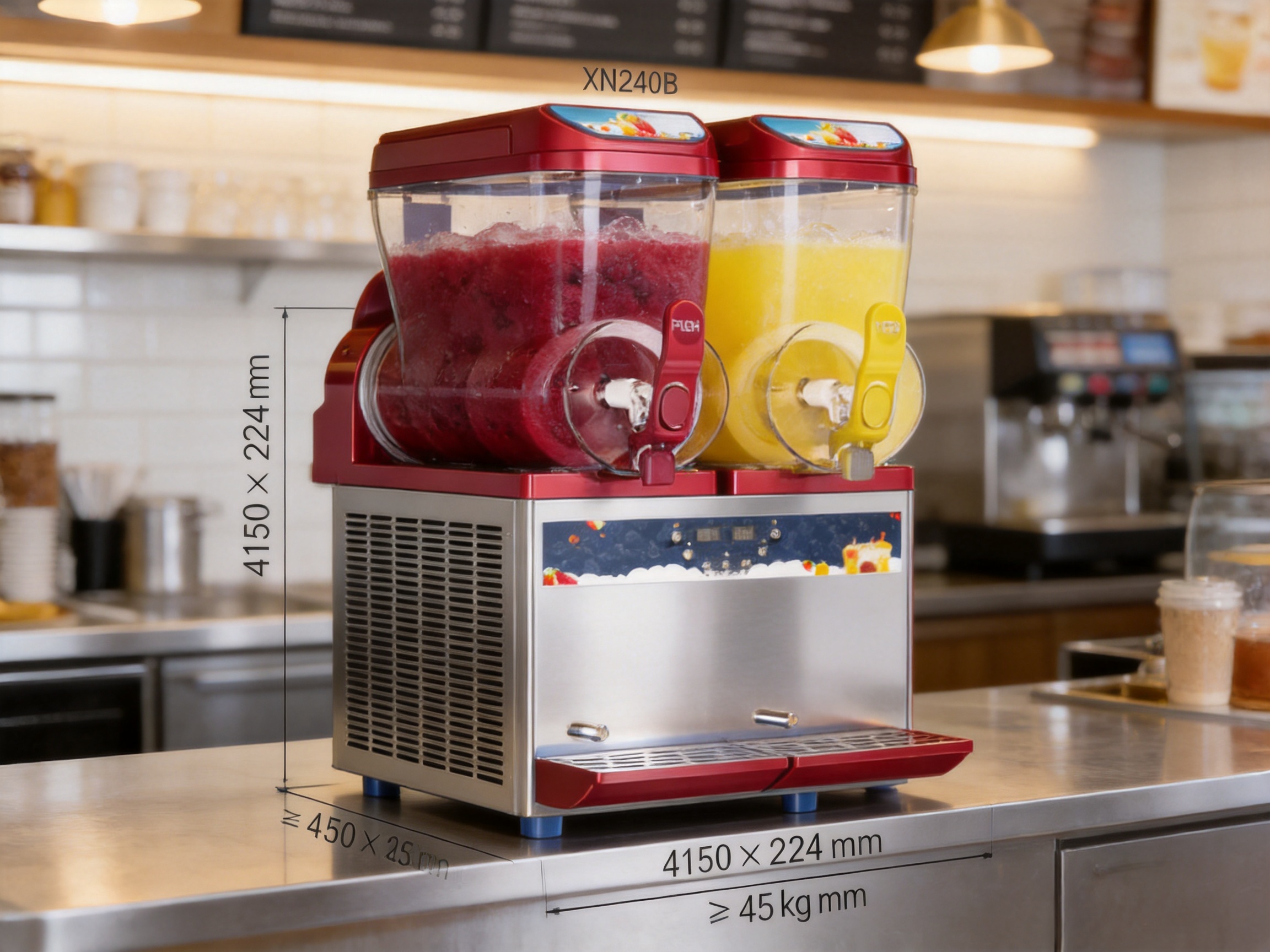
The vertical body measures approximately 414 by 550 by 824 millimeters. This footprint allows the machine to be placed on a suitable counter, service station, beverage island, or dedicated equipment table, subject to the installation requirements of the site. Its 45-kilogram net weight gives the unit a stable commercial presence while still allowing trained personnel to reposition it when necessary.
The exterior combines food-grade stainless steel and colorful sprayed steel. Stainless steel is widely used in professional foodservice equipment because it offers a durable, hygienic, and practical surface for daily operation. The sprayed steel sections provide opportunities for an attractive appearance and can help the machine coordinate with the visual identity of a beverage counter, café interior, bar, or quick-service restaurant.
A rated output of 1000 watts supports the machine’s cooling and circulation functions. Actual production performance will depend on the starting temperature of the liquid, recipe composition, ambient conditions, ventilation, serving frequency, and other operating factors. Nevertheless, the power rating indicates that the machine is designed as a commercial appliance rather than a small domestic frozen drink unit.
The refrigeration system uses R290 refrigerant, also identified in some product specifications as R290a. R290 is propane-based refrigerant commonly used in modern refrigeration equipment. The exact charging and service requirements should always be handled according to the machine’s nameplate, technical documentation, and applicable safety regulations.
Main Technical Specifications
| Item | Specification |
|---|---|
| Model | XN240B |
| Product type | Commercial dual-tank slush machine |
| Tank configuration | 2 independent tanks |
| Tank capacity | 2 × 15 liters |
| Total nominal capacity | 30 liters |
| Rated output | 1000 watts |
| Refrigerant | R290 |
| Net weight | 45 kilograms |
| Dimensions | 414 × 550 × 824 millimeters |
| Primary materials | Food-grade stainless steel and sprayed steel |
| Control concept | Independent circulation and temperature control for each tank |
Why a Dual-Tank Configuration Matters
One of the most important advantages of the XN240B is its two-tank design. A single-tank machine can be appropriate for a small location with one signature flavor, but it limits menu flexibility. A dual-tank model enables a business to offer two flavors, two colors, or two beverage categories at the same time.
For example, one tank may contain a lemon-based slush while the other holds a berry flavor. A bar may use one tank for a non-alcoholic frozen drink and reserve the second tank for another recipe. A café can offer two seasonal options, while a restaurant can separate a popular standard flavor from a rotating promotional product. This flexibility allows operators to respond to customer preferences without increasing equipment count in direct proportion to menu variety.
The two tanks also support more effective demand management. If one flavor sells faster than the other, the operator can monitor each side independently and refill only the tank that requires attention. This can reduce unnecessary product preparation and help limit waste. It also makes it possible to maintain a high-demand flavor while still keeping a second option available.
Compared with two separate single-tank machines, one dual-tank unit can simplify counter organization. A shared chassis reduces duplicated external surfaces and can create a cleaner service layout. It may also make staff training easier because the operating concept is consolidated into one piece of equipment. The appropriate choice will depend on local regulations, required recipes, electrical infrastructure, and production volume, but the dual-tank format offers a strong balance between variety and space efficiency.
Independent Control for More Consistent Results
Each tank is designed with independent circulation and temperature control. This feature is important because two different beverages may not require identical operating conditions. A thicker formulation, a sweeter recipe, or a beverage with different solids content can behave differently during freezing and dispensing.
Separate control allows the operator to manage each side according to the needs of its recipe. It also helps prevent the operation of one tank from directly affecting the product in the other tank. Independent circulation promotes a more uniform distribution of ingredients throughout the tank, helping reduce separation and supporting a consistent serving texture.
Uniform circulation is especially important when beverages contain flavor concentrates, syrups, fruit components, or other ingredients that may settle over time. A continuously moving product can provide a more stable appearance and taste from the first serving to the last. Operators must still follow suitable formulations and preparation procedures, but the machine’s circulation design provides an important mechanical foundation for consistency.
Independent temperature control also gives the business greater freedom in menu planning. The machine can accommodate two recipes that have similar general requirements but need different settings for optimum service. Operators should not assume that every formulation can be frozen successfully. Recipes should be tested before commercial launch, particularly when they contain alcohol, unusually high sugar content, dairy ingredients, pulp, or other components that influence freezing behavior.
Construction and Hygiene Advantages
Foodservice equipment must withstand repeated contact with moisture, ingredients, cleaning chemicals, staff handling, and changing temperatures. The use of food-grade stainless steel in the plate body helps support a hygienic and durable working environment. Stainless steel is valued for its smooth surface, resistance to corrosion in ordinary foodservice conditions, and ease of wiping and sanitizing when properly maintained.
The machine’s material selection also contributes to a professional appearance. In a café or bar, beverage equipment is often visible to customers rather than hidden in a back room. A clean stainless-steel surface and colorful exterior can therefore support the overall presentation of the business. An attractive machine may become part of the service counter rather than appearing as an industrial appliance that must be concealed.
Hygiene depends on more than material selection. Operators must establish a routine for draining, rinsing, cleaning, sanitizing, and drying the tanks and product-contact components. Spills should be removed promptly, and seals, dispensing areas, and drip zones should receive particular attention. Stainless steel can support sanitation, but it does not replace correct cleaning procedures or food safety management.
The vertical arrangement makes the two tanks easy to identify during operation. Clear product visibility, where provided by the tank design, can help staff monitor fill level, texture, and color. It can also allow customers to see the available flavors, which may support impulse purchases. Operators should keep transparent or exposed areas clean because fingerprints, splashes, and residue can affect the appearance of the entire service station.
Durability for Daily Commercial Use
A commercial slush machine must be prepared for a different usage pattern from a household appliance. It may operate for long periods, serve repeated portions, and be handled by multiple employees. The 45-kilogram net weight, metal body construction, and commercial refrigeration configuration provide a foundation for stable use in demanding environments.
Durability is also influenced by manufacturing precision. Correctly assembled refrigeration lines, secure electrical connections, accurately fitted panels, reliable seals, and properly aligned circulation components all contribute to service life. A strong factory production system is therefore as important as the visible material of the finished machine.
Routine maintenance remains essential. Operators should avoid overloading the tanks, blocking ventilation openings, using unsuitable cleaning tools, or moving the machine while it is connected to power. Preventive inspection can identify worn seals, unusual noise, temperature irregularities, or changes in circulation before they develop into larger service problems.
Refrigeration and R290 Considerations
The machine uses R290 refrigerant, a refrigerant selected in many modern commercial refrigeration applications because of its low global warming potential compared with several older refrigerant types. Its use reflects the broader movement toward refrigeration systems that consider environmental impact alongside cooling performance.
R290 is classified as a flammable refrigerant, so its use requires appropriate equipment design, installation practice, transportation, service procedures, and technician training. The unit should be installed and repaired only in accordance with the manufacturer’s technical instructions and relevant local regulations. Unauthorized refrigerant work can create safety risks and may invalidate warranty or compliance arrangements.
Ventilation is important for any refrigeration appliance. The machine should have adequate clearance around its ventilation areas, and it should not be placed next to equipment that produces excessive heat. A hot, enclosed, or poorly ventilated location can increase the workload on the refrigeration system and affect cooling efficiency.
Operators should also allow the machine to stabilize after installation or relocation before starting normal operation, especially if it has been transported or tilted. The exact waiting period should follow the manufacturer’s instructions. Correct positioning and careful handling reduce the risk of oil migration or other refrigeration-related issues.
Cooling Performance in Real Service Conditions
Cooling performance is influenced by more than the rated wattage. Liquid temperature, sugar concentration, alcohol content, ambient temperature, ventilation, tank fill level, and dispensing frequency all have an effect. A product placed into the machine at a lower starting temperature will generally reach service condition more efficiently than a warm mixture.
For best results, beverage mixtures should be prepared consistently. Ingredients should be measured accurately, powders or concentrates should be fully dissolved, and the formulation should be tested for the desired slush texture. An unsuitable recipe may freeze too hard, remain too liquid, separate during operation, or place additional stress on the machine.
During peak periods, staff should monitor the tanks and avoid repeatedly adding large quantities of warm liquid. Gradual replenishment with properly chilled product can help protect texture and reduce recovery time. Businesses should also consider their expected sales pattern when determining how much product to prepare and when to refill each tank.
Commercial Advantages Over Basic Alternatives
The machine offers several practical advantages over simple single-tank or non-commercial frozen drink solutions. The first is menu flexibility. Two 15-liter tanks provide two product options without requiring two separate bodies, two independent service areas, and potentially two sets of operating procedures.
The second advantage is independent management. Separate circulation and temperature systems help the operator control each flavor according to its own behavior. This is more useful than a shared tank when different recipes are served at the same time.
The third advantage is service capacity. With 30 liters of nominal total capacity, the machine can support a meaningful number of servings before replenishment is required. Actual serving yield depends on portion size and operating conditions, but the capacity is appropriate for many cafés, bars, restaurants, dessert shops, and seasonal beverage outlets.
The fourth advantage is counter efficiency. At approximately 414 millimeters wide, the unit can provide a two-flavor service point without occupying the width of two conventional appliances. Businesses should always verify the full installation space, including rear clearance, side access, electrical connection, and staff movement, but the compact width can be valuable where counter space is limited.
The fifth advantage is visual appeal. The combination of stainless steel and colorful sprayed steel can be more suitable for customer-facing locations than plain equipment with a purely industrial finish. A visible frozen beverage machine can help communicate freshness, variety, and activity to customers waiting at the counter.
The sixth advantage is maintainability. Commercial equipment is most valuable when it can be kept in service through a clear cleaning and maintenance routine. A straightforward dual-tank layout allows staff to identify product levels and deal with each side separately. Proper access to product-contact areas, together with scheduled inspection, can support stable operation over time.
Comparison with Common Equipment Choices
| Equipment option | Main benefit | Potential limitation | Where the dual-tank machine can help |
|---|---|---|---|
| Single-tank slush machine | Simple operation and lower initial capacity | Only one flavor at a time | Offers two flavors in one commercial unit |
| Two separate single-tank units | Independent equipment and configuration | More counter width, duplicated surfaces, and more complex layout | Combines two service options in one body |
| Household frozen drink appliance | Suitable for occasional low-volume use | Limited capacity and commercial durability | Provides higher capacity and foodservice-oriented construction |
| Manual ice-and-container service | Low equipment investment | Inconsistent texture and slower service | Supports continuous chilled product availability |
| Large multi-tank production system | Very high capacity | Higher space, cost, and installation requirements | Provides a more compact option for moderate demand |
Suitable Applications
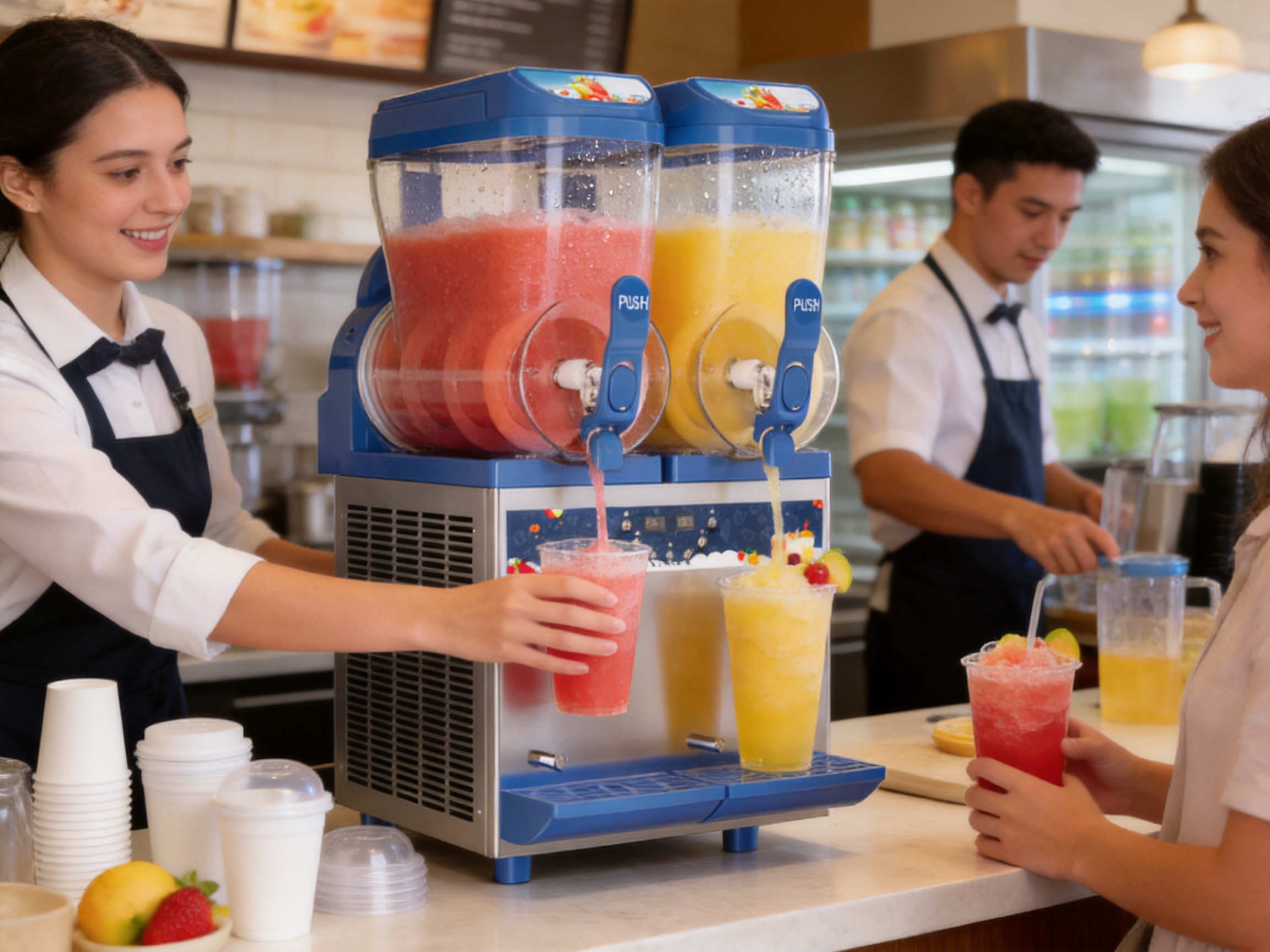
The XN240B is suitable for a wide range of foodservice environments. In cafés, it can support fruit slushes, iced beverages, and seasonal frozen drink menus. Two tanks allow the business to present a regular bestseller alongside a limited-time flavor, helping create variety without a major change to the service counter.
Bars can use the machine for non-alcoholic frozen drinks, mixers, mocktails, and appropriate frozen cocktail formulations. Alcohol changes freezing behavior, so any alcoholic recipe must be tested carefully and used only when compatible with the equipment and local regulations. A bar may also use one side for a daytime soft drink and the other for an evening specialty beverage.
Restaurants can place the machine near a dessert station, beverage counter, or takeaway area. A frozen drink can complement grilled food, fast food, pizza, sandwiches, or casual dining menus. In hot weather, the visual presence of a slush machine may encourage add-on purchases and help increase the average order value.
Snack shops and dessert stores may use the two tanks to offer contrasting flavors, such as a citrus option and a berry option. The same machine can also support color variety, which may be particularly attractive to younger customers and families. Operators should select recipes that are stable under continuous circulation and suitable for the intended holding time.
Hotels, event venues, and institutional foodservice operations can benefit from the machine’s ability to provide two choices in one organized service point. For temporary events, the machine should be transported and installed by trained personnel, with attention to electrical supply, level positioning, ventilation, drainage, and food safety procedures.
Supermarkets and convenience stores may use the machine in a prepared-food, beverage, or self-service area, subject to local operating requirements. In such settings, clear labeling, portion control, cleaning schedules, and customer access management are especially important.
Manufacturing Strengths and Production Capability
The manufacturer is a professional producer of commercial refrigeration, kitchen, buffet, and foodservice equipment. Its production base covers more than 60,000 square meters of modern facilities. This scale supports the integration of product design, research and development, manufacturing, sales, and service within one organization.
A broad manufacturing scope is valuable because commercial equipment often requires cooperation among several technical disciplines. Refrigeration engineering, sheet-metal fabrication, electrical design, food-contact material selection, thermal management, assembly, quality inspection, packaging, and after-sales support must work together. A company that maintains these capabilities under one manufacturing system can coordinate product development and production more effectively.
For a dual-tank slush machine, production quality depends on many individual processes. Stainless-steel panels must be cut and formed accurately. Sprayed steel parts require suitable surface preparation and consistent coating. Refrigeration components must be installed with care. Electrical wiring must be routed securely. Tanks, seals, circulation components, controls, and dispensing assemblies must be assembled and checked according to defined procedures.
Integrated Design and Research
In-house design and research capability can help a manufacturer respond to changing market needs. Foodservice customers may request different capacities, colors, electrical specifications, control arrangements, packaging formats, or branding treatments. An integrated development process makes it easier to evaluate these requirements and convert them into manufacturable products.
Design work should consider more than appearance. Engineers must evaluate airflow, cooling load, tank geometry, circulation performance, accessibility for cleaning, structural stability, electrical safety, and the relationship between components. A well-designed machine balances these factors instead of optimizing one feature at the expense of the entire operating system.
Research and development also supports product refinement. Feedback from distributors, operators, technicians, and end users can reveal opportunities to improve noise levels, service access, control clarity, panel strength, packaging protection, or energy performance. Continuous improvement is particularly important in commercial equipment because small operating inconveniences can become significant costs when repeated every day.
Manufacturing Process Overview
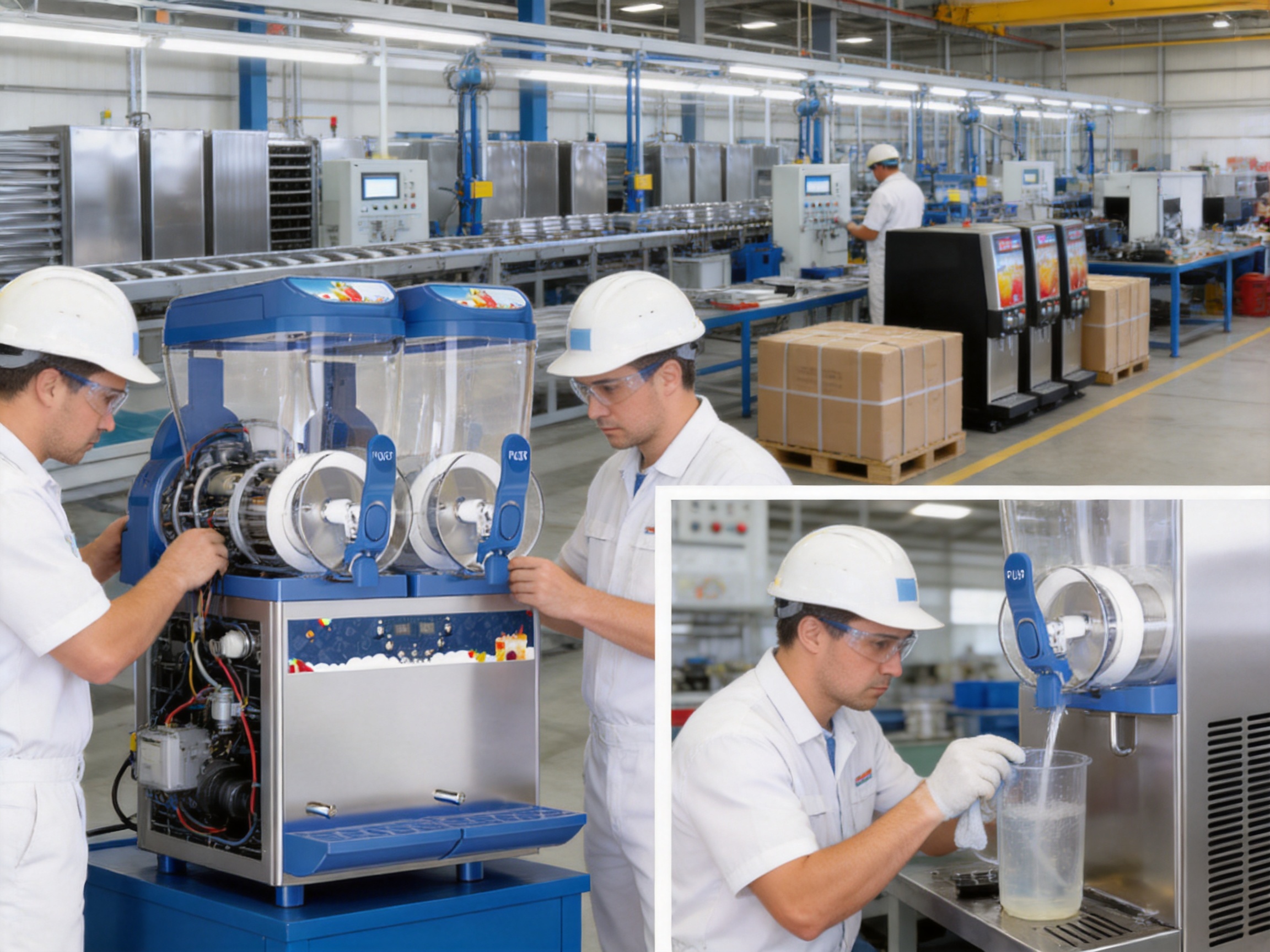
The production process begins with material and component preparation. Metal sheets and other approved materials are selected according to product requirements. Components are then cut, shaped, drilled, finished, and prepared for assembly. Dimensional accuracy is important because poorly fitted panels can affect appearance, stability, and access to internal components.
Surface treatment follows the requirements of each part. Food-contact and working surfaces must be suitable for their intended use, while exterior sprayed steel components require a durable and visually consistent finish. Correct preparation before spraying helps improve adhesion and reduce defects such as uneven coverage, peeling, or premature corrosion.
Refrigeration assembly is a critical stage. The compressor, condenser, evaporator, tubing, filter-drier, controls, and refrigerant circuit must be connected correctly. The system must be checked for leakage and abnormal pressure conditions. Because R290 is flammable, production and service procedures must include appropriate safety controls and qualified personnel.
Electrical assembly includes the installation of switches, controls, wiring, protective devices, motors, and connections. Wiring should be arranged to reduce the risk of abrasion, heat damage, moisture exposure, or accidental disconnection. Electrical testing can help verify continuity, insulation, grounding, and functional operation before the product leaves the factory.
Tank and circulation assembly must be completed with attention to alignment and sealing. The two sides should operate independently while remaining structurally integrated into the main body. Properly fitted seals help reduce leakage and support sanitation. Circulation components should be inspected for smooth operation and abnormal vibration.
Final testing should include visual inspection, functional operation, cooling verification, control response, circulation performance, and packaging review. Testing under controlled factory conditions cannot reproduce every possible restaurant environment, but it can identify manufacturing defects before shipment. A documented inspection process provides greater consistency than relying only on informal visual checks.
Quality Control and Reliability
Quality control should be applied throughout production rather than only at the end. Incoming materials and purchased components should meet defined specifications. Manufacturing stations should use clear procedures for assembly, inspection, and correction. Finished machines should be evaluated against technical requirements and customer expectations.
For this type of equipment, important inspection points include tank integrity, panel fit, surface finish, door or cover alignment where applicable, wiring condition, control response, refrigerant circuit integrity, compressor operation, noise, vibration, and temperature performance. The dispensing and circulation systems should also be checked because they directly influence the customer’s daily experience.
Reliability is not simply the absence of an immediate defect. It is the ability of the equipment to perform consistently when used according to its intended purpose. A reliable machine should be predictable for staff, maintain a stable product condition, and provide service access when inspection or repair is required.
The manufacturer’s experience across commercial refrigeration and foodservice equipment contributes to this reliability perspective. A company that produces several related equipment categories can apply knowledge of cooling systems, food-contact construction, commercial kitchens, and service requirements across different product lines.
OEM and ODM Support
Foodservice equipment buyers may require more than a standard catalog model. Distributors, restaurant groups, hotel chains, and project contractors may request special colors, packaging, electrical configurations, labels, control languages, or product combinations. OEM and ODM capabilities can support these requirements when they are technically and commercially appropriate.
OEM production generally involves manufacturing according to a customer’s specifications or branding requirements. ODM cooperation may involve adapting an existing design or developing a product around a customer’s application. For a commercial slush machine, customization may include exterior appearance, tank configuration, control details, regional electrical standards, or shipping presentation.
Customization should be managed through clear technical documentation. The buyer and manufacturer should confirm the required voltage, frequency, plug type, refrigerant regulations, dimensions, color, packaging, certifications, operating environment, and expected order quantity before production. This process reduces misunderstandings and helps ensure that the final machine is suitable for its target market.
Installation and Commissioning Guidance
The machine should be placed on a stable, level surface capable of supporting its operating weight. The installation site should provide sufficient space for staff to fill tanks, serve drinks, clean the unit, and access ventilation areas. The exact clearance requirements should follow the technical manual and local installation standards.
Before commissioning, staff should inspect the machine for shipping damage, confirm that accessories and documentation are present, and verify that the electrical supply matches the nameplate. Any visible damage should be reported before the equipment is placed into service. The machine should not be operated if important panels, cables, or refrigeration components appear damaged.
After positioning, the unit should be allowed to settle as recommended by the manufacturer, especially if it was transported at an angle. The tanks and product-contact components should be cleaned and sanitized before the first production run. Staff should become familiar with the controls, tank-specific settings, dispensing procedure, and emergency shutdown process.
Ventilation openings must remain unobstructed. The machine should not be installed immediately beside ovens, fryers, steam-producing appliances, or other heat sources unless the installation has been specifically designed for that environment. Excessive ambient heat can reduce cooling efficiency and increase compressor workload.
Daily Operation and Maintenance
At the beginning of each operating period, staff should check the machine’s general condition, cleanliness, tank level, dispensing area, electrical connection, and ventilation space. Beverage mixtures should be prepared according to an approved recipe and loaded without exceeding the recommended fill level.
During service, operators should watch for unusual noise, vibration, leaks, poor circulation, excessive frost, or an unexpected change in product texture. Any abnormal condition should be recorded and investigated. Continuing to operate equipment with a serious fault can increase repair costs or compromise food safety.
At the end of the day, the product should be handled according to the business’s food safety plan. Tanks and product-contact components should be drained, rinsed, cleaned, sanitized, and dried as required. Residue should not be allowed to accumulate around outlets, seals, covers, or drip areas.
Cleaning tools should be appropriate for stainless steel and food-contact surfaces. Abrasive pads, harsh chemicals, and unsuitable solvents can damage finishes or create contamination risks. Cleaning chemicals must be mixed, used, and rinsed according to their instructions. Staff should follow documented procedures rather than relying on memory.
Periodic maintenance should include inspection of seals, dispensing components, circulation mechanisms, electrical cords, controls, condenser areas, and external fasteners. Dust and debris around ventilation components should be removed safely. Refrigeration service, refrigerant charging, and internal electrical repairs should be carried out by qualified technicians.
Recipe and Product Management
The quality of the finished slush depends heavily on the recipe. Sugar content, solids, acidity, pulp, dairy ingredients, alcohol, and stabilizers can all influence freezing characteristics. A recipe that is too dilute may freeze excessively hard, while a recipe with too much sugar or alcohol may remain too soft.
Businesses should test each beverage before introducing it to customers. Testing should cover starting temperature, texture, flavor consistency, dispensing performance, holding time, and behavior during peak service. Each tank should be assigned a recipe and operating procedure so that staff can reproduce the result consistently.
Ingredient rotation and labeling are also important. Prepared mixtures should be identified with preparation time, flavor, and any required storage information. Operators should avoid mixing incompatible residues between flavors, particularly when allergens, dairy components, or strong colors are involved.
Business and Operational Value
A commercial beverage machine should be evaluated not only by its purchase price but also by the value it creates during daily service. The dual-tank format can support a broader menu, which may increase customer choice and encourage additional purchases. Frozen beverages can also provide a high-visibility product that attracts attention in warm weather or high-footfall locations.
Capacity planning is another important factor. Thirty liters of total nominal tank capacity can help reduce the frequency of refilling compared with smaller units. Fewer interruptions may allow staff to focus on customer service, food preparation, and order fulfillment. At the same time, the capacity is not so large that every business must prepare excessive quantities in advance.
Space efficiency can influence operating costs. A single dual-tank unit may require less counter width than two separate machines. This can leave room for cups, lids, flavor dispensers, payment equipment, or other revenue-producing items. A carefully planned service station can improve both staff movement and customer visibility.
Maintenance and cleaning also affect total ownership cost. Equipment that is straightforward to understand and maintain can reduce avoidable downtime. Clear staff procedures, preventive inspections, and timely technical support are essential to achieving this benefit.
For distributors and commercial buyers, the manufacturer’s broad product range creates opportunities for coordinated procurement. A customer sourcing several categories of foodservice equipment may be able to work with one experienced supplier for refrigeration, beverage, kitchen, and buffet applications. This can simplify communication, product matching, shipping coordination, and after-sales support.
Frequently Asked Questions
What is the total capacity of the machine?
The machine has two tanks, each with a nominal capacity of 15 liters, for a total nominal capacity of 30 liters.
Can each tank hold a different flavor?
Yes. The dual-tank design is intended to allow two flavors or beverage formulations to be served at the same time. Each side has independent circulation and temperature control, although every recipe should be tested for compatibility with the machine.
Is the machine suitable for bars and restaurants?
Yes. It is designed for commercial beverage service and is suitable for bars, cafés, restaurants, snack shops, dessert stores, hotels, supermarkets, and similar foodservice locations.
What refrigerant does it use?
The listed refrigerant is R290, also referred to in some product information as R290a. Operators should follow the nameplate and technical documentation for the exact specification. Refrigerant servicing must be performed by qualified personnel using procedures appropriate for flammable refrigerants.
What is the rated power?
The rated output is 1000 watts. Actual energy consumption and cooling performance will vary according to operating conditions, ambient temperature, beverage formulation, and service frequency.
What are the machine dimensions?
The listed dimensions are approximately 414 millimeters wide, 550 millimeters deep, and 824 millimeters high.
How much does the machine weigh?
The net weight is approximately 45 kilograms. The installation surface should be stable and strong enough to support the machine and its operating load.
Is the exterior hygienic and durable?
The plate body uses food-grade stainless steel together with sprayed steel sections. These materials support a durable and professional appearance when the machine is installed, cleaned, and maintained correctly. Hygiene still depends on proper sanitation procedures.
Can the machine serve alcoholic frozen drinks?
Some alcoholic formulations may be suitable, but alcohol affects freezing behavior and may prevent a product from reaching the intended texture. Every alcoholic recipe must be tested carefully, and operators should follow equipment instructions, food safety requirements, and local regulations.
Does the machine require special ventilation?
Like other commercial refrigeration equipment, it requires adequate airflow around its ventilation areas. It should not be placed in a hot, enclosed, or obstructed location. Installation requirements in the technical documentation should be followed.
How often should the tanks be cleaned?
Cleaning frequency depends on the recipe, operating schedule, and food safety plan. Tanks and product-contact components should be cleaned and sanitized regularly, generally after the operating cycle or according to the approved sanitation procedure for the business.
What should be done if the product texture changes?
Staff should check the recipe, ingredient ratios, starting temperature, tank fill level, ambient conditions, circulation, and temperature settings. If the issue continues or is accompanied by unusual noise, leakage, or poor cooling, the machine should be removed from service for qualified inspection.
Can the manufacturer provide customized products?
The manufacturer offers OEM and ODM capabilities for commercial refrigeration and foodservice equipment. Custom requirements should be confirmed in advance, including dimensions, electrical specifications, color, labeling, packaging, certifications, and order quantity.
Conclusion
The 2 × 15-liter commercial slush machine is designed for foodservice operators that need reliable frozen beverage production, multiple flavor options, and efficient use of counter space. Its dual independent tanks provide more menu flexibility than a basic single-tank unit, while separate circulation and temperature control help support stable texture and consistent service.
The 1000-watt rated output, 30-liter total nominal capacity, R290 refrigeration system, stainless-steel construction, sprayed steel exterior, and approximately 414 × 550 × 824-millimeter footprint make it a practical option for bars, cafés, restaurants, snack shops, dessert businesses, hotels, and other commercial environments.
Its overall value is strengthened by the manufacturing capabilities behind the product. More than 60,000 square meters of modern production facilities, integrated design and research, broad foodservice equipment experience, OEM and ODM support, and coordinated after-sales service provide a foundation for supplying customers in different markets and applications.
For the best results, buyers should evaluate the machine together with their expected volume, recipes, counter layout, electrical supply, ventilation, cleaning procedures, and service requirements. When correctly installed and maintained, the dual-tank format can help businesses offer attractive frozen beverages efficiently while supporting consistent product quality and long-term commercial operation.
References
1. Product specification sheet for model XN240B, including tank capacity, rated output, refrigerant, weight, and dimensions.
2. Commercial refrigeration equipment design and maintenance principles.
3. Foodservice sanitation and cleaning procedure guidance for beverage equipment.
4. Refrigerant safety and handling principles for equipment using R290.
5. Commercial kitchen equipment planning and foodservice workflow practices.
6. Manufacturer information concerning commercial refrigeration, kitchen equipment, buffet equipment, OEM production, and ODM development.
Product: 2*15L Commercial Slush Maker Frozen Drink Machine for Bar Cafe Restaurant

For exclusive deals and latest offers, sign up by entering your email address below.


-
spelor@spelor.com
-
+86-576-85229688
-
No.528, Changxi Road, Linhai City, Zhejiang Province, China
Commercial Refrigeration Equipment Manufacturer China
Copyright © 2025 by Spelor Electrical Appliances (Zhejiang) Co., Ltd. Rights Reserved.
