


 中文简体
12L Single-Tank Commercial Slush Machine for Bars, Cafés, and Restaurants
Admin 2026-10-25Commercial beverage operators need equipment that can produce attractive, consistent, and profitable frozen drinks throughout the service day. A dependable slush machine can help a bar, café, restaurant, convenience store, snack shop, or catering business expand its beverage menu without requiring a large footprint or complicated operating procedure. The 12L single-tank commercial slush machine is designed for this practical purpose, combining a compact body, a food-contact-oriented construction, an integrated cooling system, and a simple single-tank workflow.
With its 12-liter capacity, the machine is positioned between small countertop appliances and larger multi-tank commercial systems. It provides enough volume for daily service while remaining suitable for locations with limited counter or floor space. The single-tank format also allows operators to focus on one popular flavor, one seasonal recipe, or one high-margin frozen beverage instead of committing to the cost and space requirements of a multi-flavor unit.
This article examines the machine’s construction, operating value, application range, maintenance considerations, manufacturing background, purchasing factors, and advantages when compared with less specialized alternatives. It also explains the available technical specifications and identifies the points that buyers should confirm before placing an order.

12L Single Tank Commercial Slush Machine for Bar Cafe Restaurant
Product Overview and Commercial Positioning
The 12L single-tank commercial slush machine is a professional frozen beverage appliance identified by model X-120. It is intended for businesses that serve slush drinks, frozen fruit beverages, granitas, flavored ice drinks, and similar chilled refreshments. The tank is sized for small and medium-sized commercial operations that need reliable production but may not require several independent flavor chambers.
The machine’s design emphasizes three practical goals: adequate serving capacity, efficient use of space, and straightforward operation. These goals are particularly important in bars and cafés, where preparation areas are often crowded and staff must move quickly between beverage preparation, customer service, cleaning, and restocking.
A 12-liter tank can support regular service during peak periods while allowing an operator to produce fresh batches rather than storing large quantities of finished product. The exact number of servings depends on cup size, recipe density, ice content, dispensing practice, and the desired consistency of the finished beverage. In practical terms, the capacity is large enough for normal daily supply in many smaller foodservice locations while remaining manageable for businesses that want to limit waste.
The single-tank arrangement also simplifies menu management. Operators can use the tank for a signature fruit slush, a branded non-alcoholic frozen drink, a seasonal special, a cocktail base, or a rotating flavor. Restaurants can coordinate the machine with a limited beverage menu, while bars can use it to prepare frozen cocktails during selected service periods.
Key Product Specifications
The supplied product materials identify the machine as model X-120 and provide two sets of technical data. The core details consistently describe a 12-liter single-tank machine intended for commercial use. Some electrical, refrigerant, weight, and dimensional values differ between the product description and the supplementary information. Buyers should confirm the exact configuration, voltage, refrigerant, and final nameplate data with the supplier before purchase.
| Item | Product Information | Additional Configuration Information |
| Model | X-120 | X-120 |
| Tank capacity | 12L | 12L |
| Rated output | 550W | 700W |
| Refrigerant | R407C | R407C/R410 |
| Net weight | 29KG | 27KG |
| Machine dimensions | 240 × 530 × 800mm | 205 × 535 × 810mm |
The differences shown above may reflect different production configurations, market requirements, revisions, or source records. They should not be treated as interchangeable specifications without confirmation. A commercial buyer should request a formal quotation or technical datasheet stating the selected electrical standard, rated power, refrigerant, dimensions, net weight, plug type, and other order-specific details.
Compact Capacity for Efficient Service
One of the main strengths of the machine is the relationship between its tank capacity and its physical footprint. Large frozen beverage systems may offer multiple tanks, but they can occupy considerable counter or floor space. This can be difficult for compact cafés, small bars, kiosks, dessert shops, and restaurant beverage stations.
The X-120 uses one 12-liter tank to provide a focused production solution. The reported dimensions place the machine at approximately 800 to 810 millimeters in height and approximately 530 to 535 millimeters in depth, with the width varying according to the listed configuration. These dimensions should be checked against the final model drawing, but they indicate a tall, narrow format that can be easier to integrate into a service line than a wider multi-tank machine.
A compact machine can improve workspace organization. It may be positioned near a point-of-sale counter, bar preparation area, dessert display, or self-service beverage station. When installed correctly, the operator can keep ingredients, cups, lids, straws, and garnishes within easy reach without allowing the slush unit to dominate the entire work area.
Space efficiency can also reduce installation complexity. A smaller machine generally requires less counter planning than a large multi-flavor unit, although buyers must still provide suitable ventilation clearance, a stable support surface, safe electrical access, and enough room for cleaning and servicing.
Compared with a domestic frozen drink appliance, the 12-liter commercial format provides more useful working capacity and is better aligned with repeated service. Compared with a high-capacity multi-tank machine, it may offer a more economical entry point for businesses testing frozen drinks or serving one main flavor.
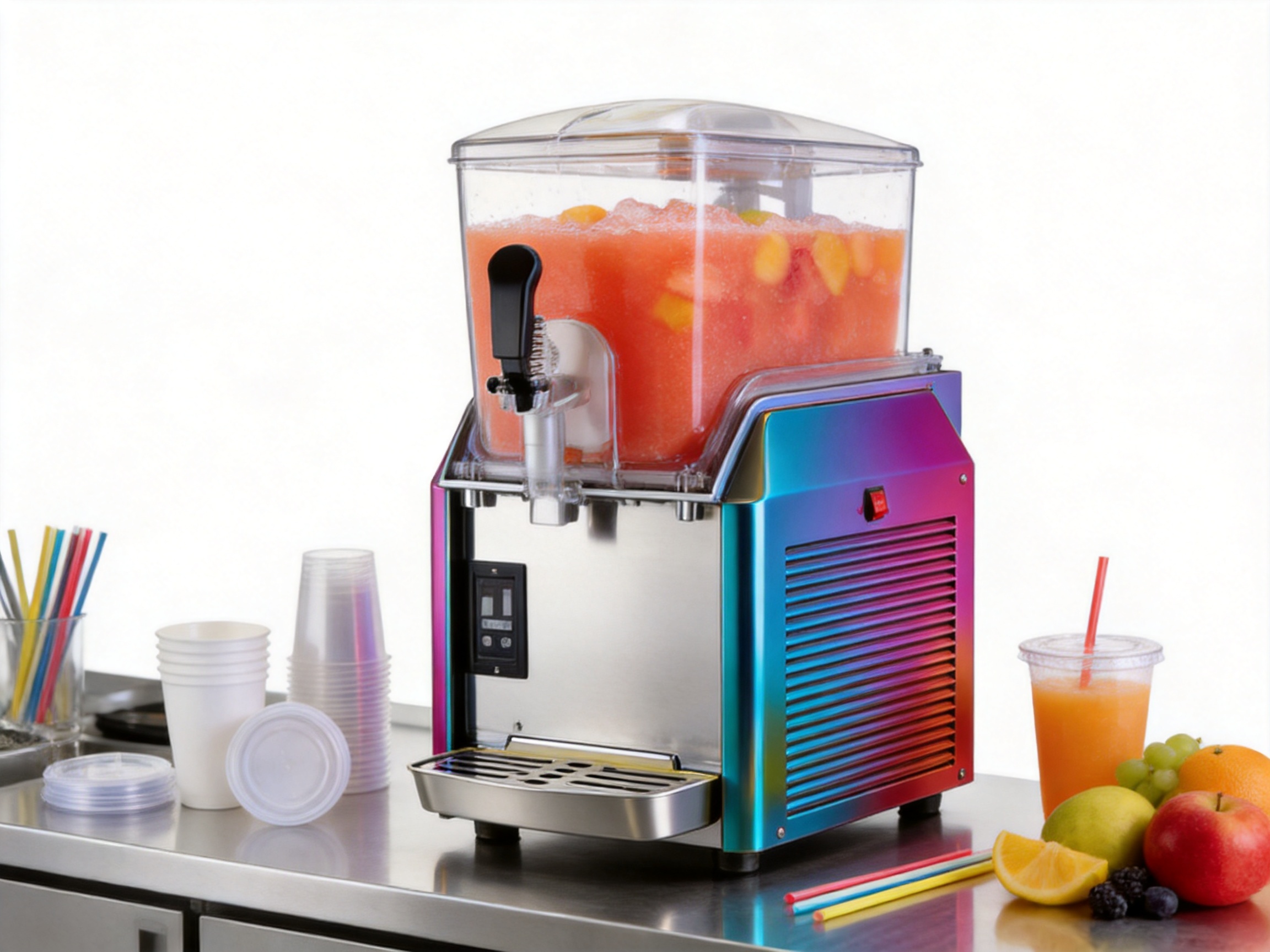
Food-Contact-Oriented Construction and Appearance
The product description states that the plate body is made from food-grade stainless steel and colorful sprayed steel. This construction approach combines a hygienic working surface with a more visible commercial appearance. Stainless steel is widely used in foodservice equipment because it is durable, relatively easy to clean, and suitable for environments where splashes, condensation, and repeated sanitation are normal.
The use of stainless steel in the body can also help the machine present a professional appearance in customer-facing locations. In a bar, café, or restaurant, equipment is often visible to guests. A clean and well-maintained finish can support the overall impression of order, quality, and attention to food safety.
The sprayed steel exterior provides an opportunity for color and visual differentiation. Depending on the selected production finish, the machine can coordinate with a business’s interior design, beverage station, or seasonal presentation. Appearance is not a substitute for performance, but it matters when equipment is installed in an open service area rather than hidden in a back room.
Operators should distinguish between external materials and internal food-contact components. Before purchase, buyers should request information about the tank material, sealing components, dispensing parts, agitator or mixing components, and recommended cleaning chemicals. The machine’s foodservice value depends not only on the outer body but also on the suitability and cleanability of the parts that contact the beverage.
Cooling and Mixing Performance
A commercial slush machine must do more than simply cool a liquid. It must help the product achieve a stable frozen texture while maintaining movement inside the tank. Efficient cooling and even blending are identified as important characteristics of this model. These functions work together: cooling lowers the temperature of the mixture, while agitation distributes temperature and suspended ingredients more evenly.
Consistent mixing is especially important for recipes containing fruit flavoring, sugar, syrups, pulps, or other ingredients that may settle during operation. A properly selected recipe and correctly maintained mixing system can help produce a smoother and more uniform beverage from the beginning of the tank to the end of the service period.
Texture control is influenced by many factors, including the recipe’s sugar concentration, solids content, alcohol content, initial temperature, ambient temperature, filling level, and serving demand. The machine provides the mechanical and refrigeration platform, but operators must still use formulas suitable for frozen beverage equipment. A recipe that is too low in dissolved solids may freeze excessively, while a recipe that contains too much alcohol or sugar may remain too soft.
The machine should therefore be viewed as part of a complete beverage process. Consistent results come from combining suitable ingredients, accurate measuring, correct pre-mixing, proper loading, appropriate operating settings, regular cleaning, and disciplined temperature management.
Advantages Over Less Specialized Alternatives
Compared with Domestic Frozen Drink Appliances
Domestic appliances are often designed for occasional household use, smaller quantities, and shorter operating periods. They may not be suitable for continuous commercial service, repeated dispensing, or the cleaning demands of a foodservice environment. A 12-liter commercial machine offers a more appropriate capacity and operating format for businesses that sell frozen beverages to customers every day.
The commercial design also supports a more organized workflow. Instead of preparing individual batches in a household blender or freezer, staff can load an appropriate mixture into the tank and dispense portions as required. This can reduce preparation interruptions and improve the consistency of the customer experience.
Compared with Manual Ice Blending
Manual blending can produce a frozen drink, but it usually requires repeated labor, ice handling, blender cleaning, and portion-by-portion preparation. During busy periods, this approach can create a bottleneck. A dedicated slush machine can maintain a ready-to-serve product, allowing staff to spend more time on customers and other foodservice tasks.
Manual blending also makes consistency more dependent on the individual employee. Differences in ice quantity, blending duration, liquid temperature, and portion measurement can affect texture and flavor. A commercial tank system creates a more repeatable process when it is operated with a standardized recipe.
Compared with Larger Multi-Tank Systems
Multi-tank machines are valuable when a business needs several flavors available at the same time. However, they usually require more investment, more counter space, more cleaning work, and more product planning. A single-tank unit can be a better fit for a location with one best-selling flavor or a limited rotating menu.
The single-tank format may also reduce the risk of unsold product across multiple flavors. Instead of dividing demand among several tanks, the operator can concentrate production on a proven recipe. This can be beneficial for seasonal businesses, new beverage programs, and establishments with fluctuating traffic.
Compared with Non-Refrigerated Beverage Dispensers
A standard chilled beverage dispenser can serve cold drinks, but it cannot provide the characteristic semi-frozen texture of a slush beverage. The X-120 is designed specifically for frozen or semi-frozen drink service, giving operators access to a product category that can command attention in warm-weather retail, leisure venues, entertainment spaces, and casual dining.
Business Applications
Bars and Cocktail Programs
Bars can use a single-tank slush machine for frozen cocktails, non-alcoholic mocktails, fruit-based drinks, and promotional beverages. A signature frozen cocktail can become a visual feature of the bar, particularly during warm seasons or themed events.
Alcoholic recipes must be developed carefully because alcohol affects freezing behavior. The operator should test the recipe before placing it into regular service and should follow all applicable requirements for responsible alcohol service, labeling, age verification, and local regulations.
Cafés and Dessert Shops
Cafés can add slush drinks to a menu that already includes coffee, tea, juice, and cold refreshments. The machine can support fruit slushes, flavored ice drinks, and dessert-oriented beverages. Its compact format is useful where the business has limited preparation space but wants to broaden its cold beverage offering.
In dessert shops, the machine can complement ice cream, fried ice cream, waffles, pastries, and other sweet products. A frozen fruit drink can provide a lighter alternative to a richer dessert, while a colorful beverage may increase visual appeal in display-oriented retail environments.
Restaurants and Fast-Service Locations
Restaurants can position the machine near the beverage counter or order pickup area. It may be used for lunch promotions, children’s drinks, seasonal menus, or meal-combination upgrades. Since the machine concentrates on one tank, the restaurant can select the flavor with the strongest expected demand.
Fast-service operations benefit from repeatability. A standardized slush recipe can be prepared in advance, kept at the intended texture, and dispensed quickly during service. Staff training can focus on a limited number of steps, helping new employees learn the workflow more easily.
Convenience Stores and Kiosks
Convenience stores and kiosks often rely on impulse purchases. A visible slush machine can attract attention through color, movement, and the association with refreshment. The 12-liter capacity provides a practical starting point for a single-flavor program or a location where demand varies throughout the day.
Operators should evaluate customer traffic, cup size, refill frequency, and peak selling periods when selecting a tank capacity. A single tank may be sufficient for a smaller site, while a high-volume location may eventually require additional units or a larger multi-tank solution.
Events and Institutional Foodservice
The machine may also be suitable for selected events, schools, recreational facilities, canteens, and institutional foodservice environments, provided that the installation, electrical supply, cleaning procedures, and local hygiene requirements are properly addressed. It can provide a controlled beverage station for celebrations, seasonal programs, or special service days.
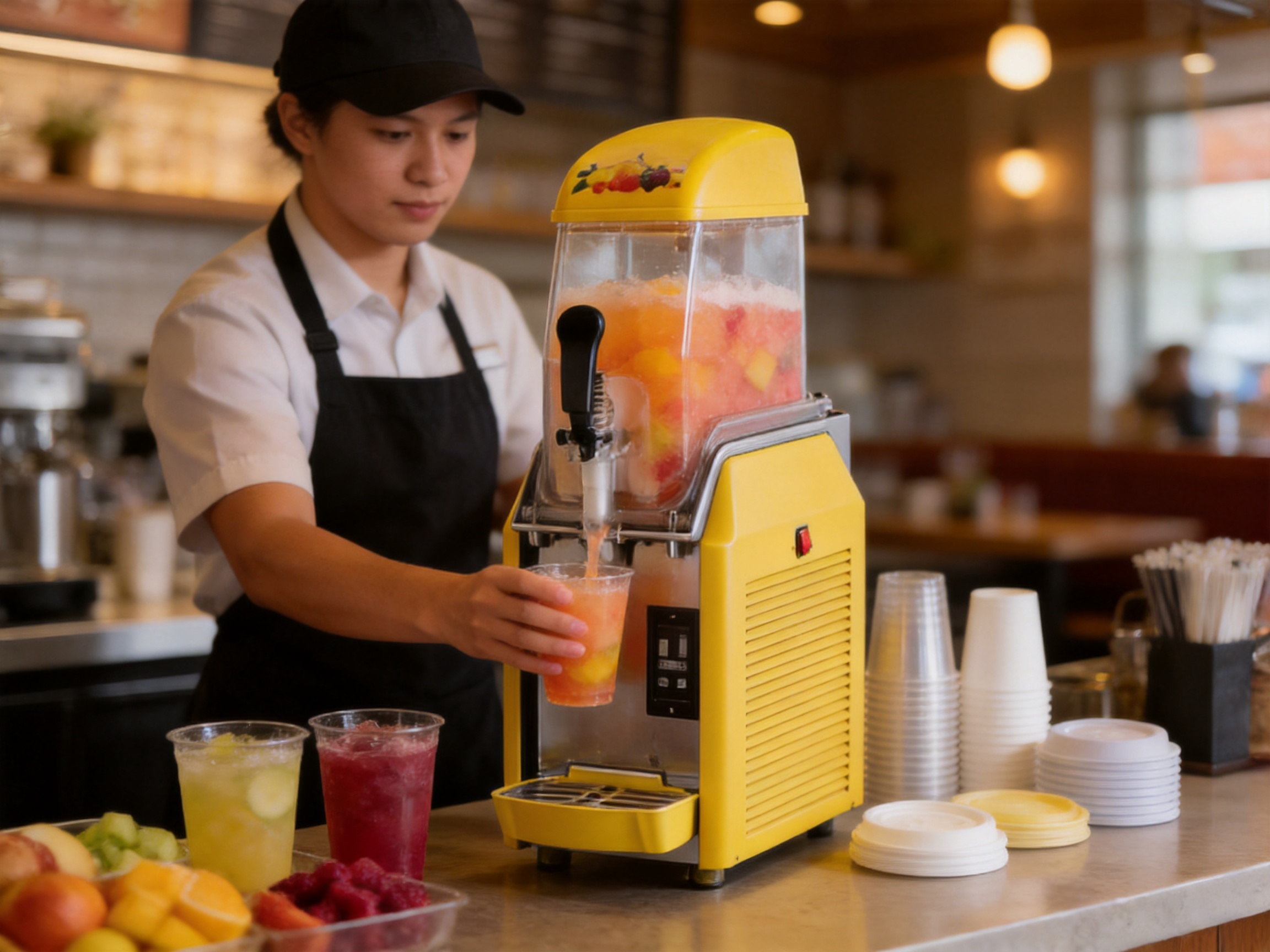
Operating Workflow
A reliable operating routine begins before the machine is switched on. The operator should place the unit on a stable, level surface with sufficient clearance around ventilation areas and service panels. The electrical supply must match the final nameplate requirements. Because the supplied records list different power and refrigerant configurations, the confirmed order specification should be used for installation planning.
The tank should be cleaned and sanitized according to the supplier’s instructions before first use. Ingredients should be mixed separately in a clean container when the recipe requires pre-dissolving sugar, flavor concentrate, powder, fruit base, or other components. Pre-mixing helps avoid concentrated ingredients settling in the tank or entering the system unevenly.
The operator should add the prepared mixture without exceeding the marked capacity. It is generally good practice to avoid running the machine below the manufacturer’s minimum level or above the maximum fill line. Correct fill levels help the mixing and cooling system operate as intended.
Once the mixture is loaded, the machine can be placed into the appropriate cooling and mixing mode. The product should be allowed to reach the desired consistency before regular dispensing begins. The exact time will vary according to recipe temperature, ambient conditions, starting quantity, and machine configuration.
During service, staff should use clean cups and dispensing practices. The tank should be monitored for product level, texture, temperature, condensation, and unusual noise. If the beverage becomes too hard, too soft, separated, or inconsistent, the operator should check the recipe, fill level, operating mode, and machine condition before continuing service.
At the end of a service period, remaining product should be handled according to its ingredients, food safety requirements, and the supplier’s operating guidance. The tank, dispensing outlet, mixing parts, seals, and removable components should be cleaned at the recommended intervals rather than waiting for visible buildup.
Cleaning and Maintenance Considerations
Cleaning is essential for both hygiene and performance. Sugar, fruit solids, flavor concentrates, and dairy or protein ingredients can create residue if they remain in the tank or dispensing path. Residue may affect flavor, appearance, odor, texture, and the movement of mechanical components.
A practical cleaning program should include routine product removal, disassembly of approved removable parts, washing with suitable foodservice detergent, rinsing, sanitizing, drying, and correct reassembly. Operators should follow the machine manual for chemical concentration, water temperature, component compatibility, and cleaning frequency.
Seals and gaskets deserve particular attention. These parts help prevent leakage around the tank and dispensing system, but they can wear over time. A damaged or incorrectly installed seal may cause dripping, air entry, product loss, or difficulty maintaining cleanliness. Spare seals should be stored in a clean and organized maintenance kit where appropriate.
The exterior should be wiped regularly to remove splashes, fingerprints, and condensation. Stainless steel surfaces should be cleaned with products suitable for the finish. Abrasive pads and unsuitable chemicals may scratch or damage the surface. Sprayed steel panels should also be treated according to the manufacturer’s care instructions.
Ventilation areas should remain free of dust, packaging, grease, and other obstructions. Restricted airflow can reduce cooling efficiency and place additional stress on refrigeration components. The machine should not be pushed tightly against walls or other equipment unless the installation instructions specifically allow that arrangement.
Preventive maintenance should include checking electrical connections, inspecting the power cord and plug, observing unusual vibration or sound, verifying dispensing action, and monitoring cooling behavior. Refrigeration service should be performed by qualified personnel familiar with the specified refrigerant and the applicable regulations.
Recipe and Product Quality Management
Machine performance and recipe performance are closely connected. A slush machine cannot correct an unsuitable formula. Operators should establish a written recipe with measured quantities and a defined preparation process. This helps protect consistency when different employees operate the equipment.
Important recipe variables include sugar or soluble solids, acidity, fruit pulp, water content, alcohol percentage, flavor concentration, and serving temperature. Products intended for semi-frozen service should be tested under the actual conditions of the business, including expected room temperature, customer demand, and refill schedule.
High ambient temperatures can increase cooling demand. Opening the tank frequently, adding warm product, or placing the machine near ovens, direct sunlight, or other heat sources may affect the time required to reach the desired consistency. Operators should plan ingredient storage and replenishment so that the machine is not repeatedly loaded with excessively warm liquid.
Product rotation is another important factor. A business should determine how long a particular recipe can remain in the tank under its food safety procedures. A popular product may need frequent replenishment, while a seasonal or low-volume flavor may require smaller batches or a different service plan.
Manufacturing Capability and Factory Strengths
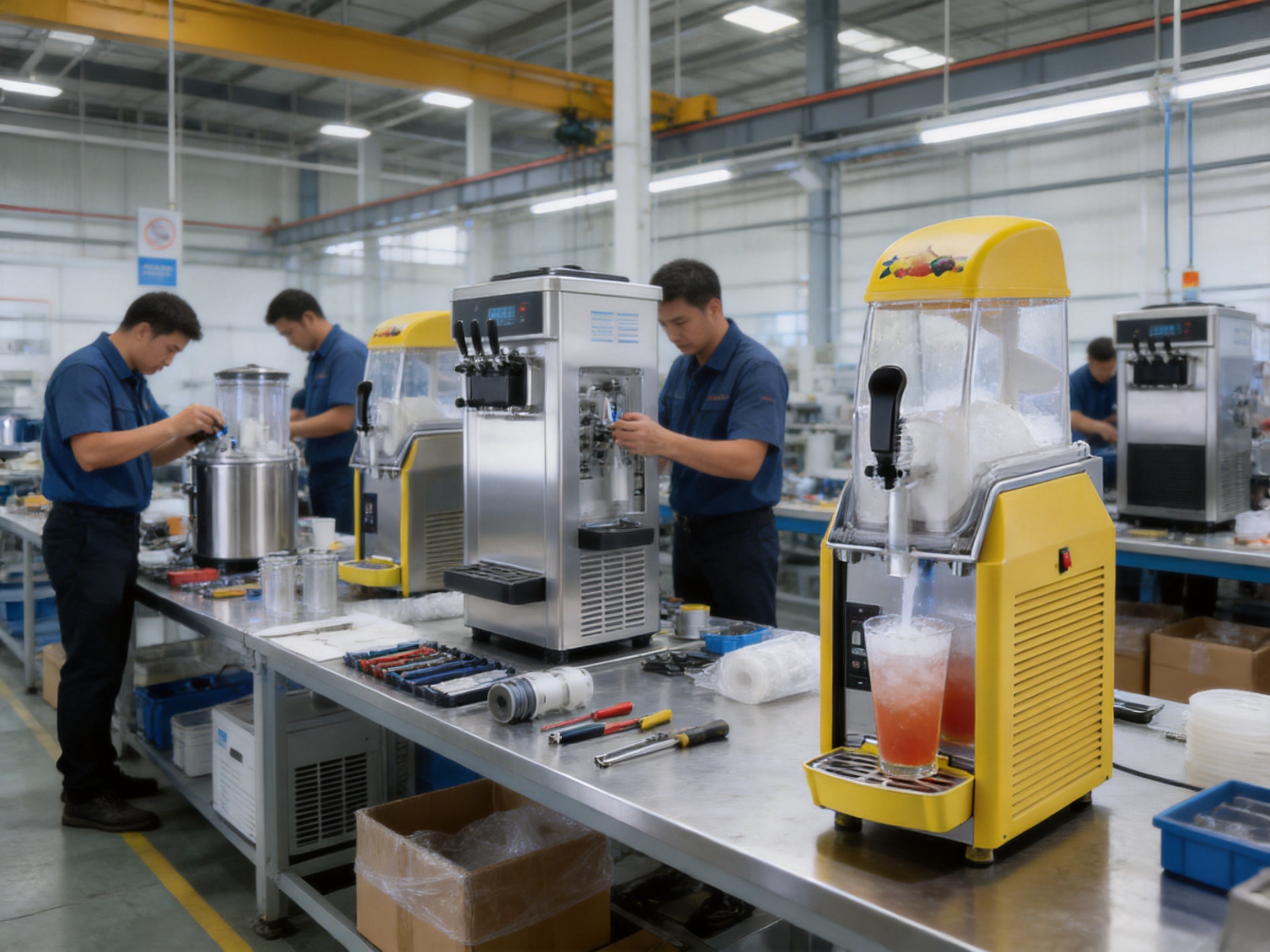
The manufacturer is identified as Spelor Electrical Appliances (Zhejiang) Co., Ltd., formerly known as Zhejiang Spelor Refrigeration Equipment Co., Ltd. The company is described as a professional manufacturer integrating design, research and development, manufacturing, sales, and service. Its reported production facilities cover more than 60,000 square meters.
This combination of in-house design, development, production, and service can be valuable for commercial equipment buyers. A supplier with broad internal capabilities may be better positioned to coordinate product engineering, appearance development, component selection, assembly, inspection, packaging, and after-sales support than a company that only resells finished equipment.
The manufacturer’s stated product range includes commercial refrigeration, kitchen equipment, buffet equipment, ice cream machines, juice dispensers, fried ice cream machines, refrigeration cabinets, slush machines, flake ice machines, cooking equipment, griddles, fryers, insulation products, barbecue equipment, and buffet solutions.
This broad category experience is relevant to the X-120 because commercial beverage equipment must operate within a wider foodservice environment. Buyers may need to coordinate a slush machine with ice makers, refrigerated storage, dessert equipment, counters, buffet systems, or other back-of-house appliances. A manufacturer serving several related categories may be able to support a more coordinated procurement process.
Design and Research Capability
Product development begins with understanding the practical needs of foodservice users. For a compact slush machine, these needs include sufficient tank volume, manageable dimensions, stable cooling, suitable mixing, cleanable surfaces, accessible controls, and serviceable components. Design decisions must balance performance, cost, appearance, and maintainability.
The stated integration of research and development with manufacturing allows product changes to be evaluated in relation to actual production. This may help improve consistency between design intent and finished equipment. It can also support adjustments for different market requirements, such as electrical standards, exterior finishes, packaging formats, or customer-specific specifications.
Production Scale
A reported production area of more than 60,000 square meters suggests substantial manufacturing infrastructure. Production scale can support organized material handling, dedicated assembly areas, inventory management, testing stations, and coordinated quality procedures. However, buyers should still request order-specific quality records, inspection standards, and production details for the exact configuration being purchased.
Scale alone does not guarantee performance, but it can provide a foundation for repeatable output and supply continuity. This is particularly important for distributors, wholesalers, restaurant groups, and project buyers who require multiple units or repeat orders over time.
Integrated Sales and Service
The company describes its service as including pre-sales consultation, product customization, flexible logistics and payment solutions, and after-sales maintenance. These services can reduce friction during commercial equipment procurement.
Pre-sales consultation is useful when buyers need to compare tank sizes, confirm electrical requirements, select an exterior finish, plan installation, or match equipment to a beverage concept. Customization support may be relevant for distributors and project customers with specific drawings, branding requirements, or market specifications.
After-sales maintenance is equally important because refrigeration equipment represents a long-term operating investment. Clear communication about spare parts, warranty terms, service procedures, troubleshooting, and technical documentation can help businesses reduce downtime and protect revenue.
OEM and ODM Potential
The company presents itself as an OEM and ODM foodservice equipment factory supplier. OEM support generally refers to manufacturing products according to a buyer’s specified design, label, or requirements, while ODM support may involve adapting an existing design or developing a product solution for a particular market.
For distributors, OEM and ODM capabilities can support private-label beverage equipment programs. Potential areas for discussion may include exterior color, control labeling, packaging, documentation, plug and voltage configuration, nameplate information, accessories, and order quantities. Any customization should be documented in an approved technical specification before production.
Buyers should ask about minimum order quantities, tooling or development charges, sample approval procedures, lead times, inspection arrangements, packaging standards, spare part availability, and the process for handling non-conforming goods. These details are especially important when equipment will be sold under a distributor’s own brand or deployed across multiple locations.
The compact single-tank platform may be suitable for market testing. A distributor can introduce one practical model for cafés, bars, and small restaurants before expanding into larger capacities or multi-tank configurations. This staged approach may help align inventory with actual demand.
Installation Planning
Before delivery, the buyer should confirm the final machine dimensions and prepare a suitable location. The support surface must be strong enough for the operating machine, product, and normal service movement. The location should also allow staff to open, clean, fill, and inspect the tank without obstruction.
Electrical requirements must be confirmed from the final nameplate rather than estimated from preliminary product information. The supplied data lists rated outputs of 550W and 700W. Voltage, frequency, phase, plug type, current draw, and protective device requirements should be specified for the destination market.
Ventilation clearance is important for refrigeration equipment. The machine should be separated from ovens, fryers, steam-producing equipment, direct sunlight, and other heat sources. Excess heat can influence cooling performance and energy use.
If the machine is installed in a self-service area, the operator should consider spill protection, customer access, cup placement, floor drainage, queue movement, and supervision. If it is installed behind a bar or counter, staff should have sufficient room to dispense drinks without interfering with other preparation tasks.
Purchasing and Commercial Evaluation
Price is only one part of the total purchase decision. Buyers should assess the machine’s intended volume, operating schedule, cleaning labor, recipe requirements, spare parts, warranty support, shipping method, installation needs, and expected service life.
A low-cost machine may become expensive if it requires frequent downtime, difficult cleaning, unavailable seals, or uncertain technical support. Conversely, a compact single-tank machine may offer strong value when it matches the business’s actual demand and avoids paying for unused capacity.
Distributors should evaluate packaging quality, container loading, documentation, replacement parts, sample approval, inspection arrangements, and the supplier’s ability to maintain consistent specifications across repeat orders. Restaurant groups should consider whether the same model can be standardized across different locations and whether staff training can be shared.
Buyers should also clarify whether the quoted price includes accessories, spare seals, cleaning tools, manuals, export packaging, shipping insurance, and other commercial terms. A written quotation should list the exact model, selected configuration, quantity, production lead time, payment conditions, delivery terms, and warranty scope.
Recommended Buyer Checklist
| Evaluation Area | Questions to Confirm |
| Capacity | Is the usable capacity suitable for expected daily demand and cup size? |
| Electrical supply | What voltage, frequency, phase, plug, current, and rated power apply to the order? |
| Refrigerant | Which refrigerant is used in the confirmed configuration, and what service requirements apply? |
| Dimensions | What are the final shipping and operating dimensions, including clearance requirements? |
| Materials | Which parts are stainless steel, sprayed steel, plastic, or other materials? |
| Cleaning | Which components are removable, and what detergent and sanitizing procedures are recommended? |
| Spare parts | Are seals, dispensing components, mixing parts, and controls available for replacement? |
| Warranty | What is covered, for how long, and how are service claims handled? |
| Customization | Can color, labeling, packaging, voltage, or other details be adapted? |
| Documentation | Will the buyer receive a manual, wiring information, parts information, and maintenance guidance? |
Daily Performance and Staff Training
Even a well-designed machine performs best when staff understand the operating sequence. Training should cover safe startup, recipe preparation, filling limits, texture observation, dispensing technique, spill response, cleaning, and shutdown procedures.
Staff should know how to recognize a product that is not behaving normally. Excessive hardness may indicate a recipe or temperature issue. Excessive softness may result from an unsuitable formula, insufficient cooling time, high ambient heat, or a mechanical or refrigeration problem. Unusual noise, leakage, vibration, or repeated tripping of electrical protection should be reported promptly.
A simple daily checklist can improve consistency. The checklist may include confirming the machine is clean, checking the tank and dispensing outlet, verifying the recipe, recording the batch time, observing the product texture, wiping the exterior, and reporting any abnormal condition.
Managers can also monitor sales by flavor, time of day, cup size, and weather. This information helps determine whether a 12-liter tank is appropriately sized, whether production should be adjusted, and whether the business may eventually benefit from additional equipment.
Sustainability and Waste Reduction Considerations
Commercial equipment selection should include consideration of waste, energy use, cleaning water, packaging, and product turnover. A single-tank machine can support a focused menu, which may help reduce the number of partially sold flavors and simplify ingredient inventory.
Waste reduction depends on accurate demand planning. Operators should avoid preparing more product than can be sold safely within the planned service period. Smaller businesses may benefit from producing one high-demand flavor rather than maintaining several low-volume products.
Energy performance depends on the refrigeration system, ambient conditions, operating hours, ventilation, recipe temperature, and maintenance. Keeping the condenser or ventilation area clean, avoiding heat sources, and minimizing unnecessary opening of the tank can support efficient operation.
Packaging and logistics also influence the product’s overall commercial impact. Buyers can ask about export packaging, recyclable materials where practical, spare part consolidation, and shipment planning. These measures should be evaluated alongside product protection and regulatory requirements.
Why the X-120 Can Be a Practical Entry Model
The X-120 is suited to a specific commercial need: a business wants to offer a professional frozen beverage but does not necessarily need several tanks or a very large production system. Its 12-liter capacity creates a manageable starting point, while its commercial construction and refrigeration platform distinguish it from ordinary household equipment.
The machine can support a focused beverage strategy. A new café can launch with one signature flavor. A bar can introduce one seasonal frozen cocktail. A restaurant can offer one promotional drink. A convenience store can test frozen beverage demand in a limited space. If demand grows, the business can add another unit or expand to a larger product range.
This flexibility is one of the strongest arguments for a single-tank design. The machine does not attempt to serve every possible menu configuration. Instead, it provides a targeted solution for operators who value compactness, manageable capacity, and simplified daily operation.
Frequently Asked Questions
What type of business is the machine designed for?
The machine is designed for commercial users such as bars, cafés, restaurants, dessert shops, snack stores, convenience stores, kiosks, and selected institutional or event foodservice operations. It is particularly suitable for businesses that need one primary frozen beverage flavor or a rotating single-flavor program.
What is the tank capacity?
The stated tank capacity is 12 liters. Actual usable fill volume should follow the tank markings and the supplier’s operating instructions. Operators should avoid exceeding the maximum fill line and should confirm whether the stated capacity represents total tank volume or recommended working volume.
Is this a multi-flavor machine?
No. The product is described as a single-tank commercial slush machine. It is intended to produce one flavor or recipe at a time. Businesses that require multiple flavors simultaneously should consider multiple units or a multi-tank model.
What is the rated power?
The supplied materials list both 550W and 700W. This difference may relate to different configurations or records. Buyers must confirm the final rated power from the quotation, nameplate, and technical datasheet for the exact order.
Which refrigerant does it use?
The product information lists R407C, while the supplementary information lists R407C/R410. The exact refrigerant must be confirmed before purchase and service. Refrigeration maintenance should be performed by qualified technicians using procedures suitable for the confirmed refrigerant.
What are the machine dimensions?
Two dimensions are provided: 240 × 530 × 800 millimeters and 205 × 535 × 810 millimeters. Buyers should use the final approved drawing for installation planning, counter preparation, shipping, and clearance calculations.
Is the machine suitable for alcoholic drinks?
It may be used for suitable frozen cocktail recipes, but alcohol affects freezing behavior. Operators should test each formula, follow the supplier’s recipe guidance, and comply with all applicable rules for alcohol service, labeling, and responsible sales.
How should the machine be cleaned?
The tank, dispensing outlet, mixing components, seals, and other approved removable parts should be cleaned and sanitized according to the manufacturer’s instructions. The correct cleaning frequency depends on the recipe, operating schedule, and local food safety requirements.
Can the machine be customized?
The manufacturer describes OEM and ODM capabilities. Potential customization may include color, labeling, packaging, electrical configuration, and other requirements, subject to technical feasibility, order quantity, approval procedures, and production terms.
What should be confirmed before ordering?
Buyers should confirm the exact model, capacity, rated power, voltage, frequency, refrigerant, dimensions, net weight, materials, accessories, warranty, spare parts, lead time, packaging, delivery terms, and documentation. The conflicting values in the supplied records make written confirmation especially important.
Conclusion
The 12L single-tank commercial slush machine offers a focused solution for foodservice businesses that want reliable frozen beverage production without the footprint and complexity of a larger multi-tank system. Its practical capacity, compact format, foodservice-oriented construction, integrated cooling, and even mixing support a wide range of applications in bars, cafés, restaurants, dessert shops, convenience stores, kiosks, and seasonal beverage programs.
Its advantages over domestic appliances and manual blending include greater working capacity, a more repeatable production process, improved service convenience, and a format designed for commercial use. Its advantage over larger multi-tank systems is different: it can reduce space, investment, menu complexity, and the risk of distributing demand across too many flavors.
The manufacturer’s stated experience in refrigeration, kitchen, buffet, beverage, and foodservice equipment provides a broader production foundation. Its reported design, research and development, manufacturing, sales, customization, logistics, and after-sales capabilities can support buyers seeking more than a standalone machine purchase.
For the best purchasing result, the operator should match the 12-liter capacity to actual demand, prepare a suitable installation area, establish consistent recipes, train staff, and maintain a disciplined cleaning schedule. Because the supplied materials contain different values for power, refrigerant, dimensions, and weight, the final technical configuration should always be confirmed in writing before production and installation.
References
1. Product specification and product description for the X-120 12L single-tank commercial slush machine, supplied commercial equipment materials.
2. Product information and technical configuration data for the X-120 commercial frozen beverage machine, supplied manufacturer materials.
3. Company profile and manufacturing capability statement for Spelor Electrical Appliances (Zhejiang) Co., Ltd.
4. General foodservice equipment principles concerning commercial refrigeration, sanitation, preventive maintenance, and beverage production.
5. General food and beverage operations guidance concerning recipe control, product rotation, staff training, and equipment installation planning.
Product: 12L Single Tank Commercial Slush Machine for Bar Cafe Restaurant

For exclusive deals and latest offers, sign up by entering your email address below.


-
spelor@spelor.com
-
+86-576-85229688
-
No.528, Changxi Road, Linhai City, Zhejiang Province, China
Commercial Refrigeration Equipment Manufacturer China
Copyright © 2025 by Spelor Electrical Appliances (Zhejiang) Co., Ltd. Rights Reserved.
