


 中文简体
40L/h Commercial Stainless Steel Hard Ice Cream Machine for Bars, Cafes, and Foodservice Operations
Admin 2026-11-04Commercial ice cream businesses need equipment that can maintain product quality while keeping pace with customer demand. A machine that freezes slowly, requires complicated cleaning, or struggles during busy service periods can reduce productivity and affect customer satisfaction. The 40L/h Commercial Stainless Steel Hard Ice Cream Machine is designed for professional environments that require dependable production, efficient operation, and a durable foodservice-ready structure.
With a stated production capacity of 40 liters per hour, this model is suitable for bars, cafes, medium-sized restaurants, dessert shops, snack stores, and other commercial locations serving hard ice cream. Its 4,500-watt input power supports high-capacity operation, while the stainless steel and sprayed steel body provides a practical balance of hygiene, durability, and professional appearance.
The machine is identified as model BQL-8140. It combines a compact commercial footprint with a substantial 185-kilogram structure, making it a serious production unit rather than a small countertop appliance. Its dimensions are 520 x 1,020 x 1,320 millimeters, allowing operators to plan installation in a dedicated production or service area while preserving valuable floor space.
This article examines the machine’s design, operating value, commercial applications, manufacturing background, quality advantages, and purchasing considerations. It also explains how a professional equipment supplier with integrated design, research and development, manufacturing, sales, and service capabilities can support foodservice customers from initial selection through long-term operation.

40L/h Commercial Stainless Steel Hard Ice Cream Machine for Bar Cafe
Product Overview
The 40L/h Commercial Stainless Steel Hard Ice Cream Machine is intended for businesses that need continuous or repeated hard ice cream production throughout the working day. Its capacity is especially relevant to locations where demand is higher than what a small batch freezer or domestic machine can provide. Bars, cafes, restaurants, and dessert counters can use this type of equipment to prepare commercial quantities without relying entirely on pre-produced inventory.
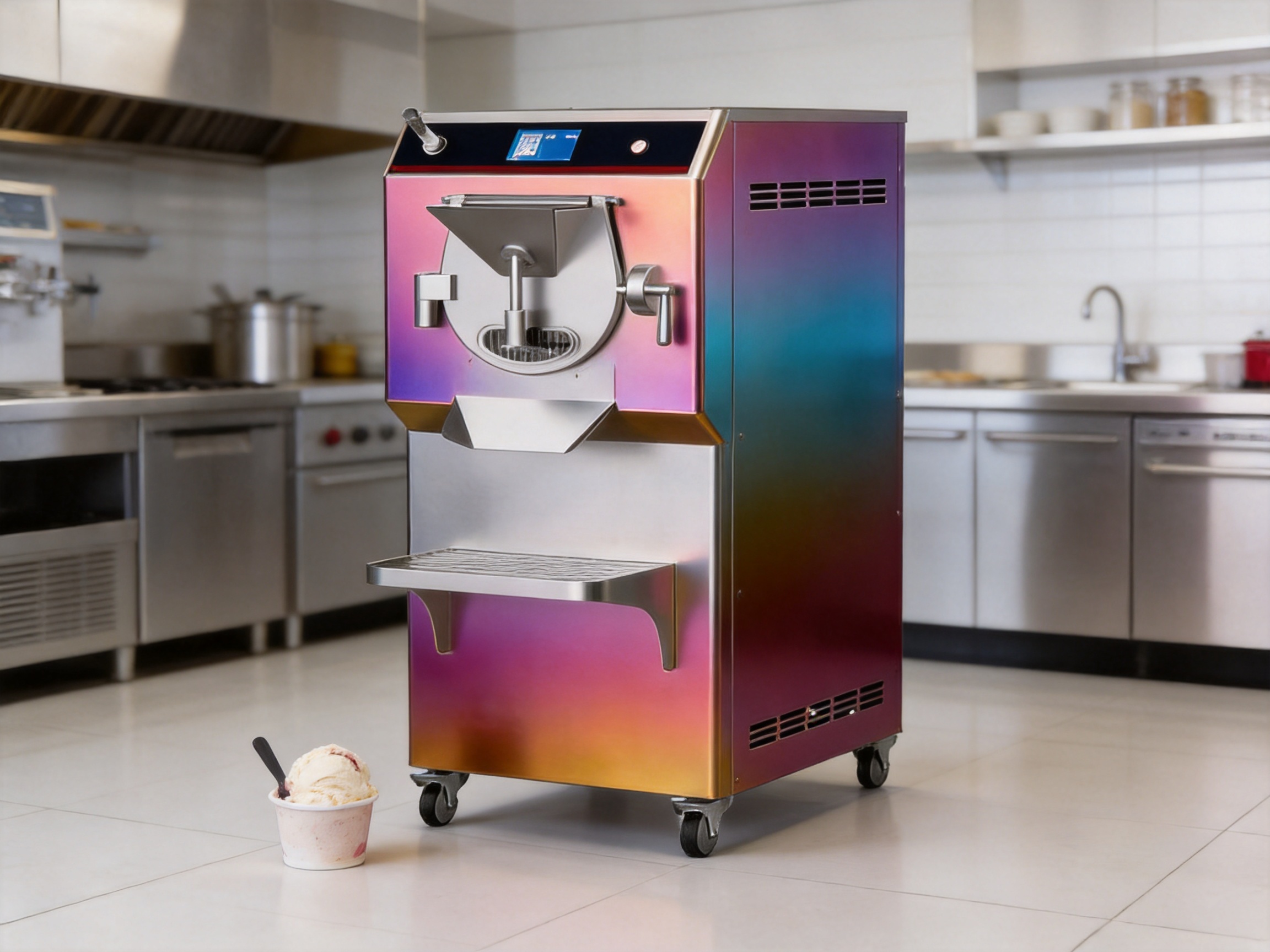
The machine uses a food-grade stainless steel plate body combined with colorful sprayed steel. This construction gives the unit a clean and professional appearance while supporting the hygiene expectations of a foodservice environment. Stainless steel is widely used in commercial kitchens because it is durable, relatively easy to wipe down, resistant to many common forms of corrosion, and suitable for regular cleaning routines.
The model’s listed production capacity is 40 liters per hour. Actual output may vary according to the recipe, mix temperature, ambient conditions, operating procedure, and required product consistency. Nevertheless, the rated capacity provides a useful reference for planning daily production and estimating whether the machine is appropriate for a particular service volume.
The 4,500-watt input power reflects the machine’s commercial scale. High-capacity refrigeration equipment requires more substantial electrical input than domestic appliances, particularly when it is expected to process product consistently during busy periods. Buyers should confirm local voltage, frequency, electrical protection, and installation requirements before placing an order.
The listed compressor refrigerant is R410. Refrigerant specifications should always be reviewed together with local regulations, service requirements, and the final technical configuration confirmed by the supplier. The provided product information also identifies water cooling, so installation planning should include the appropriate water supply, drainage, ventilation, and service access conditions.
| Specification | Product Information |
|---|---|
| Model | BQL-8140 |
| Product type | Commercial hard ice cream machine |
| Production capacity | 40 liters per hour |
| Input power | 4,500 watts |
| Net weight | 185 kilograms |
| Machine dimensions | 520 x 1,020 x 1,320 millimeters |
| Cooling information | Water cooling |
| Compressor refrigerant | R410 |
| Body materials | Food-grade stainless steel and sprayed steel |
Why Production Capacity Matters in Commercial Ice Cream Service
Production capacity directly affects how a business manages demand. A small machine may be adequate for occasional service, limited menus, or low-volume operations. However, when a business serves multiple tables, handles delivery orders, operates a dessert counter, or experiences concentrated demand during evenings and weekends, insufficient production capacity can become a serious limitation.
A 40-liter-per-hour model gives an operator greater flexibility than a low-output machine. It can support scheduled preparation before service, replenishment during operating hours, and menu expansion without requiring several small machines. A single higher-capacity unit may also simplify staff training and reduce the number of separate appliances that need to be cleaned, monitored, and maintained.
For bars and cafes, demand may be uneven. A quiet afternoon can be followed by a busy evening, particularly in locations that serve desserts after dinner or attract customers during warm weather. A commercial machine with stronger production capability helps the operator prepare for these fluctuations. It can also support promotional activities, seasonal menus, special events, and larger catering orders.
Capacity should not be evaluated in isolation. Businesses should consider the number of servings sold, the serving size, preparation schedules, available cold storage, and the time required for cleaning. The BQL-8140 is most appropriate for buyers who need professional throughput and have the utilities and floor space required for a machine of this size.
Food-Grade Stainless Steel Construction
Foodservice equipment must be designed around hygiene, durability, and practical maintenance. The stainless steel plate body of this hard ice cream machine supports these requirements. Its smooth, professional surface can be incorporated into regular cleaning procedures, helping staff remove splashes, mix residue, and dust from the exterior after operation.
Stainless steel is also valued for its structural reliability. In busy commercial environments, equipment may be exposed to frequent movement, repeated cleaning, humidity, and contact with other appliances. A robust exterior helps the machine maintain a professional appearance over a longer service life, provided that it is used and maintained according to the supplier’s instructions.
The use of colorful sprayed steel adds visual flexibility to the equipment design. In a customer-facing cafe, bar, or dessert shop, appearance can influence the overall impression of the service area. A machine that looks clean and coordinated with the business environment can contribute to a more organized and professional presentation.
Material selection is one area where a purpose-built commercial machine has an advantage over many general-purpose or domestic alternatives. Household appliances are often designed for occasional use and lighter workloads. A commercial stainless steel unit is designed with a different operating context in mind: repeated production, staff use, frequent cleaning, and integration into a professional workflow.
Cooling and Stable Commercial Operation
Refrigeration performance is central to any hard ice cream machine. The equipment must remove heat from the mix and support the desired frozen texture during production. The product information identifies this model as water-cooled and lists R410 as the compressor refrigerant. These details are important for both performance planning and installation planning.
Water cooling can be suitable for commercial locations where the required water supply and drainage are available. It may be helpful in environments where controlling heat discharge into the room is important. Compared with air-cooled arrangements, a water-cooled system may reduce the amount of warm air released into the operating area, although the final installation conditions and operating costs depend on local water quality, water temperature, utility pricing, and maintenance practices.
Buyers should discuss the cooling configuration with the supplier before installation. Questions may include the required water flow, connection size, drainage method, water pressure range, cleaning procedure, and protection against scale or impurities. These details are particularly relevant in regions with hard water or variable water quality.
Stable cooling is valuable because inconsistent freezing can affect production rhythm and product presentation. If the equipment takes too long to recover between batches, staff may need to delay service or keep larger inventories of finished product. A machine intended for commercial throughput should be integrated into a workflow that includes correct mix preparation, appropriate loading, regular cleaning, and adequate utility supply.
The listed 4,500-watt input power indicates that the system is designed for substantial refrigeration work. Operators should provide a stable electrical connection and appropriate safety protection. Electrical installation should be completed by qualified personnel in accordance with local codes and the supplier’s technical documentation.
Operational Advantages for Bars and Cafes
Bars and cafes often require equipment that can fit into a carefully planned service environment. Floor space may be limited, yet the business still needs to serve a varied menu quickly. With dimensions of 520 x 1,020 x 1,320 millimeters, this machine offers a defined commercial footprint that can be considered during layout planning.
The unit can be positioned in a production area, back-of-house kitchen, dessert preparation room, or suitable service zone. Before installation, the operator should allow sufficient clearance for connections, cleaning, inspection, and maintenance. The 185-kilogram net weight also means that the floor, delivery route, and installation method should be reviewed in advance.
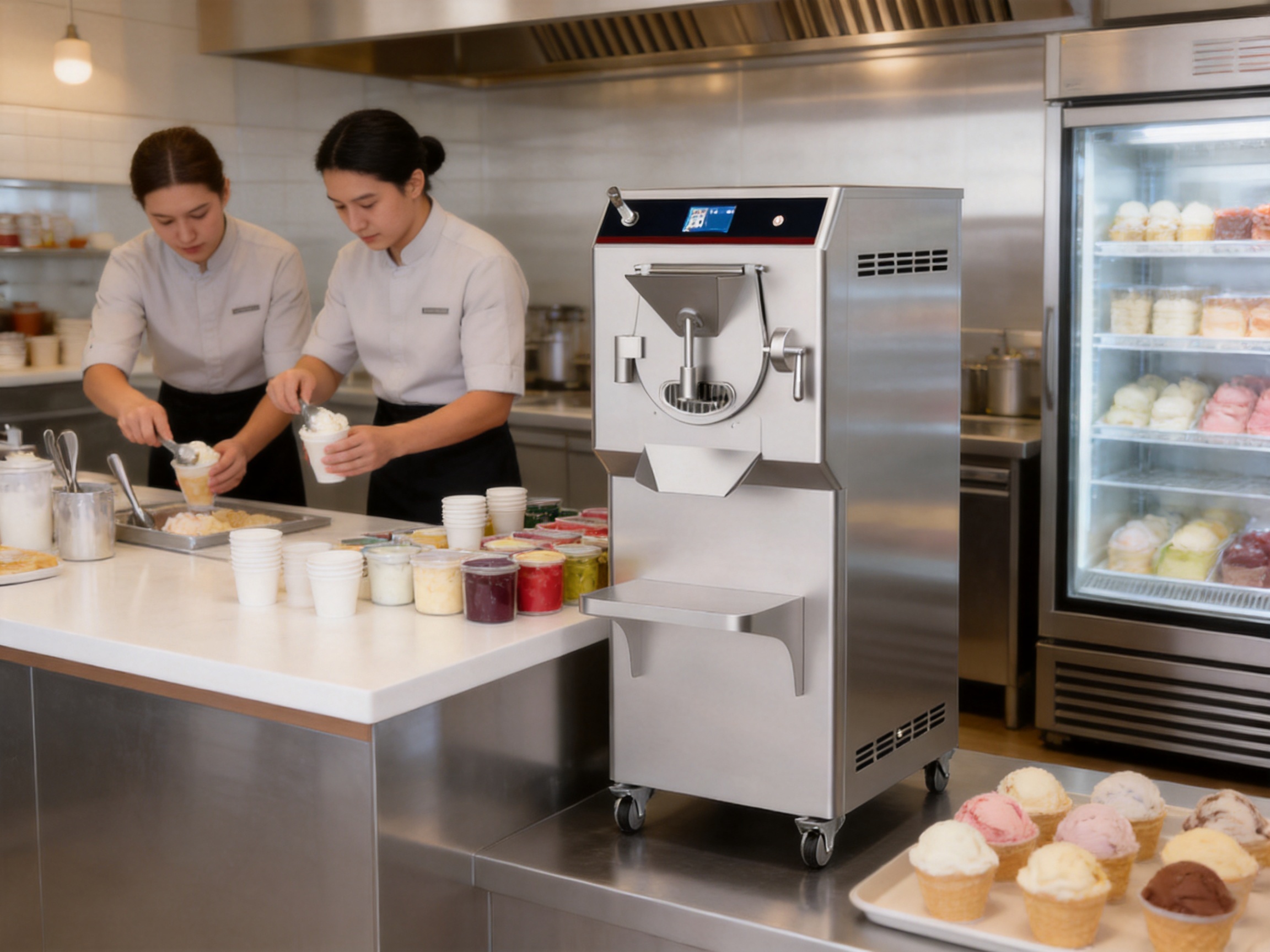
For cafes, hard ice cream can complement coffee, pastries, waffles, cakes, and cold beverages. A dedicated machine allows the business to produce or serve a dessert line without depending exclusively on external suppliers. This can create opportunities for seasonal flavors, signature combinations, and menu differentiation.
Bars may use hard ice cream in dessert cocktails, plated desserts, tasting menus, or late-night offerings. Restaurants can pair it with fruit, baked products, sauces, and other desserts. Snack shops and fast-service outlets may use it as an additional revenue category, especially when the machine is placed where staff can access it efficiently during peak periods.
The machine’s capacity also supports batch planning. Operators can prepare product according to expected demand rather than relying on very small batches throughout the day. This may help reduce service interruptions, although businesses should still follow appropriate food safety, storage, and temperature-control procedures.
Advantages Compared with Lower-Capacity or Less Specialized Equipment
Product comparisons should be based on operating needs rather than on a single specification. The main advantage of the BQL-8140 is its combination of commercial capacity, strong input power, durable materials, and a professional refrigeration configuration.
Compared with small domestic machines, the 40-liter-per-hour capacity is better suited to repeated foodservice production. Domestic machines may be practical for home use or occasional demonstrations, but they are not necessarily designed for the frequency, cleaning demands, or workload of a busy commercial kitchen. A purpose-built commercial unit can help businesses avoid overloading equipment intended for lighter use.
Compared with multiple small machines, one higher-capacity unit can simplify the workspace. Operators may need fewer electrical connections, fewer separate cleaning routines, and fewer machines to monitor. A single production system may also make staff training more consistent. However, a business should consider redundancy and menu requirements before selecting one large machine instead of several smaller units.
Compared with equipment using less durable exterior materials, the stainless steel body provides a practical advantage in environments where sanitation and repeated use are important. The machine’s commercial construction may also be more appropriate for customers who expect professional equipment to remain presentable in a visible service area.
Compared with systems that release significant heat into the room, the stated water-cooling configuration may be attractive for certain installations. This does not mean that water cooling is automatically best for every location. It means that the buyer can evaluate the machine according to the utilities and environmental conditions of the intended site.
Compared with suppliers that only provide a basic product transaction, an integrated manufacturer can offer broader support. Design consultation, production coordination, customization, logistics planning, and after-sales service can be especially valuable for commercial buyers purchasing multiple machines or developing a complete foodservice project.
Manufacturing Strength and Integrated Production Capability
The manufacturer behind this product is a professional company integrating design, research and development, manufacturing, sales, and service. This integrated structure is important because commercial refrigeration equipment involves more than assembling visible components. Product performance depends on coordinated decisions involving the cabinet, refrigeration system, electrical configuration, production process, usability, cleaning access, and service requirements.
The company operates more than 60,000 square meters of modern production facilities. A facility of this scale provides a foundation for organized manufacturing, product development, component coordination, assembly, inspection, packaging, and order management. Large production resources can also support a broader product portfolio and more consistent handling of international customer requirements.
The manufacturer’s product range includes ice cream machines, juice dispensers, fried ice cream machines, refrigeration cabinets, slush machines, flake ice machines, cooking equipment, griddles, fryers, insulation products, barbecue equipment, and buffet solutions. This range gives the company experience across several categories of commercial foodservice equipment.
For buyers, a broad product portfolio can create procurement advantages. A bar, snack shop, restaurant chain, supermarket, institution, or buffet operator may be able to source several related equipment categories from one manufacturing partner. This can simplify communication, reduce the number of technical contacts, and make project coordination more efficient.
Integrated manufacturing also supports product customization. The company provides OEM and ODM services based on customer drawings or requirements. Depending on the project, customization may involve appearance, configuration, electrical standards, branding arrangements, packaging, or other technical details. Each request should be reviewed with the supplier because the available options, minimum order quantities, lead times, and engineering conditions can vary.
A manufacturer that combines product development with direct production is also positioned to gather feedback from different markets. User requirements from cafes, fast-food chains, bars, supermarkets, institutions, and other foodservice applications can inform future improvements in usability, durability, capacity planning, and service support.
Production Process Considerations
Although the exact internal production procedures for this model should be confirmed with the manufacturer, a professional commercial refrigeration manufacturing process generally requires coordination across several stages. These stages may include material preparation, cabinet fabrication, surface treatment, refrigeration system assembly, electrical installation, component fitting, functional inspection, cleaning, packaging, and shipment preparation.
For the stainless steel and sprayed steel body, dimensional accuracy and surface quality are important. Panels must be formed and joined correctly so that the cabinet maintains its intended structure. Exposed surfaces should be finished in a way that supports cleaning and provides the desired appearance. The use of foodservice-grade materials is particularly relevant for areas that may come into contact with splashes or cleaning agents.
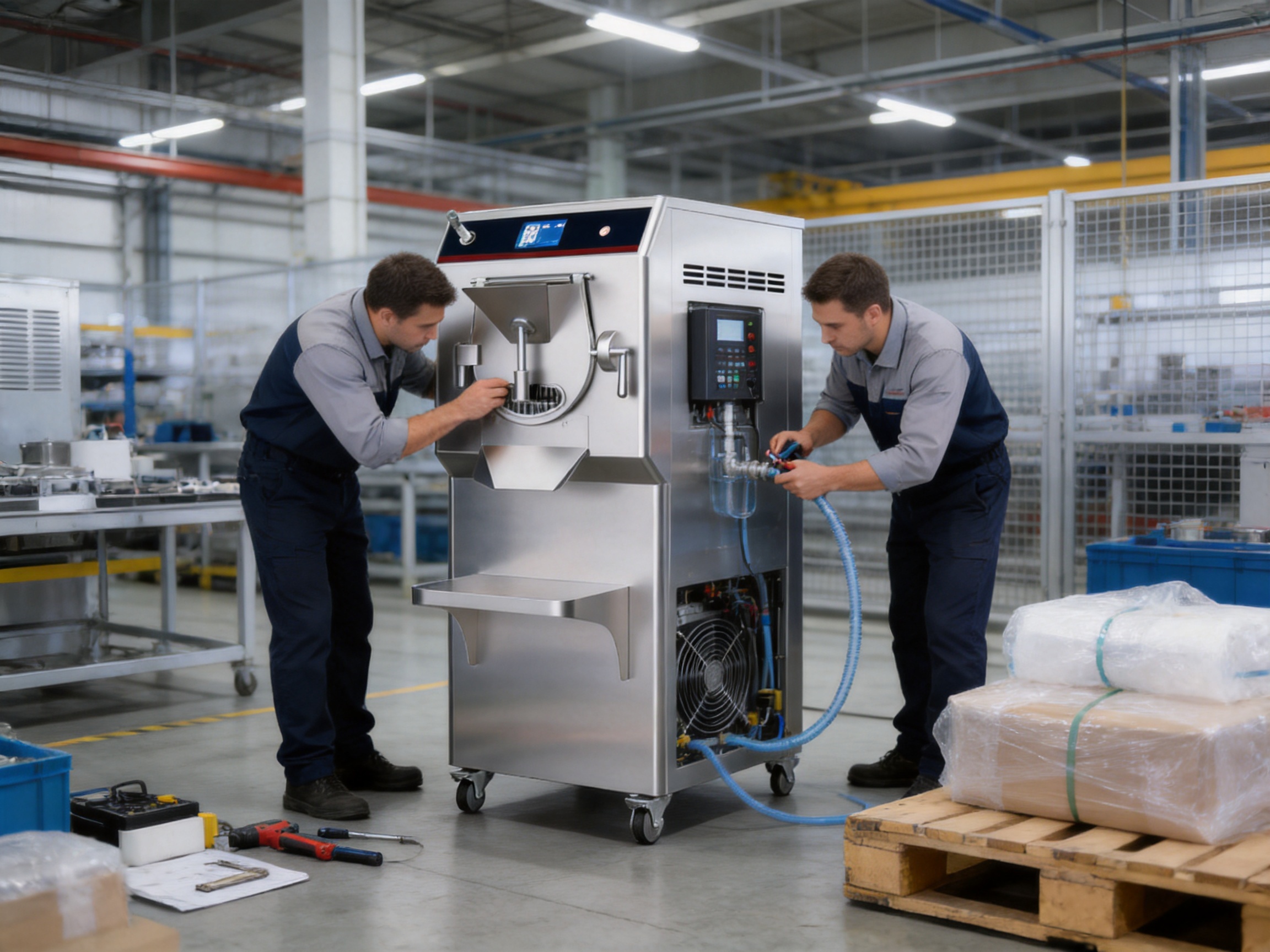
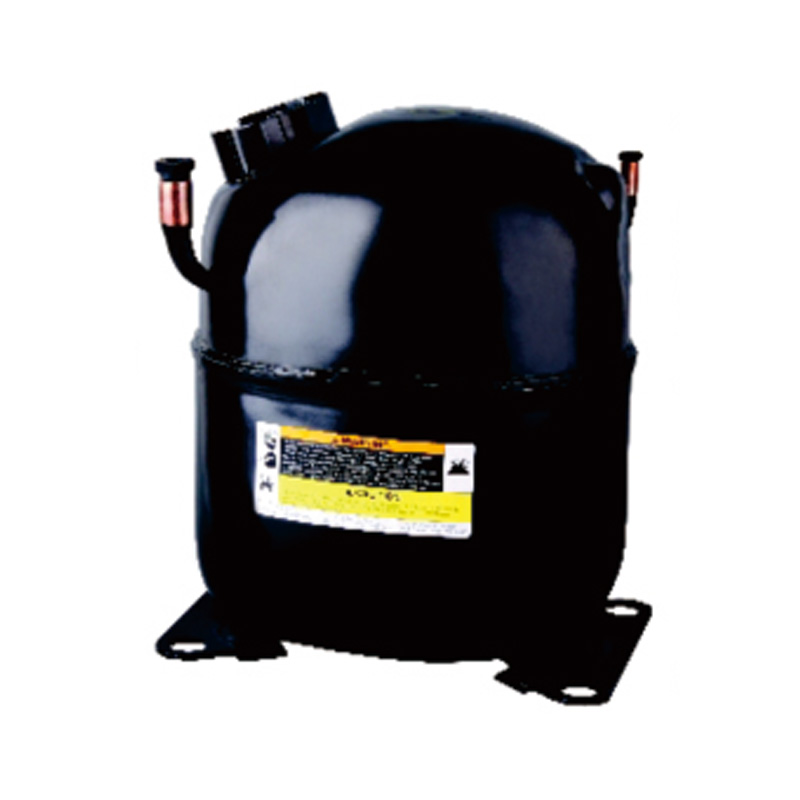
Refrigeration assembly requires careful integration of the compressor, refrigerant circuit, heat-transfer components, controls, and cooling connections. A water-cooled design also requires attention to water pathways, connection points, drainage, and protection against leakage. Proper assembly and inspection help reduce the risk of performance problems during later operation.
Electrical assembly is another essential stage. The 4,500-watt input power means that the machine must be configured appropriately for the destination market. Voltage and frequency requirements should be agreed before production. Wiring, protective components, switches, controls, and grounding arrangements should be handled according to the applicable technical requirements and the confirmed order specification.
Testing is important for commercial equipment because buyers expect the machine to function after delivery and installation. The manufacturer’s quality process should include appropriate checks of refrigeration operation, electrical safety, mechanical assembly, appearance, and basic operating functions. Customers should request details of the inspection and documentation provided with the final shipment.
Packaging and logistics also influence product quality. A heavy machine weighing 185 kilograms must be protected against impact, vibration, moisture, and movement during handling. Export packaging should be selected according to the transportation method, destination, warehouse conditions, and unloading arrangements. Buyers should provide accurate delivery information and confirm whether special lifting equipment is required.
Designing a Practical Installation Area
Successful operation begins before the machine arrives. The installation area should be measured against the machine dimensions of 520 x 1,020 x 1,320 millimeters. Doorways, corridors, elevators, ramps, loading docks, and final positioning areas should all be checked. The machine’s weight should be considered when selecting the route and installation surface.
Water-cooled equipment requires an appropriate water connection and drainage plan. The water supply should meet the manufacturer’s requirements for flow, pressure, quality, and temperature. Drainage should be designed to prevent standing water around the machine. If the site has hard water, the operator should ask about filtration, descaling, and preventive maintenance.
Electrical requirements must also be confirmed. The business should identify the correct voltage and frequency, circuit capacity, breaker protection, grounding, and local compliance requirements. A qualified electrician should complete the connection. Using an unsuitable power supply can damage equipment, create safety risks, and invalidate service arrangements.
Although a water-cooled system may reduce heat discharge into the room, the surrounding area should still be clean, dry, and adequately ventilated. Staff need enough space to load ingredients, access controls, wipe surfaces, perform sanitation, and carry out routine inspections.
The installation plan should also consider workflow. If the machine is too far from the preparation area, staff may spend unnecessary time transporting mixes or finished product. If it is placed in a customer-facing zone, the operator should consider noise, appearance, splash protection, and access control. The best position balances production efficiency, sanitation, service convenience, and maintenance access.
Cleaning, Sanitation, and Routine Care
Commercial ice cream equipment requires a consistent cleaning program. The exact cleaning method must follow the supplier’s manual and the applicable food safety rules. Staff should understand how to stop the machine, remove remaining mix, clean product-contact areas, sanitize approved components, rinse where required, and reassemble the equipment correctly.
The stainless steel body can support straightforward exterior cleaning, but the exterior should not be treated as a substitute for internal sanitation. Product-contact surfaces, dispensing areas, seals, fittings, and any removable components require special attention. Residual mix can harden, create unpleasant odors, affect product quality, and increase the risk of contamination if it is not removed properly.
Operators should establish a written schedule for daily cleaning, periodic deep cleaning, inspection of seals and connections, water-system maintenance, and refrigeration-service checks. Cleaning frequency may depend on the recipe, operating hours, local regulations, and the manufacturer’s recommendations.
Water quality deserves particular attention for water-cooled equipment. Mineral deposits can restrict flow and reduce heat-transfer efficiency over time. Preventive inspection and appropriate descaling procedures can help protect the system. Operators should not introduce unapproved chemicals or cleaning methods, as unsuitable products may damage surfaces, seals, or refrigeration components.
Routine care also includes checking the machine’s exterior, power connection, water connections, drainage, controls, and operating sound. Early identification of leaks, unusual noise, slow cooling, or inconsistent output allows the operator to contact service personnel before a minor issue becomes a major interruption.
Product Quality and Menu Development
A commercial hard ice cream machine is only one part of the final product experience. Mix formulation, ingredient quality, storage, preparation temperature, operating procedure, and serving technique all influence the result. The BQL-8140 provides the production platform, while the business determines how it uses that platform to create a consistent menu.
Bars and cafes can use the machine to develop a focused selection of signature flavors. A limited menu may simplify preparation and inventory management, while a broader menu can encourage repeat visits. Operators should assess the balance between variety and operational complexity before introducing too many flavors at once.
Restaurants may integrate hard ice cream into plated desserts. In this setting, texture, portion control, holding conditions, and timing are important. The machine can support regular production, but the kitchen must coordinate freezing, storage, and service so that the product reaches customers in the intended condition.
Snack shops and fast-service locations may prioritize speed, visual presentation, and simple portioning. A high-capacity unit can support peak periods, but staff should be trained to maintain clean serving areas and consistent portions. Clear operating procedures are particularly valuable when several employees share responsibility for the machine.
The equipment can also support business-to-business applications such as catering, event service, institutional dining, and hospitality operations. In these environments, capacity planning should account for event schedules, transport, temporary storage, and the availability of utilities at the service location.
Purchasing from a Factory Supplier
Buying directly from a manufacturer can provide advantages beyond the initial equipment price. A factory supplier may be able to discuss the technical configuration, production schedule, packaging method, documentation, and service process more directly than a general reseller. This can be helpful when a buyer has special voltage requirements, multiple units, OEM needs, or a larger commercial project.
The supplier offers OEM and ODM services based on drawings or requirements. Buyers considering customization should prepare detailed information about the destination market, voltage and frequency, cooling method, exterior appearance, logo or labeling requirements, packaging, intended application, and delivery schedule.
It is also important to confirm what is included in the quoted equipment. Buyers should ask about the machine body, controls, cooling connections, accessories, manuals, spare parts, warranty terms, commissioning support, and after-sales service. Clear documentation can reduce misunderstandings and support smoother installation.
For international orders, logistics and payment arrangements should be discussed at the beginning of the project. The manufacturer provides flexible logistics and payment solutions, but the exact terms should be agreed in writing. Customers should also verify import requirements, customs documentation, destination charges, and local service availability.
After-sales support is especially important for refrigeration equipment. A reliable supplier should be able to provide maintenance guidance, troubleshooting assistance, replacement parts information, and communication with technical personnel. Businesses that depend on continuous production should understand the expected response process before placing an order.
How This Model Supports Business Efficiency
Efficiency is not limited to electrical consumption or production speed. It also includes labor organization, cleaning time, workspace utilization, product consistency, procurement coordination, and equipment reliability. The BQL-8140 can contribute to efficiency by consolidating substantial production capacity into one commercial machine.
Its professional body reduces the need for temporary protective measures that may be required with less suitable equipment. Its defined dimensions make it easier to incorporate into a planned layout. Its water-cooled configuration gives buyers another option when managing the thermal environment of a commercial kitchen or service area.
The machine can also support more predictable production planning. Instead of purchasing all finished product from an external source, a business may prepare some or all of its hard ice cream according to demand. This can give the operator greater control over flavors, production timing, and menu changes, subject to appropriate food safety and storage procedures.
When sourced from an integrated manufacturer, the equipment can be part of a broader procurement strategy. A customer may combine an ice cream machine with refrigeration cabinets, juice dispensers, slush machines, cooking equipment, or buffet products. Coordinating several categories through one supplier can simplify project management and help create a more consistent equipment package.
Recommended Buyer Checklist
Before ordering the 40L/h Commercial Stainless Steel Hard Ice Cream Machine, a prospective buyer should review the following points:
First, estimate the expected hourly and daily production volume. Consider normal demand, peak periods, seasonal variation, event orders, and future business growth. A 40-liter-per-hour machine is intended for professional use, so the buyer should ensure that the expected workload justifies the capacity.
Second, verify the site dimensions and delivery route. The machine measures 520 x 1,020 x 1,320 millimeters and weighs 185 kilograms. Doorways, elevators, ramps, flooring, and unloading equipment should be assessed before shipment.
Third, confirm the electrical specification for the destination. The listed input power is 4,500 watts, but voltage and frequency must be confirmed for the customer’s country and facility. Electrical installation should be completed by qualified professionals.
Fourth, review the water-cooling requirements. Ask about water pressure, flow, connection size, drainage, filtration, water quality, and descaling. This is particularly important in areas with mineral-rich water.
Fifth, confirm the refrigerant and service requirements. The product information lists R410. Buyers should ensure that local technicians can legally and technically service the refrigeration system when necessary.
Sixth, request the operating manual, cleaning instructions, spare parts information, warranty terms, inspection documents, and installation guidance. These materials can help staff operate the machine safely and consistently.
Seventh, discuss customization and packaging if the order involves OEM or ODM requirements. Appearance, labels, electrical configuration, carton or crate design, and destination standards should be agreed before production begins.
Finally, establish a service communication process. The buyer should know whom to contact for technical questions, maintenance advice, spare parts, and warranty support after delivery.
Frequently Asked Questions
What type of business is the machine designed for?
The machine is designed for commercial foodservice environments such as bars, cafes, medium-sized restaurants, dessert shops, snack shops, and similar businesses that require professional hard ice cream production.
What is the production capacity?
The stated production capacity is 40 liters per hour. Actual output may vary depending on the mix, operating conditions, ingredient temperature, desired consistency, and production method.
What is the model number?
The model is identified as BQL-8140.
What materials are used for the body?
The product information specifies a food-grade stainless steel plate body combined with colorful sprayed steel. This construction is intended to provide a sanitary, durable, and professional exterior.
What are the machine dimensions and weight?
The listed dimensions are 520 x 1,020 x 1,320 millimeters, and the net weight is 185 kilograms. Buyers should allow additional space for installation, connections, cleaning, and maintenance.
What is the input power?
The listed input power is 4,500 watts. The required voltage and frequency should be confirmed with the supplier according to the destination country and final order configuration.
Is the machine water-cooled?
The provided product information identifies the machine as water-cooled. The buyer should confirm the detailed water supply, drainage, pressure, flow, and maintenance requirements before installation.
Which refrigerant is listed for the compressor?
The listed compressor refrigerant is R410. Local service requirements and regulations should be checked before installation and operation.
Can the machine be used continuously?
The machine is intended for commercial production and is described as suitable for continuous production. Continuous use must still follow the operating, cleaning, cooling, loading, and maintenance instructions supplied by the manufacturer.
Is stainless steel easier to clean?
Stainless steel is widely used in foodservice equipment because its smooth surface is practical for regular wiping and cleaning. However, all product-contact areas and internal components must be cleaned and sanitized according to the equipment manual and applicable food safety procedures.
Can the manufacturer provide OEM or ODM services?
The manufacturer offers OEM and ODM services based on customer drawings or requirements. Buyers should discuss technical details, minimum quantities, customization options, lead times, packaging, and approval procedures with the supplier.
What other products does the manufacturer produce?
The company’s product range includes commercial ice cream machines, juice dispensers, fried ice cream machines, refrigeration cabinets, slush machines, flake ice machines, cooking equipment, griddles, fryers, insulation products, barbecue equipment, and buffet solutions.
What should be checked before delivery?
The buyer should check the delivery route, floor capacity, doorway dimensions, electrical connection, water supply, drainage, service clearance, unloading equipment, and storage conditions. Because the machine weighs 185 kilograms, careful logistics planning is recommended.
How should operators maintain the machine?
Operators should follow the manufacturer’s cleaning and maintenance instructions, clean product-contact areas regularly, monitor water connections and drainage, inspect seals and fittings, and arrange qualified technical service when refrigeration or electrical work is required.
Conclusion
The 40L/h Commercial Stainless Steel Hard Ice Cream Machine is a professional solution for foodservice businesses that need substantial production capacity in a durable and organized format. Its 40-liter-per-hour rating, 4,500-watt input power, stainless steel and sprayed steel body, water-cooling configuration, and commercial-scale construction make it suitable for bars, cafes, medium-sized restaurants, dessert outlets, and other high-demand applications.
The model offers practical advantages over lower-capacity or less specialized equipment by supporting repeated production, professional workflow integration, and easier commercial planning. Its 185-kilogram structure and defined dimensions also reflect the importance of preparing a proper installation area with suitable electrical, water, drainage, and service provisions.
The strength of the product is supported by the manufacturer’s broader capabilities. With more than 60,000 square meters of modern production facilities and experience across commercial refrigeration, kitchen equipment, and buffet solutions, the company can support customers seeking individual machines as well as coordinated foodservice equipment projects.
For buyers, the best results will come from evaluating the entire project rather than focusing on capacity alone. Production requirements, site conditions, water quality, electrical standards, cleaning procedures, logistics, spare parts, customization, and after-sales service should all be discussed before purchase.
When correctly installed, operated, cleaned, and maintained, this commercial hard ice cream machine can become a valuable part of an efficient dessert production system. It gives businesses the capacity and professional structure needed to serve customers consistently while providing a foundation for menu development, seasonal growth, and long-term foodservice operations.
References
1. Product specification sheet for BQL-8140 Commercial Hard Ice Cream Machine, including capacity, power, dimensions, weight, cooling information, materials, and refrigerant details.
2. Manufacturer profile for Spelor Electrical Appliances (Zhejiang) Co., Ltd., including company history, facility scale, product categories, OEM and ODM capabilities, and service philosophy.
3. General commercial refrigeration equipment installation and maintenance principles for foodservice applications.
4. General foodservice sanitation and stainless steel equipment care practices.
5. General commercial kitchen planning guidance covering electrical supply, water connections, drainage, access clearance, and equipment workflow.
Product: 40L/h Commercial Stainless Steel Hard Ice Cream Machine for Bar Cafe

For exclusive deals and latest offers, sign up by entering your email address below.


-
spelor@spelor.com
-
+86-576-85229688
-
No.528, Changxi Road, Linhai City, Zhejiang Province, China
Commercial Refrigeration Equipment Manufacturer China
Copyright © 2025 by Spelor Electrical Appliances (Zhejiang) Co., Ltd. Rights Reserved.
