


 中文简体
2×15L Commercial Slush Machine for High-Volume Frozen Drink Service
Admin 2026-10-12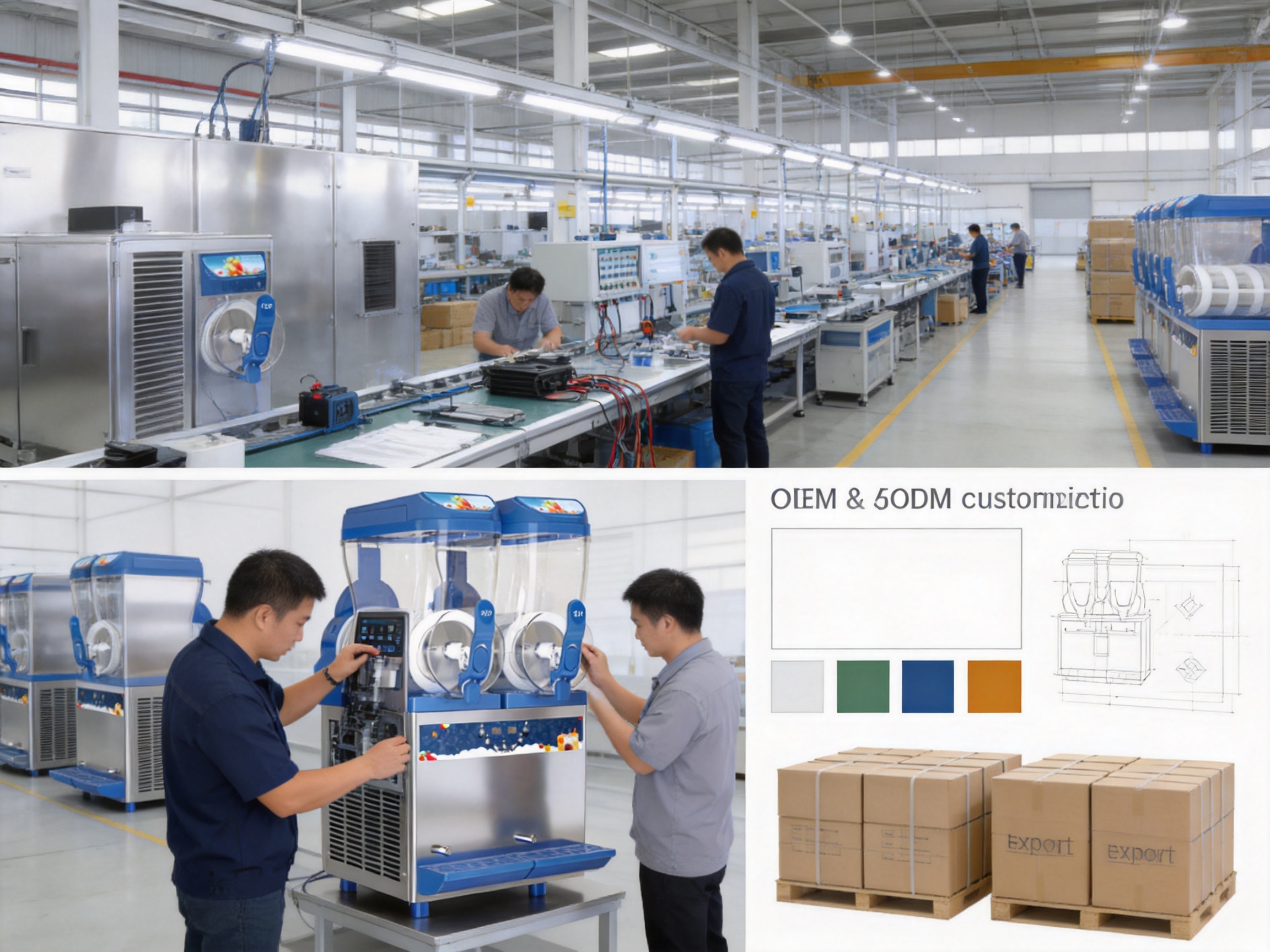
Commercial beverage operations increasingly depend on equipment that can combine attractive presentation, reliable output, simple operation, and efficient use of valuable counter space. The XN240B 2×15L commercial slush machine is designed for bars, cafés, restaurants, snack shops, fast-food outlets, supermarkets, and other foodservice environments that need to serve chilled and semi-frozen beverages throughout the day. With two independent 15-liter tanks, a 1,000-watt rated output, R290 refrigerant, stainless steel construction, and a compact vertical format, the machine is built to support multiple flavors while maintaining stable production during busy service periods.
Unlike a small domestic frozen drink appliance, this machine is designed around the practical needs of commercial service. It provides two separate beverage compartments, allowing operators to offer two flavors, recipes, or product types at the same time. Each tank is supported by an independent circulation and temperature control system, helping maintain consistent texture and flavor from the first serving to the last. This dual-zone arrangement can also simplify menu planning, because one side may be used for a classic slush recipe while the other serves a seasonal, fruit-based, low-sugar, or specialty beverage.
The product is manufactured by Spelor Electrical Appliances (Zhejiang) Co., Ltd., a Chinese foodservice equipment manufacturer with experience in commercial refrigeration, kitchen equipment, buffet equipment, and cold beverage machinery. Its manufacturing capabilities include design, research and development, production, sales, and service. With more than 60,000 square meters of modern production facilities, the company is positioned to support both standard equipment supply and OEM or ODM projects based on customer drawings, specifications, and market requirements.
Why Dual-Tank Slush Equipment Matters in Commercial Service
Frozen beverages are visually appealing and can generate strong impulse purchases. However, offering them successfully requires more than simply freezing a liquid. A commercial machine must maintain a suitable consistency, circulate the beverage evenly, withstand repeated use, and allow staff to serve customers quickly. It must also occupy a reasonable amount of floor or counter space while providing enough capacity for the intended sales volume.
The XN240B addresses these requirements through its two 15-liter tanks. A total capacity of 30 liters gives operators the flexibility to prepare substantial quantities without using two separate machines. Each tank can be managed independently, which is particularly useful when products have different freezing requirements or when two recipes need to be offered at different settings. Independent control also gives staff greater flexibility during menu changes, product testing, and seasonal promotions.
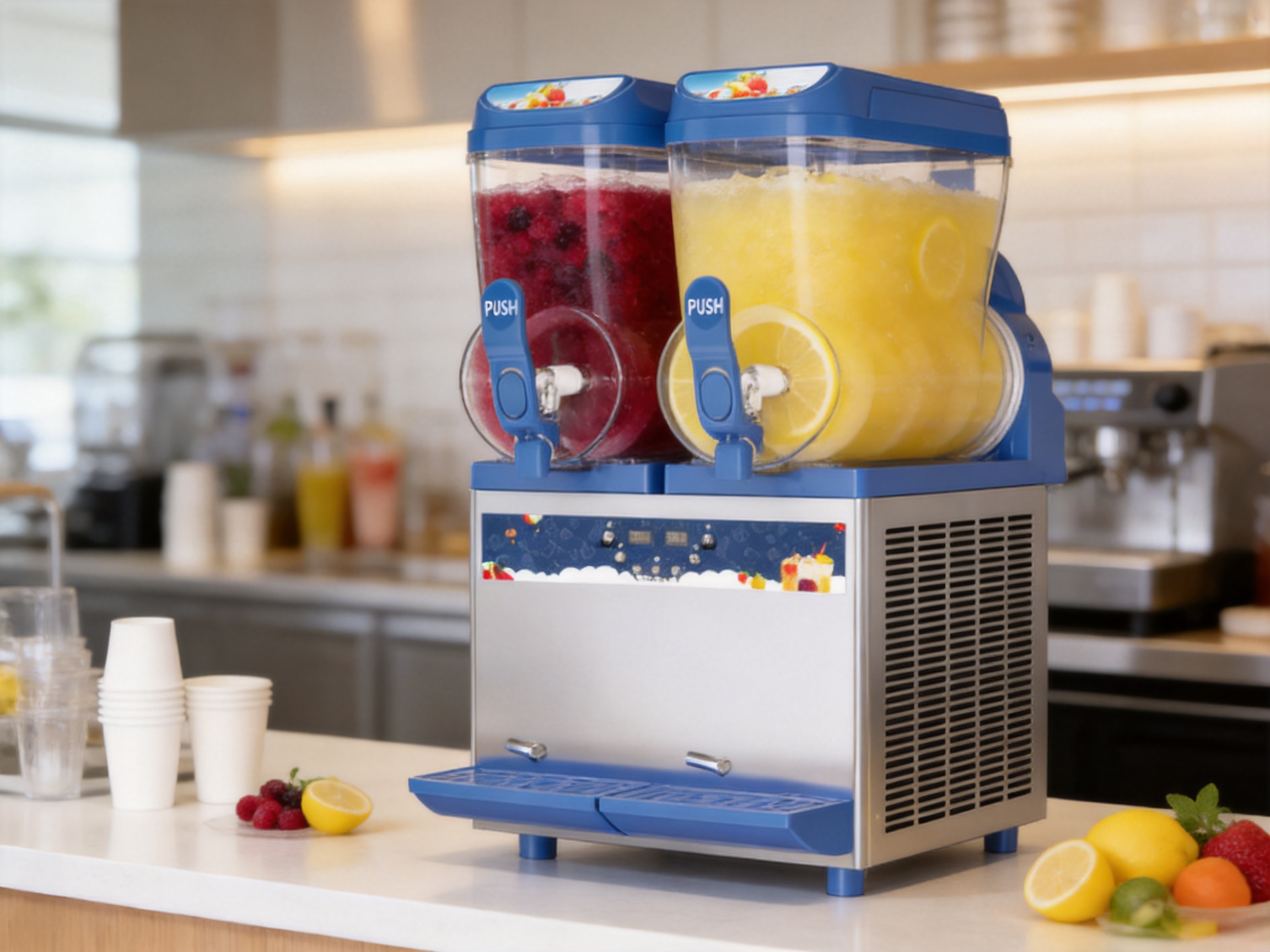
For a café, the two tanks may be used for lemonade slush and berry slush. A bar may offer a non-alcoholic frozen cocktail alongside a fruit punch or frozen mixer. A restaurant may reserve one tank for a signature beverage and the other for a rotating flavor. In a snack shop, two colorful products can create a more attractive display and encourage customers to choose a larger serving or try a second flavor.
The dual-tank design can also improve operational resilience. If one beverage is temporarily unavailable, the second tank can continue serving customers. If an operator needs to clean or change the recipe in one compartment, the other side may remain in service, subject to the applicable cleaning and food safety procedures. This flexibility is a meaningful advantage over single-tank equipment when variety and continuity are important.
Product Overview and Core Specification
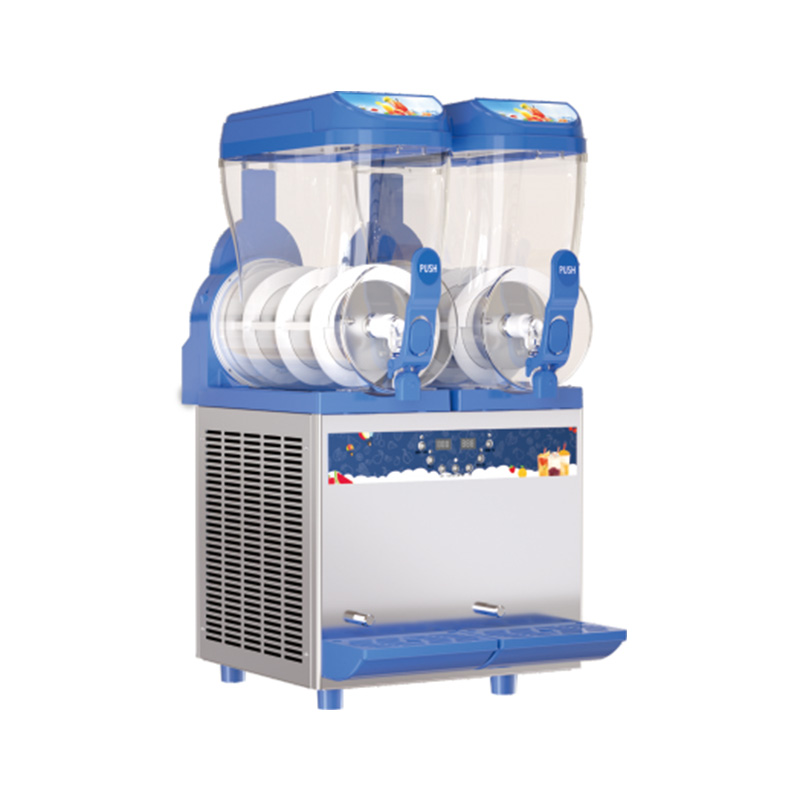
The model identified as XN240B is a commercial slush maker with two 15-liter tanks. It has a rated output of 1,000 watts and uses R290 refrigerant. The machine has a net weight of approximately 45 kilograms and measures 414 millimeters wide, 550 millimeters deep, and 824 millimeters high. Its upright format provides considerable beverage capacity without requiring the footprint of two independent units.
| Specification | Product Detail |
| Model | XN240B |
| Tank configuration | Two independent tanks |
| Capacity | 2 × 15 liters |
| Total nominal capacity | 30 liters |
| Rated output | 1,000 watts |
| Refrigerant | R290 |
| Net weight | 45 kilograms |
| Dimensions | 414 × 550 × 824 millimeters |
| Primary application | Commercial frozen and slush beverages |
The listed refrigerant is R290, a natural refrigerant commonly associated with lower global warming impact compared with many older refrigerant types. Refrigerant selection is only one part of a machine’s environmental performance, but it is an important consideration for operators and purchasing departments reviewing modern commercial refrigeration equipment.
The product description identifies the exterior as food-grade stainless steel combined with colorful sprayed steel. This combination supports a professional appearance while helping the machine attract attention at the point of sale. In beverage service, appearance has practical value: customers often make decisions based on what they see, and a clean, colorful, well-presented dispenser can make frozen beverages more noticeable in a crowded service area.
Independent Circulation and Temperature Control
One of the most important functional features of the XN240B is its independent circulation and temperature control system for each tank. This arrangement allows the two compartments to operate as separate beverage zones rather than as one combined reservoir. The result is greater control over beverage preparation and a more consistent experience for customers.
Circulation helps distribute the chilled beverage through the tank so that temperature and texture remain more uniform. Without effective movement, a frozen beverage can become uneven, with some areas becoming thicker while other areas remain more liquid. Continuous or controlled circulation helps reduce this variation and supports a smoother product during dispensing.
Independent temperature control is equally important when two recipes have different characteristics. A syrup-based slush, a fruit beverage, and a frozen cocktail may not respond identically to the same setting. Ingredients such as sugar, acidity, alcohol, and solids can influence freezing behavior. By giving each tank its own control system, the operator has more flexibility to adjust the machine to the recipes being served.
This feature offers an advantage over basic single-control or shared-tank designs. In a shared system, a setting that is appropriate for one product may be unsuitable for another. Independent control does not remove the need for correct recipe development, but it gives the operator a more useful technical platform for managing different beverages at the same time.
Consistent texture is particularly important in commercial service. Customers expect each serving to resemble the previous one, whether they purchase a beverage in the morning, during lunch, or at the end of a busy evening. Stable circulation and temperature management help the operator maintain this consistency and reduce the need for frequent manual intervention.
Capacity Designed for Busy Service
Two 15-liter tanks provide a practical balance between capacity and equipment size. Thirty liters of nominal capacity can support a meaningful number of servings, depending on cup size, product recipe, sales volume, and operating conditions. The machine is therefore suitable for businesses that need more capacity than a countertop home appliance can offer but may not require a large multi-unit installation.
Capacity should always be evaluated against the actual menu and sales pattern. A business serving small cups may obtain many portions from a full load, while a bar offering large frozen cocktails will consume product more quickly. The two-tank configuration nevertheless provides a useful planning advantage because the operator can dedicate each tank to a specific flavor and monitor consumption independently.
Separate tanks also help reduce flavor confusion. When each flavor remains in its own reservoir, staff can serve products more accurately and maintain a cleaner menu presentation. Clear labeling, standardized recipes, and appropriate cleaning procedures can further support efficient service.
The machine’s capacity is also useful during peak periods. Preparing beverages in advance and maintaining them in the machine can help staff respond faster when queues form. Instead of mixing every serving after an order is placed, employees can dispense a prepared product with a consistent texture. This can shorten transaction times and allow the business to process more beverage orders with the same labor resources.
For operators expanding their beverage menu, dual capacity may be more economical than purchasing two separate single-tank machines. One unit can provide two products while using a single service location, a single exterior presentation, and one coordinated equipment footprint. The final purchasing decision should consider power availability, menu requirements, expected demand, maintenance procedures, and local installation conditions.
Food-Grade Stainless Steel and Commercial Construction
The plate body uses food-grade stainless steel together with colorful sprayed steel. Stainless steel is widely used in foodservice equipment because it is durable, relatively easy to clean, and appropriate for environments where food and beverage contact must be managed carefully. Its smooth surface can support regular sanitation and helps the machine maintain a professional appearance over time.
Commercial equipment is exposed to repeated contact with moisture, ingredients, cleaning agents, staff movement, and customer traffic. A suitable exterior material must therefore tolerate more demanding conditions than ordinary household equipment. The stainless steel construction of the XN240B contributes to a robust appearance and supports the hygienic expectations of cafés, bars, restaurants, and institutional foodservice locations.
The colorful sprayed steel sections provide another practical benefit: visual differentiation. A machine placed near a service counter can become part of the beverage display. Color can be coordinated with the interior design, menu theme, or product branding, subject to the available finish and customization options. This is especially useful for businesses that want equipment to support merchandising rather than appear as an anonymous utility appliance.
Material quality alone does not guarantee hygiene. Operators must still follow appropriate procedures for ingredient handling, tank cleaning, disassembly where required, sanitization, and product rotation. However, durable and cleanable construction gives staff a better foundation for maintaining those procedures consistently.
Compact Vertical Design and Space Utilization
The XN240B measures 414 millimeters in width, 550 millimeters in depth, and 824 millimeters in height. This vertical form makes use of upward space while limiting the width required at the service counter. In many commercial locations, counter space is limited by cash registers, food preparation areas, display fixtures, and other appliances. A compact footprint can therefore have a direct effect on the practicality of installation.
The relatively narrow width is valuable for cafés and snack shops where several products must share the same service line. It can also help bars create a dedicated frozen beverage station without occupying an excessive amount of workspace. Restaurants may place it near the beverage pickup area, while supermarkets or institutional operations may position it where customers can easily see the available flavors.
Before installation, buyers should confirm that the available location can support the machine’s weight, dimensions, ventilation requirements, electrical requirements, and service access. The listed net weight is 45 kilograms, so the counter or stand must be structurally suitable. Clearance should also be considered so that staff can clean the machine and technicians can inspect or maintain the relevant components.
A well-planned installation improves both performance and workflow. The machine should be positioned where staff can load ingredients, monitor product levels, dispense servings, and perform cleaning without obstructing customer movement. Good placement also protects the equipment from unnecessary heat sources, water spray, impact, and excessive crowding.
2*15L Commercial Slush Maker Frozen Drink Machine for Bar Cafe Restaurant
Performance Benefits for Bars, Cafés, and Restaurants
The primary business value of a commercial slush machine is its ability to turn beverage ingredients into a ready-to-serve product with an attractive frozen texture. This creates opportunities across several foodservice formats. A café can add frozen fruit beverages to its cold drink menu. A bar can prepare frozen mixers and non-alcoholic specialties. A restaurant can provide a signature frozen drink alongside meals. A snack shop can use colorful slush products to attract children, families, and impulse buyers.
For bars, the two tanks can support both alcoholic and non-alcoholic concepts, provided the recipes and operating procedures are suitable for the machine. One tank may hold a frozen cocktail base while the second offers a zero-alcohol alternative. This can help create a broader menu without requiring separate equipment for every flavor.
Cafés can use the machine to expand beyond coffee, tea, and conventional chilled drinks. Frozen lemonade, fruit punch, flavored tea slush, and specialty seasonal beverages can provide additional revenue opportunities during warm weather. Since the two tanks operate independently, the operator can test new flavors without removing the established best-selling recipe from service.
Restaurants may use a dual-tank dispenser to create beverages that complement specific menu categories. For example, a casual dining operation could offer a citrus slush and a berry slush. A family restaurant could provide bright, non-alcoholic options. A quick-service location could use the machine as part of a high-throughput beverage station.
In supermarkets and institutional settings, visibility is often important. A well-presented machine can communicate product availability from a distance. The colorful exterior and visible frozen beverage tanks can support self-service or assisted service models, depending on local food safety requirements and the operating design of the location.
Advantages Compared with Basic Single-Tank Equipment
The XN240B offers several practical advantages compared with a basic single-tank commercial slush machine. The most obvious is product variety. Two tanks allow two flavors to be offered at the same time, which can improve customer choice and make the display more appealing. A single-tank unit may be sufficient for one signature beverage, but it can limit menu flexibility when customer preferences vary.
The second advantage is independent adjustment. With separate circulation and temperature control, the operator can manage each product according to its formulation. This is more adaptable than a design in which one control setting governs the entire machine. Different recipes can be evaluated and optimized without necessarily affecting the other beverage.
A third advantage is operational continuity. A two-tank machine can keep one product available while the other side is being replenished, changed, or serviced, subject to proper operating and sanitation practices. This can be useful during busy periods when keeping at least one product on sale is commercially important.
The fourth advantage is space efficiency. Two separate single-tank appliances may require more combined width, more duplicate exterior components, and more complicated placement. The XN240B combines two tanks in one vertical unit, helping the operator preserve counter space and simplify the service layout.
There are also potential purchasing and maintenance benefits. One dual-tank platform may be easier to integrate into a planned beverage station than multiple unrelated machines. Staff training can be more straightforward because employees work with one equipment format. Buyers should still compare total ownership costs, local service support, energy requirements, and expected demand before making a final choice.
Advantages Compared with Non-Commercial Frozen Drink Appliances
Domestic frozen drink appliances are generally designed for occasional use, smaller batches, and lighter duty cycles. They may not provide the capacity, durability, presentation, or service continuity required by a professional operation. The XN240B is intended for commercial environments where the equipment may be used repeatedly throughout the day and where product availability has a direct relationship with revenue.
The 30-liter total capacity is substantially more appropriate for commercial production than a small household reservoir. A foodservice operator can prepare and hold larger quantities, reducing the frequency of refilling during active service. The stainless steel and sprayed steel construction also present a more professional appearance than many consumer units.
Commercial equipment must be selected with attention to workflow rather than only purchase price. A low-cost domestic appliance may appear attractive initially, but insufficient capacity, slower recovery, limited controls, and unsuitable construction can create hidden costs through labor, downtime, and inconsistent product quality. A purpose-built commercial machine is better aligned with businesses that need reliable output and repeatable service.
The XN240B also supports a more organized production routine. Recipes can be standardized by tank, employees can be trained to monitor each side, and the machine can become a defined part of the beverage preparation process. This level of organization is difficult to achieve when using equipment designed primarily for occasional personal use.
Refrigerant Selection and Responsible Equipment Planning
The machine uses R290 refrigerant, a natural refrigerant used in many modern commercial refrigeration applications. R290 is propane-based and is recognized for a comparatively low global warming potential. Its use reflects the broader movement toward refrigeration systems that reduce the environmental impact associated with certain older refrigerants.
Because R290 is classified as a flammable refrigerant, installation, servicing, and repair must be handled according to the manufacturer’s instructions and applicable local regulations. Only qualified technicians should work on the refrigeration circuit. Operators should not modify the refrigerant system or attempt unauthorized repairs.
Responsible equipment planning includes more than selecting a refrigerant. Businesses should consider the machine’s service life, maintenance requirements, operating schedule, cleaning practices, electrical consumption, packaging, logistics, and end-of-life handling. Proper maintenance can help equipment perform efficiently and reduce avoidable replacement costs.
Buyers should also request the technical information needed for their region, including electrical specifications, safety certifications, installation guidance, and documentation relating to refrigerant handling. The model data provided identifies the rated output as 1,000 watts, but the final installation should always be checked against the exact regional configuration supplied by the manufacturer.
Manufacturing Capabilities Behind the Product
The company producing the machine is Spelor Electrical Appliances (Zhejiang) Co., Ltd., formerly known as Zhejiang Spelor Refrigeration Equipment Co., Ltd. It is described as a professional manufacturer integrating design, research and development, manufacturing, sales, and service. This integrated structure is important for commercial equipment buyers because product development, production control, and after-sales support can be coordinated within one organization.
The company operates more than 60,000 square meters of modern production facilities. A large manufacturing base can support organized production planning, dedicated assembly areas, material management, testing procedures, and model development. While facility size alone does not determine product quality, it provides the physical foundation for a broader production system capable of serving international customers and different product categories.
The company’s product range includes ice cream machines, juice dispensers, fried ice cream machines, refrigeration cabinets, slush machines, flake ice machines, cooking equipment, griddles, fryers, insulation products, barbecue equipment, and buffet solutions. This broad portfolio gives the manufacturer experience across several related foodservice applications.
Experience across multiple equipment categories can support practical design decisions. Commercial refrigeration, heating equipment, beverage dispensers, and buffet machinery all require attention to durability, food contact, serviceability, workflow, and customer use. Knowledge gained from one category can help inform improvements in another, particularly when developing equipment for busy professional kitchens and beverage stations.
Research, Development, and Customization Strengths
Commercial buyers do not always need an off-the-shelf machine with a standard configuration. Importers, distributors, chain restaurants, and project contractors may require specific colors, electrical versions, tank arrangements, exterior dimensions, packaging, labels, or control functions. The manufacturer offers OEM and ODM services based on drawings or customer requirements, creating a pathway for customized equipment programs.
OEM production can be useful when a distributor wants equipment under its own brand or when a foodservice group needs consistent visual identity across multiple locations. ODM cooperation can be appropriate when a customer needs a product adapted to a particular market, menu, operating environment, or purchasing specification.
Customization should be approached through a clear technical process. A buyer should provide the intended beverage recipes, target capacity, operating temperature range, electrical requirements, climate conditions, installation limitations, finish preferences, certification needs, packaging expectations, and forecasted order volume. The manufacturer can then assess the requirements and confirm the achievable configuration.
Effective research and development also involves verification. Prototype evaluation, sample approval, production inspection, and performance testing help reduce the risk of misunderstandings between the buyer and supplier. For international projects, documentation and communication are especially important because equipment may be used in different climates, electrical systems, and regulatory environments.
The manufacturer’s integrated design and production capabilities can support this process from initial consultation through final delivery. Customers can discuss the application, review specifications, coordinate sample development, and establish a production plan with one supplier. This can simplify procurement compared with coordinating unrelated design, assembly, and service providers.
Production Process Considerations
A reliable commercial slush machine depends on several production stages working together. Material selection is the first foundation. Food-contact and exterior materials must be chosen for durability, cleanability, appearance, and compatibility with the intended application. The use of stainless steel for the plate body supports these objectives.
Fabrication and forming must produce panels and structural parts with suitable dimensions and consistent fit. Accurate fabrication contributes to the machine’s appearance and helps ensure that components can be assembled correctly. Surface treatment and colorful spraying must be controlled to achieve a uniform finish and a professional presentation.
Mechanical and refrigeration components must then be integrated into the cabinet and tank structure. The circulation system, temperature control system, refrigeration circuit, electrical components, and dispensing assemblies need to operate as a coordinated unit. The dual-tank architecture increases the importance of correct separation and control because each side must function independently.
Assembly quality is particularly relevant to commercial equipment. Loose connections, poor alignment, inadequate sealing, or inconsistent wiring can affect reliability and serviceability. Organized production procedures, trained workers, and inspection checkpoints can help identify issues before shipment.
Testing should evaluate the equipment’s basic operating functions, including power-up, refrigeration response, circulation, temperature adjustment, dispensing, tank performance, and general stability. Packaging inspection is also important because commercial machines may travel long distances before reaching the final customer. Protective packaging should be selected to help reduce the risk of cosmetic and structural damage during handling.
For large orders or customized projects, quality planning may include approved samples, production specifications, inspection standards, component confirmation, and shipment documentation. These controls are useful for importers and distributors that need consistency across multiple batches.
Ease of Operation and Staff Workflow
Commercial beverage equipment should be understandable to staff with different levels of technical experience. The XN240B’s dual-tank concept is straightforward: each side is used for a separate beverage and can be managed independently. This supports a clear operational routine in which employees identify the product assigned to each tank, verify the recipe, monitor the level, and serve through the appropriate dispensing point.
Clear operating procedures can further improve consistency. Staff should be trained to use the correct ingredient ratios, avoid overfilling, recognize the desired texture, and follow the recommended start-up and shutdown sequence. They should also understand the difference between product replenishment and cleaning, since adding ingredients to a tank does not replace the need for scheduled sanitation.
The two-tank format can make shift handovers easier. A written log or digital checklist may identify the recipe in each tank, the time of preparation, the current product level, and any adjustment made during service. Such records can help the next employee understand the machine’s status without relying solely on verbal communication.
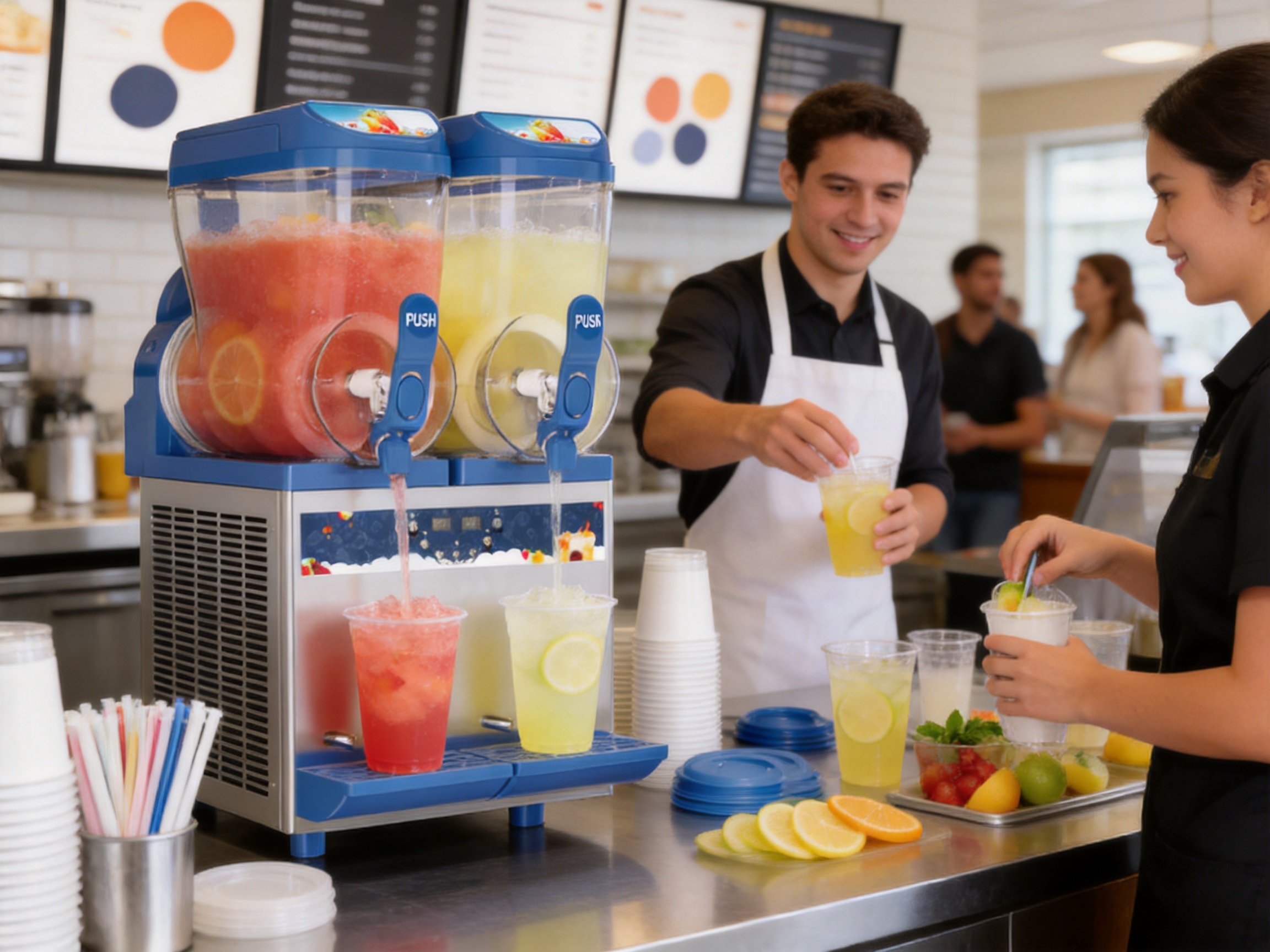
Good workflow design can reduce unnecessary movement. Ingredients, cups, lids, straws, garnishes, and waste containers should be placed close enough to support efficient service while keeping the machine accessible for inspection. If the unit is located near the point of sale, staff can coordinate order taking and dispensing more quickly.
Cleaning, Hygiene, and Preventive Maintenance
Frozen beverage equipment must be cleaned and sanitized according to the manufacturer’s instructions and local food safety requirements. Beverage residues can accumulate if cleaning is delayed, particularly when recipes contain sugar, fruit solids, dairy ingredients, flavoring materials, or other components that can adhere to internal surfaces.
A suitable cleaning program should address the tanks, lids, dispensing areas, circulation components, seals, removable parts, external surfaces, and surrounding counter. Staff should use cleaning agents and procedures approved for the machine’s materials. Components should be reassembled correctly after cleaning, and any parts showing damage or excessive wear should be replaced promptly.
Independent tanks can make sanitation planning more flexible because each side may be handled separately when permitted by operating procedures. However, the fact that one tank is independent does not eliminate the need to maintain both sides to the same hygiene standard. Operators should establish a schedule based on product type, operating frequency, local regulations, and the manufacturer’s recommendations.
Preventive maintenance should include inspection of electrical connections, controls, seals, dispensing parts, circulation components, ventilation areas, and refrigeration performance. Unusual noise, unstable temperature, reduced circulation, leaks, or changes in product consistency should be treated as reasons for inspection rather than ignored.
Because the system uses R290 refrigerant, refrigeration-circuit service should be performed only by qualified personnel familiar with the relevant safety requirements. Operators should keep service records and contact an authorized service provider when specialized attention is needed.
Merchandising and Customer Experience
A commercial slush machine is both a production appliance and a merchandising tool. Frozen beverages are often purchased because they look refreshing, colorful, and immediately available. The machine’s colorful sprayed steel exterior can contribute to a more engaging display, especially when coordinated with menu boards, cup graphics, and seasonal promotions.
Visibility is important. If customers can see the beverage tanks and recognize the available flavors, they may be more likely to ask about the product. Clear labeling can reduce ordering time and help staff explain differences between flavors, sweetness levels, or serving styles.
Two tanks create opportunities for visual contrast. An operator may select two colors that are easily distinguished or use one tank for a permanent best seller and the other for a rotating special. The display can be refreshed without replacing the entire machine, which supports flexible promotional planning.
The product experience also depends on serving consistency. A clean dispensing area, correct cup size, appropriate garnish, and stable beverage texture all contribute to customer satisfaction. Equipment performance and front-of-house presentation should therefore be managed as one complete service process.
Applications Across Different Business Models
Independent cafés can use the machine to add a distinctive cold beverage category without investing in a large production line. Its two tanks allow a small menu to include variety while keeping the equipment footprint manageable. The operator can change one flavor seasonally while retaining a familiar option for regular customers.
Bars may use the machine for frozen cocktails, mocktails, mixers, and event beverages. The independent controls can be useful when recipes have different sugar or alcohol content, although each formula must be tested for suitable freezing behavior. Staff should also follow all relevant regulations concerning alcohol service and labeling.
Restaurants can use the machine for lunch service, dinner service, family dining, outdoor seating, and special promotions. A dedicated frozen beverage can become part of the restaurant’s identity, especially when the recipe is linked to a signature dish or regional flavor.
Fast-food restaurants and snack shops may benefit from fast dispensing and visible product variety. In these environments, the machine can be integrated into a high-throughput service line, provided that staff have a clear refill and cleaning routine.
Hotels, resorts, entertainment venues, and catering operations may use the unit for seasonal service, poolside beverages, event stations, or buffet areas. The compact vertical design can be helpful when space is temporary or when equipment must be moved between service zones, although the 45-kilogram net weight means suitable handling equipment and safe lifting procedures should be considered.
Schools, institutions, and workplace cafeterias may also consider the equipment for controlled beverage programs. These users typically require particularly careful attention to recipe control, allergen management, cleaning records, and local food safety policy.
Procurement Guidance for Importers and Distributors
Importers evaluating the XN240B should begin by confirming the target market’s electrical, safety, labeling, and documentation requirements. The rated output is specified as 1,000 watts, but voltage and frequency details should be confirmed for the destination country before an order is finalized.
Packaging and shipping planning should account for the machine’s dimensions and 45-kilogram net weight. Buyers should ask for gross shipping weight, carton dimensions, pallet information, loading method, and recommended handling instructions. These details affect freight quotations, warehouse planning, customs documentation, and final delivery.
Distributors should also consider spare parts and service support. Common replacement items may include seals, dispensing components, circulation parts, control elements, and other wear items, depending on the final configuration. Establishing a parts and service plan before market launch can improve customer confidence and reduce downtime.
For branded or customized orders, buyers should confirm artwork formats, color references, logo placement, packaging design, manuals, labels, minimum order quantities, sample approval procedures, and inspection standards. Written specifications help ensure that the delivered product matches the approved sample.
Commercial customers should evaluate not only the purchase price but also the total cost of ownership. Relevant factors include expected service life, cleaning labor, product capacity, energy use, maintenance access, warranty terms, spare parts availability, shipping cost, and technical support. A machine that supports two flavors in one unit may offer a more attractive overall value when menu variety and space efficiency are important.
Company Service and Global Supply Support
Spelor provides one-stop support that includes pre-sales consultation, product customization, flexible logistics and payment solutions, and after-sales maintenance. This type of service structure is useful for international customers that need assistance beyond the factory quotation.
Pre-sales consultation can help a buyer select the appropriate tank capacity, configuration, finish, and application. Customers may discuss intended beverage types, expected demand, available installation space, and market requirements before placing an order. This reduces the risk of choosing a machine that does not fit the operational environment.
Customization support is relevant to distributors, chains, project contractors, and foodservice brands seeking a consistent equipment identity. The manufacturer’s OEM and ODM capabilities allow discussions to be based on drawings, technical requirements, or specific commercial objectives.
Flexible logistics and payment solutions can assist buyers managing international procurement. Since shipping conditions vary by destination and order size, the final arrangements should be confirmed directly with the supplier. Clear communication about delivery schedules, export packaging, documents, and responsibilities helps create a smoother transaction.
After-sales maintenance is essential for equipment used every day. A dependable support relationship can help customers understand operating procedures, obtain replacement parts, resolve technical questions, and maintain equipment over its service life. Strong after-sales support can be a significant advantage over suppliers that focus only on the initial sale.
How to Select the Right Beverage Recipes
Machine performance depends partly on recipe suitability. Operators should test each beverage before full-scale commercial launch. Sugar concentration, acidity, alcohol content, dairy ingredients, fruit solids, and stabilizers can influence freezing behavior and dispensing texture. A recipe that tastes good in a liquid state may not produce the desired consistency after freezing.
Each tank should be assigned a recipe that has been checked for the machine’s operating range. The operator should observe the product during start-up, normal holding, peak dispensing, and end-of-service conditions. Adjustments should be documented so that employees can reproduce the approved formula accurately.
Recipe consistency is important for both customer satisfaction and equipment management. Excessively thick mixtures may place unnecessary stress on the circulation system, while mixtures with unsuitable composition may not freeze properly. Operators should follow the manufacturer’s guidance and avoid using ingredients that are incompatible with the equipment.
Menu planning can take advantage of the two independent tanks. One side may carry a high-volume permanent product, while the other supports experimentation or seasonal rotation. This arrangement lets a business introduce new flavors without committing the entire machine to an untested recipe.
Installation and Daily Operating Checklist
Before installation, inspect the delivery package for damage and compare the machine with the approved order details. Confirm the model, tank configuration, finish, dimensions, accessories, manuals, and electrical information. Any shipping damage should be documented promptly according to the delivery procedure.
Place the machine on a stable, level surface capable of supporting its weight. Allow suitable clearance around the unit for ventilation, cleaning, and service access. Keep the equipment away from excessive heat and direct sources of water unless the installation design specifically permits such conditions.
Before the first production cycle, clean and sanitize the appropriate food-contact components according to the instructions. Prepare the approved recipes and fill the tanks without exceeding the recommended level. Confirm that the correct flavor is assigned to each tank to avoid menu or labeling errors.
During operation, monitor product texture, tank levels, dispensing performance, unusual noise, and temperature behavior. Refill carefully and maintain good ingredient-handling practices. At the end of service, follow the prescribed shutdown, cleaning, sanitizing, and inspection procedure.
A simple daily checklist can include power and control inspection, tank condition, dispensing area cleanliness, product identification, circulation performance, exterior cleaning, and staff sign-off. Preventive routines help identify small issues before they become expensive breakdowns.
Value Proposition for Commercial Buyers
The XN240B combines several features that are valuable in professional beverage service: two independent 15-liter tanks, a total nominal capacity of 30 liters, independent circulation and temperature control, a 1,000-watt rated output, R290 refrigerant, food-grade stainless steel construction, a colorful exterior, and a compact upright footprint.
Its main advantage is not any single specification but the way these features support a complete commercial workflow. Capacity supports volume, dual tanks support variety, independent controls support recipe flexibility, circulation supports consistency, stainless steel supports a professional and cleanable exterior, and the vertical format supports space-conscious installation.
Compared with a basic single-tank unit, it can offer greater menu flexibility and stronger display potential. Compared with two unrelated appliances, it may simplify placement and operation. Compared with domestic equipment, it is more aligned with the capacity, durability, and repeated service demands of foodservice businesses.
The manufacturer’s broader strengths add value to the equipment proposition. Its large production base, integrated research and development capabilities, broad foodservice product range, OEM and ODM experience, and after-sales support provide a foundation for both individual purchases and larger commercial programs.
For buyers seeking reliable frozen beverage service, the machine should be considered as part of a wider operating system that includes recipe development, staff training, sanitation, preventive maintenance, installation planning, and customer-facing merchandising. When these elements are managed together, the equipment can contribute to efficient service and a more attractive beverage offering.
Frequently Asked Questions
What is the capacity of the commercial slush machine?
The machine has two tanks, with each tank holding 15 liters. Its total nominal capacity is therefore 30 liters. The actual number of servings will depend on cup size, recipe, product loss, and operating conditions.
Can the two tanks serve different flavors?
Yes. The two tanks are designed to operate independently, allowing the operator to serve two different flavors or beverage recipes at the same time. Each side has independent circulation and temperature control.
Is the machine suitable for bars and cafés?
Yes. It is intended for commercial environments including bars, cafés, restaurants, snack shops, fast-food outlets, supermarkets, and other foodservice locations. Bars may use it for frozen cocktails or non-alcoholic beverages, while cafés can offer fruit slushes, lemonades, and specialty cold drinks.
What refrigerant does the machine use?
The listed refrigerant is R290. Because R290 is flammable, installation and refrigeration-system service should be performed according to the manufacturer’s instructions and applicable local safety requirements by qualified personnel.
What is the rated output?
The rated output is 1,000 watts. Buyers should confirm the exact voltage and frequency configuration for the destination market before ordering or installing the machine.
What are the machine dimensions?
The listed dimensions are 414 millimeters wide, 550 millimeters deep, and 824 millimeters high. Buyers should also confirm service clearance, packaging dimensions, and gross shipping weight before planning installation or transport.
How much does the machine weigh?
The net weight is approximately 45 kilograms. The installation surface must be stable and strong enough to support the machine, and safe handling procedures should be used during movement.
What materials are used for the exterior?
The product description identifies food-grade stainless steel and colorful sprayed steel. These materials contribute to a professional appearance, durability, and practical cleanability when suitable maintenance procedures are followed.
Can one tank be cleaned while the other is operating?
The independent tank design may provide operational flexibility, but cleaning procedures must follow the manufacturer’s instructions and local food safety requirements. Operators should never compromise sanitation in order to maintain service.
Does the machine require special recipe testing?
Yes. Different beverages freeze differently depending on sugar, alcohol, acidity, solids, and other ingredients. Each recipe should be tested for suitable texture, circulation, dispensing performance, and operating stability before commercial service.
Can the manufacturer provide OEM or ODM service?
The manufacturer offers OEM and ODM foodservice equipment solutions based on drawings or customer requirements. Buyers should discuss the desired configuration, branding, electrical version, finish, packaging, certification, and order quantity directly with the supplier.
What industries can use this equipment?
Potential users include cafés, bars, restaurants, snack shops, fast-food chains, supermarkets, hotels, resorts, entertainment venues, institutional cafeterias, catering companies, and other foodservice businesses that serve frozen beverages.
What should be considered before purchase?
Important considerations include expected sales volume, recipe types, available installation space, electrical supply, ventilation, local regulations, cleaning requirements, service support, spare parts, shipping arrangements, and the total cost of ownership.
Conclusion
The XN240B 2×15L commercial slush machine is designed to help foodservice businesses offer attractive frozen beverages with greater variety and operational control. Its two independent 15-liter tanks support simultaneous service of different flavors, while separate circulation and temperature control systems help maintain consistent texture and stable output.
The machine’s 1,000-watt rated output, R290 refrigerant, food-grade stainless steel and sprayed steel construction, 45-kilogram net weight, and compact 414×550×824-millimeter format make it suitable for many commercial beverage environments. Its design offers practical advantages over basic single-tank and domestic appliances by combining capacity, flexibility, presentation, and space efficiency in one unit.
Behind the product is a manufacturer with more than 60,000 square meters of modern production facilities and experience spanning commercial refrigeration, kitchen equipment, buffet solutions, and beverage machinery. Integrated design, research and development, manufacturing, sales, customization, logistics, and after-sales support provide a useful foundation for both standard orders and OEM or ODM projects.
For businesses that want to strengthen their cold beverage menu, improve flavor variety, and support efficient service during busy periods, this dual-tank commercial slush machine offers a balanced equipment solution. Its greatest value is realized when the machine is combined with suitable recipes, well-trained staff, disciplined cleaning, preventive maintenance, and thoughtful placement within the overall customer service workflow.
References
1. Product specification sheet for model XN240B, including tank capacity, rated output, refrigerant, net weight, and dimensions.
2. Manufacturer-provided product information concerning dual-tank circulation, independent temperature control, exterior materials, and commercial applications.
3. Manufacturer corporate information concerning design, research and development, production, OEM and ODM services, logistics, and after-sales support.
4. General foodservice equipment principles relating to commercial beverage preparation, hygienic design, cleaning procedures, and preventive maintenance.
5. General refrigeration engineering references concerning natural refrigerants, R290 applications, and qualified service requirements.
Product: 2*15L Commercial Slush Maker Frozen Drink Machine for Bar Cafe Restaurant

For exclusive deals and latest offers, sign up by entering your email address below.


-
spelor@spelor.com
-
+86-576-85229688
-
No.528, Changxi Road, Linhai City, Zhejiang Province, China
Commercial Refrigeration Equipment Manufacturer China
Copyright © 2025 by Spelor Electrical Appliances (Zhejiang) Co., Ltd. Rights Reserved.
