


 中文简体
Single-Square Five-Tank Commercial Fried Ice Cream Roll Cart Machine: Performance, Flexibility, and Professional Production Value
Admin 2026-09-13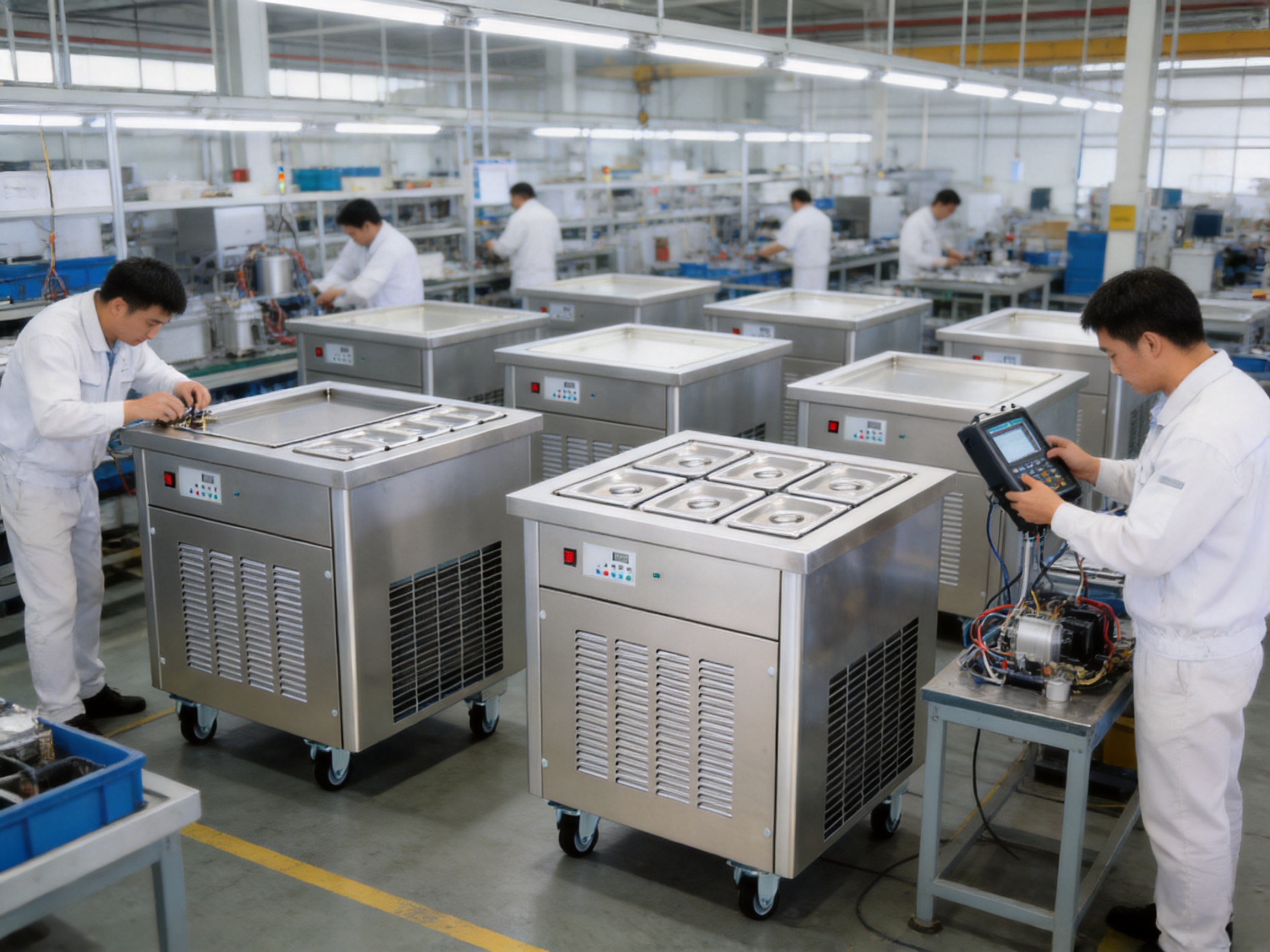
Fried ice cream rolls have become a popular foodservice product because they combine visual appeal, customization, and a memorable serving experience. Customers can watch a liquid ice cream mixture being spread across a chilled pan, blended with ingredients, scraped into rolls, and served immediately. For operators, this format creates opportunities in shopping centers, night markets, snack shops, dessert counters, cafés, fast-food outlets, and mobile food stalls.
The Single Square Commercial Fried Ice Cream Roll Cart Machine with Five Tanks is designed for commercial operators who need a practical balance of product variety, cooling performance, operating efficiency, and manageable equipment size. With a 53-centimeter square pan, five ingredient or mixture tanks, a 1,500-watt power rating, a working temperature range of approximately -17°C to -20°C, and a net weight of 70 kilograms, the machine is built for regular professional use rather than occasional domestic preparation.
Its single-square configuration provides a generous working surface while maintaining a relatively compact footprint. The five-slot arrangement allows operators to prepare or organize multiple flavors and ingredients at the same time. This can help simplify service during busy periods, reduce unnecessary movement around the workstation, and make the menu more attractive to customers seeking variety.
Manufactured by Spelor Electrical Appliances (Zhejiang) Co., Ltd., the machine reflects the company’s broader experience in commercial refrigeration, kitchen equipment, buffet equipment, and foodservice solutions. The manufacturer operates modern production facilities covering more than 60,000 square meters and integrates design, research and development, manufacturing, sales, and service within one organization. This integrated structure supports OEM and ODM cooperation, product customization, and coordinated after-sales service for international buyers.
1. Why Fried Ice Cream Roll Equipment Matters in Commercial Foodservice
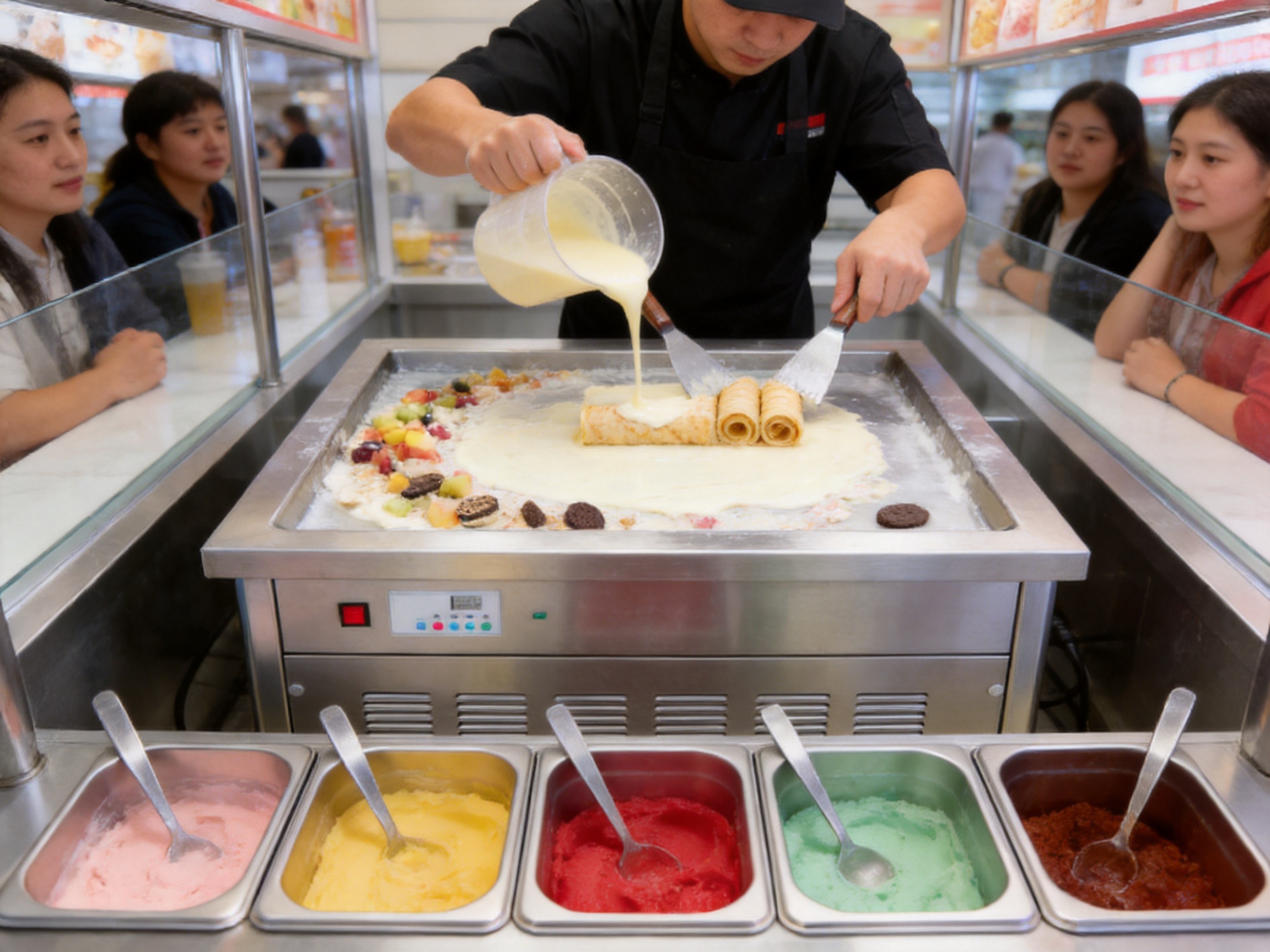
Fried ice cream rolls are not produced by traditional frying. Instead, the product is made on a rapidly chilled pan. A liquid dairy or non-dairy mixture is poured onto the cold surface, where it freezes or semi-freezes quickly. Flavorings, fruit, biscuits, chocolate, nuts, sauces, and other ingredients are then incorporated before the mixture is spread into a thin layer and scraped into rolls.
This preparation method creates several operational requirements. The pan must cool consistently across the working area. The temperature must be low enough to create an appropriate texture, but the surface must also support controlled spreading and scraping. The machine must provide sufficient room for preparation without becoming so large that it is difficult to install, clean, or transport.
Speed and consistency are equally important. If cooling is uneven, one part of the mixture may remain soft while another part becomes too firm. Inconsistent cooling can make scraping difficult and lead to irregular rolls. During a busy service period, such variation may increase preparation time and affect customer satisfaction.
A professional fried ice cream machine therefore needs more than a cold surface. It should provide a stable refrigeration system, a practical work layout, accessible controls, durable construction, and a design that supports repeatable production. The Single Square Five-Tank model addresses these needs through its commercial pan size, independent tank arrangement, refrigeration performance, and cart-style format.
2. Product Overview and Main Specifications
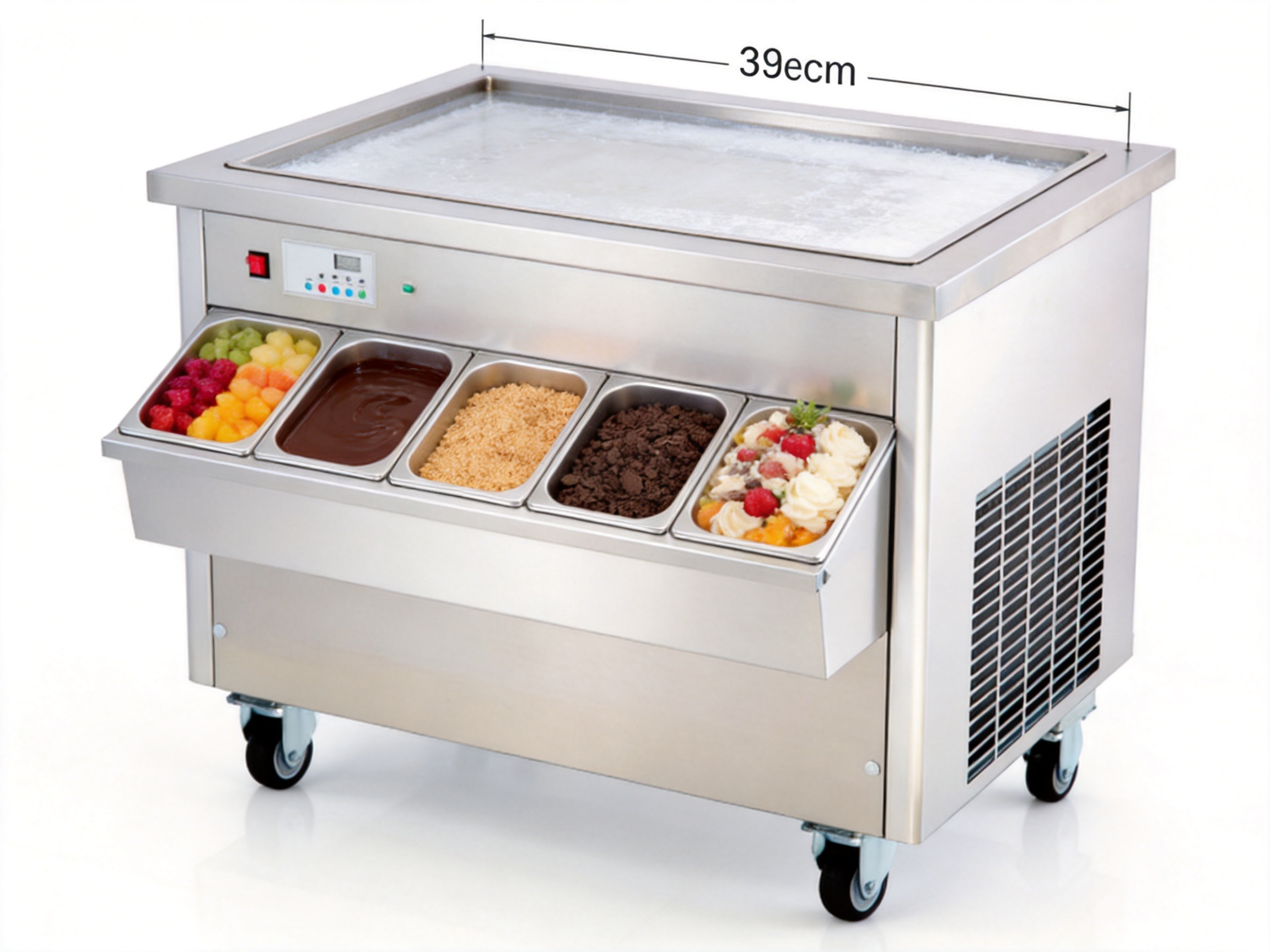
The product model is identified as CB-530F+5XF. It features one square freezing pan with a stated pan size of 53 centimeters and a pan depth of approximately 2 centimeters. The machine has a rated input power of 1,500 watts and a net weight of approximately 70 kilograms.
| Product category | Commercial Fried Ice Cream Roll Machine |
| Model reference | CB-530F+5XF |
| Pan configuration | Single square pan |
| Pan size | 53 centimeters |
| Pan depth | Approximately 2 centimeters |
| Number of tanks or slots | Five |
| Input power | 1,500 watts |
| Power supply | 220 volts, 50 hertz |
| Operating temperature range | Approximately -17°C to -20°C |
| Net weight | Approximately 70 kilograms |
| Machine dimensions | Approximately 680 x 740 x 830 millimeters |
| Compressor information | Chinese compressor listed in the specification |
| Refrigerant information | Configuration should be confirmed before purchase |
The available technical information lists R410 in one specification section and R22/R404A in another information section. Because refrigerant selection can depend on the production configuration, market, certification requirements, and customer order, buyers should confirm the exact refrigerant before placing an order. This point is especially important for importers, distributors, and projects that must comply with local environmental or refrigeration regulations.
The machine dimensions of approximately 680 x 740 x 830 millimeters provide a useful compromise between working capacity and installation efficiency. Operators should still allow additional clearance for ventilation, electrical access, cleaning, and staff movement. The 70-kilogram net weight indicates a substantial commercial unit that should be placed on a stable surface or used with a properly designed cart structure.
3. The Five-Tank Advantage
The most distinctive feature of this model is its single-square, five-slot design. A multi-tank arrangement gives operators a practical way to organize different flavors, sauces, toppings, or liquid bases near the preparation area. Instead of repeatedly leaving the workstation to retrieve ingredients, staff can maintain a more efficient production rhythm.
For a dessert shop, the five tanks may be used for several signature liquid mixtures. A customer might choose chocolate, strawberry, vanilla, mango, or coffee, for example. Alternatively, the tanks can be assigned to fruit purées, syrups, condensed milk, cookie crumbs, or other components used in the preparation process. The exact use depends on the shop’s recipes and operating procedures.
This flexibility can provide a competitive advantage over simpler single-flavor or limited-storage machines. Basic equipment may be suitable for operators with a very narrow menu, but it can create additional preparation steps when a business wants to offer more choices. A five-tank system supports menu diversification without necessarily requiring five separate machines.
The arrangement can also improve visual merchandising. In open-kitchen environments, customers can see a selection of ingredients and flavors available for customization. This creates an interactive purchasing experience and can encourage customers to try combinations they may not have considered in a conventional dessert counter.
Independent stirring and cooling systems are described as part of the product’s design. Such independence is valuable because different mixtures may have different consistencies, ingredient densities, or preparation requirements. Keeping the tank functions organized can help operators manage flavors more effectively and reduce the possibility of one mixture affecting another during service.
From a labor perspective, the five-tank layout may shorten repetitive preparation steps. A trained operator can select the required flavor or ingredient, work on the cold pan, and complete the order without excessive movement. In a high-volume environment, these small savings can accumulate across dozens or hundreds of orders.
Compared with a large multi-pan machine, the single-square format may also be easier to teach. Staff members can focus on one principal freezing surface and one consistent scraping technique. This can make the machine suitable for businesses that need flexible production but do not want the complexity or larger footprint associated with multiple independent pans.

Single Square Commercial Fried Ice Cream Roll Cart Machine with Five Tanks
4. Pan Design and Production Control
The 53-centimeter square pan offers a broad working area for spreading, mixing, and forming rolls. A square surface is particularly practical for commercial preparation because it provides clear corners and straight edges. Operators can divide the surface visually, move the mixture in a controlled pattern, and form multiple rolls without losing as much usable area as they might on a small or irregular surface.
The stated pan depth of 2 centimeters is appropriate for a work surface designed for thin-layer freezing. A shallow pan helps the mixture spread into a relatively even layer and allows the cold surface to influence the product efficiently. The operator can then scrape the layer at a suitable angle to create compact rolls.
Pan size should always be considered together with recipe portioning. A larger surface is not automatically better if staff pour too much mixture at one time. Proper portion control helps maintain consistent freezing speed, thickness, texture, and roll appearance. Operators should develop standard recipes and measured portions for each flavor so that the machine performs consistently throughout the day.
The square layout can also support more efficient cleaning. Straight edges are generally easier to inspect and wipe than complicated curved or segmented work areas. Although cleaning procedures will depend on the final construction materials and local food safety requirements, an accessible surface is beneficial for daily sanitation.
For competing products, buyers should compare not only nominal pan dimensions but also the usable work area, pan depth, cooling uniformity, access to components, and ease of scraping. A machine with a large advertised surface may not provide the same practical capacity if the working area is obstructed or cooling is concentrated in only one zone.
5. Refrigeration Performance and Temperature Stability
The machine is designed to operate at approximately -17°C to -20°C. This low-temperature range is central to fried ice cream roll production because the mixture must become firm enough to scrape and shape within a short period. Stable cooling helps operators produce rolls with a more predictable texture and appearance.
Temperature stability is generally more important than achieving the lowest possible number. If the surface is too warm, the mixture may remain soft and difficult to roll. If the surface is excessively cold or the mixture is portioned too thinly, it may harden too quickly and become difficult to spread smoothly. The objective is controlled freezing that matches the recipe, portion size, and operator technique.
The stated 1,500-watt power rating provides the refrigeration and operating capacity required for this commercial format. Actual energy consumption will vary depending on ambient temperature, usage frequency, ingredient temperature, ventilation, and maintenance condition. Operators should avoid placing the machine next to ovens, fryers, direct sunlight, or other heat-producing equipment because surrounding heat can increase refrigeration workload.
Good airflow is essential. Commercial refrigeration equipment needs adequate ventilation around the compressor and condenser area. Blocking ventilation openings, installing the unit in an enclosed cabinet, or operating it in a very hot environment may reduce cooling efficiency and shorten component life.
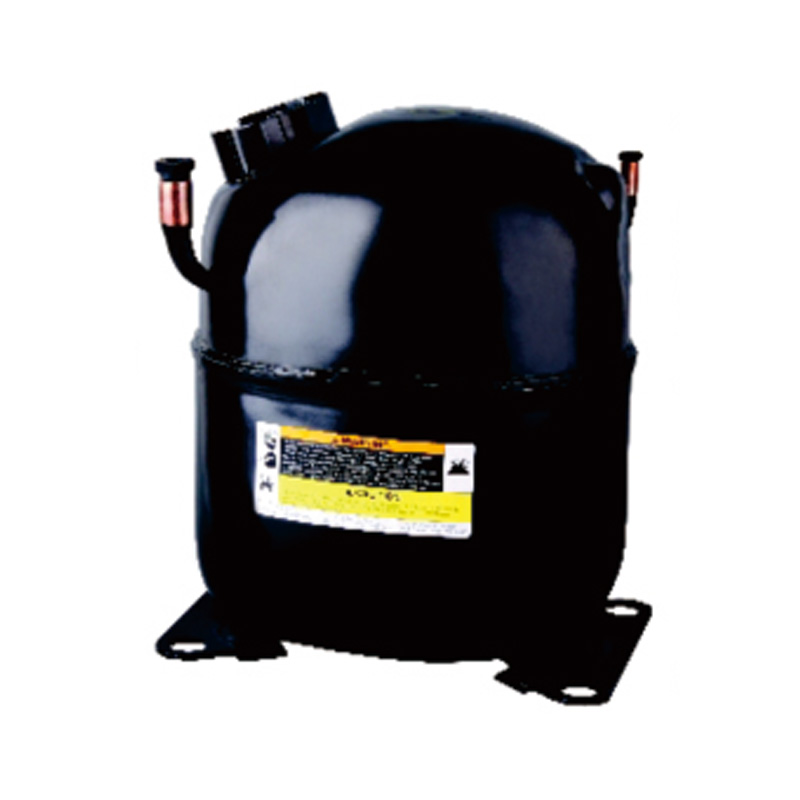
The compressor is listed as Chinese in the supplied technical information. Compressor quality should be assessed together with system design, assembly accuracy, refrigeration charge, insulation, controls, and after-sales support. A compressor alone does not determine total machine performance. Consistent manufacturing, proper leak testing, correct electrical assembly, and suitable control calibration are equally important.
Because the supplied data includes more than one refrigerant reference, project buyers should request a confirmed technical sheet for the specific order. The confirmation should state the refrigerant type, electrical standard, compressor configuration, voltage and frequency, applicable certification, and any regional modifications.
6. Commercial Advantages Compared with Basic Competitor Models
6.1 Greater flavor flexibility
A basic fried ice cream machine may provide only a single ingredient container or limited preparation support. The five-tank format gives operators more choices and makes it easier to build a varied menu. This can be especially useful in markets where customers expect customization and where visual variety influences purchasing decisions.
6.2 Efficient use of floor space
The machine combines one large square pan with five integrated slots or tanks. This can be more space-efficient than purchasing several separate units for different flavors. The approximate dimensions of 680 x 740 x 830 millimeters make it suitable for many commercial counters, stalls, kiosks, and compact dessert shops, subject to local installation requirements.
6.3 Suitable for open-service environments
Fried ice cream rolls are often prepared in front of customers. The single-pan layout gives the preparation process a clear visual center. Staff can work in an organized area while customers watch the mixture being spread and rolled. This creates an experience that conventional pre-portioned frozen desserts cannot easily replicate.
6.4 Practical commercial capacity
The 53-centimeter pan is larger than the working surfaces found on many entry-level machines. This provides more room for mixing and shaping and can help operators serve orders more efficiently. Capacity will depend on recipe, operator skill, customer order size, and recovery time, but the pan is designed for regular commercial use rather than occasional demonstrations.
6.5 Easier workflow management
Independent stirring and cooling functions help separate ingredient organization from the main freezing operation. This supports a more systematic workflow and may reduce the need for staff to handle multiple external containers during busy periods. A well-organized workstation can also improve hygiene by reducing unnecessary handling and movement.
6.6 Professional construction and service support
Commercial equipment buyers typically need more than a machine at the lowest initial price. They also need documentation, spare parts, technical communication, shipping support, and a reliable response when maintenance is required. The manufacturer’s broader product range and integrated service structure can be valuable for distributors and foodservice projects that require continuing support.
7. Manufacturing Strengths and Production Capabilities
Spelor Electrical Appliances (Zhejiang) Co., Ltd. is described as a professional manufacturer that integrates product design, research and development, manufacturing, sales, and service. This integrated model can improve coordination between engineering, production, quality control, and customer support.
A manufacturing facility of more than 60,000 square meters provides room for organized production areas, component handling, assembly operations, testing, storage, and dispatch. Facility size alone does not guarantee product quality, but it can support production planning and the ability to handle larger or more varied orders.
The company’s product portfolio includes ice cream machines, juice dispensers, fried ice cream machines, refrigeration cabinets, slush machines, flake ice machines, cooking equipment, griddles, fryers, insulation products, barbecue equipment, and buffet solutions. This product diversity indicates experience across multiple categories of foodservice equipment and refrigeration-related applications.
For buyers, a broad product portfolio can create practical advantages. A distributor may be able to source multiple types of equipment from one manufacturing partner. A restaurant project can coordinate refrigeration, beverage, dessert, cooking, and buffet equipment through one supplier. OEM and ODM customers can also discuss related product families, shared design requirements, or customized specifications with a team familiar with commercial kitchen environments.
Advanced manufacturing should be evaluated as a complete process rather than as a single machine or slogan. Important areas include engineering design, material selection, refrigeration system assembly, electrical wiring, insulation, welding or structural fabrication, surface finishing, functional testing, packaging, and final inspection.
For this fried ice cream roll machine, production discipline is especially important in the following areas:
Accurate fabrication of the pan and supporting structure.
Correct installation of refrigeration components and tubing.
Reliable electrical connections suitable for the rated power supply.
Consistent sealing and insulation around the cold surface.
Proper alignment of stirring and tank components.
Functional testing at the intended temperature range.
Inspection of dimensions, finish, controls, and operating noise.
Secure packaging for domestic and international transportation.
Manufacturers serving global customers must also manage variations in voltage, frequency, plug standards, documentation, labeling, and import requirements. The stated standard configuration is 220 volts and 50 hertz, but customers should confirm whether their market requires a different electrical arrangement.
Spelor’s stated OEM and ODM capability is relevant to buyers that need customized branding, exterior colors, logo placement, control layouts, tank arrangements, packaging, or technical specifications. Customization should be discussed early because changes may affect tooling, testing, minimum order quantities, lead times, spare parts, and certification.
8. Quality Control Considerations for Professional Buyers
Commercial buyers should request a clear quality-control process when evaluating this type of equipment. A suitable inspection program may include incoming component inspection, assembly checks, refrigeration testing, electrical safety checks, temperature verification, visual inspection, and final operational testing.
Temperature testing should verify that the pan reaches the intended working range and that cooling is sufficiently uniform across the usable surface. Testing should be performed under defined conditions because ambient temperature and pre-operation cooling time can influence results.
Electrical inspection should confirm that wiring, switches, overload protection, grounding, and connections are suitable for the stated 1,500-watt load and 220-volt, 50-hertz supply. Importers may also require factory test reports, product labels, user manuals, packing lists, and other documentation.
Mechanical inspection should focus on structural stability, pan flatness, tank fit, access panels, fasteners, wheels or cart components if included, and the general quality of the finished surfaces. Since the machine is used in foodservice, surfaces that may contact ingredients should be easy to clean and appropriate for the intended application.
Packaging is another important part of manufacturing quality. A 70-kilogram commercial machine must be protected against impact, vibration, moisture, and movement during transportation. Export packaging should be selected according to shipping method and destination. Buyers should clarify whether wooden crates, reinforced cartons, corner protection, moisture barriers, or other measures are included.
9. Operating Workflow
Before operation, the machine should be positioned on a stable, level surface with sufficient ventilation. The operator should inspect the electrical connection, confirm that the machine is clean, and make sure the tanks and pan are ready for food production.
The machine may need a pre-cooling period before ingredients are added. The exact time depends on ambient temperature and the operating instructions supplied with the unit. Starting with properly chilled ingredients can help reduce the workload on the refrigeration system and improve preparation consistency.
The operator then selects the desired mixture and places an appropriate portion on the cold pan. Ingredients can be incorporated using suitable food-safe utensils. The mixture should be spread evenly across the surface rather than concentrated in one thick area.
When the mixture reaches the correct consistency, the operator uses scrapers to divide and roll the frozen layer. Scraping technique affects roll shape, thickness, and presentation. Training should cover hand position, scraping angle, portion size, pan coverage, and safe handling of tools.
After serving, remaining ingredients should be managed according to the shop’s food safety procedures. The pan and relevant surfaces should be cleaned between flavors or at appropriate intervals to prevent cross-contact and maintain taste quality. At the end of the service period, the operator should perform a complete cleaning routine and inspect the machine for residue or spills.
10. Cleaning, Hygiene, and Maintenance
Cleaning is essential for both food safety and equipment performance. Operators should follow the manufacturer’s instructions and local regulations regarding cleaning agents, sanitizing procedures, water use, and food-contact surfaces.
The pan should be cleaned with materials that will not damage the working surface. Abrasive tools, unsuitable chemicals, and excessive force may affect the finish and make future cleaning more difficult. Staff should remove ingredients promptly rather than allowing them to dry and harden on the surface.
The five tanks should receive regular attention because syrup, dairy, fruit, and other mixtures can leave residues. Tanks and related components should be emptied, washed, sanitized, and dried according to the applicable operating procedure. If any tank includes a stirring mechanism, staff should ensure that moving parts are cleaned without damaging electrical or mechanical components.
External surfaces should be wiped regularly, especially in open-service locations where customers can see the equipment. Condenser and ventilation areas should be kept free of dust and grease. Restricted airflow can cause higher operating temperatures, longer cooling cycles, and increased stress on the refrigeration system.
Preventive maintenance may include checking electrical connections, inspecting seals, reviewing abnormal noise, monitoring temperature behavior, cleaning the condenser area, and confirming that the machine remains level and stable. If cooling performance changes significantly, operators should stop relying on guesswork and contact qualified service personnel.
Commercial users should keep records of cleaning, maintenance, temperature checks, and repairs. These records can help identify performance trends and demonstrate responsible food safety management.
11. Applications and Ideal Customer Profiles
This machine is suitable for dessert shops that want to add freshly prepared ice cream rolls to their menu. It can also serve snack shops, beverage stores, cafés, fast-food outlets, market stalls, shopping-center kiosks, food courts, amusement venues, and catering operations.
Its five-tank arrangement is particularly useful for businesses that want to promote multiple flavors or mix-ins. A shop can develop seasonal menus, limited-time combinations, children’s options, fruit-based recipes, chocolate desserts, or premium ingredient selections.
Food trucks and mobile vendors should evaluate transportation requirements carefully because the machine weighs approximately 70 kilograms. It may be suitable for mobile service when installed in a properly reinforced vehicle or cart, but the operator must consider electrical supply, ventilation, floor strength, movement protection, and local licensing rules.
Distributors may find the product attractive because it occupies a distinct position between compact entry-level machines and larger multi-pan commercial systems. It offers visible product customization without requiring the investment, floor area, or training complexity of a very large production line.
Hotels, resorts, and buffet operators may use the machine as an interactive dessert station. In these settings, presentation and customer engagement are important. The equipment can be positioned as part of a live preparation counter, provided the installation meets safety and hygiene requirements.
12. Selection Guidance for Importers and Distributors
Before ordering, buyers should define the intended market, daily production level, menu format, available electrical supply, installation location, and expected operating hours. These factors determine whether the single-square five-tank design is the most suitable configuration.
Importers should confirm the following details with the supplier:
Exact model and final configuration.
Confirmed refrigerant type.
Voltage, frequency, plug, and wiring standard.
Final machine dimensions and packed dimensions.
Whether a cart, wheels, covers, or accessories are included.
Materials used for the pan and food-contact components.
Warranty terms and parts availability.
Recommended installation clearance.
Operating manual and cleaning instructions.
Testing documents and market-specific certifications.
Minimum order quantity and production lead time.
Export packaging and shipping arrangements.
Distributors should also evaluate the product’s market positioning. Its main selling points include the five-tank configuration, broad square pan, commercial cooling range, compact professional format, and suitability for customized dessert menus. Product training and recipe guidance can make these advantages easier for end users to understand.
It is also useful to compare after-sales service rather than focusing only on the purchase price. A slightly lower-priced machine may become more expensive if parts are difficult to obtain, technical support is limited, or the product lacks clear documentation. A supplier with experience in international foodservice markets may provide greater long-term value.
13. OEM and ODM Opportunities
OEM and ODM services can help importers create a product range adapted to their own sales channels. Possible customization areas may include external appearance, branding, labeling, packaging, tank configuration, control components, power supply, and optional accessories. The feasibility of each modification should be confirmed by the manufacturer’s engineering team.
For a private-label project, buyers should prepare a clear specification document. It should define the required dimensions, cooling performance, electrical standard, materials, color, logo treatment, packaging, documentation language, and inspection criteria. Clear specifications reduce misunderstandings and make production approval more efficient.
Design customization may also be useful when the machine must match a shop interior or a mobile vending concept. A coordinated appearance can improve brand recognition and make the preparation station more attractive to customers. However, cosmetic changes should not compromise ventilation, cleaning access, structural stability, or electrical safety.
Large foodservice chains may request additional standardization. They may need identical dimensions across multiple stores, consistent controls, centralized spare parts, or specific training materials. An integrated manufacturer can help coordinate product engineering, production, shipment, and after-sales requirements for such projects.
14. Economic and Business Value
The value of a fried ice cream roll machine should be considered in relation to menu pricing, expected sales volume, ingredient cost, labor, cleaning time, energy use, maintenance, and equipment life. The machine does not guarantee profitability, but its design can support a business model based on customization and visual preparation.
Freshly made rolls often have strong perceived value because customers receive an individualized product. Operators can offer standard, premium, seasonal, and upgraded combinations. The five tanks make it easier to present multiple choices without requiring a completely separate production area for each flavor.
The machine may also support cross-selling. A beverage shop can offer fried ice cream rolls with drinks. A snack shop can combine them with waffles, fried foods, or specialty desserts. A buffet can use the equipment to add a made-to-order station. These combinations may increase average transaction value when managed effectively.
Labor efficiency depends on training and workflow design. The operator should arrange ingredients, tools, packaging, and toppings within easy reach. A clean, organized workstation helps reduce wasted motion and keeps the service process attractive to customers.
Energy management is also relevant. Staff should avoid leaving the machine exposed to unnecessary heat and should maintain the condenser area. Proper portioning prevents excessive recovery demand. The machine should be operated according to its instructions rather than being overloaded with large quantities of warm mixture at once.
15. Safety Considerations
Operators should follow all electrical, refrigeration, food safety, and workplace safety requirements applicable in their location. The machine should be connected to a suitable grounded power supply. If local regulations require a dedicated circuit or protective device, the installation should be completed by a qualified professional.
Scrapers and other preparation tools should be handled carefully. Staff should receive training on safe scraping techniques and should keep hands away from moving or sharp edges. Children and untrained visitors should not operate the machine.
The unit should not be moved while connected to power or while filled with ingredients. If the machine is installed on a cart, the cart must be stable and capable of supporting the total operating weight. Wheels should be locked when the unit is in use.
Any unusual electrical smell, repeated tripping, refrigerant leak indication, abnormal compressor noise, or failure to reach the required temperature should be treated seriously. The operator should stop using the machine when necessary and seek qualified technical assistance.
16. Why Manufacturer Experience Matters
Commercial refrigeration and foodservice equipment require coordinated knowledge of cooling systems, food-contact design, electrical controls, fabrication, sanitation, and customer service. A manufacturer focused on these categories can apply experience from related products to the development and support of fried ice cream equipment.
Spelor’s stated manufacturing scope includes commercial refrigeration, kitchen equipment, buffet solutions, beverage equipment, ice machines, slush machines, and dessert equipment. This breadth provides a foundation for serving businesses with multiple equipment requirements.
The company’s stated user-oriented and quality-driven approach emphasizes pre-sales consultation, product customization, logistics and payment coordination, and after-sales maintenance. These services are important for international buyers because equipment procurement includes more than factory production. It also involves technical communication, documentation, transportation, installation, operation, and long-term support.
For OEM and ODM customers, cooperation with a manufacturer that combines design, development, production, and service can simplify project management. Instead of coordinating unrelated parties for engineering, assembly, packaging, and support, the buyer can work with one organization that understands the complete product cycle.
17. Recommended Best Practices for Operators
Use standardized recipes for each flavor. Consistent ingredient ratios help maintain predictable freezing behavior and make staff training easier.
Measure portions. Excessive mixture on the pan can slow freezing and make the layer too thick to roll effectively.
Keep ingredients cold before production. Lower starting temperatures generally reduce refrigeration recovery time.
Do not overcrowd the work surface. Although the 53-centimeter pan provides useful room, operators should maintain a repeatable preparation pattern.
Clean between incompatible flavors. Strong flavors, allergens, and colored ingredients may affect the next order if residue remains on the pan or tools.
Maintain ventilation. The compressor and refrigeration system need adequate airflow to work efficiently.
Train staff in scraping technique. Proper angle, pressure, and timing are essential to achieving attractive rolls.
Inspect the machine daily. Check the power cord, pan condition, tank cleanliness, controls, and visible signs of damage before service begins.
Confirm specifications before installation. Pay particular attention to voltage, frequency, refrigerant, dimensions, and clearance requirements.
18. Frequently Asked Questions
Q1: What type of product can this machine make?
The machine is designed for fried ice cream rolls, also known as rolled ice cream. A liquid ice cream mixture is poured onto the chilled square pan, combined with selected ingredients, spread into a thin layer, and scraped into rolls.
Q2: How many flavors can be handled at the same time?
The machine has five tanks or slots. These can be used to organize different flavors, liquid mixtures, sauces, or ingredients according to the operator’s menu and workflow. The exact capacity and function of each tank should be confirmed in the final technical documentation.
Q3: What is the size of the freezing pan?
The stated square pan size is 53 centimeters, with a pan depth of approximately 2 centimeters. The usable area supports preparation of individual portions and gives operators room to mix and form rolls.
Q4: What temperature range does the machine provide?
The supplied information states an operating temperature range of approximately -17°C to -20°C. Actual performance can depend on ambient conditions, ingredient temperature, portion size, ventilation, and maintenance.
Q5: What is the electrical requirement?
The listed power supply is 220 volts and 50 hertz, with a rated power of 1,500 watts. Buyers should confirm the exact electrical configuration before ordering, especially when importing the unit to a market with different standards.
Q6: Is the machine suitable for high-volume production?
It is designed for commercial use and is suitable for regular production in dessert shops, food stalls, cafés, kiosks, and similar businesses. Actual output depends on operator skill, recipe design, customer orders, recovery time, and service organization.
Q7: Is the machine easy to clean?
The single square pan and organized tank arrangement are intended to support practical cleaning and maintenance. Operators must still follow the supplied cleaning instructions, use appropriate food-safe procedures, and clean tanks, tools, surfaces, and ventilation areas regularly.
Q8: Can the machine be customized?
The manufacturer offers OEM and ODM cooperation based on drawings or customer requirements. Possible customization may include appearance, branding, packaging, electrical configuration, and selected technical details. Each request should be reviewed and approved before production.
Q9: What refrigerant does the machine use?
The available information contains different refrigerant references, including R410 and R22/R404A. Because the correct refrigerant may vary by configuration or market, buyers should obtain written confirmation for the exact order before purchase and installation.
Q10: How much space is needed for installation?
The stated machine dimensions are approximately 680 x 740 x 830 millimeters. Additional space is required for ventilation, cleaning, electrical access, staff movement, and service access. The final installation should follow the supplier’s instructions and local regulations.
Q11: What makes the five-tank model different from a simpler machine?
The five-tank model provides greater ingredient and flavor organization, supports menu variety, and can reduce movement during service. It is designed for operators who want more flexibility than a basic single-flavor setup while maintaining a single main freezing pan.
Q12: Is the machine suitable for a mobile food business?
It may be suitable for mobile vending when installed in a properly designed vehicle or cart. However, its approximate 70-kilogram net weight, electrical load, ventilation needs, floor strength, transport security, and local regulations must all be considered.
Q13: What should distributors request before placing a bulk order?
Distributors should request a confirmed specification sheet, product drawings, packaging details, warranty information, spare-parts policy, test documentation, electrical configuration, refrigerant confirmation, lead time, minimum order quantity, and applicable certifications.
Q14: Does the manufacturer provide after-sales support?
The company describes its service scope as including after-sales maintenance and support. Buyers should confirm the precise warranty period, response process, replacement-part availability, remote technical assistance, and service responsibilities for their market.
19. Final Assessment
The Single Square Commercial Fried Ice Cream Roll Cart Machine with Five Tanks is a practical solution for businesses that want to offer freshly prepared rolled ice cream with a broad selection of flavors and ingredients. Its main strengths are the five-tank arrangement, 53-centimeter square pan, commercial cooling range, 1,500-watt power rating, and compact professional format.
Compared with simpler competitor machines, the five-slot configuration can improve menu flexibility and workstation organization. Compared with larger multi-pan systems, the single-square layout can be easier to install, operate, clean, and teach while still providing a visually attractive made-to-order experience.
The machine’s value is further supported by the manufacturer’s experience in commercial refrigeration and foodservice equipment. A production organization that integrates engineering, manufacturing, sales, logistics, customization, and after-sales service can provide meaningful advantages to international buyers and project customers.
Potential buyers should verify the final refrigerant, electrical standard, materials, certifications, accessories, warranty terms, and technical details before ordering. With correct installation, disciplined cleaning, standardized recipes, adequate ventilation, and trained operators, this equipment can become a dependable centerpiece for a dessert shop, snack business, food stall, café, buffet station, or customized foodservice project.
References
1. Product specification sheet for the CB-530F+5XF Single Square Commercial Fried Ice Cream Roll Cart Machine.
2. Manufacturer-provided product information concerning pan size, five-tank configuration, temperature range, power supply, dimensions, and net weight.
3. Manufacturer company profile describing design, research and development, manufacturing, sales, service, OEM, and ODM capabilities.
4. General commercial refrigeration equipment maintenance principles, including ventilation, condenser care, electrical inspection, and temperature monitoring.
5. General foodservice sanitation principles for cleaning food-contact surfaces, ingredient containers, tools, and preparation workstations.
Product: Single Square Commercial Fried Ice Cream Roll Cart Machine with Five Tanks

For exclusive deals and latest offers, sign up by entering your email address below.



-
spelor@spelor.com
-
+86-576-85229688
-
No.528, Changxi Road, Linhai City, Zhejiang Province, China
Commercial Refrigeration Equipment Manufacturer China
Copyright © 2025 by Spelor Electrical Appliances (Zhejiang) Co., Ltd. Rights Reserved.
