


 中文简体
Single Square Commercial Fried Ice Cream Roll Cart Machine with Four Tanks
Admin 2026-09-20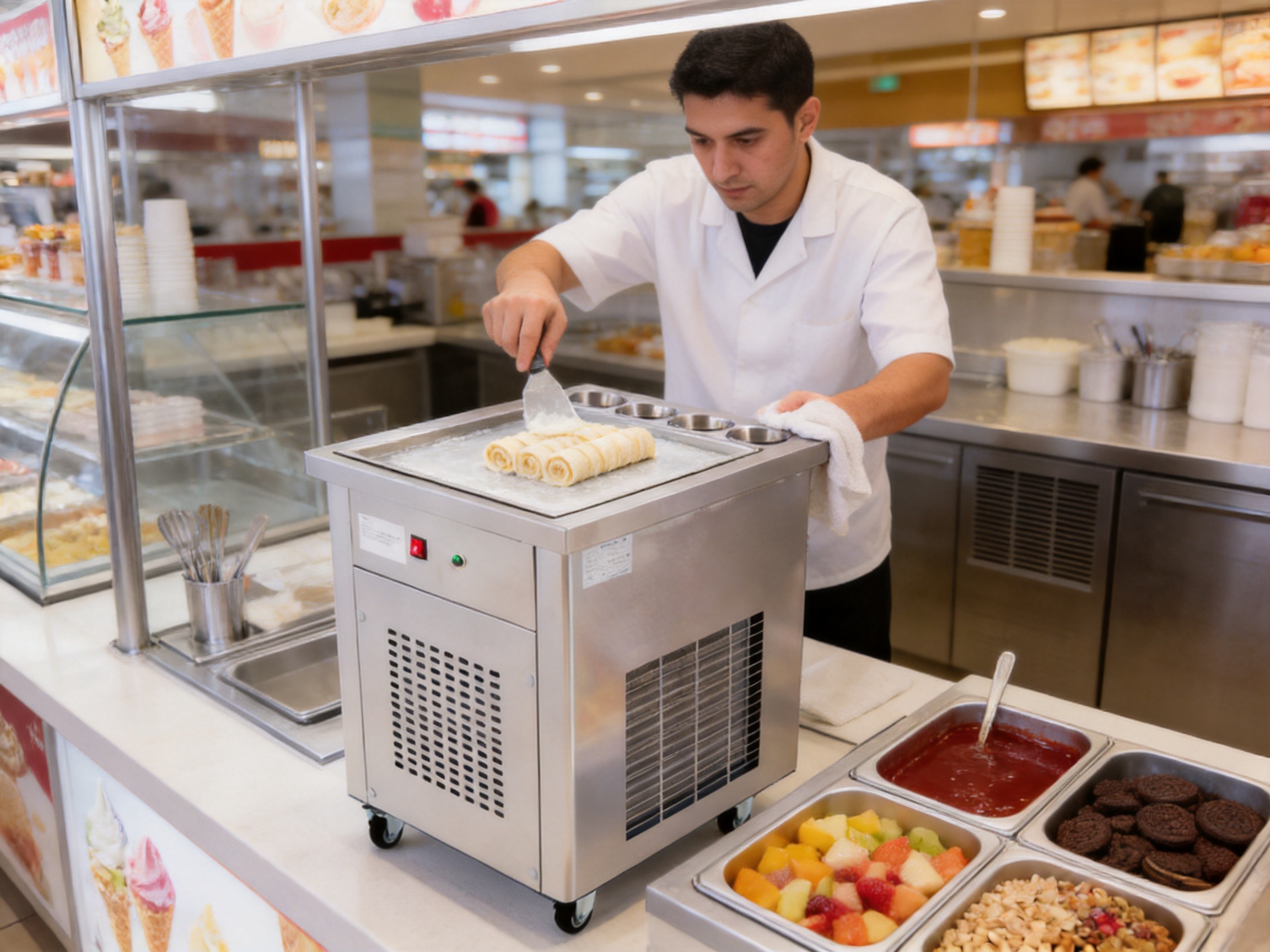
Fried ice cream rolls have become a popular prepared-to-order dessert in snack shops, food courts, cafés, night markets, mobile kiosks, and quick-service businesses. Customers are attracted by the visual preparation process as much as by the finished dessert. A liquid ice cream mixture is poured onto a chilled surface, combined with fruit, cookies, sauces, nuts, or other ingredients, and then spread, scraped, and rolled into attractive portions. For operators, the challenge is to create a machine that can deliver fast freezing, stable temperature control, consistent texture, convenient ingredient access, and reliable service in a compact footprint.
The Single Square Commercial Fried Ice Cream Roll Cart Machine with Four Tanks is designed for this operating environment. Identified as model CB-400F+4XY, it combines a single 40-centimeter square freezing pan with a four-compartment ingredient or mixture layout. The design gives operators a practical balance between work area, storage convenience, mobility, and production efficiency. It is suitable for businesses that need commercial performance without the space requirements of a large multi-pan production line.
With a 1,300-watt input, a working temperature range of approximately -17°C to -20°C, and a net weight of 50 kilograms, the machine is positioned for medium-volume dessert service. Its 680 x 520 x 730 millimeter dimensions make it easier to place at a counter, inside a snack shop, or on a mobile service cart than many larger commercial freezing systems. The four-tank arrangement also allows operators to prepare or organize several flavors and toppings within immediate reach of the working surface.
This article explains the product structure, operating value, manufacturing strengths, application benefits, purchasing considerations, and maintenance requirements of this commercial fried ice cream roll machine. It also discusses how its configuration compares with common alternatives and identifies technical points that buyers should confirm before ordering, especially power supply and refrigerant specifications.
Product Overview and Operating Concept
The machine uses a single square cold pan as its primary freezing and preparation surface. The 40-centimeter square pan provides a defined work area for pouring a thin layer of ice cream mixture and spreading it evenly. A 2-centimeter pan depth helps establish a shallow preparation zone, which is appropriate for scraping and rolling rather than deep-batch storage.
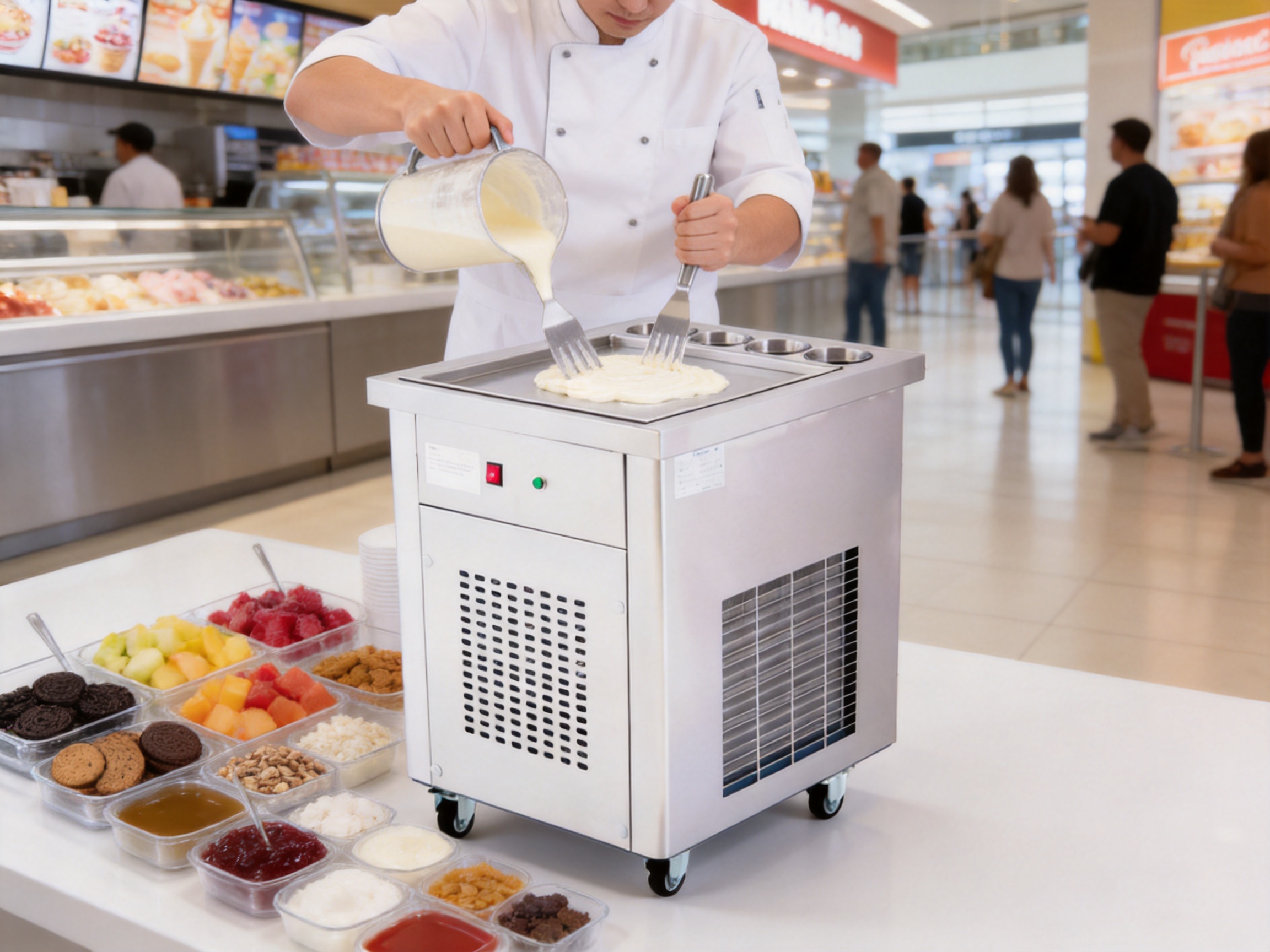
During operation, the operator pours a measured quantity of liquid mixture onto the chilled pan. Ingredients can then be added and blended while the mixture cools. Once the product reaches a sufficiently firm consistency, the operator uses a scraper to divide the frozen layer and form rolls. The open preparation process makes each serving visible to the customer and supports made-to-order customization.
The four-tank configuration adds organization to the preparation process. Depending on the selected operating method, the compartments may be used for different liquid bases, flavor preparations, fruit pieces, sauces, toppings, or pre-portioned ingredients. This arrangement reduces the need to move repeatedly between the machine and a separate preparation table. It can also help an operator keep popular ingredients separated and ready for quick service.
A single-pan format is especially appropriate for businesses that want to offer fried ice cream rolls as a focused menu item rather than operate a high-capacity dessert factory. The operator can maintain a clear workflow: choose a base, select ingredients, pour onto the pan, mix, freeze, roll, garnish, and serve. This straightforward sequence can be learned quickly by new staff and easily demonstrated to customers.
| Item | Specification | Operational Meaning |
|---|---|---|
| Model | CB-400F+4XY | Single square commercial fried ice cream roll machine with four tanks |
| Pan shape | Square | Provides a defined, efficient preparation surface |
| Pan size | 40 cm | Suitable for individual or small-batch made-to-order portions |
| Pan depth | 2 cm | Supports thin-layer freezing and scraping |
| Input power | 1,300 W | Supports commercial cooling performance for the compact format |
| Temperature range | -17°C to -20°C | Provides a cold surface for forming ice cream rolls |
| Net weight | 50 kg | Stable during operation while remaining relatively movable |
| Dimensions | 680 x 520 x 730 mm | Compact placement for counters, stalls, and small shops |
| Power supply | 220 V / 50 Hz | Suitable for compatible commercial electrical systems |
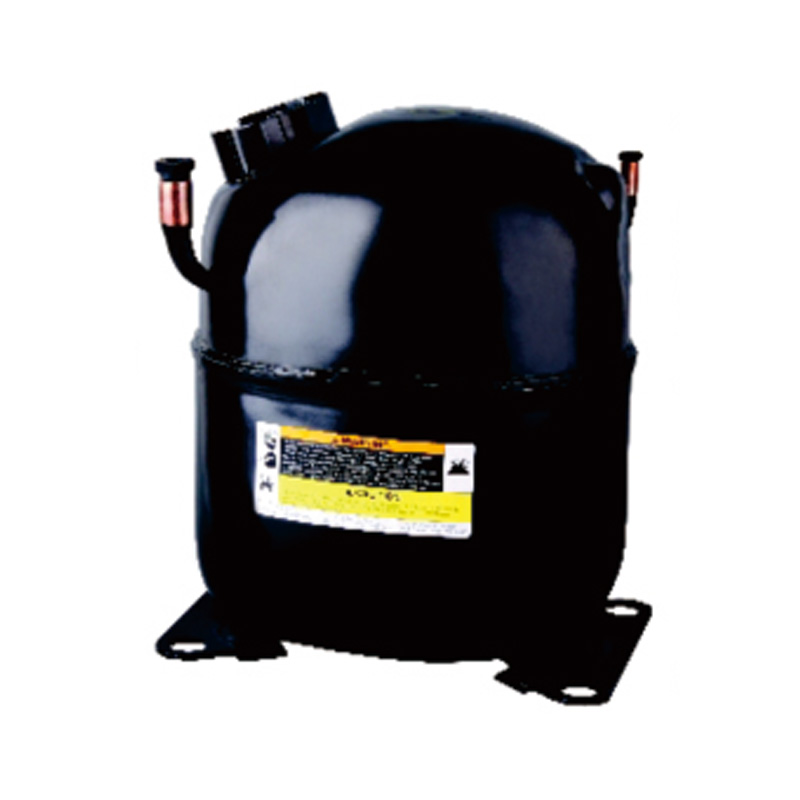
| Compressor | Chinese compressor listed in the specification | Configured for the machine’s refrigeration system |
Why a Single Square Pan Is Valuable
The single square pan is a deliberate design choice rather than simply a smaller version of a multi-pan machine. It gives the operator one clearly defined work zone that can be monitored continuously. For businesses with a limited menu, this can simplify training, cleaning, and production planning.
A square surface makes practical use of the available footprint. The operator can spread the mixture across a broad, easily visible area while keeping the corners available for controlled scraping and portion separation. Compared with a narrow rectangular surface, the square format can provide a more balanced working motion, especially when preparing one or two portions at a time.
The pan depth of 2 centimeters is also appropriate for rolled dessert preparation. Fried ice cream rolls are generally made by freezing a relatively thin layer rather than placing a deep volume of product into a container. A shallow layer can cool more evenly and can be manipulated with a scraper when the mixture reaches the desired consistency.
For a start-up, seasonal kiosk, or compact snack shop, a single pan can provide a lower equipment commitment than a double-pan or multi-pan installation. The operator can concentrate on product presentation and service speed without paying for unused capacity. At the same time, the 1,300-watt input and low-temperature operating range provide a commercial foundation rather than a purely domestic appliance configuration.
The format is also useful for menu testing. A new business can experiment with flavor combinations, portion sizes, toppings, and price points while working with a manageable production area. If demand later increases, the operator may add another unit or expand to a larger model without changing the basic preparation concept.
Four-Tank Layout and Flavor Flexibility
The four-tank arrangement is one of the product’s most noticeable advantages over simple single-reservoir machines. In a busy service period, ingredient organization can have a direct effect on speed. Having four compartments near the pan reduces the time spent opening containers, reaching for ingredients, or leaving the preparation station.
Operators can assign the compartments according to their menu. For example, one tank may hold a vanilla base, another a chocolate base, and the remaining compartments may be reserved for fruit preparations or topping components. Another shop may use all four compartments for different liquid bases. A high-volume kiosk could assign each compartment to a popular flavor profile and change the selection according to local demand.
The layout also supports visual merchandising. Customers can see that several choices are available, which may encourage customization and add-on purchases. A clear selection of sauces, fruit, cookies, nuts, or cereal ingredients can turn a basic dessert into an interactive menu experience.
Four compartments do not eliminate the need for food-safety controls. Ingredients should be stored at appropriate temperatures, protected from contamination, and replenished according to expected demand. Operators should also identify each compartment clearly and follow a cleaning schedule that prevents flavor transfer and residue buildup.
Compared with a machine that requires all ingredients to be stored separately on a remote preparation table, the four-tank design can make the service line more compact. This is particularly useful in a shopping-center kiosk, market stall, or mobile cart where every square meter matters.

Single Square Commercial Fried Ice Cream Roll Cart Machine with Four Tanks
Cooling Performance and Temperature Control
The listed operating temperature range is -17°C to -20°C. This range is intended to provide a sufficiently cold preparation surface for freezing the ice cream mixture into a workable layer. The actual freezing time will depend on the recipe, ambient temperature, starting temperature of the mixture, quantity poured, ingredient composition, and operator technique.
A well-balanced recipe is important. Mixtures containing more sugar, fat, or certain additives may freeze differently from a simple dairy or non-dairy base. Operators should test the recipe on the actual machine rather than assume that every mixture will form rolls at the same speed. Consistent portion quantities and ingredient temperatures help maintain more predictable results.
The refrigeration system is supported by a listed 1,300-watt input. This gives the machine a meaningful commercial power reserve for its compact pan size. It is designed to recover and maintain a cold work surface during repeated service, although users should avoid blocking ventilation openings or operating the equipment in excessive heat without adequate airflow.
The product information contains two refrigerant references: one specification lists R410, while another information table lists R22/R404A. Because refrigerant selection is a critical technical and regulatory matter, buyers should confirm the final refrigerant configuration, compressor pairing, voltage, frequency, and nameplate information with the supplier before purchase. The correct refrigerant must match the installed refrigeration circuit and must be serviced only by qualified personnel in accordance with applicable local requirements.
Temperature control should be evaluated as part of the complete operating system rather than as an isolated number. A cold pan, correct mixture depth, clean heat-transfer surface, good ventilation, and an appropriate service rhythm all contribute to the final product. A machine can have a low stated temperature but still perform inconsistently if the pan is overloaded or the condenser cannot release heat effectively.
Commercial Advantages Over Common Alternatives
Compared with Domestic Freezing Appliances
Domestic freezers and household ice cream makers are generally not designed for visible, continuous fried ice cream roll production. They may lack a flat freezing surface, rapid recovery capability, ingredient storage, or the structural stability required for repeated commercial use. The CB-400F+4XY is designed around the actual workflow of rolled ice cream preparation, including a dedicated pan and integrated four-tank arrangement.
Compared with Basic Single-Tank Machines
A basic single-tank machine may have a lower initial cost, but it can require more external containers and more staff movement. The four-tank format provides more organization and menu flexibility. This can be valuable when an operator wants to serve several flavors or display multiple ingredients at the point of sale.
Compared with Large Multi-Pan Equipment
Large multi-pan machines can offer greater theoretical throughput, but they also require more floor space, higher investment, and potentially more electrical capacity. If demand is medium rather than very high, a large machine may leave much of its capacity unused. The single square design concentrates the available cooling and working space into one efficient station, making it a practical choice for smaller premises.
Compared with Separate Freezing and Preparation Stations
Using a separate freezer, ingredient table, and preparation counter can create a longer workflow and increase the movement required for each order. An integrated machine consolidates the main preparation functions. This can improve counter organization and help the operator maintain a more consistent customer-facing presentation.
Compared with Oversized Mobile Equipment
Some mobile foodservice equipment is difficult to move because of excessive weight or a large footprint. With dimensions of 680 x 520 x 730 millimeters and a net weight of 50 kilograms, this machine is still a substantial commercial appliance, but its compact format is more adaptable to carts, stalls, seasonal booths, and changing retail layouts. Movement should still be planned carefully, using suitable lifting or cart-handling procedures.
Compact Design for Snack Shops and Market Stalls
Space efficiency is a major consideration in modern foodservice. Small-format retailers often need to combine preparation, storage, customer service, payment, display, and cleaning within a restricted area. The machine’s 680 x 520 x 730 millimeter dimensions allow it to fit into many compact service environments while maintaining a dedicated professional work surface.
The low overall height can support an operator-friendly counter arrangement, depending on the height of the supporting table or cart. It can also improve customer visibility of the preparation process. Since rolled ice cream is partly an entertainment product, the position of the machine can influence sales. Placing it where customers can safely observe the preparation may help create a stronger retail experience.
The 50-kilogram net weight contributes to stability during scraping and rolling. A machine that moves or vibrates excessively can make it harder to form uniform rolls. At the same time, the equipment can be relocated with suitable assistance when a business changes its layout, attends an event, or transports the unit between seasonal venues.
Before installation, operators should verify that the supporting surface can carry the machine and that the route to the final position is wide enough. Doorways, stairways, counter openings, and vehicle loading areas should be checked in advance. Adequate clearance around ventilation areas is equally important, even when the machine itself occupies a compact footprint.
Manufacturing Strengths and Engineering Capability
The manufacturer, Spelor Electrical Appliances (Zhejiang) Co., Ltd., is described as an integrated producer involved in design, research and development, manufacturing, sales, and service. This integrated structure is important for commercial equipment buyers because product performance depends on coordination between mechanical design, refrigeration engineering, electrical control, assembly, quality management, packaging, and after-sales support.
The company reports more than 60,000 square meters of modern production facilities. A facility of this scale can support organized production flows, dedicated assembly areas, raw-material management, testing operations, finished-goods storage, and export preparation. The value of the facility is not simply its size; it is the ability to coordinate multiple stages of manufacturing under one broader operating system.
For a machine such as the CB-400F+4XY, effective manufacturing begins with product design. The design team must consider pan dimensions, insulation, refrigeration layout, compressor capacity, tank placement, access for cleaning, electrical safety, structural stability, and the operator’s movement during service. A balanced design reduces unnecessary complexity while retaining the features that have direct commercial value.
Research and development capability can also support adaptation to different markets. Buyers may need different electrical frequencies, plug types, packaging requirements, language labels, counter arrangements, or private-label finishes. Since the company presents itself as an OEM and ODM supplier, it can discuss customized solutions based on drawings or requirements. Any customization should be confirmed through technical documents, samples, approval drawings, and a final production specification.
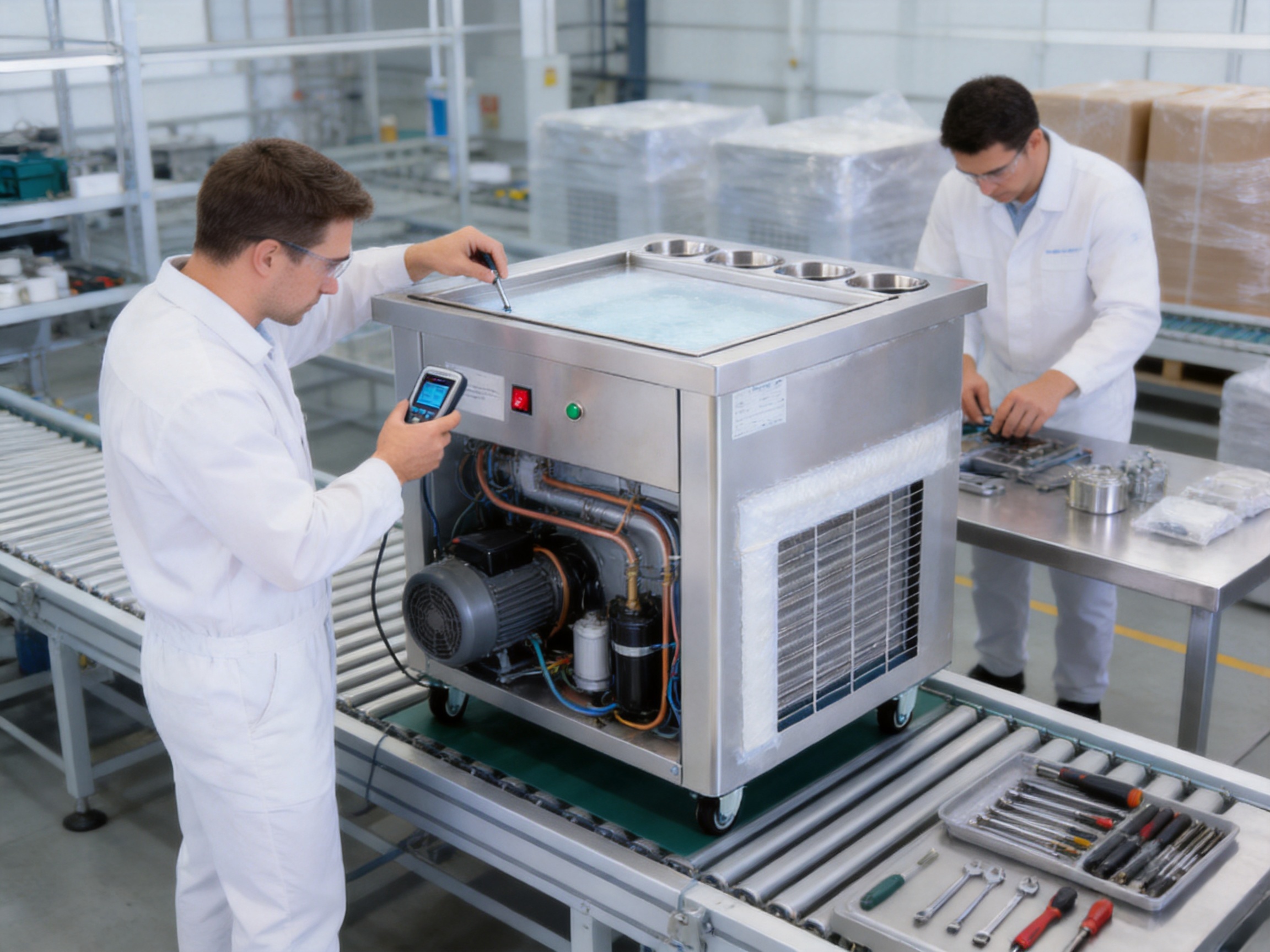
Manufacturing commercial refrigeration equipment requires more than assembling a compressor and a metal cabinet. Refrigerant piping must be routed appropriately, connections must be sealed, electrical components must be installed correctly, and the cold surface must work in coordination with the refrigeration system. Assembly consistency is important because small differences in piping, insulation, wiring, or component placement may affect long-term performance.
A responsible production process normally includes incoming material inspection, component verification, assembly checks, electrical testing, refrigeration testing, appearance inspection, and final packaging review. The exact procedures applied to a specific order should be confirmed with the supplier, but an integrated factory structure gives buyers a direct point of communication for these requirements.
Production Process Considerations
Design and Technical Review
The manufacturing process begins with a technical review of the product’s intended use. For a fried ice cream roll machine, this includes analyzing the pan size, target temperature, expected service volume, available electrical supply, ingredient workflow, and cleaning requirements. A practical design must support the operator as well as the refrigeration system.
For OEM or ODM projects, technical review is even more important. Drawings should identify the pan dimensions, tank arrangement, control interface, external dimensions, materials, finish, branding locations, packaging method, and electrical specifications. Clear documentation reduces the possibility of differences between an approved sample and mass production.
Material and Component Coordination
Commercial equipment factories must coordinate numerous components, including the pan assembly, cabinet or frame, compressor, condenser, evaporator or cooling structure, electrical controls, switches, wiring, insulation, fasteners, tank components, and packaging materials. Reliable procurement and incoming inspection help maintain consistency across production batches.
Component selection also influences serviceability. Commonly available replacement parts can make maintenance easier in international markets, while specialized components may require longer lead times. Buyers should ask about spare parts, recommended service intervals, component identification, and warranty support before placing a large order.
Refrigeration Assembly
The refrigeration assembly must be matched to the intended operating temperature and pan design. The compressor, refrigerant, condenser, expansion components, piping, and insulation operate as a system. The listed product information references a Chinese compressor and provides more than one refrigerant notation, so the final technical configuration should be documented clearly for each order.
After assembly, a commercial refrigeration unit should be checked for leakage, abnormal noise, temperature performance, and electrical operation. The test process should verify that the pan reaches the required working range and can maintain appropriate cooling under normal use. Buyers purchasing for export may request factory test records or inspection documentation when appropriate.
Electrical and Functional Testing
The machine is listed for a 220 V / 50 Hz power supply and 1,300-watt power. Electrical compatibility must be confirmed before installation. A machine intended for one electrical standard should not be connected to a different supply without an approved configuration or suitable transformer and protection system.
Functional testing should include start-up, control operation, compressor cycling, temperature response, tank-area inspection, cable condition, grounding, and shutdown behavior. The operator’s manual should explain safe startup and cleaning procedures. Commercial staff should receive basic instruction before using the unit in a customer-facing environment.
Final Inspection and Export Preparation
Final inspection should confirm dimensions, finish, accessories, labels, control functions, packaging, and order-specific requirements. Because the machine may be shipped internationally, packaging must protect the pan, controls, corners, and refrigeration system from impact. The shipping arrangement should also account for handling equipment, pallet dimensions, moisture protection, and documentation.
The company’s sales and service capabilities are relevant at this stage. A factory supplier that can coordinate production, customization, logistics, payment arrangements, and after-sales communication can reduce the number of separate parties involved in a project. This is particularly useful for distributors and foodservice equipment importers managing multiple product categories.
Operator Workflow for Consistent Results
Before opening for business, the operator should confirm that the machine is level, correctly connected, clean, and adequately ventilated. The pan should be free from residue, and all ingredients should be prepared in hygienic containers. The four tanks should be labeled or assigned according to the day’s menu.
Once the unit reaches its working condition, the operator can pour a controlled amount of mixture onto the pan. Excessive product may take longer to freeze and can reduce roll quality. A thin, even layer generally supports more consistent cooling and easier scraping. The correct quantity should be established through recipe testing and staff training.
Mixing should be performed with appropriate food-safe tools that do not damage the pan surface. Ingredients should be distributed evenly rather than concentrated in one area. The operator should watch the texture continuously because the ideal scraping point may change with room temperature, recipe composition, and customer demand.
After the layer becomes sufficiently firm, the operator can divide it into strips and roll each strip with a scraper. Uniform pressure and a consistent angle help produce attractive rolls. The finished rolls can be placed in a cup or serving container and completed with toppings from the selected tank or preparation area.
When serving continuously, staff should avoid leaving large amounts of mixture on the pan while waiting for a customer. A made-to-order process works best when portions are prepared according to demand. This reduces waste, supports freshness, and helps maintain a predictable service rhythm.
Cleaning, Hygiene, and Preventive Maintenance
Cleaning should be treated as part of the machine’s operating cycle rather than an occasional task. Residual dairy, sugar, fruit, sauces, and crumbs can harden on the pan and around the tank area. If not removed, these residues may affect hygiene, create odors, encourage contamination, or interfere with smooth scraper movement.
At the end of each service period, operators should follow the manufacturer’s approved shutdown and cleaning instructions. Food-contact surfaces should be cleaned with suitable products and tools. Abrasive materials or harsh chemicals should not be used unless specifically approved, because they may damage the surface or leave residues.
The tank compartments should be emptied and cleaned according to the ingredients used. Special attention should be given to corners, seams, handles, lids, and areas where liquid or particles may collect. Cloths and cleaning tools should be managed hygienically and should not be reused between dirty and sanitized stages without proper washing.
The refrigeration area also requires attention. Ventilation openings should remain free from dust and obstructions. The condenser and surrounding space should be inspected periodically, especially in environments with flour, cooking oil, smoke, or high airborne dust. Restricted airflow can increase operating temperature and place additional stress on the refrigeration system.
Operators should inspect power cables, plugs, switches, and visible components for damage. Any unusual noise, repeated tripping, poor cooling, refrigerant odor, oil residue, or temperature instability should be reported to qualified service personnel. Refrigeration repairs and refrigerant handling should not be attempted by untrained staff.
A preventive maintenance schedule can extend equipment life and reduce unexpected downtime. The schedule may include cleaning the ventilation area, checking fasteners, examining electrical connections, verifying temperature performance, reviewing the compressor area, and confirming that the pan remains level and undamaged. The exact maintenance interval should follow the supplier’s instructions and the intensity of use.
Applications Across Different Foodservice Businesses
Snack Shops
Snack shops can use the machine as a dedicated dessert station or as an addition to an existing menu. The compact footprint allows the operator to introduce rolled ice cream without redesigning the entire kitchen. The four tanks can support a rotating selection of flavors that matches local customer preferences.
Market Stalls and Mobile Carts
Market stalls benefit from equipment that creates an immediate visual attraction. The preparation process can draw attention from passing customers, while the single square pan keeps the service concept easy to understand. Before using the unit in a mobile setting, operators should plan stable placement, electricity, transport protection, weather shielding, and safe customer separation.
Cafés and Dessert Counters
Cafés can use rolled ice cream as a specialty product that complements beverages, pastries, and other desserts. The machine can be positioned behind a counter or at an open preparation station, depending on the layout. A carefully designed menu can combine the base flavors with seasonal fruit, syrups, cookies, and premium toppings.
Shopping Centers and Food Courts
Food-court operators often need equipment that fits a limited leased space and supports rapid customer turnover. The machine’s compact dimensions and four-tank layout can help maintain an organized front-of-house station. Operators should confirm mall requirements related to electrical load, ventilation, noise, drainage, and food-safety inspection.
Events and Temporary Installations
At festivals, exhibitions, school events, and private functions, fried ice cream rolls can serve as an interactive dessert. The 50-kilogram net weight means transport planning is necessary, but the single-pan format may be more practical than large multi-pan equipment. Temporary operators should verify stable electrical supply and protect the unit from rain, dust, and extreme ambient conditions.
Purchasing and Customization Guidance
Buyers should begin by defining their service volume, menu, operating location, electrical supply, and preferred workflow. A business serving occasional desserts may prioritize compactness and affordability, while a busy kiosk may place greater emphasis on recovery performance, spare parts, and service response.
The final quotation should identify the exact model, pan size, tank configuration, voltage, frequency, rated power, refrigerant, compressor specification, dimensions, net weight, included accessories, packaging, warranty conditions, and delivery terms. Since the supplied materials contain different refrigerant references, this item deserves particular attention in the purchase contract and technical approval documents.
For private-label or customized orders, buyers should supply artwork in an approved format and confirm the location of logos, labels, control markings, and safety information. Changes to the exterior may affect production timing, minimum order quantity, packaging, or inspection procedures. A pre-production sample or drawing approval can help prevent misunderstandings.
Importers should also ask about spare parts and service documentation. Useful items may include temperature controllers, switches, electrical components, scraper tools, seals, tank parts, and refrigeration service information. The availability of replacement parts can be as important as the original purchase price when equipment will be used in multiple locations.
Logistics planning should consider the machine’s dimensions and weight, palletization, container loading, destination handling, insurance, and local installation. Buyers should establish who is responsible for unloading and positioning the unit. The receiving team should inspect the packaging for damage and document any problems before commissioning.
Quality, Service, and Long-Term Business Value
Equipment value is determined by more than initial purchase cost. A machine that is easy to operate, simple to clean, stable in performance, and supported by a responsive supplier can produce better long-term results than a cheaper product with limited documentation or parts support.
The manufacturer’s stated one-stop service model includes pre-sales consultation, product customization, flexible logistics and payment solutions, and after-sales maintenance. These services can be valuable to international foodservice businesses that need help selecting a configuration or coordinating a larger procurement program.
The company’s product range extends across commercial refrigeration, kitchen equipment, buffet equipment, ice cream machines, juice dispensers, slush machines, ice machines, cooking equipment, griddles, fryers, insulation products, barbecue equipment, and related solutions. For distributors, this broad portfolio may support category expansion and consolidated purchasing.
An integrated manufacturer can also help standardize equipment across multiple locations. A chain of snack shops may prefer consistent dimensions, controls, branding, spare parts, and operating procedures. Standardization simplifies employee training, maintenance planning, purchasing, and menu implementation.
Long-term value still depends on correct installation and responsible operation. No manufacturing process can compensate for inadequate ventilation, incompatible electricity, poor cleaning, overloading, or unauthorized refrigeration repairs. Buyers and operators should treat the machine as a commercial system requiring routine care and documented procedures.
Safety and Installation Considerations
The machine should be installed on a stable, level surface capable of supporting at least its operating weight and any associated ingredients or accessories. The area should be dry, clean, and protected from direct exposure to rain or standing water unless a specially approved outdoor configuration is provided.
Electrical connection should be completed by a qualified person familiar with local requirements. The supply should match the machine’s nameplate. Grounding, circuit protection, plug configuration, and cable routing should be checked before use. Extension cords should not be used casually, particularly in high-load commercial environments.
Ventilation clearance is important because the refrigeration system releases heat during operation. The machine should not be pushed tightly against a wall or placed next to another heat-producing appliance unless the installation plan allows sufficient airflow. High ambient temperatures may affect cooling performance and energy consumption.
Staff should receive training on scraper use, ingredient handling, emergency shutdown, cleaning, and customer safety. The pan and nearby components may become very cold during operation, while other areas may become warm due to refrigeration heat rejection. Operators should avoid placing hands near moving or hot components and should use approved tools.
Children and untrained visitors should not operate the machine. Customers should be separated from the active preparation area where necessary. For mobile events, the operator should use barriers or counter positioning to prevent accidental contact with the pan, controls, cables, and ingredients.
Frequently Asked Questions
What type of business is this machine best suited for?
It is well suited for snack shops, dessert counters, market stalls, cafés, food courts, mobile carts, event vendors, and other businesses with medium-volume made-to-order dessert needs. It is particularly useful where a compact station and visible preparation process are important.
How many pans does the machine have?
The product uses one square freezing pan. The pan is listed as 40 centimeters in size, with a depth of 2 centimeters.
What is the purpose of the four tanks?
The four tanks provide nearby compartments for flavor bases, sauces, toppings, fruit preparations, or other ingredients, depending on the operator’s workflow. They can help reduce movement and support a more organized service station.
Can the machine make different flavors?
Yes. The single pan can be used for different flavor combinations sequentially, while the four-tank layout helps keep multiple ingredients or bases accessible. The pan should be cleaned appropriately when changing flavors to prevent unwanted transfer.
What temperature does the machine reach?
The supplied information lists a working temperature range of approximately -17°C to -20°C. Actual preparation results depend on the recipe, room temperature, ingredient temperature, portion size, and operating technique.
What electrical supply is required?
The information table lists 220 V / 50 Hz and 1,300 watts. Buyers must compare these values with the electrical supply at the installation site and confirm the final nameplate configuration with the supplier.
Which refrigerant does the machine use?
The supplied materials contain different references: one specification lists R410, while another table lists R22/R404A. The final refrigerant must be confirmed with the supplier for the exact unit ordered. This information should appear clearly on the final technical sheet and machine nameplate.
Is the machine easy to move?
Its compact dimensions support flexible placement, but its 50-kilogram net weight means that lifting and transport should be planned carefully. Use suitable assistance and avoid dragging the machine across uneven surfaces.
Does the machine require professional installation?
Professional installation or qualified commissioning is recommended, particularly for electrical connection, leveling, ventilation assessment, and refrigeration verification. The machine should be installed according to the supplier’s instructions and local regulations.
How can operators improve roll consistency?
Use a tested recipe, keep ingredients at consistent starting temperatures, pour controlled quantities, spread the mixture evenly, maintain the recommended cold range, and train staff in scraper technique. Overloading the pan or using mixtures with uncontrolled composition can reduce consistency.
What should be cleaned after every service period?
The pan, surrounding food-contact areas, four tanks, utensils, handles, and visible residue points should be cleaned according to the approved procedure. The ventilation area should also be kept free from dust and obstruction.
Can the machine be customized for OEM or ODM projects?
The manufacturer presents OEM and ODM capability based on drawings or customer requirements. Customization should be discussed in advance, with final approval of technical drawings, electrical specifications, appearance, packaging, labels, quantity, and delivery schedule.
What should buyers verify before ordering?
Buyers should verify the exact model, pan size, tank arrangement, power supply, rated wattage, refrigerant, compressor, dimensions, weight, included accessories, warranty, spare parts, packaging, inspection process, and shipping terms. Refrigerant information is especially important because the supplied product data contains more than one reference.
Conclusion
The Single Square Commercial Fried Ice Cream Roll Cart Machine with Four Tanks is designed to combine a visible dessert-making experience with practical commercial functionality. Its square 40-centimeter pan provides a focused freezing and rolling area, while the four-tank layout supports flavor choice, ingredient organization, and faster service. The 1,300-watt input, listed -17°C to -20°C working range, compact 680 x 520 x 730 millimeter size, and 50-kilogram net weight make it suitable for many small and medium foodservice environments.
Its main advantages over simpler alternatives include the integrated four-compartment workflow, commercial refrigeration configuration, compact counter-friendly format, stable single-pan working surface, and suitability for made-to-order customer service. Compared with larger machines, it can reduce space and investment requirements for businesses that do not need multiple simultaneous pans.
The manufacturer’s integrated design, research and development, production, sales, and service structure, together with more than 60,000 square meters of reported production facilities, provides a foundation for commercial equipment supply and OEM or ODM cooperation. Manufacturing strength is most valuable when combined with clear technical documentation, consistent assembly, inspection, spare-parts support, and responsive after-sales service.
For the best result, buyers should confirm the final electrical and refrigerant configuration, establish appropriate installation conditions, train operators, and maintain a regular cleaning and preventive-maintenance program. Used correctly, this machine can help snack shops, stalls, cafés, food courts, and mobile dessert businesses deliver attractive fried ice cream rolls with an efficient and organized service process.
References
1. Product specification sheet for model CB-400F+4XY, including pan dimensions, input power, net weight, machine dimensions, compressor information, and refrigerant reference.
2. Product information table for the Single Square Commercial Fried Ice Cream Roll Cart Machine with Four Tanks, including power supply, working temperature range, dimensions, and operating description.
3. Manufacturer profile for Spelor Electrical Appliances (Zhejiang) Co., Ltd., including company background, product categories, manufacturing facilities, OEM and ODM capabilities, and service scope.
4. General commercial refrigeration installation and maintenance principles, including ventilation, electrical compatibility, temperature control, cleaning, and qualified refrigerant service practices.
5. General foodservice equipment hygiene principles for preparation surfaces, ingredient storage compartments, utensils, and made-to-order dessert operations.
Product: Single Square Commercial Fried Ice Cream Roll Cart Machine with Four Tanks

For exclusive deals and latest offers, sign up by entering your email address below.




-
spelor@spelor.com
-
+86-576-85229688
-
No.528, Changxi Road, Linhai City, Zhejiang Province, China
Commercial Refrigeration Equipment Manufacturer China
Copyright © 2025 by Spelor Electrical Appliances (Zhejiang) Co., Ltd. Rights Reserved.
